
Every figure on this page is pulled from a primary source — BLS, NCCPA, ARC-PA, PAEA, AAPA — and dated so you can see how fresh it is. If a number doesn't exist, I say so instead of making one up.
There are now 201,038 board certified PAs in the United States. The median PA salary is $135,880. There are 330 accredited PA programs, and 91.5% of first-time takers passed the PANCE last year.
That's the short version. Below is the long one.
I built this page because I got tired of watching the same handful of numbers get copied from blog to blog until nobody could remember where they came from. You've seen it — the "average PA student debt is $112,500" that appears on forty websites and no primary source. The "32% acceptance rate" that isn't an acceptance rate at all.
So here's my promise for this page: every number comes with a source and a date. Where the profession genuinely doesn't publish something, I'll tell you that too, because "nobody measures this" is more useful to you than a confident-sounding fake.
Bookmark it. I keep it current.
Who actually runs the PA profession?
Five organizations do most of the work, and people mix them up constantly.
The NCCPA is the only certifying body for PAs in the United States. They write the PANCE, the PANRE and PANRE-LA, and the Certificates of Added Qualification. They also publish the best data we have on who we are — their annual Statistical Profile is where most of the workforce numbers on this page come from.
ARC-PA accredits PA programs. If a program isn't ARC-PA accredited, its graduates can't sit for the PANCE. Their public tables are the only authoritative count of how many programs exist, and they update after every quarterly commission meeting.
Here's something worth knowing before you apply: 27 programs are currently on ARC-PA probation. That's a high number, and it includes some names that would surprise you. Check any program's current status yourself — a school's marketing page will never tell you.
PAEA is the education association. They run CASPA, publish the Program Report and Student Report, and write the End of Rotation and End of Curriculum blueprints. Their data is excellent when it's current — which brings me to a caveat I want to be upfront about. Program Report 36 is still PAEA's most recent edition, and it's built on the 2021 program survey. Student Report 6 uses 2022 data. Anyone citing "current PAEA figures" on tuition, class size, or GPA in 2026 is citing five-year-old numbers whether they say so or not. I've labeled every PAEA figure on this page with its actual vintage.
AAPA is our professional society and our lobbying arm. They publish the Salary Report and drive the state-level advocacy that's been reshaping practice law.
APPAP covers postgraduate residency and fellowship programs. Worth noting that ARC-PA accreditation of postgraduate programs became optional in 2020, so the 17 accredited programs are a small slice of what actually exists. If you're weighing a residency, read our full guide to PA postgraduate programs.
And the PA History Society keeps the story of where we came from. Worth an hour of your time if you've never read it.
Why does every source give a different PA salary?
Because they're measuring different things, and once you see it you can't unsee it.
BLS says $135,880. That's the median wage employers report for 162,150 salaried PAs. It's the most rigorous number and the backbone of every state and metro comparison.
NCCPA says $125,000. That's what PAs report themselves, across all their PA positions, in banded ranges — which is why NCCPA medians always land on tidy numbers like $125,000 and $135,000, and why so many specialties tie.
AAPA says $140,000. Self-reported too, but collected as exact figures rather than bands, and covering total compensation.
None of them is wrong. They're four different lenses, and the honest move is to show you all of them rather than pick the flattering one. What you should never do is average them, or put an NCCPA specialty number next to an AAPA one in the same table. Cardiothoracic surgery reads $155,036 in NCCPA's data and $184,072 in AAPA's. That gap is methodology, not disagreement.
If you want the deep dive, our PA salary report breaks it down state by state with cost-of-living adjustments.
One more thing about the geography. Nine of the ten highest-paying metro areas in the country are in California, topping out at $207,660 in San Jose. Before you start looking at Bay Area listings, know that AAPA's own cost-adjusted ranking puts Oklahoma, Arkansas and Missouri at the top. A $207,000 salary in San Jose and a $130,000 salary in Tulsa are closer than they look.
What are PAs actually practicing?
This is the number that keeps me up at night, and it gets almost no attention.
Family medicine is no longer the largest specialty in this profession. Surgical subspecialties passed it. Family medicine held 22.4% of PAs in 2016. It's 15.9% now. Primary care overall — family medicine, general internal medicine and general pediatrics combined — has slipped from 23.7% in 2021 to 21.4%.
I work in a county health department clinic and at a homeless persons health project. I see what happens on the other end of that trend line. Every point that moves out of primary care is a patient somewhere who waits longer.
And I don't think PAs are choosing this in a vacuum. Look at the new-graduate data on the widget above: the share of newly certified PAs who say educational debt influenced their primary-care-versus-specialty decision nearly doubled in four years, from 13.3% to 23.4%. Among those still job hunting, it's 36%. When debt makes the call, it points toward specialty care by roughly two to one.
That's not a character flaw in new grads. That's a policy failure, and it's fixable.
What does it take to get in?
The average applicant applies to 8.6 programs, gets interviews at 3.6, completes 2.6, and receives 1.8 acceptances. Nearly 29% are reapplicants — which is the statistic I most want you to sit with if you're staring down a rejection. You are in extremely good company.
Average GPA is 3.6 overall, 3.5 science. Average patient-contact hours of an entering class: 3,235. Average age at matriculation: 25.2.
Now let me kill a number for you.
There is no published national PA school acceptance rate. Not from PAEA, not from CASPA, not from ARC-PA. The "33.8%" you'll find everywhere comes from PAEA Student Report 6, and it means something completely different: it's programs-that-accepted-you divided by programs-you-applied-to, averaged only across students who got in somewhere. Everyone rejected everywhere is excluded from the denominator by construction. It cannot be an acceptance rate. It's a measure of how many acceptances successful applicants collected.
I'd rather you know that than repeat a number that would make you feel worse than the truth warrants.
While we're here: those "average GRE 153/157/160" figures floating around? The GRE analytical writing section is scored 0 to 6. A 160 is not a low score, it's an impossible one. The real numbers are verbal 153.1, quantitative 152.7, analytical writing 4.1.
If you're building your application, start with the PA school application timeline and track everything in the applicant logbook. And when you're ready to figure out where to apply, PA SchoolFinder has the current data on all 330 programs.
What will PA school cost you, and what will you owe?
Tuition, per PAEA's 2021 survey: $57,955 at a public program in-state, $96,171 out-of-state, $100,212 private. Those are means for the whole program, excluding fees, and they're five years old — assume they've moved.
The debt number is more solid, and it's higher than what most sites tell you.
The median educational debt of a newly certified PA is $137,500. Mean is $129,179. That's NCCPA's own figure for the 2024 cohort, covering all undergraduate and graduate training combined. 87.6% of new PAs carry some debt, and 32.3% owe $175,000 or more.
Here's the part that should make you angry: that median was also $137,500 in 2020. Four years, no movement, while starting salaries rose 21%.
For comparison, the median medical school graduate owes $215,000 (AAMC, Class of 2025) — but 70% of MDs carry debt versus 87.6% of new PAs, and MDs earn through residency.
The good news is that the money to offset this is real and underclaimed. 5.6% of new PAs are now NHSC scholars or in loan repayment programs — triple the 1.8% in 2020. If you're willing to work where the need is greatest, the scholarships and loan repayment guide walks through every program. NHSC, HRSA, IHS, state programs, military. I was an NHSC scholar. It shaped my whole career, and I'd do it again.
Five things changing in the PA profession right now
1. The title change is real law now, in six states
AAPA's House of Delegates voted to adopt "physician associate" in 2021. What's changed since is that it stopped being a resolution and started being statute.
Six states have changed the title in law: Oregon (2024), Maine and New Hampshire (2025), Iowa, Delaware and Alaska (2026). Alaska got there over a governor's veto. Kansas and Wisconsin recognize both titles without a full statutory change.
But the federal government has not moved at all. "Physician assistant" appears in 658 sections of the Code of Federal Regulations. "Physician associate" appears in exactly one — a Railroad Retirement Board disability rule. CMS, DEA and the VA are unchanged. So we're going to live in both titles for a while yet, and AAPA's current guidance is that you may use "physician associate" at your discretion if your state has enacted it — after checking your employer policy, your licensing board, your payors and your malpractice carrier.
2. The PA Licensure Compact exists, but doesn't work yet
29 states have enacted it. That's genuinely remarkable movement. Maine became the first state to hit all three of AAPA's top priorities at once — optimal practice, the compact, and title change.
But zero privileges have been issued. The commission is still finalizing its data-system vendor, and privileges are projected for early 2027. If you read anywhere that PAs can now practice across state lines, that isn't true yet.
3. Ten states have cut the legal tether to a physician
Delaware, Iowa, Maine, Montana, New Hampshire, North Dakota, South Dakota, Utah, Virginia and Wyoming no longer require a specific supervisory or collaborative agreement. Most attach an experience gate — 4,000 hours in Maine, 6,000 in Delaware and South Dakota, 8,000 in Montana.
Nine of those states meet AAPA's full "Optimal" standard, which also requires a PA-inclusive regulatory board and direct payment. Virginia cut the tether but hasn't fixed its board structure yet, and AAPA publicly corrected its own press release on that — which I appreciate.
Kentucky also became the last major holdout to authorize Schedule II prescribing in April 2026.
4. The PANCE blueprint changed, and PANRE-LA is not the default
The 2019 blueprint is retired. A new PANCE content blueprint took effect for every exam administered from January 2025, along with a new passing standard. Fifteen organ-system content areas, eight task areas, and a new Professional Practice domain at 6%. Sections dropped from 121 to 110 while the disease list grew from about 616 to 681.
If you're studying from anything built on the 2019 blueprint, it's out of date. (We rebuilt Smarty PANCE around the 2025 blueprint the month it landed.)
On recertification: PANRE-LA is an option, not the default. You have to apply in year 6 to start in year 7, and if you miss that window you take the traditional PANRE. Both cost $350 and both use the same blueprint. Uptake has been strong — 84,044 PAs across five cohorts — but NCCPA has never published a percentage, so be skeptical of anyone who quotes you one.
A practice analysis is running right now that will likely revise the recertification blueprint. Nothing is final.
5. Federal student loan caps could shrink the pipeline
A new federal student loan rule took effect July 1, 2026 that may limit how much future PA students can borrow. AAPA surveyed more than 4,500 PAs, students and pre-PAs and found 86% relied on or expect to rely on federal loans.
This is the least-covered story on this list and possibly the most consequential. If you can only get into this profession by borrowing, and the borrowing gets capped, the profession narrows to people who already have money. That's the opposite of what got me here.
What's happening to PAs in the rest of the world?
The international picture changed more in the last two years than in the previous twenty, and almost all of it is the United Kingdom.
UK physician associates came under General Medical Council regulation in December 2024. Then in July 2025 the Leng Review landed, and it was not gentle. It recommended renaming the role back to "physician assistant," barred PAs from seeing undifferentiated patients outside defined protocols, required two years in secondary care before working in general practice, and mandated a named supervising doctor.
The consequences were immediate. The Royal College of Physicians closed its Faculty of Physician Associates. At least seven universities suspended their PA courses — of 33 GMC-approved programs, only 17 were still recruiting. PCN-employed PA numbers fell 16% from their 2024 peak. The PA union has filed a judicial review, so some of it is still unresolved. And from 13 December 2026 it becomes a criminal offence to practise as a PA in the UK without GMC registration.
I don't say any of this with satisfaction. It's a cautionary tale about what happens when a profession scales faster than its regulatory scaffolding, and it's worth every American PA understanding it.
Elsewhere: New Zealand designated PAs a regulated profession in 2025 and opens registration in October 2026. Canada now regulates PAs in seven provinces, with British Columbia licensing them for emergency departments. The Netherlands has the most mature framework in the world — full protected title, independent prescribing within specialism, and 2,465 registered PAs. Ghana quietly has the largest PA workforce in Africa. And Australia, which once looked promising, is effectively dormant: no training programs, no registration, six PAs employed across Queensland Health.
Our full series on the PA profession around the world goes deeper on each country.
Where PAs read and argue
- JAAPA — the peer-reviewed clinical journal, published monthly by AAPA.
- The Journal of PA Education — PAEA's journal, for the education side of the house.
- AAPA News Central — where profession news breaks first.
- The Physician Assistant Forum — still the most active place PAs, students and pre-PAs talk to each other honestly.
A note on how I keep this page honest
I update this page as the primary sources release. Here's roughly when each one moves:
BLS wage data lands each spring. The NCCPA Statistical Profile lands each May, with the new-graduate report following in the fall. ARC-PA program counts change after every quarterly meeting. PAEA's reports are overdue and I'll update the moment Program Report 37 appears. AAPA's Salary Report comes in May. The CASPA cycle opens in late April.
Two things I'm watching closely: PA Licensure Compact privileges, projected early 2027, and the UK's 13 December 2026 registration deadline.
If you find a number here that's gone stale before I catch it, tell me. I'd genuinely rather be corrected than be wrong in public.
Keep going
- Who gets into PA school? — the applicant profile, in plain English
- The Ultimate PA School Application Timeline — month by month
- The PA School Applicant Logbook — track hours, schools and costs
- How much do PAs make? — the full salary explorer
- Healthcare experience required for PA school — what counts and what doesn't
- PA SchoolFinder — every accredited program
- Scholarships, grants and loan repayment for PAs
- Will AI phase out physician assistants? Not on my watch
Twenty-two years in, I still think this is the best job in medicine. The data on this page says the profession is growing at five and a half times the rate of physicians, that 87.6% of us are satisfied with the career, and that a new grad now finds a job in a median of two months with two or more offers in hand.
It also says we're drifting out of primary care, that debt is doing the steering, and that a third of us report at least one symptom of burnout.
Both things are true. That's the PA life.
If you're on your way in and you want a hand with the part of the application you actually control, my team and I do personal statement editing, mock interviews, and pre-PA consulting — with options at every budget, because I remember what my budget looked like.
Thanks for reading. I'm here for you.
Stephen Pasquini, PA-C
The 2026 PA demographics infographic
Here is the whole picture on one page. Every figure on it comes from the NCCPA Statistical Profile of Board Certified PAs, current as of 31 December 2025.
I rebuilt this from scratch rather than patching the old version, because every single number on it had gone stale — and one of them, "the majority of PAs have five to nine years of clinical experience," turned out not to be published by anyone at all. It is gone.
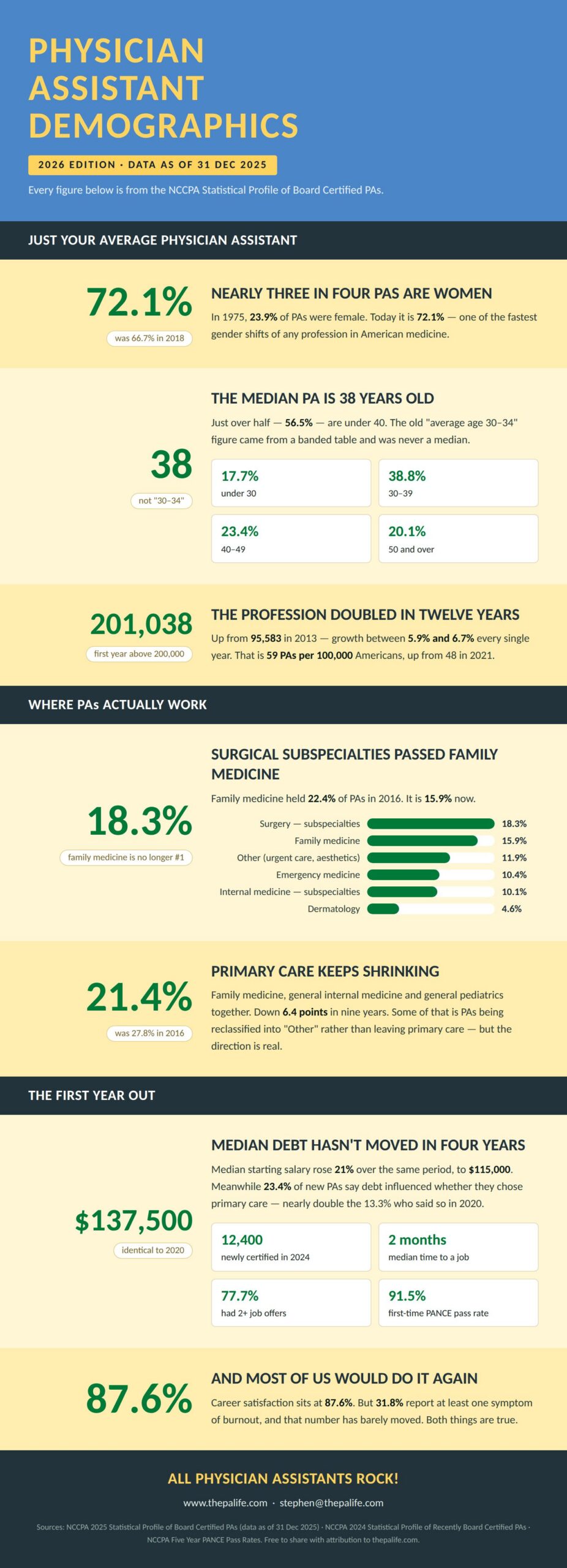
Please use it. It is free to share, post or print with attribution to thepalife.com. To put it on your own site, copy this:
<a href="https://www.thepalife.com/ultimate-guide/"><img src="https://www.thepalife.com/wp-content/uploads/2026/08/PA-Demographics-Infographic-2026-scaled.jpg" alt="Physician Assistant Demographics 2026 infographic" width="800" border="0" /></a><p>Physician Assistant Demographics 2026 — courtesy of <a href="https://www.thepalife.com/ultimate-guide/">The Physician Assistant Life</a></p>You may also like -
 The Ultimate PA School Application TimelineHere is the ultimate Physician Assistant Program Admissions Timeline for applying to PA school. When you should apply (start early) along with a monthly PA School application to-do list for guaranteed CASPA application success
- Who Gets Into PA School in 2023? Here’s What You Need to Know
Leslie Mean is a 25-year-old single white female who presents to the PA school admissions committee on her second attempt to get into PA school.
She has a 3.6 overall GPA and a 3.5 science GPA. She is holding a Bachelor of Science […]
- How Long Does It Take to Become a Physician Assistant/Associate?How Long does it take to become a PA?
It's a common question and one that I am often asked, so let me try to answer it.
Whether you are in undergrad, figuring out your career path, or looking into your second career, thinking about […]



CASPA Personal Statement Help
 We offer comprehensive, start-to-finish personal statement assistance or help to perfect a draft you already have. We have services to fit every budget.
 Schedule a Live Recorded PA School Video Interview

We offer 60-minute mock PA school interviews with post-interview feedback and advice. Includes a recorded video of your interview that you can watch, download, or share with family and friends. There is no better way to prepare!
Schedule an InterviewPre-PA Consulting and Advising
 Our pre-PA coaching service consists of a 1-hour phone consultation focused on addressing your specific questions or concerns about becoming a PA and applying to PA school.


Straight out of the @family_med_pa post and @firstlineguide. I tried to find the citation here but didn’t see it.
Thanks so much Josh! I have updated the post and added the attribution with a link to @family_med_pa post. I really appreciate you bringing this to my attention.
Stephen
I like this information. It encapsulates the essential data and helps put our profession in perspective. I will print this out and give a copy to my employer, in a private practice.
Thank you for your kind words! I’m thrilled to hear that you found the guide useful and that it helped put our profession into perspective. It’s a great idea to share this information with your employer, especially in a private practice setting where understanding the role and impact of PAs can be crucial. If you or your employer have any questions or need further clarification, feel free to reach out. Let’s continue to elevate our profession together!
Have a wonderful day!🤩
Stephen Pasquini PA-C