
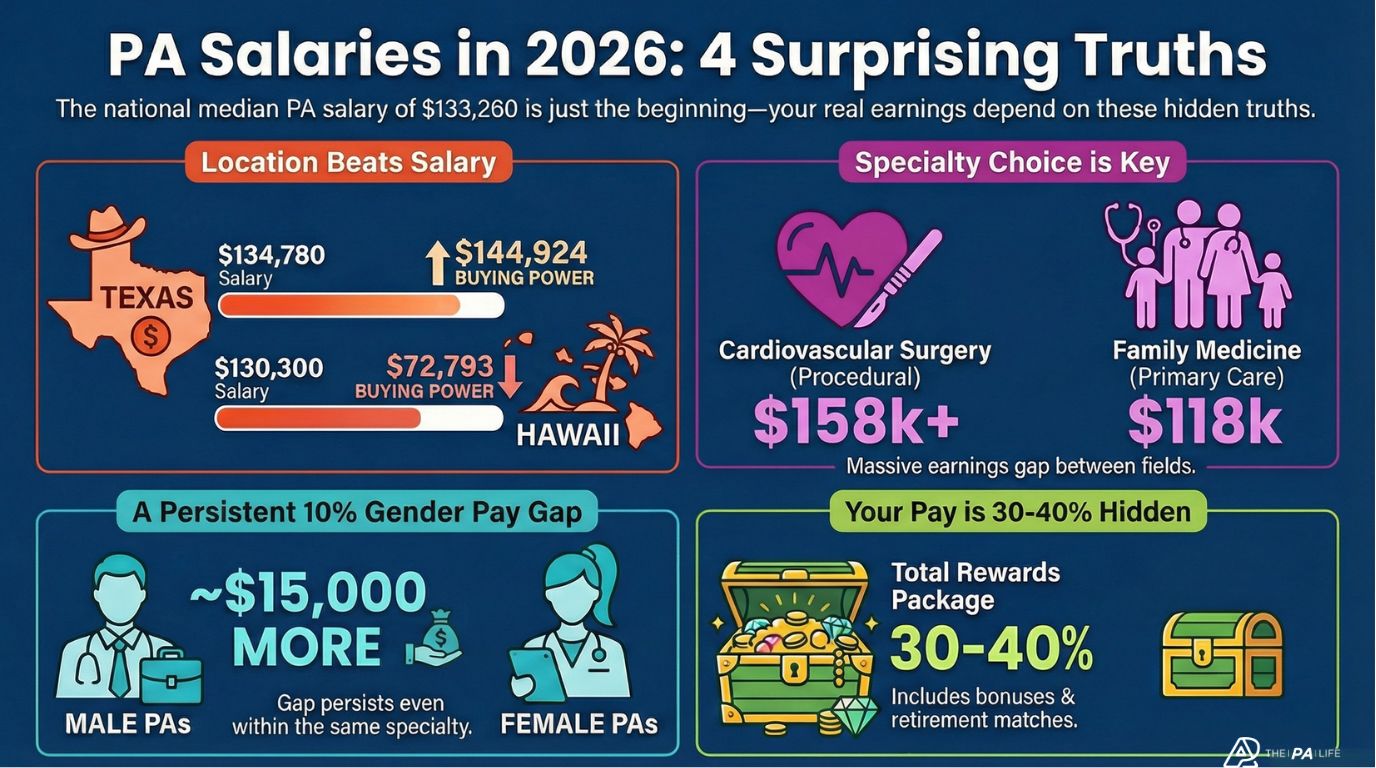
The national median salary for a Physician Assistant (PA) has reached an impressive $135,880 in 2026, a figure that signals a strong and financially rewarding career path. But fixating on that number is a strategic error. The real story of PA compensation is far more nuanced, shaped by hidden variables that can add or subtract tens of thousands of dollars from your effective take-home pay.
This article moves beyond the national average to reveal the most surprising and impactful findings from the latest 2026 data. Understanding these truths is crucial for any PA—whether a new graduate or a seasoned veteran—looking to build a truly strategic and financially successful career.
The headline salary numbers—while impressive—tell only a fraction of the story. The narrative of PA compensation in 2026 is one of nuance.
1. Where You Live Matters More Than You Think (But Not for the Reasons You Assume)
What do you think?
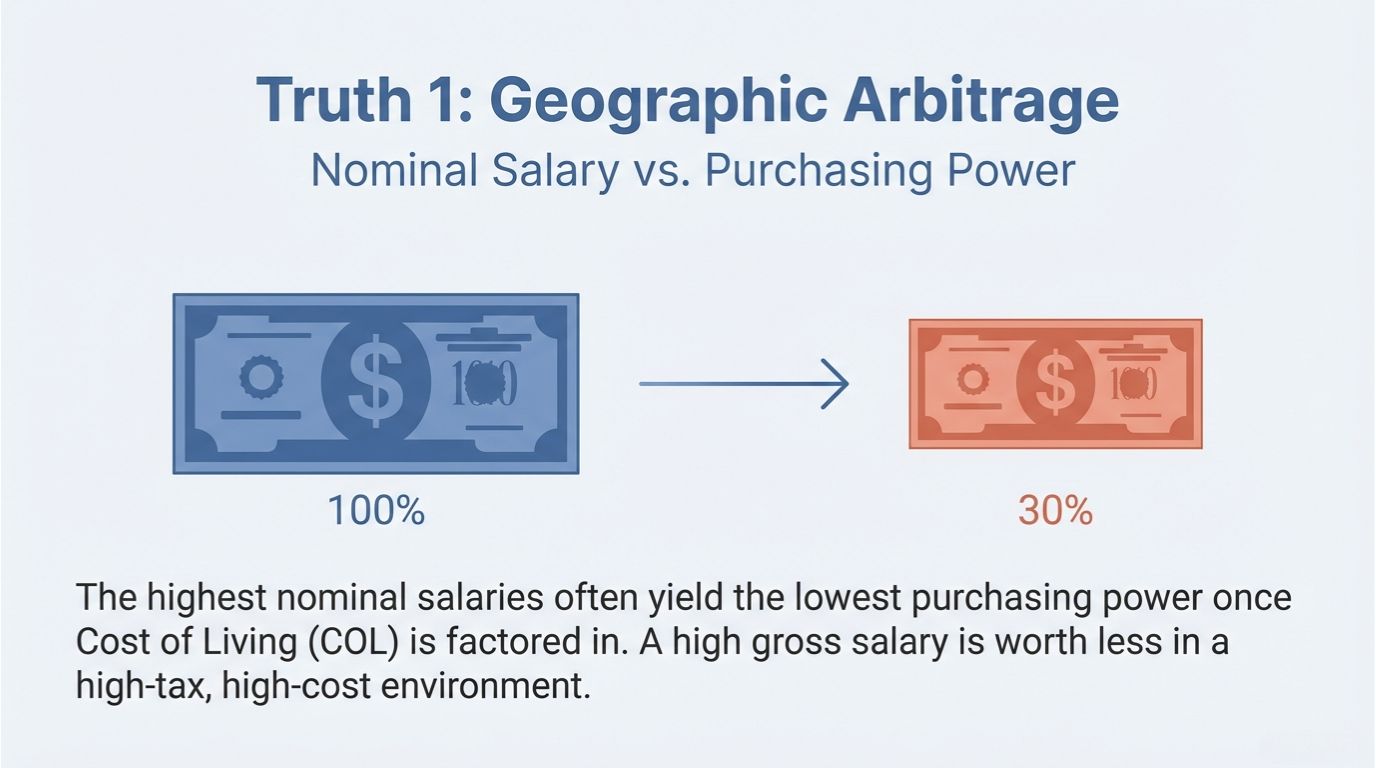
The concept of "geographic arbitrage"—where a high salary in one location is worth less than a lower salary in another—is the single most important financial truth for PAs in 2026. The highest nominal salaries often yield the lowest purchasing power once the cost of living (COL) is factored in.
States like California ($145,000 - $ 161,540) and Washington ($ 145,390) consistently top the list of the highest nominal salaries. Washington's high wage is particularly valuable due to its lack of state income tax, a significant financial advantage.
However, the real wage leaders tell a different story. When adjusted for cost of living, the most lucrative states emerge from unexpected places:
- Nevada is the top state for "real" PA salary. Its high nominal average of $154,800, combined with an average COL and no state income tax, creates a nation-leading adjusted salary of $153,267.
- Texas is another powerhouse. A nominal salary of $134,780 feels like $144,924 when accounting for the state's low cost of living and lack of income tax.
Conversely, Hawaii serves as the ultimate cautionary tale. Its respectable nominal salary of $130,300 collapses to a real wage of just $72,793 due to a crippling COL index of 179. Adding to this complexity is a counterintuitive trend: to attract talent, rural areas often pay a "rural premium," offering higher salaries than saturated urban centers where the supply of PAs is plentiful.
The strategic imperative is clear: analyze job offers not by their gross pay, but by their real, COL-adjusted value, prioritizing states where your financial power is magnified.
2. Not All Specialties Are Created Equal: The Procedural Premium
After geography, your choice of specialty is the most significant factor determining your earning potential. The 2026 data reveals a sharp financial stratification, with a potential six-figure gap between the highest and lowest-paying fields.
The top earners are in "Tier 1" procedural specialties, where PAs directly generate high-margin revenue for their employers:
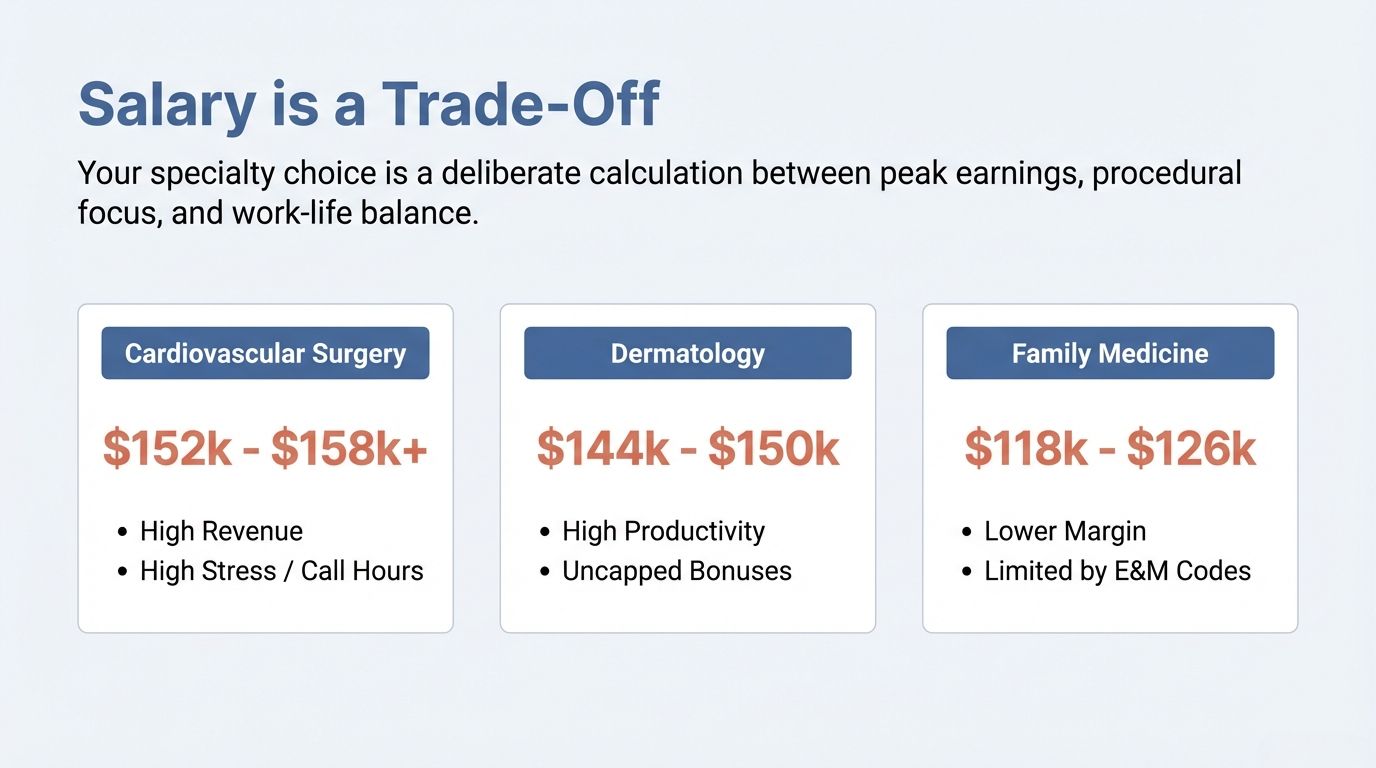
- Cardiovascular Surgery: With an average compensation of $152,500 - $158,000+, these PAs are essential for high-revenue procedures. Their work directly enables surgeons to complete more cases, making their high salary a clear return on investment for the hospital. However, this comes with a high-stress lifestyle, frequent on-call requirements, and long hours in the operating room.
- Dermatology: Averaging $144,000 - $150,000, dermatology PAs often work on productivity-based models. Bonuses tied to high patient volume create uncapped earning potential, paired with what is widely considered the best work-life balance in the profession, with no call and weekends off.
In sharp contrast are the "Tier 3" cognitive and primary care specialties, where reimbursement models constrain salaries:
- Family Medicine: With a lower average compensation of $118,000 - $126,000, these roles rely on lower-margin Evaluation and Management (E&M) codes. Without high-dollar procedures, the salary ceiling is inherently lower.
Your specialty choice is a deliberate trade-off between peak earnings, work-life balance, and procedural focus. The highest earners actively choose specialties where their labor directly drives high-margin revenue.
3. A Stubborn 10% Pay Gap Exists, Even Though Women Dominate the Profession
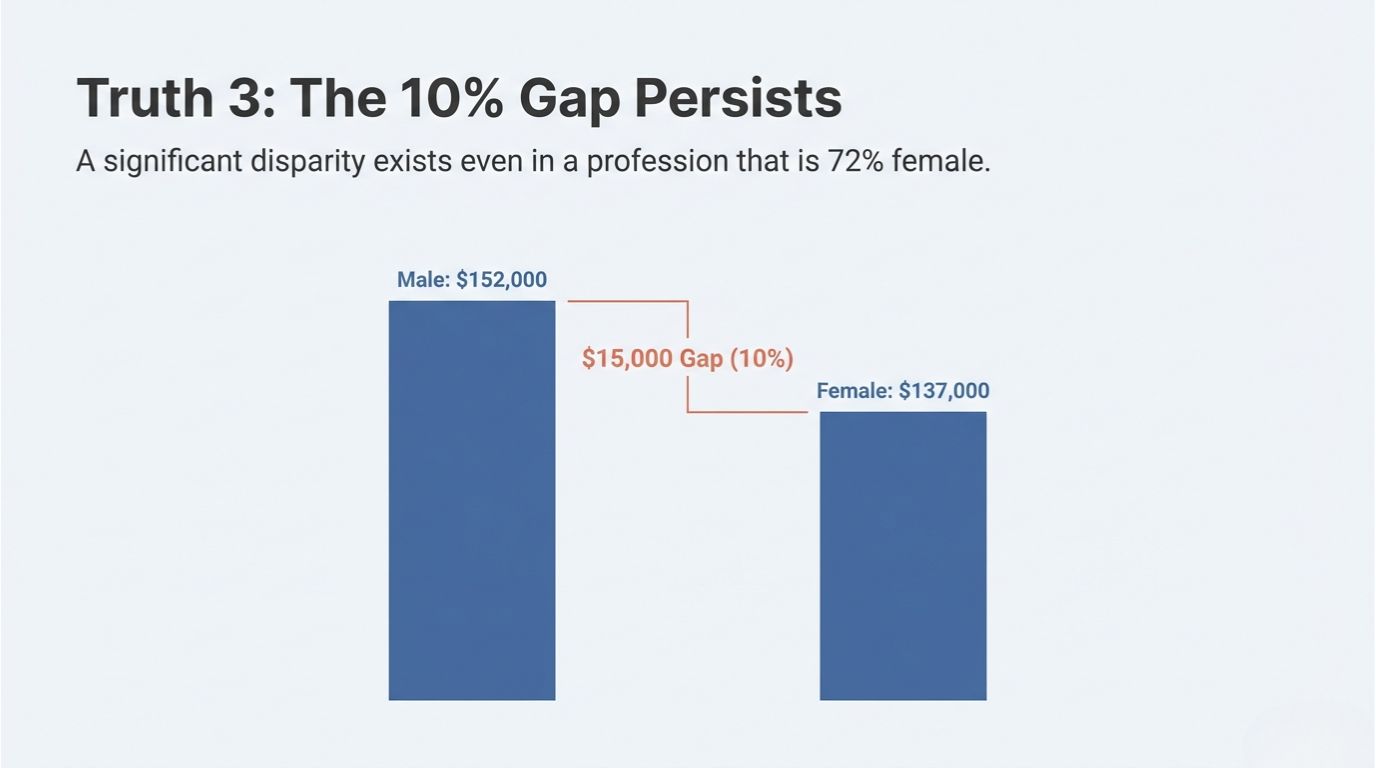
One of the most troubling findings in the 2026 data is the persistence of a significant gender pay gap in a profession that is approximately 72% female.
On average, male PAs earn a mean salary of ~$152,000, while female PAs earn a mean of ~$137,000. This represents a gap of approximately $15,000, or about 10%.
The causes are multifactorial and deeply embedded:
- Specialty Segregation: Male PAs are statistically more likely to enter higher-paying roles like surgical subspecialties and emergency medicine. Female PAs are more highly represented in lower-paying specialties such as Pediatrics and Primary Care.
- Disparities Within Specialties: Crucially, the gap is not just about specialty choice. Significant pay disparities remain even within the same field. The data shows a $34,069 gap in Obstetrics and Gynecology and a $29,359 gap in Dermatology. This proves the gap is not merely a pipeline issue; it is a systemic problem rooted in pay disparities within the exact same roles, pointing directly to differences in negotiation and institutional bias. This suggests the gap is exacerbated by factors discussed later—disparities in negotiating productivity bonuses, call pay, and other elements of the 'Total Rewards' package—making comprehensive negotiation a critical tool for achieving pay equity.
4. Your Total Compensation is 30-40% Higher Than Your Salary

Focusing solely on the base salary is a critical mistake. A comprehensive "Total Rewards" package can add 30-40% to the value of your offer, and overlooking these benefits means leaving a massive amount of money on the table.
Here are the key components of your "hidden" paycheck:
- Bonuses: The data shows that 57% of full-time PAs receive a bonus, with a median value of $7,500. These can range from signing bonuses to productivity incentives based on performance.
- Retirement Match: Failing to secure a 5% 401(k) match is the equivalent of forfeiting a $280,000 bonus over a 20-year career. For a PA earning $135,000, that 5% employer match, assuming 7% market growth, is the single most powerful wealth-building tool in your benefits package and should be treated as non-negotiable.
- Continuing Medical Education (CME): The average allowance is $2,000 - $3,000 per year, plus 3-5 days of paid time off to attend conferences. This is essential for maintaining certification and licensure.
- Malpractice Insurance: This is a non-negotiable benefit. It is critical to ensure your employer pays for "Tail Coverage" when you leave. Without it, you could face a hidden exit tax of 5,000-10,000 to cover yourself against future claims.
When comparing job offers, remember that a lower salary with a superior benefits package—especially one with a generous retirement match and fully-covered tail insurance—is often the smarter long-term financial choice.
From Salary to Strategy
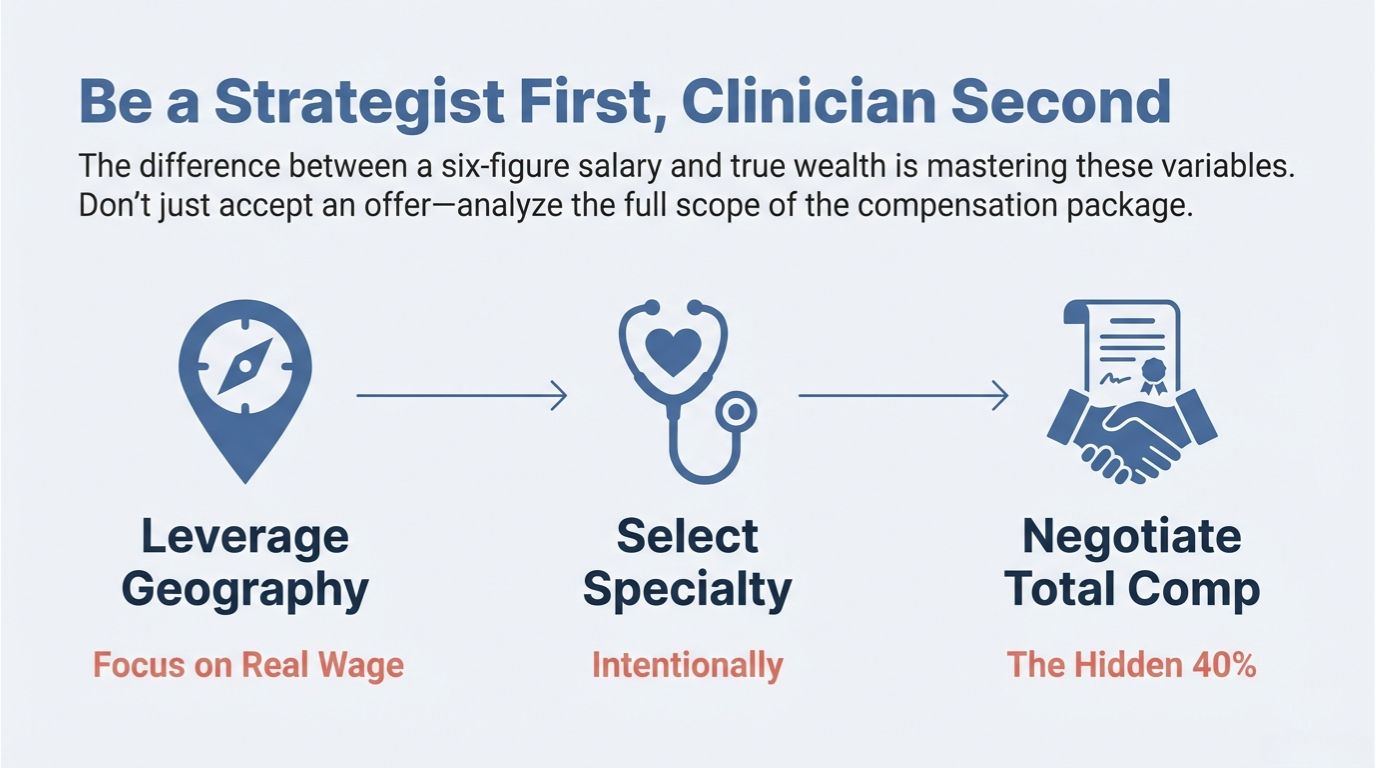
The difference between a six-figure salary and true wealth is no longer about the degree—it's about mastering the variables of geography, specialty, and total compensation. The most successful PAs of 2026 will be strategists first and clinicians second. By strategically leveraging geography, carefully selecting a specialty, negotiating assertively, and analyzing the full scope of your total compensation, you can transform a good salary into a great career.
Now that you know the hidden variables, what is the one strategic change you can make this year to maximize the real value of your career?
BONUS:
| Category | Sub-category | Median Annual Salary | Hourly Wage / Range | Key Economic Drivers | Workforce % | COL Impact |
|---|---|---|---|---|---|---|
| National Percentiles | Median (50th) | $135,880 | $65.33 | Typical experienced hospitalist or surgical PA | 50% | Moderate |
| National Percentiles | 90th Percentile | $190,280 | $91.48 | Locum Tenens or high-volume productivity models | 10% | Low |
| National Percentiles | 75th Percentile | $163,980 | $78.84 | Senior PAs or high-revenue specialties | 25% | Low |
| National Percentiles | 25th Percentile | $120,670 | $58.02 | Early-career PAs or rural primary care | 25% | Moderate |
| National Percentiles | 10th Percentile | $95,240 | $45.79 | New graduates or lower-paying regions | 10% | Moderate |
| Specialty (Tier 1) | CV / Cardiothoracic | $152,500 - $158,000+ | ~$73.30 - $76.00 | Direct revenue generation (EVH) | ~1-2% | Low |
| Specialty (Tier 1) | Dermatology | $144,000 - $150,000 | ~$69.00 - $72.00 | High volume and productivity bonuses | ~4% | Low |
| Specialty (Tier 1) | Emergency Medicine | $137,000 - $146,000 | $80 - $100+ | Shift differentials; burnout mitigation | ~12-13% | Moderate |
| Specialty (Tier 3) | Family Med & Peds | $118,000 - $126,000 | ~$56.70 - $60.50 | Reimbursement constraints; loan repayment | ~23% | High |
| Geo (COL-Adjusted) | Nevada | $154,800 | ~$74.42 | No state tax; average COL | < 1% | Low |
| Geo (COL-Adjusted) | Texas | $134,780 | ~$64.80 | Massive medical centers; low-tax state | ~6-7% | Low |
| Geo (Nominal) | California | $145,000 - $161,540 | ~$69.70 - $77.60 | High union density; provider shortages | ~9-10% | High |
| Geo (Nominal) | Alaska | $145,830 - $148,480 | $70.11 | Remote location premiums | < 0.5% | Moderate |
View all posts in this series
- Use this Interview Hack to Get The Physician Assistant Job of Your Dreams!
- PA School and PA Job Email Etiquette: Thank-You & Follow-Up Tips
- PA Interview Thank-You Email and Follow-Up: Samples & Timing
- Your Main Goal on Your Path to PA Shouldn’t be Immediate Success or Money, But to Learn as Much as Possible
- How to Create a Winning Physician Assistant Résumé (Step by Step)
- The 10 Best Websites for Physician Assistant Job Search in 2026
- How to Write the Perfect Physician Assistant Cover Letter
- The 4 Most Common Reasons PAs Quit Their Jobs
- 10 Best Cities for Physician Assistants in 2026 (Salary vs. Cost)
- Physician Assistant Salary 2026: Four Surprising Truths Revealed
- Here are 10 Reasons why PAs remain one of the top-ranked careers in America in 2026 (and beyond)
You may also like -
 How Much Money Do Physician Assistants (PAs) Make?How much do physician assistants make in 2026? The latest AAPA, BLS & NCCPA data: $140K median pay, top-paying specialties, all 50 states. Know your worth.
- Physician Assistant Salary Map: Compare Salary by State
Here at the PA Life, I am always trying to develop tools that make your life (and my life) easier. This might be one of my favorites.
Trying to negotiate a salary is hard enough. This becomes even harder when you have to adjust for […]
- How Clay Aiken and Reality TV Helped Me Ace My PA School Interview
am embarrassed to admit: I am a big fan of reality TV.
I don't watch much TV but when it comes time for a new season of Survivor, So You Think You Can Dance, or dare I say The Bachelor (I can't believe I just admitted that) I […]


CASPA Personal Statement Help
 We offer comprehensive, start-to-finish personal statement assistance or help to perfect a draft you already have. We have services to fit every budget.
 Schedule a Live Recorded PA School Video Interview

We offer 60-minute mock PA school interviews with post-interview feedback and advice. Includes a recorded video of your interview that you can watch, download, or share with family and friends. There is no better way to prepare!
Schedule an InterviewPre-PA Consulting and Advising
 Our pre-PA coaching service consists of a 1-hour phone consultation focused on addressing your specific questions or concerns about becoming a PA and applying to PA school.


Leave a Reply