
 So you are considering PA school?
👇 Jump straight to the live cost table — published tuition and tuition-plus-fees figures across accredited US PA programs, refreshed on every page load.
Great, now how are you going to pay for it?
With the average undergraduate education debt prior to PA school at $36,300 and the average anticipated debt load from PA school now ranging from $112,500 to $116,773, it's time to ask the next logical question:
How Much Does PA School Cost in 2026?
As with most college and advanced degree programs in the United States, the cost of PA school continues to rise. Based on current tuition data supplied by PA programs, the American Academy of Physician Associates (AAPA), the Physician Assistant Education Association (PAEA), and the most recent NCCPA Statistical Report:
The Most Current Average Costs Across All PA Schools (2025–2026 Data — Most Recently Published)
- The average cost across all PA programs (public and private) for resident tuition for a 27-month physician assistant/associate program is $98,075 (up from $95,165 the prior year)
- The average cost across all PA programs (public and private) for nonresident tuition for a 27-month physician assistant/associate program is $107,288 (up from $103,660 the prior year)
Based on the latest PAEA/AAPA reports:
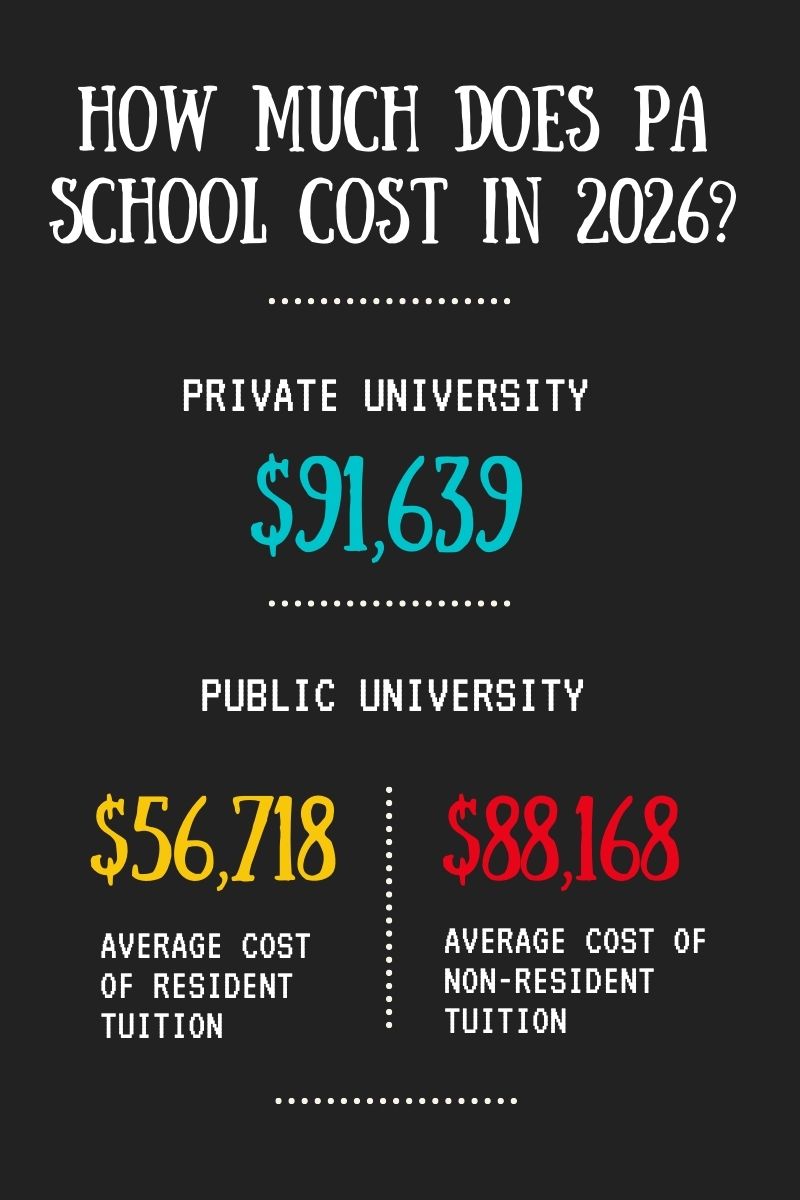
- The average cost of public resident tuition for a 27-month PA program is closer to $56,718
- The average cost of public non-resident tuition is approximately $88,168
- The average cost of private tuition for a 27-month physician assistant program is $91,639
- The average program length is 27 months
- The average PA graduate debt upon completing PA school is $112,500–$116,773, on top of any undergraduate debt
The average increase in nonresident tuition over the last five years was 3.5%, whereas resident tuition rose by 5.33%. Applying these trends, resident tuition for the 2026–2027 cycle is projected to approach $103,300 and nonresident tuition around $111,000 — though official PAEA program-level data for 2026–2027 will be published later in the year. Make sure to check individual program websites for the most current figures.
The Cost of Public vs. Private PA Programs
Of particular interest is the difference between public and private institution tuition and fees.
- The average total tuition for residents and nonresidents was higher for PA programs at private institutions than at public institutions.
- There was a 4% to 7% increase in the average total resident tuition for public and private institutions.
- The average total incidental costs (books, medical equipment, etc.) for public and private institutions increased by 23% and 139%, respectively.
- Today, 62.5% of PA programs are private, while only 35.6% are public.
- Nearly 85% of PA students take out loans to cover their education costs.
What PA Programs Actually Charge in Required Fees
Fees usually get reported as one tidy average, which makes them sound like a rounding error. They are not. We read the required-fee line off every accredited program’s own published cost page, and the spread is enormous:
- The median program charges roughly $7,000 in required fees on top of tuition.
- More than a hundred programs charge over $10,000, and well over a dozen charge more than $20,000.
- At the very top of the range, one program charges close to $50,000 in fees alone — very nearly doubling its own tuition.
These are not optional, and they are not living costs. A program fee, a clinical placement fee, a technology fee — they land on your student account exactly the way tuition does. The tuition-plus-required-fees column in the live table above is the number that actually gets billed.
⚠️ CRITICAL 2026 UPDATE: Grad PLUS Is Gone — but the PA Loan-Cap Fight Just Swung Our Way
Two major federal loan changes collided this summer, and every current and future PA student needs to understand both. Here is exactly where things stand:
1. Grad PLUS loans are gone for new borrowers — this took effect July 1, 2026. The Grad PLUS program, which lets graduate students borrow up to their full cost of attendance, is closed to new borrowers under the “One Big Beautiful Bill” Act. If you borrowed federal loans for your current program before July 1, 2026, a legacy provision allows you to continue borrowing under the old rules for up to 3 more years or until you finish your program, whichever comes first.
2. The $100,000 loan-cap threat to PA students is currently ON HOLD. Under the new law, students in “professional” programs can borrow up to $50,000 per year ($200,000 lifetime), while “graduate” students are capped at $20,500 per year ($100,000 lifetime). The Department of Education’s RISE rule attempted to classify PA programs as “graduate” — a cap that sits below the total cost of many programs in the live table above. The AAPA and PAEA sued the Department of Education, and in late June 2026, a federal court issued a preliminary injunction blocking that narrow definition. For now, PA students can qualify for the higher professional-tier loan limits while the litigation plays out.
What this means for you: plan as if federal borrowing will be tighter than it was for the classes before you. Program cost now matters more than ever — weigh the live tuition numbers above heavily, look hard at your in-state options, and confirm your specific loan eligibility with each program’s financial aid office and studentaid.gov before you commit.
Status as of mid-July 2026. This litigation is active, and the rules can change — I’ll keep this section updated as it develops.
Cost of APPLYING to PA School in 2026
Just when you thought it couldn't get worse, before you enjoy the hefty cost of PA school itself, you have to factor in the cost of applying. Based on my calculations, the total cost of applying could exceed $6,000 in 2026. Here's the breakdown of major application expenses:
- CASPA Application Fee: $184 for your first program + $61 for each additional program. If you apply to 12–15 schools (the average), CASPA fees alone run $784–$949.
- CASPer Test Fee: $85 (includes results sent to 8 programs) + $15 per additional program. A growing number of PA programs now require this test.
- Transcript Entry Service (PTE): $75–$150 depending on the number of transcripts.
- Supplemental fees: Many programs charge $25–$100 or more per secondary application.
- Interview travel costs: Flights, hotels, and transportation for in-person interviews can add hundreds or thousands more.
Note: CASPA fee waivers are available on a first-come, first-served basis for applicants with financial need (covering two programs, valued at $245). Apply early!
For my full breakdown with every cost itemized: Sticker Shock Alert! The Real Cost of Applying to PA School.
Looking for the best programs to apply to? Use my Ultimate PA School Applicant Logbook to track your hours, schools, and costs — all in one place.
Cost of All US Physician Assistant (PA) Programs
The live table below includes every accredited US PA program. It shows full-program resident and nonresident tuition where the school publishes it, with tuition plus required fees in a separate column. A school that publishes only a combined total stays in the table, with that figure under tuition plus fees; a cost the school has not published is labelled rather than guessed. The figures come from our PA School Finder directory, and the table reloads the current CSV each time you open this page. The date stamp below shows when your browser loaded it.
How Much Did It Cost Me to Go to PA School?
When I was enrolled in the Rutgers University PA program (formerly UMDNJ) in 2001 — yes, that feels like a long time ago — the annual tuition was only $10,000 per year (excluding fees). Since this was a three-year program, my total cost for the PA school education, excluding fees, was approximately $30,000.
I was fortunate to receive a stipend from the National Health Service Corps, which covered my PA school expenses. I strongly recommend looking into this program — especially now that Grad PLUS loans are being phased out; service-based funding is more important than ever.
How Much Would My Same PA Program Cost in 2026?
Here is the breakdown of my school (Rutgers PA program) and the projected cost of tuition and fees for the 3-year program starting in 2026.
Projected Total Cost of Attending the Rutgers Physician Assistant Program in 2026
- The estimated total cost of in-state tuition is approximately $105,374 (2025: ~$101,321; 2024: $97,424; 2023: $93,677; 2012: $69,524)
- The estimated total cost of out-of-state tuition is approximately $158,125 (2025: ~$152,043; 2024: $146,195; 2023: $140,572)
Note: 2026 Rutgers figures are projections based on the ~4% annual increase trend. Verify with the Rutgers School of Health Professions for current figures.
How About the Fees (Estimated for 2026)?
- ~$500 campus fee
- ~$950 technology fee
- ~$475 school fee
- ~$500 lab-intensive fee
- ~$195 clinical admin fee
- ~$160 parking/year × 3 = $480
Total in Required Fees (Estimated): ~$3,100
A note on what I count as a fee: Rutgers also requires a student health plan, about $2,650 a year and roughly $7,950 across the three years. Real money — but you can waive it if you carry your own coverage, which makes it a cost of living rather than a charge for being enrolled. I leave it out of the fee total for the same reason I leave out books and rent, and we apply that same rule to every program in the directory.
In a later blog post, I will discuss the cost of books, medical supplies, and general living expenses. Unless you attend PA school part-time, it isn't easy to maintain a job along with a full-time PA school curriculum.
You may also have noticed that Rutgers University has a three-year PA school curriculum. How does this compare with shorter programs? Take a look at my 14-variable Perfect PA Program Picker!
Is PA School Worth the Cost in 2026?
This is the question every pre-PA should be asking, and it deserves a real answer. The short version: for most people, yes — but only if you go in with a plan. And if part of you is still weighing PA against medical school, I’ve run that exact money comparison — tuition, years of lost income, debt, and lifetime earnings — in PA vs. MD: Following the Money.
Here's the math that matters. The national median PA salary in 2026 is approximately $133,000–$134,000, with bonuses pushing total compensation close to $141,500. That is a high income, and demand for PAs continues to grow. Check out the 10 Best Cities for Physician Assistants in 2026 and the PA Salary by Cost of Living comparison to see where your dollar goes the farthest.
However, with average PA school debt now at $112,500–$116,773 — and federal loan access shrinking thanks to the Grad PLUS loan changes — it is more important than ever to choose your program wisely. Attending an in-state public program, utilizing service-based scholarships and loan repayment programs, and minimizing borrowing can make an enormous difference in your long-term financial health.
Also, if you are wondering who gets into PA school and what it takes to put together a winning application, check out my guide: Who Gets Into PA School?
If you are just starting your pre-PA journey, the Ultimate Pre-PA Getting Started Guide is the best place to begin.
Frequently Asked Questions About PA School Costs
How much does PA school cost?
Per the latest PAEA data, average private-program tuition is about $91,639, while public programs average $56,718 for state residents and $88,168 for nonresidents — tuition only, before fees and living costs. The live table above includes every accredited program, shows each available cost under its proper heading, and labels figures the school has not published. It updates on every page load.
How much debt do PA students graduate with?
The average PA graduate leaves school with roughly $112,500–$116,773 in student loan debt from their PA program alone, on top of any undergraduate loans. Programs vary enormously, which is why comparing total cost — not just tuition — matters so much.
Is PA school worth the cost?
For most students, yes. PA school takes roughly 27 months, and the median PA salary is around $133,000–$134,000 with total compensation often approaching $141,500 — one of the strongest returns on investment in medicine relative to the time and debt required. The key is going in with a borrowing and repayment plan, and weighing each program’s total cost against its outcomes. See PA vs. MD: Following the Money for the full comparison.
Can I still borrow enough for PA school after the Grad PLUS changes?
Grad PLUS loans closed to new borrowers on July 1, 2026. As of mid-2026, PA students qualify for the higher professional-tier federal loan limits ($50,000 per year, $200,000 lifetime) while the AAPA/PAEA lawsuit over the RISE rule proceeds — see the critical update section above for the full picture, and confirm current rules at studentaid.gov and with your program’s financial aid office before you commit.
How much did your PA school cost? Is it worth it? Drop a comment below — I'd love to hear your story!
— Stephen Pasquini, PA-C
You may also like -
 Scholarships, Grants, and Loan Repayment Programs for Physician Assistants (2026 Update)PA School Is Expensive — But So Is Not Going
It goes without saying that PA school is expensive. It is also demanding, which means you will have limited (if any) time to work while attending.
With the average undergraduate education […]
Scholarships, Grants, and Loan Repayment Programs for Physician Assistants (2026 Update)PA School Is Expensive — But So Is Not Going
It goes without saying that PA school is expensive. It is also demanding, which means you will have limited (if any) time to work while attending.
With the average undergraduate education […]- MD Versus PA Showdown Round 1 – Show Me The Money!The net hourly wage of an internal medicine physician is 1.13 times that of a high school teacher and 1.25 times LESS THAN that of a physician assistant! Read more...
- How Much Money Do Physician Assistants (PAs) Make?How much do physician assistants make in 2026? The latest AAPA, BLS & NCCPA data: $140K median pay, top-paying specialties, all 50 states. Know your worth.

CASPA Personal Statement Help
 We offer comprehensive, start-to-finish personal statement assistance or help to perfect a draft you already have. We have services to fit every budget.
 Schedule a Live Recorded PA School Video Interview
We offer 60-minute mock PA school interviews with post-interview feedback and advice. Includes a recorded video of your interview that you can watch, download, or share with family and friends. There is no better way to prepare!
Schedule an InterviewPre-PA Consulting and Advising
 Our pre-PA coaching service consists of a 1-hour phone consultation focused on addressing your specific questions or concerns about becoming a PA and applying to PA school.


Hi, I am currently residing in California. From your experience what are some reputable schools in or around California? I am currently a student at NAU and will be attending SFSU for my bachelors in Biology. Thinking back now would you have pursued a different degree prior to applying to a PA program?
Thanks in advanced!
Seems like every year you post this, Duquesne ends up being most expensive by a HUGE margin, and I finally figured out why. Duquesne does not admit PA students at the graduate level. The only way to get in is as a high school senior, which is actually a very good thing compared to other direct-admit PA programs, who often weed out kids and fill open spaces at the graduate level. So the cost of Duquesne’s program includes 3 years of undergraduate study as well as the 2 years of graduate study, which includes 3 summers. Putting it on this list is comparing apples to oranges and misleading.
Just an FYI, according to Touro Nevada’s website, their PA Program actually costs $101k in total and not $77k.
Thanks, Jen! I have updated the table. I have also updated the prices on my companion website at http://www.paschoolfinder.com
What major does PA fall under?
I am currently in Senior year of High school and interested in being a Physician Assistant. Can you guide what should I see while going through the colleges. What courses specifically and which colleges are good for that, if any suggestions.
Hi Karman, here is a post I wrote on prerequisite coursework you can see what I took as Biology/Zoology major to complete my prerequisites: https://www.thepalife.com/prerequisites/
Any major will do so long as you complete the required courses. And almost every school in the country can get you there. There are schools which offer 3 + 5 “direct entry” as well which are becoming more and more popular. I am not sure they are any better but it is an option. Here is a post I wrote on that: https://www.thepalife.com/direct-entry-and-dual-degree-bsms-physician-assistant-programs/
There are endless options, but just being prepared and having a direction is a good start, and I can tell you have already jumped the biggest hurdle! Let me know if you have any more questions and I will be happy to answer.
Stephen
Hi Macy,
I’m very interested in becoming a PA. I worked as a medical assistant for 10 yrs but haven’t worked in 5 yrs due to a medical Illness. I’m ready to jump on the band wagon again and follow my dreams. Does my medical experience still count towards the requirements?
Hi Stephen,
I’m about to embark on my freshman year and I have always had an interest in oncology. I felt that becoming an oncologist was too long of a time period since I want to start a family. I have family and friends who are PAs and I learned that you are able to be specialized so I plan to be a PA in oncology. I have been looking into the cost of PA school and have a question about it. If the PA school is 27 months and it says it costs $128,000, does that mean that the program costs 128,000 per year or for the entire program? Also, since I want to be a PA in oncology do is it mandatory to do a fellowship after PA school? Thanks for the help!
Great questions Ellery!
1. If the cost is $128,000 that is for the entire program. It often does not include books and fees though so you may want to factor these in as well. The cost has been skyrocketing since I graduated in 2004 which makes programs like the National Health Service Corps even that more attractive. Although PAs in specialty medicine make a very good income so it is still a good value.
2. You do not need to go through a residency program. Some specialty jobs ask for prior experience. I would just make sure to double down on my elective rotations. My wife was an RN who worked for years in oncology with a lot of midlevel providers. It’s a wonderful specialty.
Best of luck to you and your future, enjoy the journey!!!
Stephen
Hi Stephen,
I’m a freshman and am very interested in becoming a PA. My parents are for it 100% but I -and i’m sure they- know it would be very expensive. Please could you suggest any other agencies or organisations such as NHSC that support PA students in exchange to partake in some service or work ?
My aunt- who is a RN- is persuading me to opt for nursing but I would rather become a PA. I’d really appreciate your reply.
Hi Macy,
Congratulations on your decision to pursue a career as a PA… You won’t be disappointed. With over 48,000 current job openings your parents will be very happy as well 🙂 I wrote a post earlier this year that will be helpful: https://www.thepalife.com/scholarships-grants-and-loan-repayment-programs-for-physician-assistants/
As a NHSC scholar I am a bit partial to this path. I think they offer the best balance of loan repayment and an opportunity for a great/meaningful experience working in an underserved area. I can’t recommend it enough!
Stephen