
Most accredited PA programs in the United States will read an application from an international applicant — the table below names every one of them, along with what each program charges a non-resident, whether it wants a TOEFL score, and when its CASPA deadline falls. It updates itself from the PA School Finder directory, so what you see is what the programs are saying now.
Use the search box to check a specific school, or the state menu to build a regional shortlist. Then read the section underneath the table, because there is one question the table cannot answer for you, and it is the question that decides whether you actually get to go.
Read this before you use the table. “Accepts international applicants” is the school’s answer to whose application we will read — it is not a promise to sponsor an F-1 visa. Many of these programs will read your file and still require US citizenship or a green card before you can matriculate. Use this list to build your shortlist, then ask each program the two questions in the script below.
| Program | State | TOEFL | Total cost | Length | Seats | CASPA deadline |
|---|
Candidate baseline from the reviewed October 3, 2026 CSV · refreshes automatically from the PA School Finder directory
Total cost is the non-resident figure — the one that applies to you — and includes program fees where the school publishes them; rows marked “tuition only” have no published fee schedule. Seats is the most recent published class size. Programs outside the main list either do not accept international applicants or have not confirmed a policy; treat unclear cases as “ask before you apply,” not as a no. Distant campuses are listed separately because their deadlines and requirements can differ. Data from the PA School Finder directory, which is re-verified against program websites every week.
If you would rather browse these programs inside the full directory — where you can layer on every other filter, from GRE requirement to deadline month to class size — PA School Finder keeps the same list at PA programs that accept international applicants, alongside the ones that don’t.
The question the list can’t answer: will they sponsor your visa?
Here is the distinction that costs international applicants the most time and money, and almost nobody spells it out.
“We accept international applicants” is an answer about whose file the admissions committee will read. It is not a promise to sponsor an F-1 student visa. Those are two different decisions made by two different offices, and a program can say a warm yes to the first while the second is a flat no.
Read enough program pages and you find the word “international” doing four separate jobs:
- Anyone who isn’t a citizen or permanent resident. The strictest reading, and the one that usually comes with a citizenship requirement attached.
- Anyone educated abroad, citizenship irrelevant. Under this definition a US citizen with a degree from Lagos or Manila is an “international applicant” and owes the same credential evaluation and English test as everyone else.
- We welcome your foreign coursework, but you must already have status. Very common. The door is open to your transcript and closed to your visa.
- Nothing at all. The largest group by far. Silence reads like a yes and usually isn’t one.
Only a small minority of programs say the thing you actually need to hear, which is that they will issue you a Form I-20. When a program does say it, it says it unmistakably.
What a real yes sounds like
- Augsburg University tells you exactly which documents it needs in order to “process your Form I-20,” down to the certification of finances and the passport page.
- University of Evansville states that evidence of financial support must be on file when the I-20 is issued.
- Western University of Health Sciences points you at its International Student Services staff for the I-20, the F-1 and SEVIS.
- Stanford lists visa-eligible international applicants, DACA recipients and undocumented applicants as eligible, and describes certifying an I-20.
What a real no sounds like
- University of Wisconsin–Madison: it does not consider applicants on student or other temporary visas.
- Towson University requires citizenship, permanent residence, or work authorization that doesn’t depend on student visa sponsorship.
- University of Arizona requires US citizenship or permanent residence, full stop.
- Nazareth University explains that its hybrid format itself rules F-1 out — see below, because this one catches people.
Two structural traps worth knowing before you build a shortlist
The hybrid-format trap. An F-1 student may count only one class, or three credits, per term toward a full course of study if it’s delivered online. A PA program with an online or hybrid didactic year therefore cannot accommodate an F-1 student at all, no matter how much the admissions committee likes your file. Nazareth says so out loud; most programs in the same position simply don’t mention it. If a program advertises a hybrid or distance didactic year, assume F-1 is off the table until someone there tells you otherwise in writing.
The Form I-17 trap. Visa sponsorship is certified school by school and program by program. A university lists its approved areas of study on a form called the I-17, and a program that isn’t on that form cannot enroll F-1 students even though the university across the quad enrolls hundreds. So the question is never “does this university take international students.” It is “is the PA program on your I-17.”
The two emails that save you a year
Send these before you spend a dollar on a credential evaluation. Put them to the PA program’s admissions coordinator and to the school’s designated school official (DSO) separately, because they will give you different answers and you need both.
- To admissions: “I hold [your status]. Is your PA program able to issue a Form I-20 for F-1 study, and is the PA program listed on the university’s Form I-17? If not, what immigration status must an applicant hold to matriculate?”
- To the DSO: “Will the clinical year be authorized as curricular practical training? If so, will twelve or more months of full-time CPT leave me ineligible for post-completion OPT?”
That second question is not hypothetical, and I want to be straight that I could not find a clean public answer to it. Full-time curricular practical training of a year or more eliminates OPT eligibility, and a PA clinical year is typically twelve months or longer. How individual schools handle that for a required, unpaid, degree-embedded rotation appears to vary. Get the answer in writing from the school, not from a forum.
Your transcript, CASPA, and the year most people don’t budget for
CASPA does not record foreign coursework. Transcripts sent to it from a school outside the US or English-speaking Canada are discarded, including ones printed in English. Your foreign grades will never appear in a CASPA GPA.
What happens instead is a three-step relay, and each step takes longer than you expect:
- Your institution sends your documents to a US credential evaluation service. CASPA names five that applicants have used — WES, ECE, Josef Silny, IERF and Educational Perspectives — and is careful to say it endorses none of them. Individual programs are far pickier: some accept only WES, some only WES or ECE. Check your shortlist before you order, because a second evaluation is a second full fee.
- The service produces a course-by-course report and sends it directly to CASPA. WES publishes roughly two weeks for document verification plus about two weeks for the evaluation itself, so plan on four to six weeks after they have everything — and your university abroad is usually the slow part.
- You take US coursework anyway. This is the step that surprises people. A foreign degree can tick the bachelor’s box, but programs routinely require the science prerequisites at a regionally accredited US or Canadian institution, and many add a floor of 30 to 60 US credits on top.
If you attended a Caribbean medical school, read this twice. CASPA treats all Caribbean medical schools as foreign institutions regardless of whether they hold US offices or lead to US licensure. Transcripts sent directly from them are discarded like any other foreign transcript. Route them through an evaluation service.
Two tools that will save you a lot of guessing
Once your evaluation is back, run your real numbers before you pay a single application fee. And if you want the shortlist built for you rather than by you, let the matcher do it.
English proficiency and the TOEFL score scale
Roughly four in five of the programs in the table want an English proficiency test. On the old TOEFL iBT scale of 0 to 120, PA program minimums generally ran from 80 to 100 and clustered at 90 to 100 — and the speaking sub-score is the one to watch, because 25 or 26 is common. That is a higher speaking bar than most graduate programs set, and the reason is obvious once you say it out loud: this is a job where you explain a diagnosis to a frightened person.
TOEFL now uses a 1–6 scale in half-point increments, a change that took effect in January 2026. Score reports show both the new number and a comparable 0–120 estimate until January 2028, and a great many program websites still publish the old number. When a program lists a minimum, work out which scale it means before you book a test date.
IELTS is widely accepted, usually at band 6.5 to 7.0. The Duolingo English Test is accepted by some programs and not most, so don’t assume it.
One misconception worth killing: being from a country where university is taught in English does not automatically waive the requirement. Several programs say explicitly that country of citizenship or medium of instruction doesn’t exempt you, and at least one requires the test of any applicant whose first language isn’t English even if they are a US citizen. Waivers do exist, but they usually hang on holding a degree from a US institution, or on a specific number of graded English credits earned in the US. Check the wording, not the vibe.
Use the TOEFL toggle above the table to see the programs that don’t require a test at all — for some applicants that filter alone reshapes the whole shortlist.
Paying for it, without federal loans
This is the quiet reason so many programs mean “permanent resident” when they write “international.”
Student visa holders are not eligible for US federal student aid. No FAFSA, no Direct Unsubsidized loan, no Grad PLUS. The federal rules list F-1, F-2 and M-1 among the visa categories that convey no Title IV eligibility. Permanent residents, refugees, asylees and several other categories of eligible non-citizens get the full federal menu, which is exactly why the green card is the dividing line so often.
The median PA program in the table costs a non-resident well north of $100,000 in tuition and fees before you have eaten a meal or paid rent. On an F-1 you have to show you can cover roughly a year of that in liquid funds before anyone will issue your I-20 — ask each program for its published first-year cost of attendance, because that figure, not a number you find on a forum, is what you must document.
What’s left:
- A US cosigner. Most private lenders will work with an international student who has a creditworthy US citizen or permanent resident cosigner. This is still the most common route.
- No-cosigner lenders. MPOWER Financing lends to international graduate students without a cosigner or collateral and specifically markets to PA students. It periodically pauses new lending when it reaches funding capacity, so confirm it’s open before you build a plan around it. Prodigy Finance is the other name people mention, but health professions are not among its listed supported fields — run your specific program through its eligibility tool rather than assuming.
- Institutional and private scholarships. Program-level scholarships are frequently open to admitted students regardless of citizenship, and they’re under-applied for. Start with our PA school scholarship and funding hub, and check what PA school actually costs so you’re working from real totals.
If you trained as a physician abroad
You are a large share of the people reading this page, so let me be direct rather than encouraging.
Your medical degree will not shorten a PA program. I have not been able to find one ARC-PA accredited program that grants advanced standing, a bridge track or an accelerated pathway for a foreign medical degree, and several state in writing that they don’t — no advanced placement, no substitution of coursework, the same prerequisites as everyone else. You will do the whole program.
Your clinical years may not count as patient care experience, either. CASPA itself sets no country restriction and its definition of patient care describes exactly what you did as a physician. But CASPA also says plainly that each program decides for itself, and some programs slam that door: one excludes patient care hours earned abroad as a licensed practitioner, including residency, fellowship and internship, from its 2,000-hour requirement outright; another requires at least 200 US patient care hours regardless of what you did at home. Assume you will need US hours and start earning them early.
And a hard one: a foreign medical degree can make you less eligible at some programs, not more. Stanford, which does sponsor visas, will not accept an applicant whose only degree is a non-US, non-Canadian one — including a medical degree — and does not accept credential evaluations in place of the degree requirement.
None of that means don’t do it. It means do it with the real timeline in front of you. If you want the longer version, I’ve written a full IMG guide to becoming a US physician assistant.
After graduation: the part almost nobody plans for
Plan this before you apply, not in your clinical year.
Certification is not the obstacle
NCCPA requires graduation from an ARC-PA accredited program to sit the PANCE, and it does not gate eligibility on citizenship or immigration status. You get six years and six attempts from graduation. The exam is the fair part of this whole process.
The twelve-month clock
Post-completion OPT gives a graduate twelve months of work authorization. The 24-month STEM extension is not available to PAs — the physician assistant CIP code is not on the DHS STEM designated degree program list, and the health codes that are on it are laboratory and pharmaceutical sciences, not PA. So you have twelve months, with no more than 90 days of unemployment allowed inside them, and realistically one H-1B lottery cycle falling in that window.
TN doesn’t help, even for Canadians
The TN professions list under USMCA has not changed since NAFTA, and physician assistant has never been on it. Dentists, dietitians, pharmacists, physiotherapists, registered nurses and psychologists are; PAs are not. (Physicians are on it only for teaching or research.) If you are Canadian or Mexican and someone tells you TN will cover a PA job, they are wrong.
H-1B, and the two provisions worth knowing
The regular H-1B cap is 65,000, with up to 20,000 more reserved for people holding a US master’s degree or higher — which your PA degree gives you. Two details make a real difference:
- Cap-exempt employers don’t use the lottery at all. Universities, and nonprofits related to or affiliated with them by a formal written affiliation agreement, plus nonprofit and governmental research organizations, can petition at any time of year. And you can qualify even if a qualifying institution isn’t your direct employer, so long as at least half your working time is spent performing your duties at one. For a new PA that points straight at university-affiliated academic medical centers and nonprofit teaching hospitals.
- The licensure catch-22 has a written escape hatch. A license is normally required before an H-1B petition can be approved — but the regulation allows a petition to be approved for up to one year when the only obstacle to licensure is the lack of a Social Security number or employment authorization, and you are otherwise fully qualified and have applied. Show that rule to an employer who tells you it can’t be done.
State licensure
No federal law bars someone in lawful nonimmigrant status from professional licensure; the federal restriction that people cite is written to exclude nonimmigrants from its reach. Licensure is still decided board by board, some states require a Social Security number or taxpayer identification number to issue a license, and DACA recipients’ eligibility genuinely varies by state. Confirm with the specific board before you accept a job offer in a state you haven’t practiced in. Our state licensing board finder will put you in front of the right one in a couple of clicks.
What the odds actually look like
You should know what you’re walking into. The best data available comes from an analysis of more than 113,000 CASPA applicants across five cycles: non-US-citizen applicants ran around 1,000 per cycle out of roughly 30,000 — a little over three percent — and were significantly less likely to matriculate, with adjusted odds roughly 32 to 42 percent lower than US citizen applicants. That gap held in every cycle studied.
I don’t print that to discourage you. I print it because a three percent applicant pool with a structural disadvantage is a pool where preparation is worth more than it is for anyone else. The applicants I see get in are the ones who fixed the boring things early: evaluation ordered a year out, US prerequisites finished with As, US patient care hours banked, TOEFL speaking sub-score comfortably above the line, and a shortlist built from programs that had already confirmed in writing that they could enroll them.
Do the boring things early
Your essay is the one place where being from somewhere else is an advantage rather than an obstacle — if you write it as a story about a clinician rather than an apology for a passport. Build it free, and get a human read on it when it matters.
Common questions
Do US PA programs accept international students?
Yes. Most of them do. About seven in ten accredited US PA programs will read an application from an international applicant, and the table on this page lists every one of them by name. What far fewer programs will do is sponsor an F-1 student visa, so treat “accepts international applicants” as permission to apply, not permission to enroll.
Can I study to be a PA on an F-1 student visa?
You can, at the programs that sponsor one. The school has to be certified by the Student and Exchange Visitor Program and the PA program itself has to be listed on that school’s Form I-17 before anyone can issue you an I-20. A university can enroll F-1 students in its business school and still not be able to enroll you in its PA program, which is why you ask about the program and not the university.
Will my foreign transcript work for CASPA?
Not on its own. CASPA does not record foreign coursework and will discard foreign transcripts sent to it, even ones printed in English. You send your documents to a US credential evaluation service for a course-by-course report, and that service sends the report to CASPA. Your foreign grades will not appear in your CASPA GPA.
Do I have to retake my prerequisites in the United States?
Almost certainly some of them. A foreign degree can satisfy the bachelor’s requirement, but programs commonly require the science prerequisites, and often 30 to 60 additional credits, at a regionally accredited US or Canadian institution. Budget a year for this and start it before you open a CASPA application.
What TOEFL score do PA programs want?
On the old 0–120 scale the usual range was 80 to 100, clustered at 90–100, with unusually high speaking sub-scores of 25 or 26 because so much of the job is talking to patients. TOEFL moved to a 1–6 scale in January 2026 and score reports carry both numbers until January 2028, so check which scale a program’s published minimum refers to.
Can international students get federal student loans for PA school?
No. Student visa holders are not eligible for federal Title IV aid, which means no FAFSA, no Direct Unsubsidized loan and no Grad PLUS. Permanent residents and other eligible non-citizens get the full federal menu. That single line of federal law explains why so many programs quietly mean “green card holders” when they say they accept international applicants.
Can a foreign-trained physician get advanced standing in a PA program?
I have not found a single ARC-PA accredited program that offers it, and several state plainly that they do not. A medical degree earned abroad does not shorten a PA program by one day, and some programs will not count the clinical work you did as a physician toward their patient care experience requirement either.
Can I get a PA license and take the PANCE as a non-citizen?
The certifying exam is not the obstacle. NCCPA requires graduation from an ARC-PA accredited program and does not gate eligibility on citizenship or immigration status. Licensure is state by state, and federal law does not bar people in lawful nonimmigrant status from professional licensure, but you should confirm the rules with the specific board you plan to apply to.
How this page is kept honest. The program table is generated from the PA School Finder directory, which is re-verified against program websites weekly; the counters above it are calculated from that same feed each time the page loads, not typed in by hand. Immigration and financial-aid statements here are drawn from the governing federal regulations and agency guidance — SEVP and USCIS on F-1 study, curricular and optional practical training, the STEM designated degree list, TN professions and H-1B cap exemptions; the Federal Student Aid Handbook on non-citizen eligibility; NCCPA on PANCE eligibility; and CASPA’s own help center on foreign transcripts, evaluation vendors and experience categories. Program-specific policies link to the program’s own page, because they are the only authority on their own rules and those rules move.
Applicant-pool figures come from an analysis of CASPA data across five application cycles published in BMC Medical Education (Showstark et al., “PA applicant U.S. citizenship status and likelihood of program matriculation”), which remains the only published study of its kind; it covers cycles through 2020–21.
One thing I can’t verify for you, and neither can anyone else: there is no public dataset of which PA programs will actually sponsor an F-1 visa. Nobody collects it. That is precisely why the two emails above matter so much.
International Pre-PA Applicant Consultation Service
Are you an international Pre-PA student or IMG in need of specialized assistance?
Our International Pre-PA Applicant Consultation service is designed to help international students and IMGs who are interested in pursuing a career as a physician assistant (PA) in the United States. The service includes a comprehensive review of an applicant's background and qualifications, as well as a personalized consultation with one of our expert advisors.
Click here to view our International Pre-PA Applicant Consultation Service
You may also like
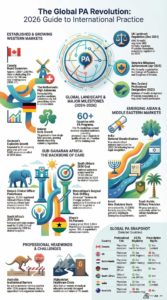
 Where PAs and Physician Associates Can Work InternationallyThe contemporary physician assistant/associate (PA) movement began in North America and Africa in the mid-1960s. What started as a bold experiment to …
- An Open Letter to all Graduates of Foreign Medical Schools and Others Interested in PA Programs in the United StatesAfter reading a number of questions about acceptance into PA programs a prevailing theme has emerged. Many international physicians stated that their …
 The Australian Physician Assistant: The PA Model Around the WorldThis is part eight of a ten-part series by documentary filmmaker Adam Halbur on the PA model around the world. Today we …
CASPA Personal Statement Help
 We offer comprehensive, start-to-finish personal statement assistance or help to perfect a draft you already have. We have services to fit every budget.
 Schedule a Live Recorded PA School Video Interview

We offer 60-minute mock PA school interviews with post-interview feedback and advice. Includes a recorded video of your interview that you can watch, download, or share with family and friends. There is no better way to prepare!
Schedule an InterviewPre-PA Consulting and Advising
 Our pre-PA coaching service consists of a 1-hour phone consultation focused on addressing your specific questions or concerns about becoming a PA and applying to PA school.


Hello, I am Ray and have recently gained admission into USA University to offer Biochemistry with a Pre-PA track, I ant to ask how possible I can get into a PA graduate program after my degree as an international student.
Hello Raymond,
First, congratulations on your admission — that’s a great accomplishment.
Yes, it is absolutely possible for international students to gain admission into a PA graduate program, but there are some important factors you need to be aware of early so you can plan strategically.
Here are the key considerations:
• Most PA programs require applicants to have permanent residency or U.S. citizenship. Only a small number of programs will consider students on certain visas. You will need to research each program carefully.
• All prerequisite coursework must be completed at a regionally accredited U.S. institution (which you will be doing — that’s excellent).
• You will still need significant direct patient care experience (hands-on clinical work such as CNA, EMT, MA, etc.).
• Strong GPA in your science courses is critical.
• You must meet English proficiency requirements if applicable (TOEFL or equivalent, depending on the program).
Being on a Pre-PA track is helpful because it keeps you aligned with prerequisites, but admission ultimately depends on your GPA, healthcare experience, letters of recommendation, and program-specific eligibility requirements regarding immigration status.
My advice:
1. Start building direct patient care experience as early as possible.
2. Maintain a strong science GPA (especially biology, chemistry, anatomy, physiology).
3. Begin researching PA programs now to see which accept international applicants.
4. Speak with your university’s Pre-PA advisor to confirm visa implications for graduate programs.
With careful planning, strong academics, and solid clinical experience, it is achievable. The earlier you understand the requirements, the better positioned you’ll be.
Wishing you the best as you begin this journey.
– Stephen
I’m a US resident – I want to go international for a PA program full time. Where do you suggest, not just a clinical rotation?
Most non-US-based PA programs do not meet the criteria upon graduation to take the PANCE and return to work in the USA. Do you plan to return to the US to work? If so, I would recommend sticking to a US-based PA program and then working overseas upon graduation. Here are countries around the world that employ PAs, many of which also have PA programs at various levels of development: https://www.thepalife.com/physician-assistants-pas-and-associates-around-the-world/
I hope that helps some!
Warmly,
Stephen Pasquini PA-C
Hi, I am a specialised dentist in maxillofacial surgery with over 22 years of clinical experience . I am currently a professor in a dental teaching institute in india . What are the steps and requirements for me to join a pa masters program ?
Hello NC,
To become a PA in the United States, individuals must attend and graduate from an ARC-PA–accredited entry-level PA program and pass the Physician Assistant National Certifying Exam (PANCE) administered by the National Commission on Certifying of Physician Assistants (NCCPA). This means your education outside of the United States is not recognized by the NCCPA and therefore you will need to attend a PA school in the United States to sit for the PANCE exam.
Here is a wonderful resource on the topic from the ARC-PA (they accredit US PA programs and determine who may sit for the PANCE exam): http://www.arc-pa.org/frequently-asked-questions/non-us-health-care-professionals/
From the standpoint of the ARC-PA, individuals educated as health care providers (MDs, PAs, nurses, etc.) outside of the United States are not treated any differently than any other prospective PA student regardless of degree. To practice as a PA in the United States, one must graduate from an ARC-PA accredited program and be certified by the NCCPA. If interested in applying to a PA program, such individuals should contact the PAEA for information on specific programs.
Before you can work in the US, you must contact the Commission on Graduates of Foreign Nursing Schools (CGFNS International) to complete a visa screening program which, in part, will determine if your education was equivalent to that from a US-PA Program. If your education is comparable, you are eligible for a certificate that you can submit to the US State Department with your visa application. The State Department’s approval of your occupational visa may help you enter the U.S., but you are still not eligible to work as a PA in the U.S.
For information on PA programs, contact the Physician Assistant Education Association (PAEA): https://paeaonline.org/ and the directory of PA programs here: http://directory.paeaonline.org/.
Eligibility criteria for taking the Physician Assistant National Certifying Exam (PANCE) are available on the NCCPA website: http://www.nccpa.net/.
Additional information on practicing as a PA in the US can be found at the American Academy of Physician Assistants (AAPA) website: https://www.aapa.org/.
To determine if an individual state allows non-US educated physicians to practice as PAs without additional education and national certification, you will have to contact the licensing bodies of the specific states. https://www.aapa.org/advocacy-central/state-advocacy/state-licensing/list-of-licensing-boards/
To find PA programs that accept international students:
I would start by searching the PAEA directory website and click the box “Accept int’l applicants.” Currently, 138 programs accept international students (this may have increased since I have written this email). From there, you need to narrow down further based on requirements. I would then use my PA program picker table. You can narrow your search even further using all your variables: https://www.thepalife.com/pa-program-picker/.
Then, follow the links to the PA program websites and reach out to them personally. They will be able to guide you better than I can since every program is a bit different. If you have any questions afterward, just shoot me a reply.
You can also browse my website at http://www.thepalife.com or visit our knowledge base, where I am growing a list of guides intended to cover a broad range of topics.
I hope that helps.
Also, we offer online one-on-one advising if you have additional questions. Our team consists of certified PAs (like me) who know the ins and outs of the PA school admissions process. If you are interested, you can read more about that here: https://www.thepalife.com/pre-pa-consulting/.
Warmly,
Stephen Pasquini PA-C
Hello Steve,
I am from Ghana, I want to pursue PA in the US, but going through the university list sounds to me that the fees are quite challenging for me. Are there scholarships available for international students .?
Hello,
I have completed BAMS (bachelor of Ayurved Medicine and Surgery)
From India. Which includes One year rotating Internship in Hospital
Am I eligible for PA program in USA.
Hello, I have completed my MBBS and have worked at a hospital in India. I have completed undergraduate coursework, but do not know if all of my courses apply to the specific prerequisites required by PA schools. Would the World Education Services transcript evaluation be able to provide me these details regarding prerequisites? Also, would a MBBS medical degree typically cover these requirements per your expert experience in this content?
Related to above query, does MBBS fulfills need of pre requisite courseworks?
The courseworks related to general biology with labs, is it equivalent to higher senior secondary school board examination with subjects of biologyx chemistry.
I’m a final year Bachelors of pharmacy (B.pharmacy) student from India.
I just want to know how could I apply for pa program.
Hi, Roshani,
You must first complete all the required coursework to apply for a US PA program, meet the minimum requirements and find PA programs that accept international applicants. Here is a cheat sheet I put together to help guide you with links to more resources: https://www.thepalife.com/cheat-sheet/
To find PA programs that accept international students, you can use my companion website. Here is the link to all current programs accepting international students: https://www.paschoolfinder.com/cat/accepted/
To broaden your search across categories use this link: https://www.paschoolfinder.com/item/
Follow the links to the PA program websites and reach out to them personally. They will be able to guide you better than me since every program is a bit different.
Stephen Pasquini PA-C
http://www.thepalife.com
http://www.smartypance.com
Hello I’m an international student.
Can I persue a PA school without a bachelors
I mean with a associate degree and after attending PA school can I get a job in the US ?
Hi, Moli!
You cannot pursue PA school in the US without a bachelor’s degree (and the required prerequisite coursework) unless you attend a US-based 3+2 program that allows you to complete your undergraduate PRE-PA coursework as part of a 5-year program.
To practice as a PA in the United States, one must graduate from an ARC-PA accredited program and be certified by the NCCPA. If interested in applying to a PA program, such individuals should contact the PAEA for information on specific programs.
Here is a wonderful resource on the topic from the ARC-PA (they accredit US PA programs and determine who may sit for the PANCE exam): http://www.arc-pa.org/frequently-asked-questions/non-us-health-care-professionals/
Before you can work in the US, you must contact the Commission on Graduates of Foreign Nursing Schools (CGFNS International) to complete a visa screening program which, in part, will determine if your education was equivalent to that from a US-PA Program. If your education is comparable, you are eligible for a certificate that you can submit with your visa application to the US State Department. The State Department’s approval of your occupational visa may help you enter the U.S., but you are still not eligible to work as a PA in the U.S.
To become a PA in the United States, individuals must also attend and graduate from an ARC-PA–accredited entry-level PA program and pass the Physician Assistant National Certifying Exam (PANCE) administered by the National Commission on Certifying of Physician Assistants (NCCPA).
For information on PA programs, contact the Physician Assistant Education Association (PAEA): https://paeaonline.org/ and the directory of PA programs here: http://directory.paeaonline.org/.
Eligibility criteria for taking the Physician Assistant National Certifying Exam (PANCE) are available on the NCCPA website: http://www.nccpa.net/.
Additional information on practicing as a PA in the US can be found at the American Academy of Physician Assistants (AAPA) website: https://www.aapa.org/.
To determine if an individual state allows non-US educated physicians to practice as PAs without additional education and national certification, you would have to contact the licensing bodies of the specific states.
To find PA programs that accept international students:
I would start by searching the PAEA directory website and click the box “Accept int’l applicants.” Currently, 138 programs accept international students. From there, you need to narrow down further based on requirements. I would then use my PA program picker table. You can narrow your search even further using all your variables: https://www.thepalife.com/pa-program-picker/.
Then, follow the links to the PA program websites and reach out to them personally. They will be able to guide you better than me since every program is a bit different. If you have any questions afterward, shoot me a reply.
Stephen Pasquini PA-C
Hi,
I’m a Psychology major from Turkey and want to get into PA program in US. What is required of me and which schools would be suitable for me?
Hi Ruby,
To practice as a PA in the United States, one must graduate from an ARC-PA accredited program and be certified by the NCCPA. If interested in applying to a PA program, such individuals should contact the PAEA for information on specific programs.
Here is a wonderful resource on the topic from the ARC-PA (they accredit US PA programs and determine who may sit for the PANCE exam): http://www.arc-pa.org/frequently-asked-questions/non-us-health-care-professionals/
Before you can work in the US, you must contact the Commission on Graduates of Foreign Nursing Schools (CGFNS International) to complete a visa screening program which, in part, will determine if your education was equivalent to that from a US-PA Program. If your education is comparable, you are eligible for a certificate that you can submit with your visa application to the US State Department. The State Department’s approval of your occupational visa may help you enter the U.S., but you are still not eligible to work as a PA in the U.S.
To become a PA in the United States, individuals must also attend and graduate from an ARC-PA–accredited entry-level PA program and pass the Physician Assistant National Certifying Exam (PANCE) administered by the National Commission on Certifying of Physician Assistants (NCCPA).
For information on PA programs, contact the Physician Assistant Education Association (PAEA): https://paeaonline.org/ and the directory of PA programs here: http://directory.paeaonline.org/.
Eligibility criteria for taking the Physician Assistant National Certifying Exam (PANCE) are available on the NCCPA website: http://www.nccpa.net/.
Additional information on practicing as a PA in the US can be found at the American Academy of Physician Assistants (AAPA) website: https://www.aapa.org/.
To determine if an individual state allows non-US educated physicians to practice as PAs without additional education and national certification, you would have to contact the licensing bodies of the specific states.
To find PA programs that accept international students:
I would start by searching the PAEA directory website and click the box “Accept int’l applicants.” Currently, 138 programs accept international students. From there, you need to narrow down further based on requirements. I would then use my PA program picker table. You can narrow your search even further using all your variables: https://www.thepalife.com/pa-program-picker/.
Then, follow the links to the PA program websites and reach out to them personally. They will be able to guide you better than me since every program is a bit different. If you have any questions afterward, shoot me a reply.
Stephen Pasquini PA-C
Hi there,
I am a foreign medical doctor and planning to apply for PA program. I just don’t know which university accept bachelor degree outside of US. I know about prerequisites but first thing if they even consider it. Thanks
Hi, Wanali,
From the standpoint of the ARC-PA, individuals educated as health care providers (MDs, PAs, nurses, etc.) outside of the United States are not treated any differently than any other prospective PA student regardless of degree. To practice as a PA in the United States, one must graduate from an ARC-PA accredited program and be certified by the NCCPA. If interested in applying to a PA program, such individuals should contact the PAEA for information on specific programs.
Here is a wonderful resource on the topic from the ARC-PA (they accredit US PA programs and determine who may sit for the PANCE exam): http://www.arc-pa.org/frequently-asked-questions/non-us-health-care-professionals/
Before you can work in the US, you must contact the Commission on Graduates of Foreign Nursing Schools (CGFNS International) to complete a visa screening program which, in part, will determine if your education was equivalent to that from a US PA Program. If your education is comparable, you are eligible for a certificate that you can submit with your visa application to the US State Department. The State Department’s approval of your occupational visa may help you enter the U.S., but you are still not eligible to work as a PA in the U.S.
To become a PA in the United States, individuals must also attend and graduate from an ARC-PA–accredited entry-level PA program and pass the Physician Assistant National Certifying Exam (PANCE) administered by the National Commission on Certifying of Physician Assistants (NCCPA).
For information on PA programs, contact the Physician Assistant Education Association (PAEA): https://paeaonline.org/ and the directory of PA programs here: http://directory.paeaonline.org/.
Eligibility criteria for taking the Physician Assistant National Certifying Exam (PANCE) are available on the NCCPA web site: http://www.nccpa.net/.
Additional information on practicing as a PA in the US can be found at the American Academy of Physician Assistants’ (AAPA) website: https://www.aapa.org/.
To determine if an individual state allows non-US educated physicians to practice as PAs without additional education and national certification, you would have to contact the licensing bodies of the specific states.
To find PA programs that accept international students:
I would start by searching the PAEA directory website and click the box “Accept int’l applicants.” Currently, 138 programs accept international students. From there, you need to narrow down further based on requirements. I would then use my PA program picker table. You can narrow your search even further using all your variables: https://www.thepalife.com/pa-program-picker/.
Then, follow the links to the PA program websites and reach out to them personally. They will be able to guide you better than me since every program is a bit different. If you have any questions afterward, shoot me a reply.
You can also browse my website at http://www.thepalife.com or visit our knowledge base, where I am growing a list of guides intended to cover a broad range of topics.
Stephen Pasquini PA-C
http://www.thepalife.com
Hi there
I am General physician with 25 years practicing in Iran.I will be in sandiego a bout 2 month later. I want to study in PA what should I do . Please inform me .
is there any option and merits for international medical gradutes to reduce or short the duration of PA study.
Thanks in advance.
Hi, Peymaneh,
From the standpoint of the ARC-PA, individuals educated as health care providers (MDs, PAs, nurses, etc.) outside of the United States are not treated any differently than any other prospective PA student regardless of degree. To practice as a PA in the United States, one must graduate from an ARC-PA accredited program and be certified by the NCCPA. If interested in applying to a PA program, such individuals should contact the PAEA for information on specific programs.
Here is a wonderful resource on the topic from the ARC-PA (they accredit US PA programs and determine who may sit for the PANCE exam): http://www.arc-pa.org/frequently-asked-questions/non-us-health-care-professionals/
Before you can work in the US, you must contact the Commission on Graduates of Foreign Nursing Schools (CGFNS International) to complete a visa screening program which, in part, will determine if your education was equivalent to that from a US-PA Program. If your education is comparable, you are eligible for a certificate that you can submit with your visa application to the US State Department. The State Department’s approval of your occupational visa may help you enter the U.S., but you are still not eligible to work as a PA in the U.S.
To become a PA in the United States, individuals must also attend and graduate from an ARC-PA–accredited entry-level PA program and pass the Physician Assistant National Certifying Exam (PANCE) administered by the National Commission on Certifying of Physician Assistants (NCCPA).
For information on PA programs, contact the Physician Assistant Education Association (PAEA): https://paeaonline.org/ and the directory of PA programs here: http://directory.paeaonline.org/.
Eligibility criteria for taking the Physician Assistant National Certifying Exam (PANCE) are available on the NCCPA website: http://www.nccpa.net/.
Additional information on practicing as a PA in the US can be found at the American Academy of Physician Assistants (AAPA) website: https://www.aapa.org/.
To determine if an individual state allows non-US educated physicians to practice as PAs without additional education and national certification, you would have to contact the licensing bodies of the specific states.
To find PA programs that accept international students you can use my companion website. Here is the link to all current programs accepting international students: https://www.paschoolfinder.com/cat/accepted/
To broaden your search across categories use this link: https://www.paschoolfinder.com/item/
Stephen Pasquini PA-C
http://www.thepalife.com
http://www.smartypance.com
Hi!
I live in the U.S., and I am a naturalized citizen, but my Bachelor’s degree is not from the U.S. I have being checking if these schools accept a BS from overseas, and so far “Arizona School of Health Sciences” does not accept it. They only accept Bachelor’s degree that are done in the U.S.
Hello,
I am planning to apply to PA surgery program as a back up in case MD programs do not work out. I was wondering if I do PA surgery and go to medical school after do I still have to do residency? Whoever replies, please advise me if it is a good options. I want to get into MD programs with scholarship but it is very hard for international students. Thank you.
Hi Teljan, I would recommend you not use PA as a backup plan. You will have to prove to any prospective PA program that you are interested in PA, not MD it’s highly competitive and this would not be a good route for you.
Stephen
Hey, this is the first thing I’ve seen about international studying and US PA programs. I’m an American student looking to get my Bachelors abroad, and I wanted to know if a degree from Europe would be accepted or frowned upon by PA schools. I have always wanted to travel, and I feel like this is my chance to, while hopefully making myself stand out a bit. Do you think getting a bachelors abroad would be okay, would I have to get it in a certain country (ex Poland or Netherlands), or would PA schools prefer I stayed in the US? Thanks so much, and I look forward to hearing back!
Hi and great question. As I am not an International student myself I may not be the most qualified to answer this question but I have spoken with academic advisors in the past and it seems as the most important question is if your credits are transferrable here to the US and will meet PA program prerequisite requirements. Many International undergraduate programs are linked with US schools and the credits are equal and transferrable without questions. So if you go this route I would do my homework and make sure to have these questions answered by several PA school administrators and undergraduate US academic advisors so you can move forward with confidence. I think international study is a wonderful option but you just want to be able to be confident that if you’re planning is to come back to the US to start PA school you have a solid foundation and plan. The first step is to reach out to some programs and schedule an appointment with an academic advisor.