
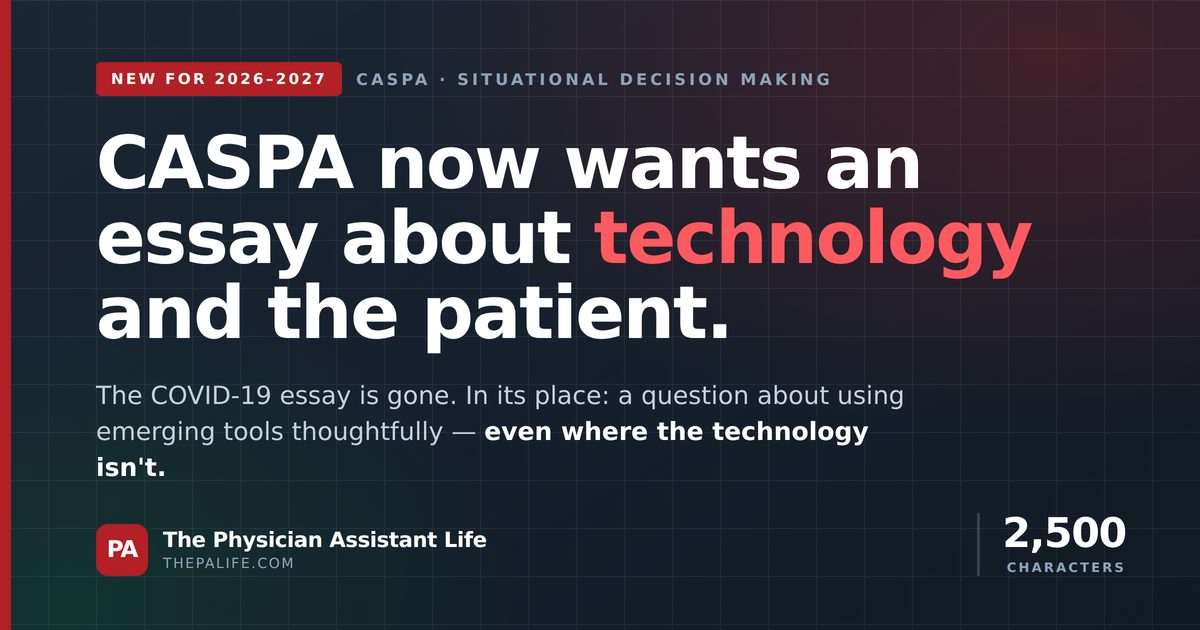
CASPA retired the COVID-19 essay and replaced it with the Situational Decision Making essay — a new 2,500-character question about technology and the human side of medicine. Here's the exact prompt, where it's hiding, the answer almost everyone is about to write — and how to write a better one.
So you opened your CASPA application, clicked into the Personal Information section, and found a question nobody warned you about.
You're not losing your mind. It's new.
For the 2026–2027 cycle, CASPA retired the COVID-19 Impact Essay — which had been quietly outliving its usefulness for a couple of years now — and replaced it with something called the Situational Decision Making question.
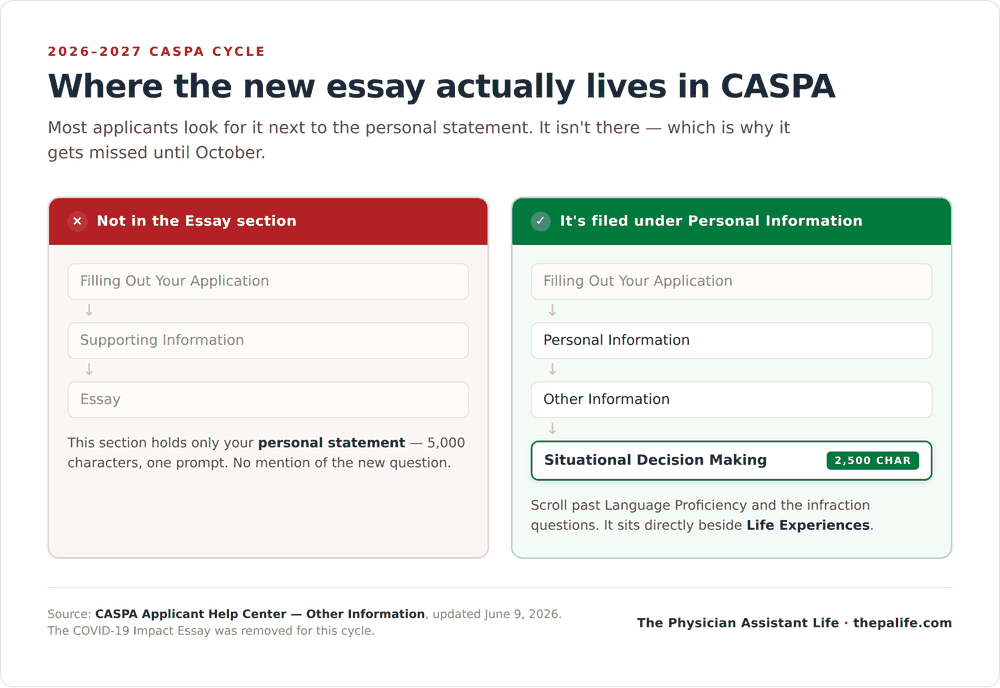
And here's the first thing that trips people up: it isn't in the Essay section.
Where the Situational Decision Making essay is hiding in CASPA
You won't find it next to your personal statement. It lives under Personal Information → Other Information, down past Language Proficiency and the infraction questions, sitting right beside the Life Experiences prompt.
Plenty of applicants are going to scroll right past it, notice it in October, and write it in eleven minutes at midnight.
Don't be that applicant. Let's get ahead of it.
The exact prompt
Here's what you'll see on screen, word for word:
Situational Decision Making
Write a statement about how you believe future PAs should use emerging technologies thoughtfully while still maintaining strong, human-centered relationships with patients, even in settings where technology may be limited.
You can enter up to 2,500 characters.
A quick note on that number: 2,500 characters, not words. That's roughly 400–425 words — about half the length of your personal statement. This is a short answer, not an essay. One idea done well beats four ideas done fast.
In the material PAEA published announcing the change, they framed the same question a little more expansively, naming the technologies they had in mind: artificial intelligence, telemedicine, and wearable health devices. Useful context for what they're picturing. But write to the prompt in the box — that's the one you're answering.
One more thing: check the programs on your list. I can't find anything from CASPA or PAEA stating whether this question is required or optional, and I'm not going to guess at something that could cost you an application. Look at your programs' own requirement pages. When in doubt, answer it. An extra 400 words has never hurt anybody.
What this question is actually asking
Read the prompt again and notice how much is hiding in that last clause: "even in settings where technology may be limited."
That's not filler. That's the whole question.
A lazy reading gives you: do you like technology? A careful reading gives you something much more interesting, and much more like being a PA:
Can you use a powerful tool without letting it do your thinking? And can you still take care of a person when the tool isn't there?
That's not a technology question at all. It's a clinical judgment question wearing a technology costume. They're using AI and telemedicine as the setting because it's current — but they're probing whether you understand that the equipment is never the point.
Which, if you've spent any real time in patient care, you already know. You've watched someone stare at a screen instead of at the person in the chair. You've also seen a tool catch something a human would have missed. Both are true. They want to know if you can hold both.
The answer 90% of applicants will give (please don't)
Let me save you from the pile.
Here's the essay thousands of people are going to submit this cycle, and I could write it right now without knowing a single thing about you:
Technology is rapidly transforming healthcare. While artificial intelligence and telemedicine offer exciting opportunities to improve efficiency and expand access, it is important to remember that technology can never replace the human connection at the heart of medicine. Future PAs must strike a balance between embracing innovation and maintaining compassionate, patient-centered care…
Perfectly reasonable. Perfectly true. Perfectly interchangeable.
Every word of that could have been written by someone who has never set foot in a clinic — and this cycle, plenty of it will be written by a machine, which is its own kind of irony on a question about using technology thoughtfully.
Here's the trap: this prompt is abstract, so it invites an abstract answer. Resist that. Abstract is where applications go to die.
Three things to avoid:
- Don't write a position paper. Nobody is grading your take on the future of AI in medicine.
- Don't be afraid of technology. "Technology is dangerous and we must be careful" reads as naive, not wise. You're going to practice with these tools your entire career.
- Don't just cheerlead either. "AI will revolutionize healthcare!" skips the actual question, which is about judgment.
How to write one that works
Start with a moment, not a thesis.
You have 2,500 characters. Spend the first few hundred putting the reader somewhere specific.
Not "technology can enhance patient care when used appropriately" — but a room. A person. A moment where the tool and the human were both in play and you noticed the difference. Two or three sentences is plenty.
You have more of these than you think:
- A time the monitor said one thing and the patient's face said another
- A patient who couldn't do a telehealth visit — no smartphone, no data, no private room, no reliable address — and what your clinic actually did about it
- Watching a provider type through an entire visit, and watching a different one put the laptop down
- A translation app that got you 80% of the way there, and what the other 20% required
- A glucometer or blood pressure cuff a patient couldn't afford, and the workaround
- A time a piece of technology caught something everyone had missed
Then say what you took from it. One clear idea, stated plainly. Not "balance" — balance is the word people use when they haven't decided anything. Something with an edge on it. Something you'd defend out loud.
Then answer the part everyone forgets — the "even in settings where technology may be limited" clause. This is where you separate yourself, because most applicants will skip right past it.
Health care in this country is not evenly distributed, and neither is the technology. Some of your future patients will arrive with a wearable full of data. Others won't have a working phone number. A PA who can only practice well with a full toolkit isn't much of a PA. If you've worked anywhere that runs lean — a free clinic, a rural site, a shelter, a mobile unit, an under-resourced ED, a community health center — that experience is worth more here than any opinion about AI. (If you want my actual view on where this is all heading for the profession, I wrote that down too.)
Close on what kind of PA it makes you want to be. One or two sentences. Land it and stop.
A structure you can steal
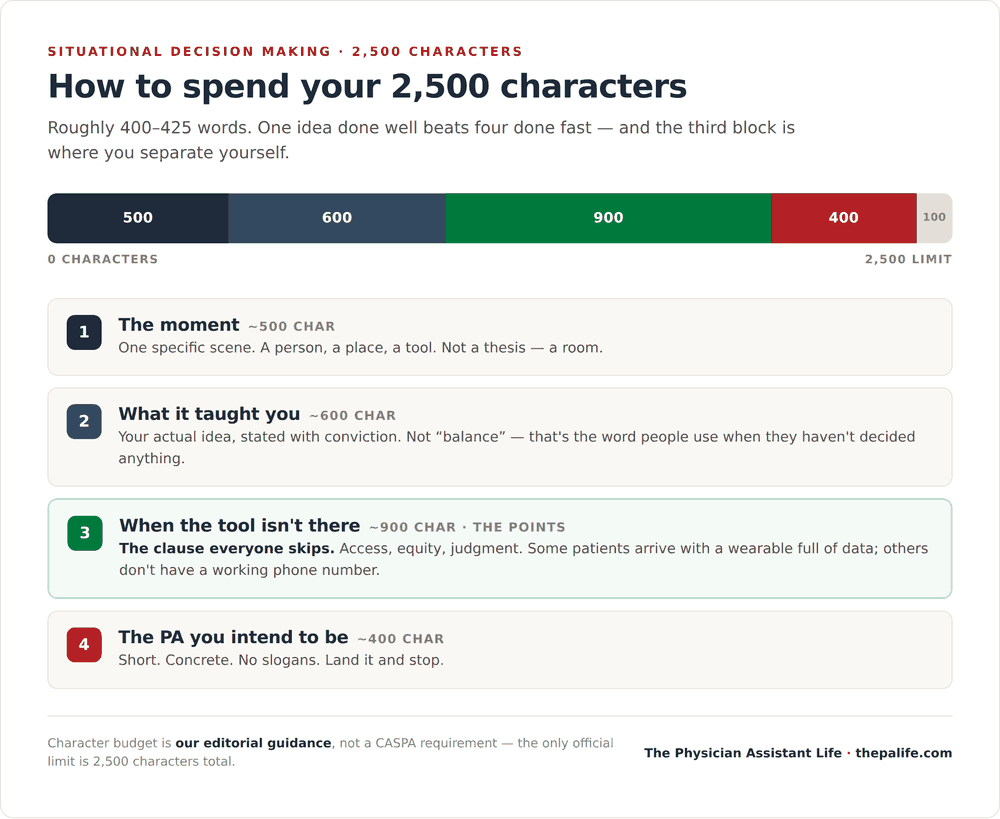
That leaves you a little slack. Use it on the third block — that's where the points are.
The part I can't write for you
Years ago I was a phlebotomist at a university clinic, and every Wednesday at six a woman named Margaret came in for routine blood work. She used to tell us stories about her childhood and about her husband, who had given his life to the war. She was fond of me because, in her words, I had freckles like her grandson.
By the last time I saw her, she had gotten too weak to speak. Her daughter came with her and said quietly, "The best vein is in her hand — it doesn't hurt her there." I put my hand on hers and it was cold. I drew the sample, put a bandage on, and looked up at her. Her hand was warm now. She raised her head and smiled at me. Without a word, she made perfect sense.
I never saw Margaret again.
That entire exchange happened with zero technology. No device on earth would have charted what passed between us — and no chatbot could invent it, because it only exists in my memory, and it only got there because I kept showing up on Wednesdays and paid attention.
I wrote about Margaret in the personal statement that got me into PA school after four rejections. It is still the most useful thing I have ever written about myself.
That's the bar for this essay. Not eloquence — specificity. You have your own Margaret. Go find her.
One more time on the irony
CASPA is asking you to explain how to use technology thoughtfully.
I probably don't need to say the next part, but I'm going to: do not have a chatbot write this one. Not because you'd get caught — because you'd be answering a question about judgment by demonstrating a lack of it, and the result will read exactly like that interchangeable paragraph above.
CASPA did loosen its AI rules for this cycle, and there's a lot of confusion about where the line now sits. If you're unsure what's allowed, I broke the whole thing down here: Can you use AI on your PA school personal statement? What CASPA's 2026–2027 rules actually say.
The short version for this question: brainstorm with it if you want, fix your spelling with it, and write every sentence yourself.
Your next step
Set a timer for ten minutes and answer one question on paper:
When have I seen a piece of technology help a patient — and when have I seen it get in the way?
Write both. Don't organize them. Don't make them good.
Whichever one you wrote faster is your opening.
That's the part no tool can do for you, because it isn't in any dataset. It's in your memory, and it only got there because you showed up and paid attention — which, as it happens, is the exact quality this question is trying to measure.
You've got this. And I can't wait to read what you come up with.
Stephen Pasquini, PA-C
Stuck on the blank page? Draft your CASPA essays one guided section at a time with our free builder — real prompts, a live character counter, and human editors when you want them.
Quick answers
Where is the Situational Decision Making essay in CASPA?
Under Personal Information → Other Information — not the Essay section. Scroll past Language Proficiency and the infraction questions; it sits beside the Life Experiences prompt.
How long is the CASPA Situational Decision Making essay?
2,500 characters, which is roughly 400–425 words. Characters, not words — about half the length of your personal statement.
Is the Situational Decision Making essay required?
CASPA and PAEA have not published a blanket answer, so check the requirement pages for the programs on your list. When in doubt, answer it — an extra 400 words has never cost anyone an acceptance.
Did the COVID-19 Impact Essay go away?
Yes. PAEA removed it for the 2026–2027 cycle and the Situational Decision Making question took its place.
Can I use AI to write it?
CASPA now allows non-substantive help like spelling and grammar, and names brainstorming as a legitimate use — but the finished writing has to be yours. On a question that is explicitly about using technology with judgment, outsourcing the writing answers it badly. Here is where the line actually falls.
Sources
- CASPA Applicant Help Center — Other Information — the live prompt and 2,500-character limit, updated June 9, 2026
- PAEA — Admission Suite of Products Updates — confirms the COVID-19 Impact Essay removal and the new question
- CASPA Application Cycle Dates — the 2026–2027 cycle opened April 30, 2026
You may also like
 Can You Use AI on Your PA School Personal Statement? CASPA’s 2026–2027 RulesCASPA lifted its blanket ban on generative AI for the 2026–2027 cycle. Here is where the line actually falls: what is allowed, …
 Will AI Replace Physician Assistants? Not on My Watch — and Now I Have the DataI wrote this in 2023 on conviction alone. Three years later the data is in: the Bureau of Labor Statistics projects PA …
 ChatGPT Answers the Top 46 PA School Applicant Interview QuestionsJust be yourself! This is the one piece of interview advice we have all heard a gazillion times. Maybe you heeded this …
CASPA Personal Statement Help
 We offer comprehensive, start-to-finish personal statement assistance or help to perfect a draft you already have. We have services to fit every budget.
 Schedule a Live Recorded PA School Video Interview
We offer 60-minute mock PA school interviews with post-interview feedback and advice. Includes a recorded video of your interview that you can watch, download, or share with family and friends. There is no better way to prepare!
Schedule an InterviewPre-PA Consulting and Advising
 Our pre-PA coaching service consists of a 1-hour phone consultation focused on addressing your specific questions or concerns about becoming a PA and applying to PA school.


Leave a Reply