
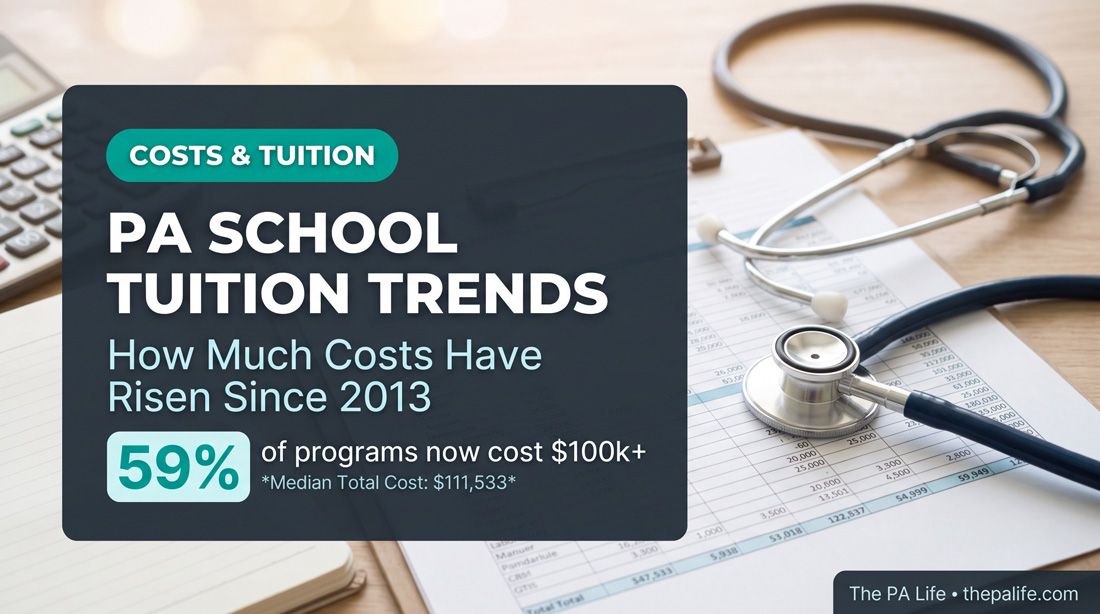
We've published PA school tuition tables since 2013. Put them side by side and the change is hard to miss: the median resident tuition has climbed from $78,000 in 2015 to more than $100,000 today, and most programs in our current dataset now charge at least $100,000.
Every few years I sit down with the old tuition tables from this site's archives, line them up against the current numbers, and feel the same knot in my stomach. When I applied to PA school back in 2001, the price tag was scary. What today's pre-PAs are looking at is something else entirely.
The chart below isn't an estimate or a projection. The first three bars come straight from the tuition tables The PA Life published in 2015, 2017, and 2018 — snapshots frozen in time. The last bar is calculated live from our PA School Finder database every time this page loads, so the gap you're seeing is always current.
Median total resident tuition, 2015 to today
From the tuition tables we published in each of those years, next to today's live number.
2015, 2017, and 2018 medians come from The PA Life's own archived tuition tables (219, 219, and 248 priced programs). Today's bar and every stat card above are recalculated live from the PA School Finder database each time this page loads.
Looking for today's full program-by-program table? Our complete PA school cost guide has live tuition for every accredited program — searchable and sortable — plus fees, application costs, and the latest on federal loans.
If you already have a few schools in mind, use PA Program Match to compare current tuition with accreditation status, prerequisites, and application deadlines. Build your short list there, then confirm the final cost on each program's official website and verify its current status on the ARC-PA accredited-program list before you apply.
And remember: the sticker price isn’t the bill. Building the PA School Finder cost data taught us something maddening: schools quote tuition because it’s the smaller number, and required fees — program, technology, clinical, lab — quietly add thousands more. At some programs the gap between tuition and the true with-fees total tops $30,000. That’s why the first stat card above leads with the median total cost with fees, pulled live. When you budget, budget from that number — and check both columns for every program in our full cost guide.
Same school, then and now
Averages can feel abstract, so here's the trend at the level of individual programs — the figure each school published in our 2015 table next to the same school's number today. These are total resident program tuition, not per year.
| PA program | 2015 | Aug 2026 | Change |
|---|---|---|---|
| Miami Dade College (in-state) | $25,000 | $41,437 | +66% |
| Yale University | $83,162 | $126,343 | +52% |
| University of Southern California | $157,916 | $221,361 | +40% |
| Duke University | $79,268 | $106,912 | +35% |
| George Washington University | $86,148 | $114,594 | +33% |
| Emory University | $99,799 | $121,780 | +22% |
| University of Washington (in-state) | $73,861 | $89,208 | +21% |
| Quinnipiac University | $95,000 | $112,330 | +18% |
Sources: The PA Life 2015 tuition table (archived) and the PA School Finder database, August 2026. Even the "modest" movers outpaced a decade of ordinary inflation — and notice that the cheapest program on this list rose the fastest.
What thirteen years of data actually shows
The floor is rising faster than the ceiling. In 2015, 38 of the 219 priced programs in our table charged residents under $50,000, about 17%. In today's campus-specific comparison set, only 31 do, about 9%, even though our database now tracks 356 program locations. The bargain seats are becoming the exception, not the rule.
Six figures went from outlier to normal. In our 2015 table, about 12% of programs crossed $100,000 in resident tuition. By 2018 it was 15%. Today it's more than half. That happened in roughly a decade — quietly, one admissions cycle at a time.
Growth hasn't slowed the climb. Our comparison set grew from 219 priced programs in 2015 to more than 350 campus-specific program listings today. More choices and more seats might be expected to hold prices down. That has not happened.
I won't pretend to be neutral about this. I believe becoming a PA should not be a luxury purchase, and every year the entry price drifts further from the students I most want to see in this profession — the EMTs, the medical assistants, the CNAs working nights. The good news: the cheapest paths still exist, and the money to fund this dream is still out there — the NHSC paid for my own training, and it shaped my whole career.
Common questions about the tuition trend
How much has PA school tuition increased?
Using The PA Life's archived tables, median total resident tuition was $78,000 in 2015 and $81,066 in 2018. The live comparison above is now over $100,000, an increase of more than one-third from 2015. The exact current figure is calculated from the PA School Finder database whenever this page loads.
Is in-state public still the affordable path?
Yes — and more than ever. Nearly all of the programs still under $50,000 are public universities charging in-state rates. If your home state has a public PA program, that remains the single biggest cost lever you control. Compare every program's current price in our full cost guide.
Does rising tuition mean a better education?
No. Tuition and quality are different columns. Some of the least expensive public programs post PANCE pass rates that embarrass schools charging three times as much — check any program's five-year pass rate in our pass-rate rankings before paying a premium.
Where does this data come from?
The historical numbers come from tuition tables The PA Life published in 2013, 2015, 2017, and 2018, preserved exactly as they ran. Today's figures are pulled live from the PA School Finder database, which is re-verified against each program's own published costs on a weekly cycle.
If you're planning your own path through these numbers, start with the complete cost guide, weigh where a PA paycheck actually stretches with the salary-by-cost-of-living analysis, and please — before you count yourself out over a price tag, read the funding guide. People fund their way through this every single year. You can too.
Thanks for reading — I'm rooting for you!
Stephen Pasquini PA-C
You may also like
 Physician Assistant Postgraduate Residency and Fellowship Programs: The Ultimate GuidePostgraduate PA School Residency and Fellowship Programs Just here for the list? Every active PA residency and fellowship in the country is …
 MD Versus PA Showdown Round 1 – Show Me The Money!The net hourly wage of an internal medicine physician is 1.13 times that of a high school teacher and 1.25 times LESS …
 Who Gets Into PA School in 2026? Here’s What You Need to KnowLeslie Mean is a 23-year-old single white female who presents to the PA school admissions committee on her second attempt to get …


CASPA Personal Statement Help
 We offer comprehensive, start-to-finish personal statement assistance or help to perfect a draft you already have. We have services to fit every budget.
 Schedule a Live Recorded PA School Video Interview

We offer 60-minute mock PA school interviews with post-interview feedback and advice. Includes a recorded video of your interview that you can watch, download, or share with family and friends. There is no better way to prepare!
Schedule an InterviewPre-PA Consulting and Advising
 Our pre-PA coaching service consists of a 1-hour phone consultation focused on addressing your specific questions or concerns about becoming a PA and applying to PA school.


Hello Sir, My Name is Barat Kumar i have been completed MB.BS, from CHINA .NOW I am looking for PA programme in USA because i want to get exposure to US clinicals and certification.Please give me information about which universities are funding international students and after PA programme is it possible to do specialization.
THANK YOU
Hi Barat,
The best place to find information regarding specific PA programs is the PAEA PA Program Directory. You can search among schools that accept international students. From there you will want to contact the programs directly and speak to their admissions office. They will be able to provide you with the information you need. I wish you the best of luck!
– Stephen
My granddaughter will be going to college this fall and has been accepted into a college that offers her as a direct admit into their PA program. The school is expensive $50,000 per year. The question is does she go to a less expensive school $20,000 per year and then after 4 years apply to a school PA program. Question is being a direct admit worth the difference in money. With the direct admit she would not have to go through the process of interviewing, etc.
Hi Patricia,
Now that is a dilemma. I was not aware three were any direct admit PA programs, may I ask where she is going? Also how long is the undergrad portion of this program? Is it 3 or 4 years?
The question really depends on your means to pay for this type of education. I came out of my 4 years of undergrad with $20,000 in debt and had my PA school paid for by the National Health Service Corps. It still took me some time to pay down the 20K in accrued debt plus interest. Having $100,000 or more of undergrad debt coupled with up to $100,000 or more of graduate school debt will have a significant impact on ones life and their choices upon graduation. So that is the first question: how will her school be paid for and how much debt will this decision incur?
The next thing to consider is what if she changes her mind? I am not sure what the latest statistics are on change of major but last time I checked the average college student will change their major 4 times, so if she decides not to attend PA school do you feel this particular college is worth the investment?
It is true that PA school is highly competitive and becoming more so each year, so it is a difficult process that will require time, effort and dedication on her part. I assume she will have to hit benchmarks to receive “direct admit” to PA program as well?
I am always skeptical of these types of set-ups and I personally, would chose the best fit college over anything else. Four years is a long way down the road and no matter how positive she feels about her future now, this may (is likely) to change. If it means a shorter undergrad and a faster transition into PA school the higher tuition may be balanced by shorter time in undergrad and a quicker transition into the workforce… so you would just have to run the numbers.
To summarize – if the only reason you are choosing this school and paying the higher tuitions is because of the “direct admit” option I would probably take my chances and go to the school that is the best overall fit.
I hope this helps some,
Best to you both, I can already tell your daughter has a very bright future no matter what she decides.
Stephen
A question for anyone who knows. My daughter is choosing between a really expensive , well know university with a great reputation, and a very good school in a rural community. One is 60 thousand plus per year and the rural one is 20 plus thousand a year. So… is a PA degree “the same” no matter where you get it. Is it worth the debt to get it at a more prestigious university???
Hi MJ,
Yes, as far as employers are concerned a PA degree is “the same no matter where you get it”. As a student, there is a difference between schools and some schools prepare students much better than others. But, if you are comparing apples to apples and one apple is only considered better because it comes from a tree with more prestigue and costs 3x as much, I would go for the less expensive apple. As you very well know student loans are a ball and chain, and your daughter will be better off getting a degree from a very good school and cutting her repayment period by more than half. That being said, if she has her heart set on a certain school for other reasons beyond the costs, this needs to be taken into consideration as well. But, feel confident knowing, no employer has ever been concerned with the school I graduated from… Only that I had a license to practice, that it was valid and I could get started right away 🙂
Best of luck,
Stephen
I looked at Stanford PA program and it says non resident is 65,000?
This is an old table Mikee, this post was written almost 2 years ago. I have since created the pascoolfinder website which reflects the most current prices: http://www.paschoolfinder.com/item/stanford-university/. And as you mentioned you can also find the most updated prices on the program website http://pcap.stanford.edu/financial.html.
I would like to update this table for 2014-2015 as well and maybe I will do that here in the coming month.
– Stephen
Hi Stephen,
Just out of curiosity, this table (as of Sept 6, 2014), says University of New England is ~88,000, but on your Pa school finder, it says it is ~38,000. Which is the correct number? Similarly, Stony Brook (for out of state) says 36,000 on this table, but ~58,000 on the PA school finder website. Do you know which number is accurate?
Hi Lauren, Thank you for asking! The table currenlty displays the most updated figures. Hopefully I will have the PAschoolfinder website updated here shortly as well with the newest figures. As always though, I would make sure to follow the links corresponding to the school’s website for the most up-to-date figures as they change constantly.
– Stephen
Where is Cuny York College on this list?
Just a correction. PA program at Cook County is PA residency and not a PA program.
I will try to update the database, thanks Swati!
Stephen
hello,
i appreciate all the info you have gathered here. great job.
from the info that i have been able to see so far, there are some schools that do not require for one to have a BS degree rather they offer it right away with some prerequisites. examples are the city college of chicago (malcolm x) which is offering the PA program as an Associate in Applied Science (AAS) with 78 credit hours. i can see that this is an associate degree level and not a masters degree;
i was wondering if there are different kind of PA entry levels because ,once graduated, they entered the salary at below 60k; and i have not seen anywhere that a PA is making that less.
by the way here is the link to that site which you do not have linked in you list: http://www.ccc.edu/colleges/malcolm-x/programs/pages/physician-assistant-associate-in-applied-science.aspx
Hi Zargoona,
Salary is not at all dependent on degree level in my opinion. Once you are a PA-C that is really all that matters. From that point forward it just depends on the job and the location. Salaries can vary greatly even in the same county. Salaries are also growing at a record pace and just in the last few years I have seen a huge change. This is interesting about the Malcolm X college program, it is great to see there are many options. You will have to let me know what path you take and give me an update in the future.
– Stephen
Just wanted to comment on UAB’s numbers. Here is their most recent detailed cost of expenses, which adds up to considerably more than what is listed here. http://www.uab.edu/shp/cds/images/pdf/UAB_SPA_Estimated_Expenses_2012.pdf
I was wondering if these costs include student housing, health insurance, meal plan, and transportation or if they are for courses, books, and materials?
Thanks!
Hi Claire,
This is the price of the program and fees only.
I didn’t see Touro Nevada on your list. I was just accepted and the costs given us for the 28 month program is: tuition $39,945 additional cost estimated (books, board, transportation) $41,995.
Hi Stephen,
AAPA staffers in the know told me the following: PAEA currently sells a PA Program Directory for $35 that includes total tuition costs for residents/non residents as well as any supplemental fees. The programs themselves update this yearly with PAEA as part of their membership.
Great info, thanks. I’m just stunned at the enormous disparity in costs. Wow. (By the way, these institutions have periods instead of commas in their costs: Rochester Institute of Technology, Marietta College, Kettering College of Medical Arts, Butler University/Clarion Health, Wagner College/Staten Island University Hospital, Southern Illinois University, and Wayne State University.)
Thanks Andy,
I swore I got all those pesky little periods out of the table, just goes to show how easily our eyes can deceive our brains 🙂
People speculate that the low bar to publishing make the internet a dangerous place to procure information, but I think this post and the comments it has generated proves the opposite point. By creating free, organic resources the internet becomes a self correcting tool, that opens the doors to collaboration and often more up to date information.
I really appreciate your feedback, thanks so much! When I transferred the table data over to my WordPress publishing platform these periods were inserted. Hopefully I will get them all this time!
Stephen
Update: Medical College of Ohio is now called The University of Toledo and the PA program is 27 months not 24. Thanks for compiling this as I have several friends that are interested in applying to PA school.
Hi David,
Just updated the comparison table with the new information…Thanks so much!
Stephen
Hi Stephen,
This is great. I posted to AAPA’s Facebook page yesterday. Two edits: Wake Forest, not Woke Forest. And a commenter on Facebook says the University of Texas Pan American PA program is 28 months, not 24.
Thanks again for compiling this!
Thanks so much Janette for sharing this post on the AAPA’s Facebook page. I was surprised to log-on and see so many “likes” and I received a ton of Feedback that has helped me make the comparison tool more accurate…You have to love the self correcting nature of the internet! It no longer reads “Woke” Forest (although this is humerus) and I updated the University of Texas program duration.
It would be great to have a searchable database on the AAPA website that allowed each accredited program to update their program requirements and costs. When I was compiling this table I was surprised to see that such a database does not already exist.
Thanks again,
Stephen
Hi Stephen,
I’m going to pass that along to the staff who are working on a new AAPA web portal for PAs and students.
Janette
Nice list. Few corrections —
– Univ of Southern California is private (hence why no different out-of-state tuition).
– Charles Drew is no longer a PA program.
– Toro is “Touro” also a Joint PA/MPH program.
This is a great resource, I’ll give to my pre-PA sutdents!
Thanks so much Joy I will update it right now… Hopefully in the next week or so I will have time to create a hyperlink which will link each school to the appropriate fee structure on each programs site. That would make it a bit more useful.
Stephen
I apologize, I didn’t see it earlier. Thanks for the information Stephen, very useful to see it all in one document.
No worries, I am editing it right now so that it doesn’t confuse people. When I land on a page like this I rarely read the fine print at the top, so I really do appreciate the comment.
These values are yearly costs and have to be multiplied by two (for a two year program) for the full amount.
Yep Chris, I did mention that at the beginning of the post but I think I will highlight that in a colored box so that it stands out a bit more. I don’t want to confuse people and several people have already emailed me…Thanks for the feedback.
Stephen
See Stephen’s comment at the top of this page.
Sure thing! Thanks for taking the time to put all of this info in one place. Great resource for PA student applicants.
These must also be yearly costs. So you would need to multiple by 2+ for most all programs.
Thank you so much Zach! I had meant to mention that in the beginning of the post. I just made the change. Really appreciate it!
Stephen
I’m a little confused here I’m just trying to get clear picture of tuition and costs and I did some more research and most of what you say are tuition fees for the entire program? For instance d’youville tuition we precise on the tuition cost for the entire program. what exactly is yearly? It’s crazy if 70k is only for one half of the program because Sophie Davis entire program is about 28 very confused arena I’m just trying to find a rend clear path on prices. What I’m looking for is to get my masters degree in a pa progrm of two years after getting my biology degree bs. At Fresno state . Also trying to find an a credited and cheapest programs and decide from that point their all going to cost I understand but with little investment in comparing coats u I’m pretty sure I can see thousands of dollars any help advice would be great!
Hi Zach,
Tuition figures listed in this table are based on annual updates by schools posted to the PAEA online Physician Assistant School Directory. Tuition is for the entire duration of the program. Some programs may include student fees and other costs into the tuition figure. It is always best to check any figures with the PA program on their website or to contact the program directly as figures tend to change constantly and can even even be reported incorrectly by the school.
– Stephen