

Leslie Mean is a 23-year-old single white female who presents to the PA school admissions committee on her second attempt to get into PA school.
She has a 3.68 overall GPA and a 3.61 science GPA. She holds a Bachelor of Science degree in biology. She never sat for the GRE, because most PA programs stopped requiring it.
She has two years of hands-on clinical experience working as a CNA and a long history of volunteer work, which exemplifies her desire to help her community.
She is kind and considerate and has reference letters that demonstrate her maturity and strong interpersonal skills.
She was accepted into PA school on her second attempt.
Who is Leslie, and why did she get into PA School?
When asking the question: What do I need to do to get into PA school? You would be smart to talk to Leslie.
Leslie is a hypothetical PA school applicant who went on to become a PA school student, an entirely average PA school student.
She also embodies what PA schools across the country are looking for at this very moment.
How do I know this?
Because PAEA publishes the numbers, and I went and got them. 35,280 people applied to PA school in the 2025–2026 cycle — the most ever. In the cycle before that, 34,625 applied and 13,195 matriculated. Those figures, and the profile of the students who got in, come straight out of PAEA's CASPA applicant and matriculation data files.
So when I tell you what the average admitted student looks like, I am not describing a stereotype. I am describing 13,195 real people who started PA school in the most recent class PAEA has counted.
As much as I like to talk about not being average and differentiating yourself from the pack, it's nice to know what average is. Average provides a baseline by which you can measure your progress, set goals, and develop an application timeline.
Does this mean you have to be just like Leslie to get into PA school?
Absolutely not, first, factors such as race, age, ethnicity, etc., are of no importance, and you certainly don't have to be female to get into PA school (I am living proof).
But it is safe to assume that most schools are looking to keep their graduation and certifying exam pass rates high. They have an incentive to take fewer risks, and because of this, anything below average is considered a risk.
Thus, take a good look at Leslie and focus on factors that you can control to differentiate yourself, like your academic standing, your experience, your volunteer activities, your references, and your essay.
If you set the bar at Leslie and end up being a Mother Theresa, I am fairly sure you will be accepted into PA school, although I have no data on religious preference and PA school acceptance rates. 🙂
What are your chances of getting into PA school?
- 35,280 people applied to PA school in the 2025–2026 cycle — up from 30,049 four cycles earlier. The applicant pool has grown every single year.
- In the last cycle with complete numbers on both sides, 34,625 applied and 13,195 started PA school — 38.1%. Careful with that figure: it is matriculants divided by applicants, not an acceptance rate, and PAEA does not publish it as one. I am doing that arithmetic for you.
- From a program's side of the desk it looks nothing like 38%. Applicants apply to an average of 8.45 programs each — roughly 292,000 applications chasing about 13,200 seats, or 22 applications for every single seat.
- Both pictures are true, and confusing them is the most common mistake I see pre-PAs make. You are not applying once. You are applying eight times. That is the whole reason your personal odds look so much better than any one program's.
- Matriculating students applied to a median of 8 programs and finished the cycle with a median of 1 acceptance. One yes is all you need.
- 29% of this year's applicants were re-applicants, up from 24% four cycles ago. Nearly three in ten people in the pool got told no before and came back anyway. If that is you this year, read that sentence twice.
So, what does an average PA school applicant who is admitted to PA school (i.e., student) look like?
Let's take a look:
In studies, the five most influential noncognitive factors known to have an effect on PA school admissions are faculty interactions, career motivation, knowledge of the PA profession, maturity, and professionalism. - Journal of Physician Assistant EducationClick To Tweet→ The average PA school student is 23 — and getting younger
- The median age of a matriculating PA student is 23, and the average is 23.71.
- 82.9% of matriculants are between 20 and 25. The single biggest misconception about PA school is that it is full of second-career thirty-somethings. It is not.
- But the range runs from 18 to 68. Read that again if you are a career-changer convinced you have aged out. Somebody started PA school at 68.
- The class is getting younger, fast. The average matriculant age has dropped from 25.67 to 23.71 in four cycles — nearly two full years. Pre-PAs are figuring this out earlier and applying sooner.
| Age at matriculation | Matriculants | Share |
|---|---|---|
| Up to 19 | 43 | 0.3% |
| 20–25 | 10,932 | 82.9% |
| 26–30 | 1,517 | 11.5% |
| 31–35 | 378 | 2.9% |
| 36–40 | 150 | 1.1% |
| 41–45 | 68 | 0.5% |
| 46 and older | 38 | 0.3% |
| Did not report | 69 | 0.5% |
Median 23 · average 23.71 · range 18 to 68. Source: PAEA CASPA matriculation data, 2024–2025 cycle (n = 13,195).
→ Four out of five PA students are women
The PA profession skews heavily female, and the gap is widening. 81.45% of matriculating students are women, up from 77.27% four cycles ago.
- Female: 81.45% (10,747 students)
- Male: 18.48% (2,439 students)
- Declined to state: 0.07%
| Cycle | Female | Male |
|---|---|---|
| 2024–2025 | 81.45% | 18.48% |
| 2023–2024 | 80.33% | 19.56% |
| 2022–2023 | 78.52% | 21.39% |
| 2021–2022 | 78.30% | 21.39% |
| 2020–2021 | 77.27% | 22.52% |
Source: PAEA CASPA matriculation data (n = 13,195 in the most recent cycle).
So yes — the majority of your future classmates will be women, and more so every year. That mirrors healthcare broadly, where women make up most of the workforce.
I want to be careful here, because this is a place where people love to speculate. The data reports who matriculates. It does not report why. I have seen it claimed that women are "more likely to be accepted" than men — there is nothing behind that, so I am not repeating it.
If you are a man reading this and wondering whether you belong in a class that is four-fifths women: you do. I am living proof, and so are 2,439 of the students who started last year.
→ Two out of three admitted students hold a Bachelor of Science
Almost everyone who starts PA school already holds a bachelor's degree, and it is usually a BS. A small but real slice arrives with a master's already finished.
| Degree held at matriculation | Matriculants | Share |
|---|---|---|
| Bachelor of Science | 8,730 | 66.2% |
| Bachelor of Arts | 1,629 | 12.3% |
| Master of Science | 323 | 2.4% |
| Other bachelor’s | 131 | 1.0% |
| Bachelor of Arts and Science | 86 | 0.7% |
| Master of Public Health | 69 | 0.5% |
| Bachelor of Science in Education | 50 | 0.4% |
| Master of Arts | 46 | 0.3% |
| Bachelor of Applied Science | 35 | 0.3% |
| Bachelor of Science in Nursing | 33 | 0.3% |
Source: PAEA CASPA matriculation data, 2024–2025 cycle. Top 10 degrees only, so this does not account for every degree held by all 13,195 matriculants.
→ What do admitted PA students major in?
Biology dominates, but not as completely as people assume. Here are the ten most common majors among students who actually got a seat.
| Undergraduate major | Matriculants | Share |
|---|---|---|
| Biology | 3,602 | 27.3% |
| Health science | 1,503 | 11.4% |
| Psychology | 936 | 7.1% |
| Biological sciences | 762 | 5.8% |
| Biomedical science | 750 | 5.7% |
| Exercise science | 722 | 5.5% |
| Kinesiology | 604 | 4.6% |
| Neuroscience | 538 | 4.1% |
| Public health | 502 | 3.8% |
| Human biology | 378 | 2.9% |
Source: PAEA CASPA matriculation data, 2024–2025 cycle (n = 13,195). Top 10 majors only, so this does not capture every major.
Group the biology-flavored majors together — biology, biological sciences, biomedical science, human biology — and they account for about 42% of the entering class. That makes sense, because a bio degree quietly knocks out most of your prerequisites along the way.
But look at the rest of that list. Psychology is the third most common major in the country. Exercise science, kinesiology, public health, neuroscience. There is no such thing as a "PA major." Programs care that you finished the prerequisites and did well in them. They do not care what your diploma says.
I have said this for twenty years and I will keep saying it: major in something you will actually work hard at. A 3.8 in a subject you love beats a 3.1 in biology you slogged through, every time.
Here are some tips on how to choose the best undergraduate major for PA school.
→ Matriculating PA students had a median of 3,200 patient contact hours
PA school applicants come to the table with a variety of medical experiences, especially if they are strong applicants.
This is the single most misunderstood number in PA admissions, so slow down here. The hours a program requires and the hours the people who actually get in have are two completely different numbers.
| The two numbers people confuse | Hours |
|---|---|
| What programs require — median minimum direct patient care | 500 hours |
| What matriculants actually had — median direct patient contact | 3,200 hours |
Requirement: PAEA Curriculum Report 6 (2021–22); 67.4% of programs required direct patient care, median minimum 500 hours, range 80–2,500. Matriculant hours: PAEA Student Report 6, Table 53.
Meeting the minimum makes you eligible. It does not make you competitive. If a program says 500 and you show up with 500, you are bringing about a sixth of what the median admitted student brought. Aim for 2,000 hours as a floor, and 3,000+ if you can get them.
Experience in one of the following areas is common:
- Nursing
- Registered Nurse (RN)
- Licensed Practical Nurse (LPN)
- Certified Nursing Assistant (CNA)
- Allied Health
- Physical Therapist
- Occupational Therapist
- Registered Radiologic Technologist
- Athletic Trainer
- Emergency Services
- Emergency Medical Technician (EMT)
- Paramedic
- Emergency Room Technician
- Miscellaneous
-
- Phlebotomist (that was me!)
- Medical Researcher
- Medical Volunteer
-
Medical Experience Statistics for PA School Applicants
96.1% of admitted students had been employed in a healthcare field before PA school. The most commonly reported roles were medical assistant (34.8%), nursing assistant (33.0%), scribe (21.4%), EMT/paramedic (17.8%) and home health aide (10.3%). Students could pick more than one, which is why the column below adds to well over 100% — most people did two or three of these jobs on the way in.
| Health Care Employment Prior to PA School | Percent |
| Medical assistant | 34.8% |
| Nursing assistant | 33.0% |
| Scribe | 21.4% |
| EMT/Paramedic | 17.8% |
| Home health aide | 10.3% |
| Emergency room technician | 8.8% |
| Phlebotomist | 7.8% |
| Clinical research coordinator/assistant | 7.0% |
| Physical therapy assistant | 5.5% |
| Pharmacy technician | 4.0% |
| Medical reception/records | 3.8% |
| Medical technician | 3.7% |
| Ophthalmic technician/assistant | 3.2% |
| Surgical technician/assistant | 2.8% |
| Athletic trainer | 2.7% |
| Healthcare administrator | 2.7% |
| Medical lab technician | 2.3% |
| Dental assistant/hygienist | 1.3% |
| Radiologic technologist | 1.1% |
| Health services researcher | 1.0% |
| Source: PAEA Student Report 6, Table 52 (n = 3,117). Students could select more than one role, so these do not sum to 100%. |
How many patient contact hours do PA students actually have?
Here is the full spread of direct patient contact hours among students who started PA school in 2022. Notice how enormous the range is — the top 10% arrived with nearly ten thousand hours, while the bottom 10% got in with 840.
| Direct patient contact hours | Hours |
|---|---|
| 10th percentile | 840 |
| 25th percentile | 1,750 |
| Median | 3,200 |
| 75th percentile | 5,600 |
| 90th percentile | 9,600 |
| Mean | 4,994 |
Student self-reported hours, derived from weeks worked × hours per week — which is why the mean (4,994) runs far above the median. A handful of second-career nurses and paramedics with 20,000+ hours drag the average up. The median is the number to plan against.
Admissions directors Q&A: What are some of the points that are extremely impressive to you in the application?
Commitment to community, overcoming adversity, a WELL written narrative, great letters of reference from someone that REALLY knows you, ability to juggle many responsibilities simultaneously, and activities that show a particular passion for something are what we look for in a PA school applicant - Penn State University PA ProgramClick To Tweet→ Do you still need to take the GRE for PA school?
For most applicants in 2026, no — and this is the biggest change in PA admissions since I first wrote this post.
The last time PAEA formally counted, reviewing program websites in 2021–22, 52.2% of PA programs required the GRE. Today it is a minority requirement. Our own running list of PA schools that don't require the GRE puts it at 92 of 338 programs (about 27%) as of July 2026, and an independent prerequisite tracker counted 86 of 318 (27.0%) in April 2026. Two people counting separately landed in the same place.
| Share of PA programs requiring the GRE | Percentage |
|---|---|
| 2021–22 — PAEA Curriculum Report 6 | 52.2% |
| July 2026 — program-by-program trackers | about 27%, or roughly 1 in 4 |
The 2021–22 figure is PAEA's own count. The 2026 figure comes from program-by-program trackers, not PAEA, which has not published an update — I am labeling it that way rather than dressing it up as official. Note too that "requires" and "accepts" are different things: another ~70 programs will look at a GRE score if you have one but do not ask for it.
So what does this mean for you? It means the GRE is now a targeting decision, not a rite of passage. Build your program list first, then find out whether anyone on it wants a score. Plenty of applicants never take it.
If you do need one: among the programs that published a GRE expectation in PAEA's last count, the average total was about 307 — roughly 153 verbal, 152 quantitative, and 4.1 on analytical writing. A composite around 300 is workable, and above 310 is genuinely strong.
A note on what I am not telling you. You will find tables all over the internet listing "mean GRE scores of matriculated PA students," often down to a decimal. PAEA's student survey does not ask matriculants for their GRE scores at all — the only GRE data in it is how much people spent on prep books. Any national matriculant GRE average you see, including the one that used to sit in this post, is not coming from where it claims to.
| Admission exam | Share of programs requiring it (2021–22) |
|---|---|
| TOEFL (international applicants only) | 97.0% |
| GRE | 52.2% then; about 27% in 2026 |
| CASPer | 17.2% |
| PA-CAT | 5.6% |
| MCAT | 4.9% |
Source: PAEA Curriculum Report 6 (February 2023; review of 273 accredited program websites, October 2021–February 2022, of which 268 had usable admissions data). This is the most recent national count PAEA has published.
Percentiles matter more than raw scores. Every GRE administration differs slightly in difficulty, which is exactly why the percentile exists. If your score sits above the 50th percentile, treat it as competitive and put your energy somewhere it will move the needle more — like your hours, your grades, and your personal statement.
→ What GPA do you need for PA school?
Students who got into PA school last cycle had a 3.68 cumulative undergraduate GPA and a 3.61 science GPA. Both have climbed every year for four straight cycles.
But here is the number almost nobody publishes, and it is the most useful one on this page. Compare the people who applied with the people who got in, in the same cycle:
| GPA, 2024–2025 cycle | Everyone who applied | Everyone who got in | The gap |
|---|---|---|---|
| Cumulative undergraduate | 3.47 | 3.68 | +0.21 |
| Science | 3.36 | 3.61 | +0.25 |
The science gap is bigger than the overall gap. That is the whole ballgame. Admissions committees are not just reading your cumulative number — they are pulling out your science coursework and reading that. A quarter of a grade point is the difference between the average applicant and the average admit.
| Cycle | Applicant GPA (cum. undergrad) | Matriculant GPA (cum. undergrad) | Matriculant science GPA |
|---|---|---|---|
| 2024–2025 | 3.47 | 3.68 | 3.61 |
| 2023–2024 | 3.47 | 3.67 | 3.60 |
| 2022–2023 | 3.45 | 3.64 | 3.57 |
| 2021–2022 | 3.43 | 3.62 | 3.55 |
Source: PAEA CASPA applicant and matriculation data files. Applicant GPAs for the 2025–2026 cycle are already in: 3.48 cumulative undergraduate, 3.37 science — the pool keeps getting stronger.
| What programs set as a minimum | Value |
|---|---|
| Median minimum overall GPA (97.4% of programs state one) | 3.0 |
| Range of stated overall minimums | 2.5 – 3.5 |
| Median minimum prerequisite GPA (94.1% state one) | 3.0 |
| Range of stated prerequisite minimums | 2.0 – 3.5 |
Source: PAEA Curriculum Report 6. A 3.0 gets your file read. A 3.68 gets you admitted. If you are sitting below the median right now, the fix is an upward trend and a strong recent science block — not despair. Programs read the trajectory, not just the number.
→ What is the racial and ethnic makeup of PA students?
Most matriculating PA students are white — but that is changing faster than almost anyone realizes.
White matriculants have fallen from 66.8% to 59.1% in four cycles. Every other group grew. This is one of the fastest demographic shifts in health professions education right now, and it is happening quietly.
| Race / ethnicity | Matriculants | 2024–2025 | 2020–2021 |
|---|---|---|---|
| White | 7,801 | 59.1% | 66.8% |
| Asian | 1,998 | 15.1% | 12.3% |
| Hispanic | 1,734 | 13.1% | 11.0% |
| Black or African American | 690 | 5.2% | 4.5% |
| Two or more races | 576 | 4.4% | 3.2% |
| American Indian | 23 | 0.2% | 0.2% |
| Native Hawaiian | 8 | 0.1% | 0.1% |
| Did not report | 365 | 2.8% | 1.9% |
Source: PAEA CASPA matriculation data, 2024–2025 cycle (n = 13,195). Unlike PAEA's student survey, these categories are mutually exclusive and sum to 100%.
The direction of travel is genuinely encouraging. PAEA also reports that applicants from groups underrepresented in medicine grew by about 35% over the same stretch, rising from 21.4% to 25.5% of all applicants. That matters — patients do better when the people caring for them reflect the communities they come from.
→ How many PA programs should you apply to?
- Matriculating students applied to a median of 8 programs (mean 8.6).
- They received a median of 1 acceptance (mean 1.8). Most people who get in, get in once.
- Across the whole applicant pool the average is 8.45 programs — so eight is genuinely the national habit, not a rule of thumb somebody made up.
My honest advice: eight to twelve well-chosen programs, where "well-chosen" means you actually meet the prerequisites and the mission fits you. Firing off twenty applications to schools whose minimum coursework you have not finished is expensive and does nothing. Build your list first, then count it.
→ Pucker up, baby. Most PA students are single!
80% of matriculating students are single (including engaged), and 20% are partnered.
91.4% have no legal dependents. For the 8.6% who do, the average is two dependents, with a maximum of five. If you are applying with kids at home, you are not alone, and you are not disqualified — roughly one in twelve of your classmates is doing exactly the same thing.
| Legal dependents | Percentage of matriculants |
|---|---|
| Without dependents | 91.4% |
| With dependents | 8.6% |
→ Where do PA students grow up?
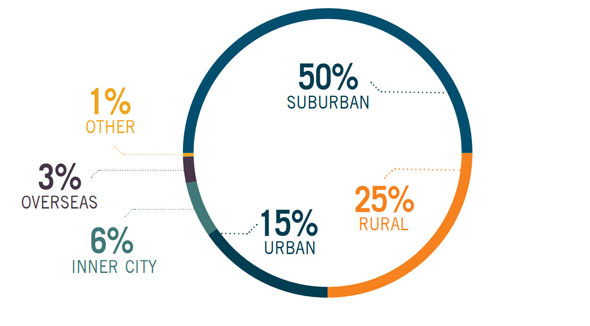
Not where you would guess. Six in ten matriculants grew up in a town or small city of fewer than 50,000 people, and only 5.6% came from a metro area of over a million. PA education has deep small-town roots, and a lot of programs are actively looking for students who intend to go back.
| Size of the community where the student spent most of their life | Percentage |
|---|---|
| Isolated rural (under 2,500) | 8.0% |
| Small town (2,500–9,999) | 22.6% |
| Large town (10,000–49,999) | 30.1% |
| Mid-size city (50,000–99,999) | 18.1% |
| Large city (100,000–1 million) | 15.6% |
| Urban (over 1 million) | 5.6% |
→ Do you need money and connections to get into PA school?
I get some version of this question constantly: everyone applying seems to come from a medical family with money, and mine doesn't. The data says otherwise, and it is not close.
CASPA asks every applicant a set of questions about disadvantaged background. Here is how the students who got in answered them.
| Among students who started PA school last year… | Matriculants | Share |
|---|---|---|
| Went to a high school where many students got free or reduced-price lunch | 4,774 | 36.2% |
| Come from a Health Professional Shortage Area or Medically Underserved Area | 2,681 | 20.3% |
| Come from a family that receives public assistance | 2,021 | 15.3% |
| Went to a high school where few seniors earned a diploma | 448 | 3.4% |
| Took part in a Health Careers Opportunity Program | 148 | 1.1% |
Source: PAEA CASPA matriculation data, 2024–2025 cycle (n = 13,195). Students could answer yes to more than one.
More than one in three admitted PA students came from a high school where hunger was common enough to be measured. One in five came from a place without enough clinicians. Those students got in. Read that again if you have been quietly wondering whether people like you get into PA school.
And here is the part I care about most: those are exactly the PAs the country needs. Students who come from underserved places are far more likely to go back and practice in them. If that is your story, it is not a weakness in your application. It is the strongest thing you bring.
Admissions directors Q&A: Who is the perfect PA school applicant?
Our program will look to utilize a holistic approach to admissions. We look at academic success, life experiences, and community activities to evaluate all candidates. There is no one mold to fit the PA profession. However, PAs need strong communication skills, leadership, grit, and a willingness to support the community - Michigan State University PA ProgramClick To Tweet Students need to be well organized, know how to manage their time and outside influences, and have a genuine desire to help and care for people. PA school is rigorous, so we recommend honest conversations with family and friends ahead of your start. - CWRU PA ProgramClick To Tweet→ PA school students don't smoke pot and are not drug dealers or part of the Italian Mafia
Assume yes to both. Every PA program I am aware of requires a criminal background check, and the large majority require drug screening before you can start clinical rotations — hospitals demand it of the program, so the program demands it of you.
I am giving you that as my read of the landscape rather than a statistic, because the percentages that used to sit here were attributed to a PAEA student report that does not measure this at all. Check the program's own admissions page — that is the only source that binds them.
If you have something in your history, disclose it early and honestly. I have watched applicants with old convictions get into PA school. I have also watched applicants get pulled from a class over something small they tried to hide. The offense is almost never the thing that ends it. The nondisclosure is.
Some Important Points
It's Not Rocket Science: It is important that a candidate demonstrates reasonable aptitude in the hard sciences such as anatomy, physiology, chemistry, and biology. It is more likely that the committee may overlook a grade of C in U.S History or Spanish I. They will be less tolerant of a marginal grade in the sciences.
Show compassion: Your GPA is stellar, and you've amassed an impressive amount of medical work experience in the little spare time you have while keeping your grades pristine, but you still get that dreaded rejection letter. Why?
You didn't do enough volunteer work. Volunteering exemplifies your desire to help your fellow man—the attribute identified by schools as one of the most integral to becoming a successful PA.
Students who have had experience in working with underserved populations, rural or diverse populations, performing volunteer service or disaster relief, or other experiences that illustrate a drive and compassion for others often stand out to the admissions committee!
The view from the top isn't that crowded
It's an easy race to the bottom, so set your sights on the top.
People deflate when they read that only about a third of applicants get in each year. I think that is exactly backwards. Being in the top third of any field is not nearly as hard as it sounds — because most of the competition is not doing the work you just did by reading this far.
You have just read the whole thing. You know what the median actually is on hours, on GPA, on how many programs to apply to — and you know which "statistics" floating around the internet are made up. That already puts you ahead of most of the people you are competing with.
If you aim high, you will be competing with a much smaller minority, and your odds of getting an acceptance letter will increase dramatically. It also helps if you apply to 12 programs. 😉
What is new for the 2026–2027 CASPA cycle
- The cycle opened April 30, 2026 and closes April 1, 2027.
- The COVID-19 impact essay is gone. In its place is a new situational question asking how future PAs should use emerging technology — AI, telemedicine, wearables — while keeping care patient-centered.
- There is now an AI attestation. You confirm the application is your own work. Write your own essay. I mean it.
- Fees are $185 for the first program and $65 for each additional one. Fee waivers are available at or below 200% of the federal poverty guidelines, cover your first two programs, are first-come first-served, and the submission window is now 21 days.
- There are 330 ARC-PA accredited PA programs as of May 2026, and eight more were granted provisional accreditation at the April 2026 meeting. The number of places to apply keeps growing.
Sources — so you can check my work:
- Applicant counts, applicant GPAs and re-applicant share: PAEA CASPA Applicant Trend Numbers, cycles 2021–2026 (posted May 2026). This is where the 35,280 applicants for 2025–2026 comes from.
- Matriculant counts, GPA, science GPA, age, gender, race, majors, degrees and disadvantaged-background data: PAEA CASPA Matriculation Data, 2020–2025 (posted March 2026), covering the 2024–2025 entering class (n = 13,195).
- Programs per applicant and URiM growth: PAEA, "PA Program Applications Show Growth, Persistence."
- Admission exams, minimum GPAs and minimum patient-care hours: PAEA Curriculum Report 6, a review of 273 accredited program websites.
- Patient contact hours, prior healthcare roles, programs applied to, marital status, dependents and where students grew up: PAEA By the Numbers: Student Report 6, PAEA's most recent national student survey. CASPA's data files do not measure these, so this is the only national source for them.
- Accredited program counts: ARC-PA, Currently Accredited Programs.
- Cycle dates, fees and application changes: PAEA 2026–2027 CASPA Applicant Guide.
Where a number is my own arithmetic on PAEA's figures rather than something PAEA publishes directly — the 38.1% matriculation rate, the 22-applications-per-seat figure — I say so in the text. Where a number simply does not exist, I say that too instead of filling the gap. Numbers on this page were last verified in July 2026.
You may also like -
 My PA School Rejection Letters – How to Turn Your “Set Back” into a “Set Up”If I fail more often than you, I win!
I have written before about the importance of becoming an epic failure and how this is a fundamental part of becoming an epic success.
I was cleaning out some of my old file cabinets today and came […]
My PA School Rejection Letters – How to Turn Your “Set Back” into a “Set Up”If I fail more often than you, I win!
I have written before about the importance of becoming an epic failure and how this is a fundamental part of becoming an epic success.
I was cleaning out some of my old file cabinets today and came […]- Overcoming Obstacles on Your Path to Becoming a Physician Assistant
Life is full of obstacles. They can be as simple as getting out of bed in the morning or as arduous as writing the perfect PA school application essay.
Most of the time, the biggest obstacle is ourselves (affiliate link). The […]
- Physician Assistant Application Letter of Recommendation Samples: Applying to PA School
PA School Letters of Reference
Here are two letters of recommendation I received when applying to PA school.
I am not posting them here to fluff my feathers but merely to serve as an example of what I included as part […]

CASPA Personal Statement Help
 We offer comprehensive, start-to-finish personal statement assistance or help to perfect a draft you already have. We have services to fit every budget.
 Schedule a Live Recorded PA School Video Interview

We offer 60-minute mock PA school interviews with post-interview feedback and advice. Includes a recorded video of your interview that you can watch, download, or share with family and friends. There is no better way to prepare!
Schedule an InterviewPre-PA Consulting and Advising
 Our pre-PA coaching service consists of a 1-hour phone consultation focused on addressing your specific questions or concerns about becoming a PA and applying to PA school.


Hi,
My name is Masa.
I currently hold a BA in Liberal Arts, but would really like to attend a PA program. I virtually need to take every PA program requirement since none besides Writing are in my BA. Since I’m tight on funds I’ll be doing it at community college. Also I’ll be getting EMT certification and working in the state for 1 year. This is all future tense.
I wanted to know if taking community college courses will make me uncompetitive at good PA programs (ones with high certification rates). I went to Soka University, and it’s currently ranked in the top 50 nation Liberal Arts colleges but being that my prerequisites are going to be from community college I worry about being uncompetitive.
Soka is a peace and human rights college so I know it will benefit me to the extent of making me a unique applicant.
My second question is do you have any advice for someone with a BA, on a budget, and virtually starting with no prerequisites and patient hours yet. Your advice would be greatly appreciated.
I am a 52 year old navy veteran with 20 years of medical experience as a surgical and Orthopaedic tech. I’ve taught at the NSHC seminars for casting and splinting. I have a degree in international affairs and anthropology. I have a wife and family. I need to take pre requisites but have little money as I am the bread winner in my home. I feel stuck. I have taken Micro. I need chemistry and stats as well as A/P. Any insight on how to get this done? I desperately want this. I’m in no way your average student
Hi Gari,
I would go to my local community college and/or university and make an appointment to speak with an academic advisor. Make a list of all the prerequisite courses you need and see what is available – as a busy dad (and the main source of income in your case) I would take a good look at online courses – distance learning is a wonderful option and geography won’t be a limiting factor. But start locally, and explain your situation and goals in detail – then expand out from there. In 2016 so many options exist that I am confident you will be able to tailor a plan to suit your needs – it’s certainly a wonderful time in your life to make this happen!!!
Stephen
Hello Stephen,
I am a senior graduating with my B.A. in Chemistry. I had a rough fall semester which reflects on my gpa but I would like to get it up to a 3.5 this semester. I am planning on taking at least a couple years off to gain medical experience. I was planning to get my EMT training and work in that for atleast a year. I was also planning to maybe work as a scribe for a while. Do you think it would be beneficial to work as a scribe before getting certified as an emt to get familiarized with medical terminology? I also plan on volunteering at a shelter during this time but perhaps volunteering at a hospital would also be beneficial?
Hi Elizabeth,
I am currently working with a medical scribe at my new clinical practice and I think this experience is one of the best you can have as a pre-PA. In fact (as a certified EMT myself) I think the hands on experience and learning opportunities are superior as a scribe if you work in a supportive practice setting – especially if you are able to work with a doctor who likes to teach. This can also be a wonderful place to get a strong medical reference.
And yes, any and all volunteer experience is helpful!
– Stephen
Hi,
so unfortunately I was previously on a nursing track and I struggled balancing a major of psychology and nursing so my GPA is hurting, sitting at an 2.6, there were a few classes that I knew for sure that I would be taking over but I am really concerned with what I should do now. I’ll be graduating in December with the plan to return back home to finish taking the prerequisites at an community college then retaking any classes that I have to but what should I do from this point.? I am also the president of 2 organizations but I am involved in more than 5 orgs, I’m a CNA and I have a boat load of shadowing hours.
Hi Ariel,
As you probably know the nursing and PA school prerequisites are different. And although many of the nursing level sciences will satisfy the PA school minimum prerequisite requirements I would try to take the upper division science classes that are usually part of the pre-med track. Maybe you are doing this already. This will show that you are willing to challenge yourself and that you are able to handle the rigors of PA school. Also, make sure you are not overextending yourself, which could sacrifice your studies. I would continue accumulating paid and volunteer hands on patient care experience and focus on building your medical resume. It is extremely important that you use the next 2 years wisely to bring your GPA up and get the necessary experience to be a competitive candidate. Sounds like you have plenty of shadowing experience so that is a big plus! Keep up the good work, get yourself into as many challenging and uncomfortable situations that make you stretch and grow as a person, consider doing some overseas medical work as well for a couple weeks or more – sometimes you can find comparable programs here in the US as well. This can we a wonderful experience that will make you grow as a person and a future healthcare provider.
– Stephen
Hi Stephen,
I was searching for PA schools and looking up things to consider when I came across this post. I wanted to thank you for writing this–it’s well written, thoughtful, and has just the right amount of humor. You’ve given me some things to consider as I move forward with my education, so I wanted to thank you for that.
Have a great day!
Kelsy
Hi! I have a question about clinical experience. I have tons of hours shadowing and general volunteering (not in a specific department) especially in an underserved area, but I don’t have any paid patient interactions during my undergraduate schooling. I also have several hours of general volunteering at a hospital from high school. Will these items count towards the hours of experience they are looking for? Thanks!
Hi Matt,
More often than not shadowing and volunteer work will not count towards the direct patient contact experience schools are looking for. For this you really need to get your hands “dirty” and work with and suffer with your patients. This will not only make you a more viable candidate it will go far to make you a much better PA. Medical decision making is a big part of what we do on a day to day basis and shadowing places you in the role of an observer. As volunteers you may be given certain responsibilities, but this is still quite different from a paid position within the medical field. I would suggest making the time to gain some much needed paid, hands-on experience. It will help make you a better PA, a better PA school candidate and provide you with experiences necessary to gain strong references and material for your essay and interview.
– Stephen
Hello!
First of all, I have to say that I absolutely LOVE your website! I have always had an interest in health care yet I couldn’t decide whether or not I should go into nursing or medicine. After reading many articles and reading a few of the books you recommended I have finally decided that I would love having a career as a physician assistant. I am 19 and about to complete my 2nd year of college (the first semester I dabbled around in nursing courses but I decided that it would not be a good fit for me at the end of the semester) and I do not think that I will graduate with a biology degree focusing on medicine until 2018. By then, I will be 21 years old. Currently I am looking at becoming a scribe and I have recently became a volunteer at a hospital. My GPA was not too good last year (2.8) but I finally got out of my ‘rough’ and my last semester GPA was a 3.5!
As for my question: will I be too young to go into PA school? So far I think that my only problem is that I do not have enough hours in hospital volunteering/health care experience. I believe that if I do them only over the next 2 summers (while taking classes) then I will have around 2,000 hours of scribe and volunteer experience! I am not sure if I will be reaching the ‘average’ physician assistant student/applicant by then.
Thanks! 🙂
Hi Catherine,
You won’t be judged by your age as much as by the strength of your experience, your maturity, and how well you present this to the admissions committee. When you graduate from PA school (a very short 2 years) you will be expected to perform at a very high level the minute you pass your certifying exam and get your first job. The experience you garner prior to PA school is as important as your time in PA school in many ways. So you want to make sure you maximize this time and are ready to hit the ground running. PA schools want to graduate candidates who are able to succeed in school and afterwards. It may be possible to perform at a high level in school while working and volunteering and still get the hand on patient care experience you need. If you can sell yourself well enough you may stand a good chance. Often though, steady paid work (a scribe is a wonderful option) for even just a year after graduation will increase your odds. Of course you can apply to school while you are working. Having strong paid experience will also give you the material you need for your personal statement, help you to get strong references and carry you through an interview. But this is certainly on a case by case basis so you will have to evaluate your situation and determine when you feel you have the experience you need.
Sounds like you are already off to a great start!
Stephen
Hi there,
Most PA schools, at least here in CA, do not count hours from a scribe job as “clinical experience” although they do value them as a great experience. I was a medical scribe in an ER for a year and just started working as a CNA to get those clinical hours, but I don’t for a minute regret working as a scribe. It can be more stressful than working as a CNA depending on where you work but worth the effort 🙂 Love your site by the way!
Iliana
Hello!
My name is Rebecca, and I am currently finishing up my fourth year in college. I will be graduating next year with a bachelor’s in Health Science because I am a transfer student, but it seems like I won’t be getting into any PA school due to the accelerated programs that are offered to a lot of them.
Where I’m from, a lot of places let freshman college students go into an accelerated bachelor’s program that allows them to get their bachelor’s and master’s degree as a PA in 5 years. They are also guaranteed a seat if they keep their GPA up to a 3.0. I currently have a 3.545 GPA and I’m taking 6-7 classes a semester, and I have almost 150 clinical hours as a volunteer at a residency home. However, my advisor tells me I might not get in because my GPA should be around a 3.8 and I should be an EMT or CNA to be highly considered. I only have one year left, and there are no places offering these classes around where I am. Is there anything I can do?
Hi Rebecca,
Cast a wider net. There are plenty of PA programs all over the country looking for highly qualified candidates as yourself. Have you considered applying out of state? I traveled 3,000 miles across country to attend PA school at Rutgers. Not only was it a wonderful school, but the experience of attending in a new state so far away from home was invaluable. If I were you I would look far and wide, this should open up many possibilities.
– Stephen
Thank you for the response!
I apologize for the delay in answering, finals are coming up and I need to focus. I am not really allowed by my parents to go to far away from home. I can try for schools in PA, NJ, and maybe NY, but that’s about it. The places I was considering was PhilaU (if I can get in), Arcadia, Pennstate, PCOM, Drexel (I know I won’t get in, but I gotta apply to as many as possible), Jefferson, and a few others.
Hi!
First off I’d like to thank you for writing this post, I think its great that there are people like you giving pre-PA hopefuls like us a nice snapshot of what it takes to become a PA!
I am currently wrapping up my final semester as an undergraduate student. I majored in Political Science and finished all of my electives by junior year when I realized it wasn’t the right field for me. I got an internship at a hospital, loved the environment and the role of the PA and decided to double major in Biology. However, I’m haven’t had the chance to get any paid, hands on patient care experience which seems to be the key to success. I plan on getting my CNA certification this summer but wanted to know if you think that applying to PA school this coming fall would be too soon. My GPA is good and I’ve been committed to volunteer work since high school but I’m afraid that the lack of clinical experience will make me a weak candidate. Do you think that taking a year to work as a CNA would be the best option or should I shoot for the stars and apply right away?
Hi Chelsea,
The only thing you have to lose by applying early is your application fee, so if you are feeling like you would like to roll the dice this year and see what happens there is little “risk” otherwise. Some schools have minimal HCE requirements so the other factor at play is where you will be applying. If you are applying to MedEx in WA then I would say no, wait, if you are applying to several of the schools with lower requirements you may have a much better chance. I think the experience will help you as a PA and as an applicant, especially when it comes to writing a meaningful essay and during your interview. You will have to weigh the pros and cons in regards to the schools to where you will be applying and see what makes the most sense in your current situation.
– Stephen
Hi there!
My name is Kelly and I am looking to become a PA. I came across your blog when looking for advice on steps to becoming a PA. I am currently a senior in college but the only thing getting in the way of me becoming a PA is the fact that I am majoring in criminal justice. I came across the Physician Assistant career path about four months ago, and by that time it was too late to change my major. I know that I am passionate about helping people and I liked the idea of studying human behavior but now I know that I am passionate about making/keeping people healthy and curing them when they are sick. I would love to become a PA, but I am concerned about applying for school with my criminal justice major, especially because the schools are extremely competitive as is. I plan on taking all the Pre-Reqs before applying, and I also plan on shadowing a PA for as long as possible. I was just wondering if you could give me any advice on what a good next step would be for me. I am concerned about my background and applying to PA school, but I know it is what I want to do, and ill work as hard as I need to to get there.
Hi Kelly,
I think your criminal justice background is a strength. PA schools love to accept a wide array of students with diverse backgrounds and interests. So please do not let your major discourage you. As long as you complete the necessary prerequisites and starting getting your “hands dirty” you will be on your way.
– Stephen
Hello Stephen,
I am a second year Pre PT major at my university and has become very interested in the PA program. My main goal is to become a PA at a children’s hospital. While my hopes are high, I am a bit concerned. I was told by my academic advisor that I would not be accepted into an PA school let alone grad school and I should change my major towards the subject I am better at (math). As a sophomore, I have a 2.8 GPA currently. I had a rocky first year and will be retaking Anatomy for the 3rd time to earn a better grade. I feel like a have time to improve as sciences is very new to me. I am also worried that the statistics are against me. I am only 20 and will graduate by the time I am 22, I earned a dental assistant certification and feel that won’t be enough experience, and also I am a double minority. Are there any tips you can give me so I can get on the right track?
Thanks for any feedback!
My advisor told me the same exact thing my sophomore year, goes to show guidance counselors are not fortune tellers after all.
It was at that pivotal moment in my life where I regrouped and I changed majors – for me I changed to Zoology so that I could get more science and physiology exposure. I went from a 2.8 student like yourself to dean’s list for the next 2 years and earned my ticket to PA school. So my first piece of advice is don’t sell yourself short just because somebody else does. The second piece of advice is to start getting into the patient care trenches. Make it your journey to engage in the suffering of others.
Dental assistant is good but you need to get real hands on patient care experience – for you – specifically, pediatrics. Sounds like it is your passion so make it your passion. Start volunteering at your local children’s hospital, start working with kids in any capacity possible, prove to everyone around you that you are in this for the long run. The more you put yourself out there, the more connections you will make the opportunities will come your way and you may find that your performance in school improves as you passions and your purpose align. You may need to rethink your major, it could be math if you like, as long as you complete your prerequisite coursework. I suggest you hang in there and don’t give up, like you said, time is on your side, now you just have to use it wisely.
Warmly,
Stephen
How do PA schools look at your GPA in graduate school? Is it based on the same scale in general? I am currently working on my Master Degree in Public Health, my GPA in the previous semester was average, not as good as I would wanted it to be. I understand that most PA students came with their undergraduate degrees, therefore, the GPA scale is based on that. I was wondering if it is the same criteria for graduate GPA as well. Thank you
This is a good question Cuong, I would suggest you contact several of the schools to which you are applying and ask them directly. It will probably vary from school to school and I don’t want to give you false information. If you get some good answers I would love it if you stopped by and let us know what you find out!
– Stephen
Hi!
So I have just graduated from Georgia Southern University with an overall GPA of a 3.32 and science GPA of a 3.4. I am currently getting certified for CNA and plan to work at least 2000 hrs as a CNA before applying to PA school. Doespecially that sound like I have a good shot at being accepted into PA School?u
Hi William,
These are what I consider to be the basic requirements of PA school. Where you will differentiate yourself (and where schools will make their decision) is in the areas that allow you to separate yourself from the 100’s of others with 3.4 GPAs and 2000 hours of CNA work. You will need volunteer and shadowing hours, a deep understanding of the PA profession, excellent recommendation letters and a personal statement that is above and beyond average. You have completed the basics, and this is a big accomplishment so pat yourself on the back, now get to work on making yourself truly stand out by focusing on those parts of your application that allow you to express your drive, creativity, positive attitude and ability to make a real difference in the lives of others. I have confidence you will do wonderfully!!
– Stephen
Hi Stephen,
My name is Jeniffer I am currently doing my B.S in public health in two more years I will graduate. My first semesters I used to be a Biology major but since I have to work I wasn’t having good grades, so I change to Public health. I already took A&P 1 and 2 I got B’s , Microbiology I got C, my college accepted some science courses from my country since I used to studied out of USA, they accepted my General bio 1, Chemistry 1, and organic chemistry 1 but without my labs. Right now I am applying to do volunteer hours at the hospitals and also I used to work in a pediatric office 3 years ago. I need some recommendations since I am doing Public health, if with this bachelor I could get accept to the PA program and if the rest of my pre-requisites is better to take it online or at the college. Thanks I appreciated your help.
Hi Jennifer,
Since I am a little fuzzy on all of your details I would definitely suggest you make an appointment with an academic advisor and sit down for a couple sessions to lay out your plan and personalize your goals for the next 1-2 years. If you can compile a list of all the necessary prerequisite coursework and requirements summarized in a table of your top 12 schools you will be able to present this to your advisor and you can come up with a plan of action. It is not that important that your coursework is done online or on campus, what is important is that you have gone above and beyond the minimum requirements and show an upward trajectory with regards to your grades and overall performance. You will also need to get shadowing experience and more recent healthcare experience to be competitive, this will also lead to strong letters of recommendation. I am confident you will be able to develop a plan that works for you and makes you a competitive pa school applicant. I wish you the best of luck, drop me a line if you have any more questions along the way!
– Stephen
Hi Stephen,
I am having trouble finding a PA to shadow. I was also hoping to have a PA write a letter of recommendation. It appears that I will have neither of the two when I complete my CASPA. Many schools don’t require either, but I know it is definitely a plus. How do you think this will impact my chances off getting interviews?
Hi Jessica,
Part of this requirement is that they know finding a PA to shadow is difficult so it is a bit of a test of your determination and willingness to go the “extra mile”. Put yourself on the admissions committee and pretend you are looking at two applications with equal qualifications and one has strong shadowing experience and the other has none – would this affect your decision? It may be less of a concern during the interview as you can differentiate yourself with your winning personality, but getting to the interview is the key, so you will really want to try to make this happen. Kelly, in her videos makes some great recommendations on how to approach this very real problem: http://www.paflix.com/videoscategory/shadowing/
– Stephen
Hi Jessica,
Part of this requirement is that they know finding a PA to shadow is difficult so it is a bit of a test of your determination and willingness to go the “extra mile”. Put yourself on the admissions committee and pretend you are looking at two applications with equal qualifications and one has strong shadowing experience and the other has none – would this affect your decision? It may be less of a concern during the interview as you can differentiate yourself with your winning personality, but getting to the interview is the key, so you will really want to try to make this happen. Kelly, in her videos makes some great recommendations on how to approach this very real problem: http://www.paflix.com/videoscategory/shadowing/
As far as recommendations are concerned I don’t think it is all that important that one is from a PA as long as the ones you do have are strong and highlight your grit, determination, and all your amazing personality traits 🙂
– Stephen
I see you listed “medical researcher” as an acceptable miscellaneous job for hands on clinical experience. Yet, I’ve seen several PA schools list “research positions” as a job that does not count as paid clinical experience. Could you please clarify this (ie clinical research assistant is accepted, but not wet lab research)?
Hi Chris you are right, this is a very grey area. Some researchers (studying cholera in a medically underserved area in Haiti for example) may have a lot of hands on patient care experience while other research positions would certainly not qualify – so user discretion is advised!
– Stephen
Hi Stephen,
I was looking for advice on how to eventually become a physician assistant. I do not have a medical background at all since my whole career has been teaching in the special education field. I have been feeling that I want to go into the medical field for quite some time now. I have a personal interest with pediatric neurosurgery and that is the avenue that I might want to go. What do you suggest that I should do besides taking the prerequisite classes? I was thinking that I should shadow physician assistants or possibly go back to school first and get an associates degree as a surgical tech. Any advice that you have is welcome.
Thanks,
Christine
Hi Christine, shadowing is a must as is obtaining enough paid hands on patient care experience, volunteerism and community service can round out your resume. Make it a point to challenge yourself and go beyond your comfort zone, find ways to “suffer with your patients” in a way that builds upon your humanity, provides a better understanding of the challenges our patients face and makes you a more capable and empathetic healthcare practitioner. This is what the admissions committee is really looking for in an applicant. Your background is a wonderful start!!
– Stephen
Hi Stephen,
Next year, I will be 29 when I graduate with my BS in biochemistry. I have 7 years of dental assisting experience in general/family, pedo, and surgical/outpatient dentistry. A few of those years were spent serving a rural community. My gpa is 3.2 while my science gpa is 3.5. There’s a few C s I got taking liberal art classes as an aimless teenager. I’ve gotten A s in physics, orgo, bio and calculus. I’ve been making dean’s list the past few semesters and should continue to increase my gpa as I have a solid year and a half of school remaining before I graduate.
I’m preparing to take the GRE with little study time and fear my score will not be competitive (average). I’m trying to start PA school the same year I graduate; however, my school finishes in mid June so I may have to wait another application cycle to apply if I don’t get accepted right away, in which case I can retake the GRE and study accordingly.
What suggestions can you offer regarding how I could potentially stand out as an applicant?
Cheers,
Jessica
Hello– I am in my second year at an elementary school as a Speech Language Pathologist (bachelors level). Do you think I should pursue becoming a cna on the side? Or is my experience enough to apply now? Would love your insight, thanks in advance.
Hi Stephen,
I’m a graduating senior for undergrad with a biology degree and a psychology minor. I don’t have a great GPA around a 3.1 and science around a 3.0, but I have clinical experiences with about 800 hours from interning at a family practice and being an EMT. I do community service and involved on campus. What do you suggest I do to become a stronger candidate. I would like to attend PA school as soon as possible.
Thanks ahead!
Hi Victoria,
I think you are certainly on the right track. You have a solid GPA and the kind of health care experience and volunteer hours that the admissions committee likes to see. If you can bring this all together with solid references and a well-crafted personal statement you stand as good a chance as any. Keep gaining experience, 1,000 hours I what I consider to be an acceptable minimum, and can take you far but chalking up those hours will help. Finding acceptable shadowing experience and understanding the PA profession inside and out, including your place in it. In the words of Dori from Finding Nemo “just keep swimming”! I think you are doing great and are certainly on the right track!!!
– Stephen