
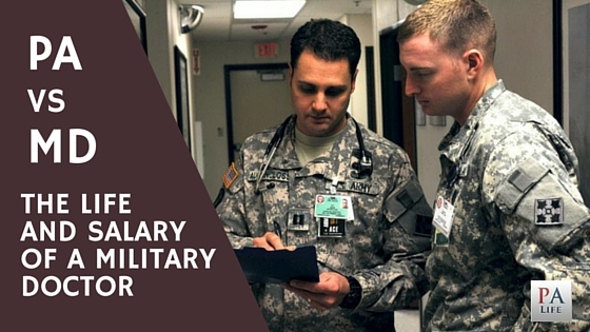
As part of the ongoing MD vs. PA discussion, I like to feature comments on the blog from both PAs and MDs.
It's a chance to learn more about what life is really like working in the trenches.
Today's post comes from Doctor B. an active duty military internist.
Dr. B. explains how he went to medical school for free. What his lifestyle is like as an active duty staff physician and gets honest about his salary.
How much is a military internist actually paid if you break it down by the hour?
What are the work hours like as a medical doctor in the military?
Heads up: Dr. B. wrote this several years ago. I kept his words and his numbers exactly as he sent them, then added a reality check below using current pay tables so you're not planning a career off old pay scales.
Let's find out:
Salary of a Military Doctor
I am a military Internist who went to undergrad at the Univ of Louisville with multiple scholarships (the norm among many of my colleagues) and made $12,000 on top of my costs, went to medical school (USUHS) for free as an active duty 2nd Lt ($45,000/yr), and made about $60,000/yr as a resident.
As a staff physician, you start at $135,000/yr but jump to $150,000 after three years (promotion to Major) and, for me, to $190,000 two years later (bonuses).
Average is closer to the $200-210,000/yr during career. Average net (as staff) is around $140,000 for argument sake.
Total in 28 years (20-year service not including retirement here) is $2.78 million.
We work 46 weeks per year (30 days of leave + federal holidays) at the expense of deployments (during deployment, I worked 12-16 hrs per day, six days per week, eight months).
For a nondeployable IM physician (doesn’t exist mind you), the average hourly wage assuming 55 hrs/week [I actually do 60ish with resident and medical student teaching], 46 weeks per year, 28 years working) comes to only $39.36/hour.
This comes at the cost of (a) deployments, (b) military politics that interfere with proper medical care (a “Captain” physician has difficulty with his “Lt Colonel” nurse for example), (c) added stress from frequent moves, and (d) innumerable other things. Personally, I love it.
This goes up to ~$60/hr if I factor in that I might collect retirement for 20 years afterward.
Life of a Military Doctor
I am probably GROSSLY underestimating my hours, however.
For instance, I do 10-12 weeks of inpatient but only get a TOTAL of one comp day PER WEEK of inpatient (could factor in 0.625 days of leave I accrue during that inpatient week, but this doesn’t make up when compared to a typical hospitalist schedule).
My actual duty includes 10-12 weeks inpatient, acting medical director (19 physicians), resident clinic director (30-40 residents), medical student preceptor (two months per year during administrative time), staff physician (only 350 patients), disaster response team lead, group practice management advisor, and I am the de facto physician alternate for several working groups.
I average about around 800 RVU (relative value units) per month.
So, hey, if you're feeling patriotic and want opportunities early in your career, I’d say go military MD.
I wouldn’t, however, just do it because the “actual” hourly compensation is better.
- Dr. B
What would Dr. B.'s paycheck look like today?
Good question, because the numbers above are dated. Here's what the official pay tables say now.
Base pay. An O-4 (Major) earns $75,535 to $126,119 a year in base pay, depending on years of service. At 8 years of service, that's $105,797. That table includes the most recent 3.8% raise.
Special pay on top. DoD's FY2027 table (effective October 1, 2026) lets Medical Corps officers collect extra pay. These are the maximums, not guarantees. Each service sets its own amounts:
- Board certification pay: up to $8,000 a year
- Incentive pay, general internal medicine: up to $43,000 a year
- Retention bonus, internal medicine: up to $20,000 (2-year) or $60,000 (6-year), paid annually
Tax-free extras. Housing (BAH) and food (BAS) come on top and are untaxed. For an O-4 with dependents, BAH averages about $3,096 a month nationally, and BAS is $328.48 a month.
Here's an illustrative ceiling for an O-4 internist with 8 years of service. It is not a typical paycheck:
| Piece | Annual |
|---|---|
| Base pay (O-4, 8 years) | $105,797 |
| Board certification pay (max) | $8,000 |
| Incentive pay, internal medicine (max) | $43,000 |
| Cash pay subtotal | $156,797 |
| BAH (national average, with dependents) + BAS | about $41,094 |
| Total with tax-free allowances | about $197,891 |
Using Dr. B.'s own assumption of 55 hours a week for 46 weeks (2,530 hours), that works out to roughly $62 an hour in cash pay, or $78 an hour counting the tax-free allowances. Before you get too excited: that's the ceiling, it ignores his 60-hour weeks, and it ignores deployments.
Context: The Bureau of Labor Statistics puts median pay for civilian physicians and surgeons at $275,930 a year ($132.66/hour) as of May 2025. Dr. B. isn't in it for the money, and he'd be the first to tell you so.
What does a military PA make?
Most military PAs serve as junior-to-mid-grade officers. Take an O-3 (Captain) at 4 years of service: $88,592 in base pay. DoD allows PAs up to $5,000 a year in incentive pay, plus retention bonuses from $10,000 (2-year) up to $35,000 (6-year), paid annually. Add tax-free housing and food allowances, and you get zero tuition debt on top.
For comparison, the Bureau of Labor Statistics lists 2025 median civilian PA pay at $135,880 a year ($65.33/hour) and projects PA jobs to grow 21% from 2025 to 2035. See how that plays out in our PA salary report.
How do you become a military PA?
The Army, Navy, and Air Force train PAs together through the Interservice Physician Assistant Program (IPAP) at Joint Base San Antonio–Fort Sam Houston. It runs 29 months: 16 months of classroom work, then 13 months of clinical rotations. You earn a Master of Physician Assistant Studies through the University of Nebraska Medical Center.
Important note: In September 2025, ARC-PA placed IPAP on Accreditation-Probation status, with its next review in October 2027. Read UNMC's statement before you commit, and ask a recruiter how it affects graduates.
"Your PA school is fully funded" is still the deal. It comes with a service obligation, so get the current commitment in writing from a recruiter. (Another way to go to PA school for free: the NHSC.)
How is the military PA lifestyle?
If you've read this far, you've seen that Dr. B. works A LOT. Stateside, the military PA schedule often looks more like a civilian PA's, but I'd rather hear it from you than guess.
Here is a video by Captain James Stoufflet, a U.S. Air Force Physician Assistant:
What I keep hearing from military PAs: great job satisfaction, a built-in path to sub-specialty training, a lot of support baked into the system, and the chance to deploy (exciting or scary, depending on who you ask).
Here's one voice that stuck with me. Nathan McQuarrie, a former Navy corpsman now training as a PA at MEDEX Northwest, describes the active duty PA who inspired him: he was "able to practice autonomously in the field and hold a lot of responsibility." (Source: MEDEX Northwest, University of Washington)
Have you served as a military PA? Tell me about it in the comments, and I'll feature your story in a future post.
Military PA vs. military MD: the honest comparison
| Military MD (internist) | Military PA | |
|---|---|---|
| Training path | 4 years medical school (USUHS or HPSP) + residency | IPAP: 29 months |
| Base pay | O-4 at 8 years: $105,797 | O-3 at 4 years: $88,592 |
| Special pay (DoD max) | Up to $8k board cert + $43k incentive | Up to $5k incentive |
| Retention bonus (DoD max) | $20k to $60k a year | $10k to $35k a year |
| Hours | Dr. B.: about 60/week + deployments | Closer to civilian when stateside |
| Tuition debt | None | None |
Special pay figures are DoD maximums. Individual services set the real amounts.
The bottom line
If the hourly math is your reason for going military, don't. Dr. B. said it himself. If you want early responsibility, no tuition debt, deployments, and being part of something bigger than a paycheck, that's a different conversation.
Which one speaks to you: more training and more pay, or a faster start in medicine? Tell me in the comments. I'd love to hear from military PAs and physicians.
Cheers,
Stephen Pasquini PA-C
Further reading
- Air Force: Physician Assistant
- Army: Physician Assistant Officer
- Navy: Physician Assistant Careers
- Interservice Physician Assistant Program (IPAP) at UNMC
Keep reading
- PA vs. MD: Understanding the Differences (2026 Infographic)
- MD Versus PA Showdown Round 1: Show Me The Money!
- Torn Between PA or MD? Here's How You Decide
- How Much Does It Cost to Go to PA School?
Sources: BLS Occupational Outlook Handbook (PAs; physicians and surgeons), 2025 data. DFAS basic pay tables, effective 1/1/2026 (check dfas.mil for the current year's table). DFAS Medical Corps special pay, FY2027 (eff. 10/1/2026), and health profession officer special pay (eff. 10/1/2025). UNMC IPAP page. Military pay figures are DoD maximums; services set actual amounts.
You may also like
 MD Versus PA Showdown Round 1 – Show Me The Money!The net hourly wage of an internal medicine physician is 1.13 times that of a high school teacher and 1.25 times LESS …
 Torn Between PA or MD? Here’s How You Decide!Are you struggling to decide between PA or MD, NP or PA, pre-nursing or biochem, a new job vs. your comfy job, …
 PA vs. MD: Understanding the Differences [2026 Infographic]PA vs MD in one graphic: what it takes to get in, time to practice, cost, salary, and burnout — every number …


The idea that a military physician works A LOT and the military PA just has a very similar lifestyle to a civilian PA is hilarious, as a former Army now civilian PA (Seamus details it well above). A whole other part of duties not really mentioned is being medical director for medics (usually 20-35 at a time), responsible for all combat casualty training for all soldiers in your unit, and being in charge of medical planning and logistics for medical operations in remote locations all around the world. (Do you live preventive medicine? I hope you do!)
But for all those interested in the military’s PA program, IPAP, in addition to checking out the main program website, join the facebook group for current, former & prospective students and faculty: “Interservice Physician Assistant Program (IPAP)”
Does anyone know if I already have a bachelors in business if my college credits can be used towards the bachelors portion of the IPAP program?
I’d love to dive straight to the graduate portion. I’m very interested in making a career transition, but want to calculate timing for schooling. Thanks in advance.
Hi Alan, have you reached out to the admission committee at the IPAP program. I would assume the answer is yes, many of your credits would be transferrable but you will still have had to complete the necessary requisite courses.
Stephen
Rob G –
If you’re reading this, please email me – I have questions about working as a USAF PA-C
Thanks,
Brad Walters
[email protected]
Hello,
My name is Seamus and I am an Active Duty PA-C in the US Army. I joined the Army straight out of high school in 2003 as a combat medic. After several years working up the ranks and being stationed in Italy and having 3 trips to Afghanistan and 1 deployment to Iraq doing everything from being a rifle platoon medic to the triage sergeant for an Airborne Forward Surgical Team (FST) I applied for IPAP. While none of my prior experience was a requirement, the Army does like PAs who have “been around the block” so to speak and are not just civilians in uniform.
IPAP was the single hardest 3 years of my life (counting my 3 years deployed btw.) It was a total blur. I ate, slept and breathed medicine during that time. Many of my classmates failed out of the program and we graduated about 40 of the original 70 in my class.
My life consists of seeing soldiers as patients about 3 days a week and working for my infantry battalion for the other 2. I have weekends “off”. Truth is, I am bringing work home most every night, mostly my laptop to finish notes, send emails, doing administrative paperwork, and other kinda boring and tedious tasks. But all that hum-drum it totally worth it when I get back into the field.
My unit recently finished a rotation to the National Training Center at Fort Irwin, CA. It is a desolate high desert that is beyond hot during the day and horribly cold at night (a lot like Iraq actually). There we practiced fighting a mock enemy for 2 straight weeks, 24/7, received mock mass casualty events, received mock incoming enemy artillery fire, repelled direct enemy attack and even where hit with mock chemical weapons that required us to get into our protection suits (JSLIST and M50 series masks) in a simulated chemical environment. We then had to decon ourselves, the patients and then treat and evacuate the “wounded” to the next echelon of care. All the while dealing with actual sick people or soldiers cutting their hands on a piece of steel armor, dropping engine parts on their toes, falling down a mountain or getting injured in a vehicle roll over. Lots of fake injuries with a few “real-world” injuries as well that need to be evacuated to the nearest hospital.
Field training can be beyond exhausting, not sleeping for up to 2-3 days straight (not exaggerating one bit on this) or mind numbingly boring, with only the occasional poison ivy patient coming to “sick call” (boring means no one is getting hurt, so you learn to appreciate how good boring can be.) But it can also be genuinely fun. You live with your medics and teach them everything you can to help give them an edge in saving lives and helping sick soldiers get better.
All in all Military PA life is good in my book, but the Army life is VERY unique and the culture here is certainly not for everyone. I was a Sergeant First Class and on my way to being a career soldier when I applied to IPAP. So I am biased.
Long and short of it, if you and dirt doing get along, perhaps being a PA in the Army isn’t for you. But if deployments, sleepless nights, adventure, responsibility, and plain hard work is right up your ally then this may be a career path you might like.
IPAP is a double edge sword. Yes you get a BS and MPAS out of it but it’s also likely the most challenging PA program in the nation. Because the reqs are minimal to apply, you have to complete approx 33 semester hours every 16 weeks. The first year is spent in class from 0700-1700 daily with 3 exams per week. I’ve heard they have lengthened the course but I’m unsure how that impacted the day to day. On the surface it’s great because you don’t have any financial debt. However, once you graduate you realize that you have just sold your soul to the devil.
Being a PA in the Air Force is the worst decision I’ve ever made. I spend about 11 hours per day dealing with patient care and most of us work 1 day each weekend in order to complete all administrative requirements. And good luck finding time to perform any actual military tasks.
To make matters worse, nurses are in charge of everything and their decisions often put you at risk of harming your patients. There is minimal room for career advancement as you’re simply there to see patients and make the AF “money”.
I don’t know any PAs in the Air Force who actually enjoys their job and there are quite a few who are suicidal.
In short, don’t be lured by the smoke and mirrors of no debt and travel opportunities. If you bite, you’ll look up one day 10 years from now, and 100 sexual assault briefings later, wondering who your kids are and what happened to your life.
Should’ve went Navy lol
Hi Stephan, So what if, I want to get into military PA school in Ft.Houston in Texas? Without going in as active duty enlisted person, Can I just get admission there and then become PA and serve in the Navy after I graduate?
Hi Amit,
This is a great question. I would suggest you contact the interservice program directly: http://www.cs.amedd.army.mil/ipap/
Great informative article and comments. I am currently taking undergrad classes after 5 years as an enlistee in the marine corps. I would love to get into medicine, I wish I knew of the IPAP before I got out! Would it be worth it to get back in at an attempt to MAYBE be accepted for it? I would like to be a physician, physiatrist to be specfic, but I’m 28 so I want to hurry, I probably wouldn’t start med school until i’m 30. With that being said I definitely wouldn’t mind taking the PA route.
If anyone can give any information for a physician or pa mentor that would be very helpful and motivating. if there is such a thing? Thanks!
-Justin
Hi Justin,
You may want to try to reach out with a local PA in your area – come bearing coffee and ask for a moment of their time. I know if somebody said they were interested in the PA profession and came bearing Starbucks they would have a mentor for life 🙂
It is a great profession with 48,000 current job openings, great pay/benefits and a high satisfaction rating – I can’t recommend it enough.
Stephen
I am currently applying for the Air Force HPSP. This year there are only 7 spots available so it seems like it’s going to be pretty competitive. Do you happen to know anyone that is currently a PA in the Air Force or other branch of the military? I’m really looking forward to hearing more about their experiences.
Thank you 🙂
Hi Courtney,
My wife was paid to attend nursing school through the Air Force and then when she graduated they let her out of her contract because they didn’t have nursing positions available. Talk about a great deal 🙂 That being said, I have spoke with PAs who work in the military and love their time and their service. I wish I could put you in touch with someone directly but I don’t currenlty have any contacts. You may consider reaching out through the PA forum or on Reddit – there is a very active community there.
Stephen
I recently spoke with the Navy and Air Force about them paying for PA school in exchange for time served. Unfortunately, at least for 2016, they only have the HSCP program for PA students. This pays you a monthly salary while in school of around 4500 but does not cover tuition. If you are in a position where you can use that to pay for school thats great! If not then you will still have student loans.
Hi Ernest,
Thanks for sharing this, that is really interesting. What are the after school requirements associated with this in regards to service? If you were able to budget wisely (eating beans and rooming with a couple other PA students) this could work out quite nicely. If you are married or have children this also provides a good source of income to cover expenses and if your partner is able to work you could certainly bring down your loan amounts or take out the loan for safety and make payments on it while you are in school before it begins accruing interest. This is an interesting approach to financial aid!
– Stephen
There is always the Interservice Physician Assistant Program (IPAP) option. With that option, you have to be in the military and get accepted, but if you are successful in this, they pay you as an E-5 (about 2,496.60 per month once you have the required years of service, but a little less if you get in early with a waiver). The kicker is on top of that, they pay for housing (about 1,200 per month), Tricare Health insurance for you and your family is covered, and tuition is also fully covered. The program gets you a Masters in PA Studies and you then take the PANCE and get your PA-C. After all this you owe the Branch of service you signed up with about 4.5 years of fully paid service for active duty folks (more time for National Guard or Reserve, but you get to work as a civilian PA instead of a Military one in that case). If this is interesting to you google IPAP and the first link will be the right one. Cheers!
Thanks for the great info Rob, I have always been interested in the Interservice PA Program option but have been confused by the process… Thanks so much taking the time to clear this up and providing resources on how to find more information!
– Stephen