
You’ve earned the white coat, survived the didactic year, and the PANCE is behind you (or breathing down your neck). Now every job application wants a résumé that proves you can practice — when your entire PA career so far fits inside a clinical year of rotations. Here is exactly how to write it, with the full sample and the template to match.
Let’s be honest — the new grad PA résumé feels like a trick question.
You just spent years accumulating exactly the experience employers want, but none of it came with a job title that says “Physician Assistant.” So you stare at the blank page wondering what could possibly fill it.
Here’s the reframe: your rotations are your experience. A hiring team reviewing a new grad isn’t looking for a decade of employment — they’re looking for evidence you can walk into clinic and safely see patients. Your résumé’s one job is to make that evidence impossible to miss.
The first version of this résumé was the one I used myself as a new graduate, and it helped me land an interview for every PA job I’ve ever applied to. The format below is the modern version of that same approach — the approved PA Life format we now use across the templates, samples, and Application Studio.
Start with the sample
Before any advice, look at the finished product. This is a complete new grad PA résumé in the PA Life format — read it top to bottom and notice how fast you can answer the questions a hiring team actually asks: Where did she train? Is she licensed yet? What has she actually done with patients?
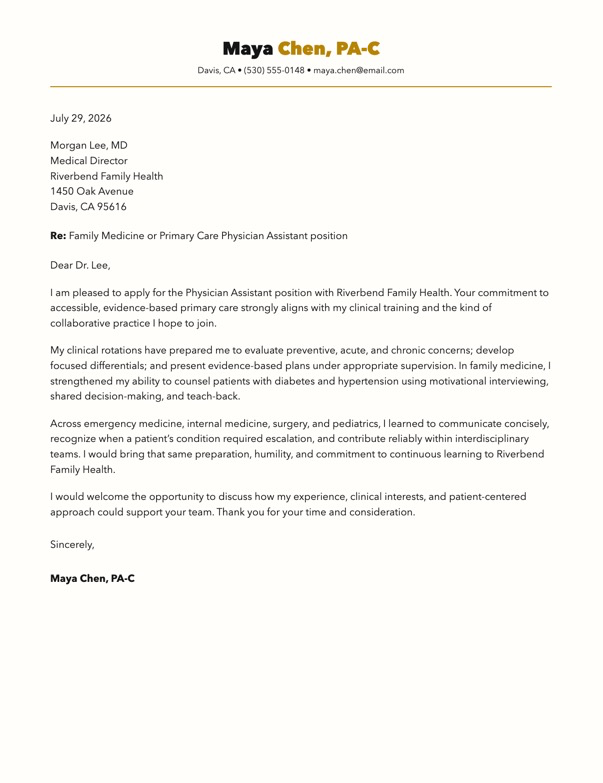
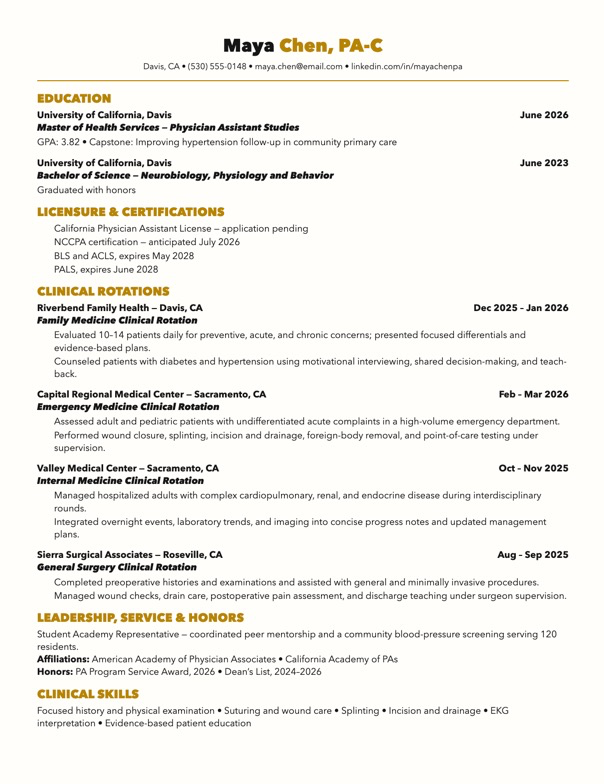
The complete new grad set — the résumé with its matching cover letter. Click the résumé to view full size. Build yours free in the Application Studio or download the Word template.
The section order that works (and why)
Every section earns its position by answering a hiring team’s next question. Here’s the order the sample uses:
- Header and credentials. Name, PA-C (once you have it), city, phone, professional email, LinkedIn. No street address needed.
- Education. Your PA program first with graduation date, then undergrad. GPA and a capstone are optional — include them when they help you.
- Licensure and certifications. State license status (“application pending” is perfectly normal for a new grad), NCCPA certification with its date — even an anticipated one — plus BLS, ACLS and anything else current. Vague credential status is the fastest way to get set aside, because a recruiter can’t move you forward without it.
- Clinical rotations. The heart of the document, and the section that deserves half your writing time. Site, specialty, dates, and two to three bullets each.
- Leadership, service and honors. Student academy roles, community screenings, awards, AAPA and state chapter memberships.
- Clinical skills. A tight single block — suturing, I&D, splinting, EKG interpretation — the procedures you’re ready to use on day one.
How do you write rotation bullets hiring teams actually read?
Weak bullets describe the rotation. Strong bullets describe you working — patient volume, what you did, and the clinical thinking behind it.
Compare:
❌ “Completed family medicine rotation. Saw patients in clinic.”
✅ “Evaluated 10–14 patients daily for preventive, acute, and chronic concerns; presented focused differentials and evidence-based plans.”
Same rotation. One is a receipt; the other is evidence. The formula: strong verb + patient population or volume + what you actually did + the clinical reasoning.
One honest warning — don’t inflate. Describe patient scope, procedures and contributions accurately, without overstating independent responsibility. Hiring teams have precepted students; they know exactly what a rotation looks like, and credibility is the whole game.
Should your new grad PA résumé be one page?
One strong page is ideal when your content fits naturally. Two pages are appropriate when substantial rotations, prior healthcare work, leadership or research would otherwise get cramped. Readability wins over an arbitrary page limit — a crowded single page reads worse than a clean page and a half.
Résumé or CV — which one do you need?
For clinical jobs — urgent care, family practice, hospital medicine, surgery — send a résumé. Save the full CV for academic positions, fellowships and research roles, where publications, posters and teaching belong. Same skeleton; the CV simply keeps growing. (The template pack covers both.)
Five mistakes I see on new grad résumés
- An objective statement instead of evidence. “Seeking a challenging position where I can grow…” tells a hiring team nothing. Your rotations tell them everything. Lead with substance.
- Duties instead of outcomes. If a bullet could describe every PA student in America, rewrite it until it could only describe you.
- Hiding your credential status. License pending? Boards scheduled? Say so, with dates. Recruiters plan around timelines — they just need to know yours.
- A design that fights the reader. Decorative columns, graphics and photos are what most often trip up applicant tracking systems. Conventional headings and clean hierarchy get parsed — and read.
- Sending it naked. A résumé without a tailored cover letter is a handshake without eye contact. The cover letter connects your credentials to their practice.
And before you sign anything, know what you’re worth — I learned that lesson the expensive way with my own first contract. Start with the PA salary report.
Two ways to get this exact format
You don’t need to rebuild this design from scratch in Microsoft Word (please don’t — that’s an evening of margin-wrestling you’ll never get back).
Build it free in the Application Studio. The new-grad path walks you through every section above with PA-specific guidance and a live print preview. Creating and printing are free.
Build my new-grad résumé free →
Prefer to work in Word? The Résumé Pack ($9.99) includes the editable new-grad template plus the completed sample above to model from.
And if you want experienced human eyes on your draft before it goes out, our résumé editing service has been polishing PA documents for years.
Your next step
Here’s tonight’s homework, and it takes one hour: open the sample above side by side with a blank page and write your clinical rotations section first. It’s the hardest section, it’s the one hiring teams read, and once it exists the rest of the résumé is mostly bookkeeping.
Your rotations already made you ready for this job. Now make sure the page proves it.
Thanks for reading — I’m rooting for you!
Stephen Pasquini, PA-C
You may also like -
 The #1 Mistake PRE-PAs Make on Their Personal Statement
What's the #1 mistake that potential PAs and pre-physician assistant students make while drafting their PA school personal statement?
A failure to outline and plan!
Outlining your personal statement is like following a proven […]
The #1 Mistake PRE-PAs Make on Their Personal Statement
What's the #1 mistake that potential PAs and pre-physician assistant students make while drafting their PA school personal statement?
A failure to outline and plan!
Outlining your personal statement is like following a proven […]- PA School and PA Job Email Etiquette: Thank-You & Follow-Up TipsNot sure what to write to a PA program or employer? Here’s how to choose a subject line, say thank you, follow up, and avoid the mistakes that make people hit Delete.
- Don’t Make This Mistake with Your PA Resumé
Why your physician assistant resumé needs a summary section and how to write one
Resumé writing is hard, but a good SUMMARY section can do a lot of your work for you.
This often overlooked, yet simple-to-add section of your […]

CASPA Personal Statement Help
 We offer comprehensive, start-to-finish personal statement assistance or help to perfect a draft you already have. We have services to fit every budget.
 Schedule a Live Recorded PA School Video Interview
We offer 60-minute mock PA school interviews with post-interview feedback and advice. Includes a recorded video of your interview that you can watch, download, or share with family and friends. There is no better way to prepare!
Schedule an InterviewPre-PA Consulting and Advising
 Our pre-PA coaching service consists of a 1-hour phone consultation focused on addressing your specific questions or concerns about becoming a PA and applying to PA school.


Do you have any sample forms they I can have my supervisor fill out for confirming and explaining my hands on patient contact hours for required documentation for PA school applications? Thank you.
No I don’t Becky but this would be a good idea. Maybe I can put something together in the future.
Stephen
I used your resume as a template along with a sample I received from a classmate and instructor from school. I really like your layout, the fact that it is pre-formatted helped a lot.
Thank you for the wonderful site and all your heard work to support now and future PA’s.
Jonathan
Thank you for the kind words Jonathan! It is great to hear that it helped.
Stephen
What a wonderful site! This is very helpful for a new grad like myself. Thank you!
Anytime Lauren, let me know if there are any other resources you may find helpful.
Stephen