
Patient Care and Healthcare Experience for PA School
'GPA and performance in the prerequisites are undeniably very important but a meaningful HCE is a near second!' - Duke Physician Assistant ProgramClick To TweetToday we are going to tackle step 2 of my 5 steps to PA school series by taking a very detailed look at healthcare experience requirements for PA school.
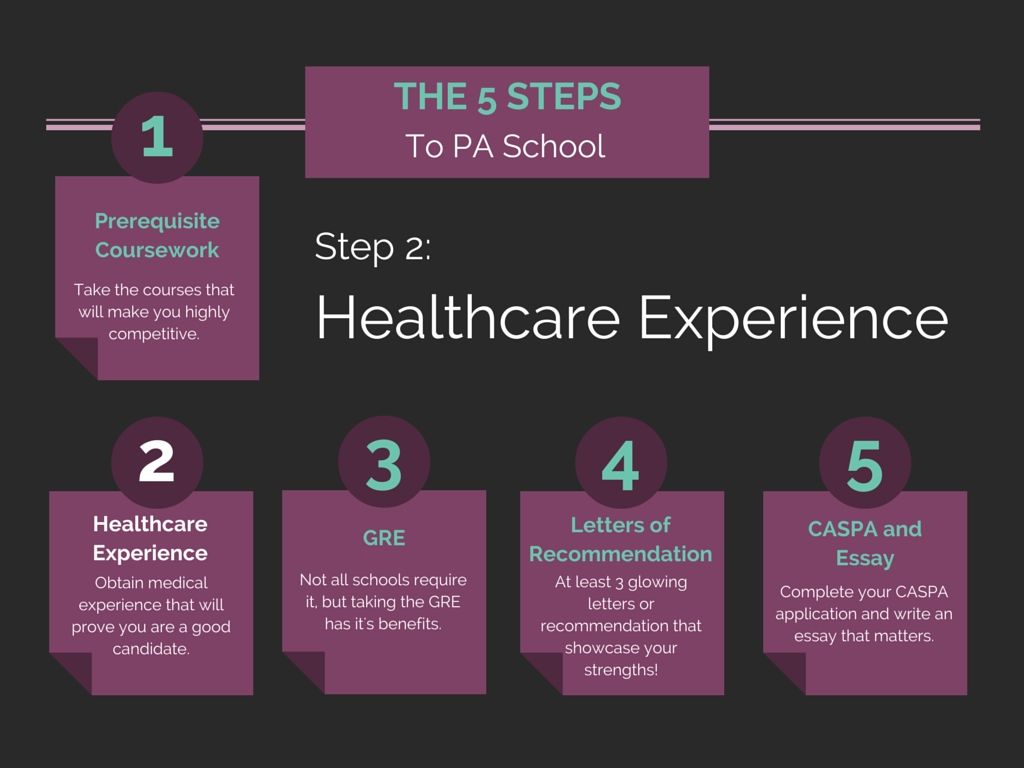
- Complete the necessary prerequisite coursework
- Obtain the required medical and hands-on patient care experience ← you are here
- Successfully prepare for and take the GRE (or avoid it)
- Obtain at least 3 high-quality letters of recommendation
- Complete the CASPA application essay and all supplemental materials on time
Finished step 1 already? The prerequisite planner will tell you in about ten minutes exactly which courses you still owe each of your programs — and whether any of them will expire before you matriculate.
Included, in this discussion is a side-by-side comparison of healthcare experience requirements of all PA programs in the United States.
PA is different from most other health professions in that to be competitive as an applicant it often requires a very large number of hours of paid healthcare experience.
But the question remains: How many hours of healthcare-related experience do you need to give yourself a competitive advantage along with a broad range of application options in the shortest amount of time?
What do you think?
Healthcare Experience Requirements for PA School
Below is a table comparing the hours of healthcare experience required and type of healthcare experience requested by the majority of Physician Assistant Programs in the United States.
Here are some of the fields that are typically accepted by most programs:
- Military Corpsman
- EMT or paramedic
- Combat Medic
- Registered Nurse (RN), BSN, LPN
- EEG or EKG technician
- Emergency room technician
- Physical therapy aide
- Certified Nurse Aide (CNA)
- Medical Assistant (MA)
- Respiratory Therapist
- Dietician
- Phlebotomist
- International healthcare based mission trips
- Hospice
- Medical Technologist
- Licensed Practical Nurse
- Dental Hygienist OR Technologist
- X-Ray Technologist
- Physical/Occupational Therapist
- Medical Social Worker Mental
- Health Care Counselor
- Aide in Dialysis Unit
- Optometry Assistant
- Chiropractic Assistant
We have had many military medics as students in our program. This experience is a great foundation for the profession. - Elissa Love, BCM PA Program in Houston
Here are some activities that are typically not accepted by most programs:
- Taking care of a family member is not really clinical experience. You can mention it and talk about the clinical care you provided, but it's not really what PA schools are looking for. (Although you should take care of your family)
- Observation of any kind (i.e., shadowing a physician or PA)
- Conducting research
- Helping in the health center at a summer camp
- Medical records personnel or clerical worker in a medical office or hospital
- Pharmacy technician/clerk
- Training without employment (such as EMT/MICT, etc.)
- Healthcare experience which is part of a healthcare training program (i.e., clinical rotations, fieldwork, or internships)
- Providing first aid as a coach, scout leader, etc
See more detailed list at the end of this post
Here are some activities that are highly variable:
- Medical Scribe is one of those very gray areas in that it provides exposure but is not always hands-on. Many schools accept it and many don't.
- Working as a medical interpreter
- Volunteering
- Athletic trainer
"We strongly believe that HCE is a predictor of success because it readies the student for the clinical environment, introduces them to pathophysiology, and prepares them for the rigor of our program and the demands and high standard of our didactic and clinical years." - Case Western Reserve University
Healthcare Experience vs. Patient Care Experience. What's the difference?
In the CASPA experience section, you will be asked to enter both patient care and healthcare experience hours.
They sound like the same thing, but It's important that you understand the difference as you can only enter each experience once and schools may prefer one over the other.
Patient Care Experience (PCE): Experiences in which you are directly responsible for a patient's care. For example, prescribing medication, performing procedures, directing a course of treatment, designing a treatment regimen, actively working on patients as a nurse, paramedic, EMT, CNA, phlebotomist, physical therapist, dental hygienist, etc.
Healthcare Experience (HCE): Both paid and unpaid work in a health or health-related field where you are not directly responsible for a patient's care, but may still have patient interaction; for example, filling prescriptions, performing clerical work, delivering patient food, cleaning patients and/or their rooms, administering food or medication, taking vitals or other record-keeping information, working as a scribe, CNA (depending on the job description), medical assistant, etc.
To make it simple, think of patient care experience as hands-on patient care hours. Everything else is healthcare experience. It's also important not to "double-dip." You can enter your experience only once, but you can divide your experience hours from one job into both PCE and HCE.
For example, say you work at an interventional pain medicine clinic where you spend half your time at the front desk answering calls and the other half of your time as a patient care technician assisting in the surgery center. If you had 2000 hours of experience split equally, you would enter 1000 hours as HCE and the other 1000 hours as PCE. Problem solved!
"If one school accepts your experience as patient care experience, list it under patient care in CASPA. And the schools that don't count it as patient care let them make the decision to consider those healthcare hours so you don't jeopardize your chances at a program that does see them as direct patient care." - James Kim PA-S
There are two numbers here, and mixing them up is the most expensive mistake in this entire post.
What programs REQUIRE. Across the programs that publish an hours minimum, the median is about 500 hours — and a couple of dozen programs require none at all. Those are floors. The live table below counts them for you and updates itself.
What people who GET IN actually have. PAEA’s national student data tells a very different story: the median matriculating student had worked roughly 100 weeks of direct patient contact at about 36 hours a week — call it two solid years, on the order of 3,500 hours. At the 75th percentile it is 156 weeks. Three years. (PAEA By the Numbers, Student Report 6, published January 2025, 2022 matriculating class, Table 53.)
Clearing a 500-hour minimum makes you eligible. It does not make you competitive. For the full picture of accepted students, see who gets into PA school.
PA School Applicant Quick Tip:
Here is my healthcare experience prior to PA school
- Two years working hands-on as an outpatient and inpatient phlebotomist and lab technician at the University of Washington Hospital as an undergraduate and one year part-time in the outpatient clinic.
- Two years working for the Puget Sound Blood Center as a Senior Mobile Phlebotomist after graduation
- Three months working with special needs youth through Seattle Parks and Recreation
- One year working in medical records and shadowing with the PAs and doctors as a freshman at the UW (this is how I got my start in the hospital)
- Many hours volunteering in patient transport and at Seattle Children's Hospital
- Certification as an EMT (although I never worked as one so I guess this doesn't count, but it sounds good 🙂 )
Total hours: Upwards of 5,000 hands-on patient care hours + many as a volunteer
Take a minute (or thirty) to browse through the table and I will meet you again at the bottom for a heated discussion! (and the answer to the survey question above: 4% — only 17 programs set their minimum at 2,000 hours or more)
PA school patient care experience requirements: every program, always current
This spot used to hold a table of 204 programs that I typed and re-typed by hand. It aged badly — programs quietly change their hour minimums between cycles, and no hand-maintained table survives that. So I tore it out.
What follows is built live from the PA School Finder directory, verified against each program’s own admissions pages, CASPA and the ARC-PA, and it rebuilds itself every time this page loads. It covers every accredited program, not 204 of them.
How to read it: sort by Hours required to find the programs you already qualify for. Then read the very next column — whether that program counts broader healthcare experience or only hands-on patient care. That one column decides whether your scribe year, your pharmacy tech year or your lab job counts at all, and it is the single most overlooked thing on this page.
If you found this table useful please share it with everyone you know :-). If you would like more info, updates from the blog and occasional free goodies please make sure to sign up for my email newsletter.
What the table actually tells you
Three things jump out once you sort it, and all three matter more than the raw hour count.
1. The floors are lower than the internet thinks. The median published minimum sits around 500 hours, and a meaningful number of programs require none at all. If you have been told you cannot apply until you hit 2,000 hours, that is folklore, not policy. Sort the table by Hours required and you will find programs you already qualify for today.
2. A blank is not a zero. A large block of programs publish no hours minimum whatsoever. That is not the same as "no hours needed" — it usually means the program keeps its bar unwritten and holistic, and its admitted class still shows up with thousands of hours. The table lists these separately, on purpose, instead of quietly counting them as zero. Never treat silence as permission.
3. The kind of hours can matter more than the number. Only a minority of programs state plainly whether non-patient-facing healthcare work counts toward the requirement — and a chunk of those explicitly decline to say. This is where applicants lose whole years. A scribe job, a pharmacy tech job, a lab position: at some programs every hour counts, at others not one of them does. Ask the program in writing before you bank a year on it. The "Does other healthcare experience count?" column tells you which programs have actually answered.
Not so fast — the requirement is not the target
Here is the trap. A program requiring 1,000 hours means you could work part-time for a year and technically be eligible. But eligible and competitive are different words.
Nationally, the median student who matriculated had roughly two years of full-time direct patient contact behind them, and the top quartile had three. So when you clear a 500-hour minimum, you have not caught up to the field — you have earned the right to be compared to it.
That is not meant to discourage you. It is meant to stop you from applying a year too early with hours that were never going to compete, and losing a cycle you did not need to lose. Read Who Gets Into PA School for the full accepted-student profile, and if hours are genuinely your weak spot, look hard at the programs that don't require healthcare experience before you write off this cycle.
And if you are not sure which programs to aim at, the PA Program Match AI scores every accredited program against your actual hours, GPA, coursework and location — and tells you how many more hours would open how many more programs. That is a far more useful question than "am I behind?"
What constitutes healthcare experience (HCE)
As you can see from the table above, the acceptable experiential preparation requirements varies from school to school.
Most schools report accepting:
- Paid experience with hands-on patient care
- Volunteer experience with hands-on patient care
- Shadowing a physician or physician assistant as acceptable HCE.
Many schools don't accept shadowing or volunteer hours as acceptable HCE so, as always, you must check the school website and contact the PA program directly if you have any questions whatsoever.
In the PAEA graphs and tables above you may have noticed that HCE was broken down into 6 general categories. This is because CASPA (Central Application Service for Physician Assistants) has 6 experience categories for reporting work and volunteer activities and the PAEA report is based on CASPA applicants.
Again, some PA programs will not accept HCE outside of the patient care experience category, although many do.
CASPA Reporting Work and Volunteer Experiences Categories
For a wonderfully detailed look at how to report work and/or volunteer experience in each of these categories I recommend you check out Paul Gonzales' amazingly thorough explanation on his blog "Trust me, I'm a PA Student".
The six CASPA reporting categories are as follows:
1. Patient Care ExperienceThis is the most important section. List experiences in which you are directly responsible for a patient’s care; for example: prescribing medication, performing procedures, directing a course of treatment, working on patients as an active EMT, etc.
2. Other Health Care Experience
You are working in the health or a health-related field but are not directly responsible for a patient’s care; for example, filling prescriptions, performing clerical work, delivering patient food, cleaning patient rooms, working as a “Candy Striper” or hospital volunteer, etc.
3. Health Care Shadowing
Time spent officially following and observing a health care professional at work.
4. Research
Research projects done in addition to classroom work; research should NOT appear as credit on a school transcript.
5. Community Service
Volunteer work done outside of the healthcare field; for example, working for Habitat for Humanity, tutoring children, participating in or working for a fundraiser walk or blood drive, etc.
6. Other Work Experience
Paid work done outside of the healthcare field; for example a retail or restaurant job.
Let's look at what some of the PA schools themselves are recommending for HCE:
Upstate Medical University’s Definition
Documentation of 1000 hours will be required prior to matriculation.
Preferred experiences: Military corpsmen or medic, nursing (ex. certified nurse assistant, nurses aide, RN, home health care aide), EMT’s employed full time (active hours only for EMT volunteers), paramedic, medical technologist, massage therapist, radiation therapist, respiratory therapist, phlebotomist, X-Ray technologist, medical imaging, clinical counselor, medical assistant, chiropractor, PT or PT aide, athletic trainer, New Visions, volunteer experience with direct patient care.
Acceptable: Shadowing a health care professional (200 hours maximum), Pharmaceutical Sales with patient contact, health-related research (will be reviewed on an individual basis), pharmacy technician (100 hours maximum).
Yale Physician Assistant Program Definition
Competitive applicants are recommended (but not required) to have a minimum of six months full-time healthcare employment, or 1,000 total hours of hands-on patient care experience and/or community service in a healthcare setting. Preference is given to applicants having experience that requires a period of training and results in direct (hands-on) patient care.
- Examples include: EMT, Paramedic, Registered Nurse, Medical Assistant, CNA, ER Tech, Physical Therapy Aide
- Hours associated with the completion of academic degrees, certifications, or training will not count
Evidence of community service (i.e., healthcare for underserved populations, medical mission trips) is highly valued.
Northeastern Physician Assistant Program Definition
Evidence of significant direct hands-on patient care experience is required in order for applicants to have a basic understanding of and comfort with patient care as well as a minimum level of clinical maturity. Strongest preference will be given to applicants who have approximately 2000 hours of hands-on patient care experience prior to applying to the program. Applicants with less than 2000 hours may also be given consideration depending upon the strength of their entire application.
- Hands-on patient care involves working one-on-one with patients and doing procedures that require touching patients yourself including, but not limited to:
- taking vital signs
- drawing blood
- doing EKGs
- changing bandages and dressings
- casting and splinting
- removing sutures and staples
- bathing and toileting
- A partial list of hands-on patient care positions includes, but is not limited to:
- certified nursing assistant
- medical/clinical assistant
- ER tech
- EMT doing more than patient transfer
- physical therapy assistant
- paramedic
- nurse
- physical therapist
- respiratory therapist
- medical corpsman
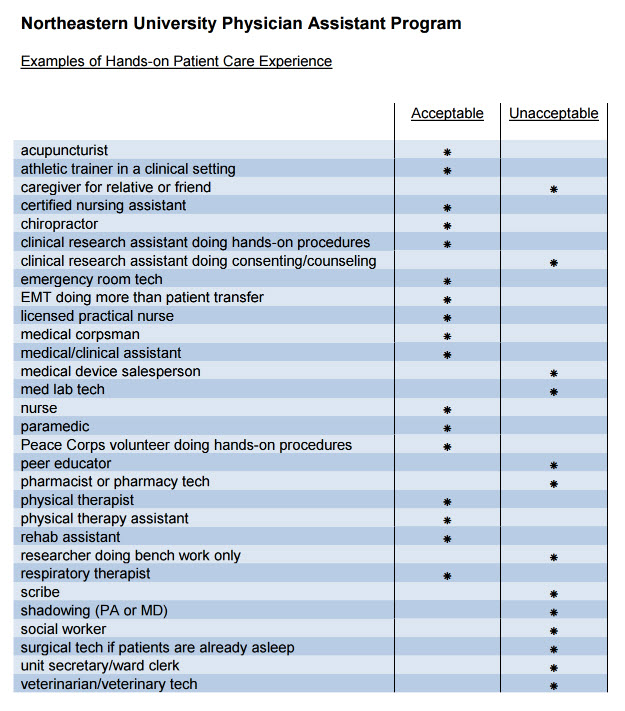
Full-time paid employment done after completing your bachelor’s degree is always most competitive!
Health Care Experience that is NOT ACCEPTABLE for PA School
Just as it is important to know what to report as HCE, it is equally important to know what not to report.
Below is an example from the Duke University. The following types of experience are NOT accepted toward the 1,000 hours of patient care experience as required by Duke.
- PA or physician observer or shadow
- non-clinical research assistant positions
- student clinical experience (student nurse, student EMT, student athletic trainer, or other health care student)
- student "intern" experiences, candy striper or junior volunteer positions
- CPR or ACLS instructor
- wilderness medicine instructor
- patient transporter
- pharmaceutical representative
- ski patroller
- lifeguard
- aerobics instructor
- unit clerk, insurance clerk
- medical secretary or other clerical positions.
Here is a list from South Carolina School of Medicine PA Program
Unacceptable forms of clinical experience include:
- Veterinarian Assistant
- Receptionist for Physician's Office
- Administrator or Business Manager for Physician’s Office
- Massage Therapist
- Chiropractic
- Acupuncture
- Aesthetician
- Dental Hygienist/Assisting
- Inpatient Patient Transport/Orderly
- Health Fitness Specialist
Does PA Shadowing Count Towards Healthcare Experience?
Applicants are encouraged to "shadow" a PA to become knowledgeable of the role of the physician assistant; More often than not this experience does not count as patient care experience, so as I always say, make sure to contact your PA program prior to submitting your application.
Two thousand hours: where the rule of thumb comes from
You have probably heard the 10,000-hour rule — Malcolm Gladwell's claim in Outliers that expertise takes about ten thousand hours of practice. (It gets misattributed to Blink constantly, and the researcher whose work Gladwell drew on, Anders Ericsson, spent years pushing back on how neatly it got packaged. Deliberate practice matters more than raw clock time.)
You do not need to be a healthcare expert on application day. But the underlying idea holds: hours change you, and admissions committees can tell.
So here is my rule of thumb, and the honest reasoning behind it. Aim for 2,000 hours — one year of full-time, hands-on patient care — before you submit. Not because most programs demand it (sort the live table above; very few set their minimum that high), but because:
- It clears essentially every published minimum in the country. You stop filtering yourself out of programs and start choosing between them.
- It gives you something to write about. A year in is when you stop describing tasks and start describing patients. That is the difference between a personal statement that lists a job and one that earns an interview.
- It gives you something to say out loud. Interview answers about hard patients, dying patients, and the day you got it wrong come from time on the floor. They cannot be manufactured the month before.
- It is still below the national median. Remember: matriculating students typically had closer to two years of full-time direct patient contact. 2,000 hours makes you a real candidate — it does not make you an outlier.
And a word for anyone reading this at 300 hours feeling behind: you are not behind, you are early. Every hour you work between now and your application is an hour that counts. Keep going.
My Healthcare Experience
When I applied to PA school back in 2004 I had roughly 5,000 hours of direct patient contact experience as well as quite a bit of work and volunteer experience both inside and outside the realm of healthcare. I accumulated this through work as a phlebotomist both as a student in the campus health clinic and then later after graduation while working in an outpatient mobile health setting.
Many schools at the time (specifically MEDEX and OHSU where I was hoping for acceptance) considered even this to be insufficient. I could have been patient and accrued more patient care experience and let more time pass but instead, I chose to throw a larger net and apply to schools that did not require so many hours. At the time many of these school were on the East Coast.
People write me all the time frustrated that their schools of choice won't give them the time of day. It is important to keep your options open, the wider the net you cast the greater your chances of catching a fish.
There are many ways to garner the patient care experience you need and the sooner you start the easier it will be to fulfill these requirements in a timely matter.
You should aim to have enough hours to be competitive, look at the median of accepted applicants, this is a good goal to have.
And most importantly it should not be seen as a burden to entry, it should be seen as an opportunity to get your hands wet in a field you love in preparation for a life of fulfilling work practicing what you love as a PA
Note:
This post is part two of my continuing series: The 5 Steps of PA School. To receive immediate updates when new posts are published sign up for the blog email.
Sources for this post (last verified July 2026):
- Per-program hour requirements — the PA School Finder verified directory, checked against each program's own admissions pages, CASPA and the ARC-PA. The table above reads from it live.
- National matriculant experience — PAEA By the Numbers, Student Report 6 (January 2025, 2022 matriculating class), Table 53.
- Experience categories and reporting rules — the CASPA Applicant Help Center.
View all posts in this series
- How to Write the Perfect Physician Assistant School Application Essay
- PA School Prerequisites: What Programs Actually Require (and What Expires)
- Healthcare Experience Required for PA School: The Ultimate Guide
- Secrets of Successful PA School Letters of Recommendation
- The GRE and PA School: The Pre-PA Advisor Series
You may also like -
 How to Find The Direct Patient Care Experience You Need to Become a Physician Assistant
Read on: But you may also be interested in my newest post Healthcare Experience Required for PA School: The Ultimate Guide
I could probably summarize this entire blog post with the following sentence:
"THE MORE HANDS-ON PATIENT […]
How to Find The Direct Patient Care Experience You Need to Become a Physician Assistant
Read on: But you may also be interested in my newest post Healthcare Experience Required for PA School: The Ultimate Guide
I could probably summarize this entire blog post with the following sentence:
"THE MORE HANDS-ON PATIENT […]- The Pre-PA Advisor Series: Patient Contact Hours and Healthcare Experience
The Pre-PA Advisor Series
Welcome to the PA Advisors Series - a special series of posts where PA school applicants like yourself ask the tough questions and admissions directors from top-ranking PA schools provide the […]
- No Experience Required! PA Schools That Don’t Require Healthcare ExperienceAre you looking to get into PA School fast?
Then skip the healthcare experience!
Below is a list of PA programs in the United States that do not require patient care experience for PA school admission.
I use "require" lightly because […]


CASPA Personal Statement Help
 We offer comprehensive, start-to-finish personal statement assistance or help to perfect a draft you already have. We have services to fit every budget.
 Schedule a Live Recorded PA School Video Interview

We offer 60-minute mock PA school interviews with post-interview feedback and advice. Includes a recorded video of your interview that you can watch, download, or share with family and friends. There is no better way to prepare!
Schedule an InterviewPre-PA Consulting and Advising
 Our pre-PA coaching service consists of a 1-hour phone consultation focused on addressing your specific questions or concerns about becoming a PA and applying to PA school.


Hi,
Would working as a Health Aide alongside a RN at a kids summer camp be considered health experience?
Hi Margaret,
There are so many variables that it is hard to say, my first impression is that this is something you could list additionally to other high quality, paid, hands on experience but I certainly wouldn’t use this as my primary source. I usually ask myself “does this experience allow me to suffer with my patients”? If the answer is yes, then you have found good hands on patient care experience, if the answer is no it doesn’t mean it isn’t valuable, it just means you are going to have to search to find ways to put yourself out there a bit more.
– Stephen
Is a CNA job in a hospital viewed as a more valuable experience than a CNA job in a nursing home or home health agency?
Hi Nicole,
This is a good question. On paper they will be equal, but the experience itself and how you portray that to the admissions committee in both the essay and the interview is what matters the most. So make sure to take every opportunity to you can to “engage in the suffering of your patients”. It is at these precious moments of great human vulnerability that we become the practitioners we were meant to be. Address that in your writing and with the admissions committee, this is what matters the most.
– Stephen
Hello Stephen!
I was working as a veterinary technician for a year and have about 1000 hours of experience. I was helping doctors during appointments and surgeries, was giving shots, filling prescriptions, checking glucose, drawing blood and etc. Would this experience be counted towards HCE hours? What do you think?
Thank you
Hi Katerina,
You are best to contact the specific PA programs you are applying to. But typically hands on patient care experience of the “human kind” is the type of experience schools both require and are looking for.
– Stephen
Hey! Thank you so much for this post. I was wondering if these are the hours required by the time of application or before actually starting the program? Because I just recently switched from pre-med to pre-pa and I will be applying this coming April and I don’t have a lot of hours..only about 200 and so I would get more before I actually start the program if I get in so I was wondering if they consider that you are currently working or will be working on that gap year after graduation and before starting PA school when checking applications! Please let me know. Thank you 🙂
Hi Garima,
They are going to be looking at the hours you have already clocked in at the time of application, this is what you will be entering into your CASPA application as well.
– Stephen
I work at the YMCA as a wellness coach. We guide members through the process of finding a workout routine, and connect them with other resources in our facility. A large portion of the job is customer service based, but I do a lot of one on one fitness & wellness counseling with different members. Can I list this as healthcare experience? If not, how should I express this experience in my application so it is viewed as valuable experience?
Hi Nicole,
This is extremely valuable experience, working with people and customer service is a skill that is hard to teach and those who are good at it do very well by their patients. Unfortunately, it will probably not count towards HCE hours, but you should make it a point to discuss this in a creative way within your personal statement. Using an anecdote (client story) is often very effective way to get your point across without trying to make a list of all the ways it has helped you grow as a person, don’t belabor the point in your essay (which many people do), share a short story and then move on. Your essay is a great place to do this!
– Stephen
Hi there!
I’m curious to know if my job as an IHSS (In Home Supportive Services) care provider would be considered HCE? It was a job paid for by Contra Costa County (East Bay Area, CA). I would have to regularly visit the private homes of seniors and assist them with their daily tasks such as housecleaning, meal preparation, laundry, grocery shopping, personal care services (such as bowel and bladder care, bathing, grooming and paramedical services), accompaniment to medical appointments, and protective supervision for the mentally impaired.
What do you think?
Thank you!
Hi Phill,
I would consider this HCE but my opinion doesn’t really matter. The best things you can do is to visit the PA school website of the schools you are interested in and see if they answer this question directly. If the answer is still unclear do not stop there, you must contact the program/s by phone. You want to make sure you have a concrete answer as each school has different requirements and different considerations when it comes to HCE so I can’t say for sure.
Best of luck on your research!
– Stephen
Hi,
I was just wondering if I can get some help if my current job counts as medical experience. Right now I am working as a medical aid at a senior facility. Where I provide medication to the seniors; orally, insulin injection, blood glucose level, diagnosing if an individual has an affection or needs the EMT, et. I also provide caregiving.
Thanks
Hi Brandon,
This should count as hands on patient care experience but, as always, if there is any doubt whatsoever it is best to contact the schools you will be applying to directly. Every school has different requirements and they are not always completely clear on the program website.
– Stephen
Hi, I have worked as a Legal Assistant at a personal injury firm but I was known as their Medical Records Analyst. From there, I accepted a job at Bactes Release of Medical Information and have been working there for a year now. I have direct access to Medical Information and understand the administrative side of the PA field well. The PAs I have shadowed stated that they wish they knew more about that since it is hefty part of their job. I hoping these experiences would count as HCE because I plan on applying this upcoming year. What do you think?
Hi,
As a former ski patroller/EMT, I can tell you it’s excellent healthcare experience, loaded with direct patient care. I’m surprised you say it shouldn’t be listed as HCE. Duke IS the only program I’ve seen make that statement. I think you are seriously underestimating the dedication to medicine and patient care you’ll find in the men and women that ski patrol.
I will definitely be using it as HCE because I was an EMT on skis. My serious question is: how do I actually submit this time? Because it’s not in a hospital where you are more or less constantly around patients, it seems to be a bit trickier.
Thanks for your time!
Matt
Just as a follow-up to my comment, I obtained 6 interviews and was accepted on my 2nd interview. Ski patrol experience as an EMT isn’t unacceptable as your site suggests. In fact it’s excellent experience, albeit unconventional. You shouldn’t be so quick to write off something you may not understand. That’s just my 2 cents. Thanks for your dedication and your excellent website.
Hello, thank you for sharing this. Quick question, would working as a Home health care aide (specifically work for IHSS) count as paid hours in my application. Please let me know.
Hi Anne,
You should definately refer to the school(s) applicant section of their website or speak with someone on the admissions staff. Each school has a different opinion on what constitutes hands on patient care experience. This is especially important if you need this to cover your prerequisite HCE hours. You certainly don’t want to leave this to chance.
– Stephen
I am currently working as a medical assistant, and am considering furthering my education and become a PA. My Bachelor of Science is in Business Management. Not clinical or medical at all, will that hurt my chances of getting into a PA program? If so, would taking science courses make up for that? Thank you.
Hi Paulina,
No, your BS in business management will not hurt your chances at all. As long as you complete all the necessary prerequisite coursework and show a strong aptitude for the sciences. Make sure you take the more advanced science courses as well, I discuss this a bit in my post about prerequisite coursework: . It is great you are getting tons of hands on medical experience working as an MA. This will help you to make strong contacts and become familiar with the healthcare system in general.
– Stephen
Hello Stephen,
What would be the best route to go in regards to attaining HCE without having to get a certification? In other words, how would I go about volunteering and gaining HCE in direct patient care considering the fact that I just started college. Would hospitals just let me volunteer and interact with patients without any formal training?
Hi David,
This is a great question, unfortunately I do not have a great answer. It depends on the school(s) you are applying to. Many of the schools we interviewed for our new book http://www.thepaessay.com/ mentioned that they would not even consider a candidate without paid health care experience. But, as you can see from the table some schools do not even require HCE hours. When I was a freshman in college I simply walked into the campus hospital (you could do this in any hospital) and asked them who I could talk to about volunteering. I think they had me volunteering that very same day. From there I met a lot of people in the hospital and the satellite clinics and that is how I picked up my first paid hospital position. Over the summer I looked up internships or programs in my community. That is how I found the special needs youth summer camp, which was a wonderful experience as well. You can also do a search online to find overseas volunteer opportunities. Depending where you live, they have opportunities in Mexico, Central and South America as well as Haiti and Dominican Republic on the East Coast. This type of experience may be enough for some schools. Just make sure you call the program(s) you are interested in and confirm this, so you know you are making the best use of your valuable time.
– Stephen
Hi Stephen,
I will be applying to PA school in the next few years. I’m currently a CNA with a pre-med degree. I will also be a certified surgical technologist in approximately 1 year. I plan on using that degree for about a year or two before applying for graduate school. I’m hoping my CNA experience as well as my surgical experience will give me a leg up in the competition.
I have no problem taking the time to rack up thousands of HCE hours. My biggest concern, though, is about the time limit on certain classes. I graduated with my undergraduate degree in December 2014. Some of the very important classes, like anat. & phys., will be close to 8 years old once I’m ready to apply to PA school. I am worried I will have to go back and retake several science courses.
How do applicants avoid this issue? Am I taking too much time finishing business?
Thanks
Hi Molly,
You do not need to worry about this, you have completed your prerequisites and you are now using them in the real world environment. The experience will speak for itself and you will taking Anatomy and Physiology as part of your didactic year of PA school. No need to worry and no need to repeat these courses or take “refresher” courses. You are certainly on the right track… Keep up the great work!
– Stephen
Ok so I have a strange question–I am currently applying to PA school for the 2015-2016 cycle. Most (about 3,000 hours) have been “unofficial” by shadowing a PA, Surgeon, or PCP. In these hours, I have been allowed–under their direct supervision of course–to participate in procedures and even surgeries. How should I list these hours? So far in my application, I have given myself the title “medical volunteer”–I just want to make sure I am logging everything the way it should be. Any input would definitely help. Please and thank you.
Hi Eve,
This is going to be tough. What I would suggest you do is contact a couple of the schools you are applying to directly and explain your situation, when you have them on the phone ask them this question. They will be able to guide you a bit better and make sure you are listing your activities in a way that it does indeed fit their definition of health care experience hours. “Medical Volunteer” may not be your best option and I am sure the admissions faculty can help you find the correct phrasing.
– Stephen