
* To build your own prerequisite plan against every accredited PA program, free and with no sign-up, use the PA School Prerequisite Planner.
Let's start with the thing nobody tells you.
There is no national prerequisite list. None. ARC-PA — the body that accredits every PA program in the country — had exactly one standard that even mentioned prerequisites, and they rescinded it in August 2025. What each program requires is entirely that program's business.
Which is why you're here, staring at a browser with nine tabs open, trying to work out whether the biochemistry you're signed up for next term is going to count anywhere.
I remember that feeling. In my case it was organic chemistry — a subject that beat me up so thoroughly at the University of Washington that I switched off the pre-med track in the spring of my junior year, partly out of strategy and partly out of self-preservation.
Here's what I wish someone had shown me back in 2001: most PA programs don't hard-require organic chemistry at all. More on that in a minute, because the numbers genuinely surprised me.
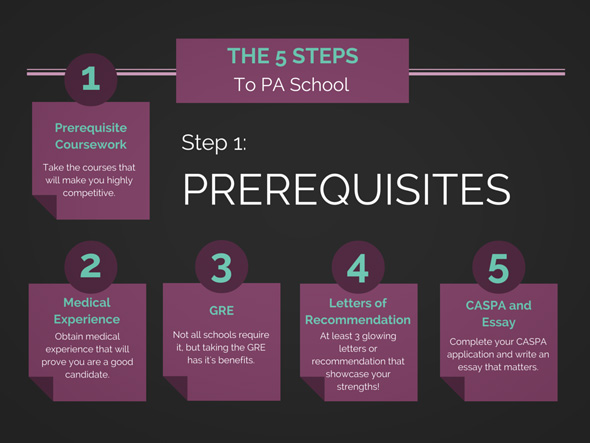
This post is part of my 5 steps to PA school series, to go from zero to PA school hero:
- Complete the necessary prerequisite coursework ← you are here
- Obtain the required medical and hands-on patient care experience
- Successfully prepare for and take the GRE (or avoid it)
- Obtain at least 3 high-quality letters of recommendation
- Complete the CASPA application essay and all supplemental materials on time
What do PA schools actually require? Here are the real numbers.
For years the honest answer to this question was "it depends, go look them up." So we went and looked them all up — every accredited program, read off that program's own admissions page, with the source link recorded next to it.
Here is how often each course appears. This table is generated live from the PA School Finder database every time this page loads, so it reflects what programs publish today, not what they published when I wrote this paragraph.
Read that bottom section twice.
Physics and calculus are almost never required. Two per cent and one per cent. If you have been white-knuckling your way through a physics sequence because you assumed PA schools wanted it — they mostly don't. That is a semester of your life, and a chunk of your science GPA, back in your pocket.
The top five are your non-negotiables. Anatomy, physiology, microbiology, statistics and general chemistry will get you in the door almost everywhere. Everything below general chemistry on that list is a strategic decision, not a requirement — and which ones you take should depend entirely on where you're applying.
Upper division prerequisite requirements can be completed at a four-year institution, community college, or online courses from regionally accredited institutions. We do not look down on community college coursework. It will be factored in the same way. - Penn State PA ProgramClick To TweetDo I really need organic chemistry?
Probably not. This is the finding that surprised me most.
Across every accredited program:
- 38% hard-require organic chemistry.
- 29% will accept biochemistry instead.
- 27% don't require it at all.
- 6% don't publish a clear policy.
So the course that has terrified pre-PAs for two decades — the course that redirected my own undergraduate career — is a hard requirement at fewer than four programs in ten.
Don't misread me. If organic chemistry interests you and you'll do well in it, take it. It keeps every door open and it's decent preparation for pharmacology.
But if you are choosing between a C+ in organic chemistry and an A in biochemistry, the A in biochemistry is worth more to you. It satisfies almost as many programs and it doesn't drag your science GPA down a tenth of a point.
That is a real strategic choice, and until now nobody could see the landscape clearly enough to make it.
The three prerequisite rules nobody tells you about
Course names are the easy part. These three are what actually cost people a cycle.
1. Your credits have an expiration date
Most applicants have no idea this exists. Across accredited programs:
- 24% never expire your prerequisites — a course you took in 2011 still counts.
- 12% expire them in 5 years or less.
- 20% expire in 6–7 years, and 38% in 8–10 years.
If you are a career changer, that first line is the most valuable sentence in this post. Roughly one program in four will count the coursework you already have, in full, no matter how old it is. Those are the programs your list should start with.
No directory will sort them for you either, because that information sits in prose on hundreds of different websites. If your oldest science course is eight years old, this single fact opens or eliminates dozens of programs before you have thought about GPA, location or tuition.
We will accept humanities credits that are older than 5 years. Science credits must be taken within 5 years of applying. - Touro University PA ProgramClick To Tweet2. A pass isn't always a pass
Ninety-three programs publish a minimum letter grade for every prerequisite. For most of them that's a C — but thirteen programs require a B- or better, and at those a C simply doesn't count, no matter how good your overall GPA looks.
Worth knowing before you decide whether a course needs retaking.
3. AP and CLEP credit is a coin flip
- 45% accept AP/CLEP credit for prerequisites.
- 46% accept it with limits — most commonly "only if it appears on your university transcript with a grade."
- 15 programs won't take it at all.
If you tested out of general chemistry in high school and never took it again in college, you need to know which bucket each of your target programs falls into before you build your list. This is one of the most common ways a strong applicant discovers in March that they are short a prerequisite.
Build your prerequisite plan in ten minutes instead of ten hours
This is the part of this post that used to say: make a list of fifteen schools, open the program directory, look each one up, and fill in a worksheet by hand.
You don't have to do that any more.
→ Open the PA School Prerequisite Planner
Pick the programs you're applying to, tick off the courses you've already completed, and it hands you back:
- exactly which courses you still need, ranked by how many of your schools require each one — so you know which class to sign up for first
- a warning if any of your programs will expire the coursework you already have
- a school-by-school table you can print or download as a CSV
- every program's real prerequisite list, searchable, with expiration, the organic chemistry rule, AP/CLEP policy and minimum grade side by side
It's free, there's no sign-up, and it reads the live database rather than a snapshot.
Then take the printout to your academic adviser. That conversation is still the most valuable hour in this whole process — you're just walking in with the research already done instead of doing it in the meeting.
Want that plan in one place all cycle long? Save your schools in the free PA school application planner and you'll see each one's recorded prerequisites next to your GPA, hours and deadlines. With Planner Plus, you can map your prerequisites against every school you save.
What if you don't know where you want to apply yet?
Fair. Most people don't, and "pick fifteen schools" is easy advice to give and hard advice to follow.
Prerequisites are only one of the things that decide where you should apply. GPA, patient care hours, location, tuition, deadlines and whether a program even counts your kind of experience all matter, and they interact with each other.
The PA Program Match AI takes your whole profile — GPA, hours, the coursework you've finished, where you can move to, what you can afford — and scores every accredited program against it. It tells you which ones you're genuinely competitive at, which are reaches, and the part I like best: which single fix opens the most programs for you. Sometimes that's 200 more patient care hours. Sometimes it's one chemistry class.
If you'd rather just browse and filter for yourself, the free PA Program Match tool does that too — including filters for organic chemistry, prerequisite expiration, biochemistry, genetics, medical terminology and minimum grade.
Is there a "standard" prerequisite list I can trust?
Sort of, with a caveat that matters.
CASPA publishes a Common Prerequisites List of twelve courses: anatomy, physiology, biochemistry, general biology, microbiology, general chemistry, organic chemistry, English composition, genetics, medical terminology, general psychology and statistics.
Here's the caveat, in CASPA's own words: the list is "non-exhaustive, courses not on the Common Prerequisites List may still be included." It is a naming convention — a way of standardising how your courses get labelled inside the application — not a statement of what programs require. Plenty of advisers and blog posts present it as a requirements list. It isn't one.
Use it to understand how your coursework will be categorised in CASPA. Use the programs' own pages, or the planner above, to find out what they actually require.
And while we're on directories: the old PAEA Program Directory is now the CASPA Program Directory. It is still free and still worth knowing about — it's the best single source for tuition, class size and deadlines straight from the programs.
Should I take upper-level courses?
Yes, if you can. Here's why, and it's personal.
My wife was pre-nursing. On her academic adviser's recommendation she took all lower-level science courses — they satisfied the stated requirement, so why not? When she applied to the University of Washington School of Nursing, then ranked number one in the country, her prerequisite coursework paled next to applicants who had taken the upper-level series.
To her boyfriend's dismay 🙂, she wasn't admitted. She went to Seattle Pacific University's School of Nursing that year instead and has had a wonderful career — but she'd tell you herself it was an avoidable detour.
Take chemistry at the University of Washington as an example. Chem 110 and 120 are the introductory series — "lower level." Above them sit Chem 142, 152 and 162: the year-long general chemistry series with labs that pre-med students are required to take. Same subject. Very different signal on a transcript.
Organic chemistry works the same way (Chem 220 versus the 237–239 series), and so does biology (the 100 series versus the 200s). You will find that pattern at almost every university and community college in the country.
The rule: meeting the minimum requirement and being a competitive applicant are two different goals. Some programs — George Washington among them — require upper-level coursework outright. Taking the harder series keeps every door open and tells an admissions committee something a transcript otherwise can't.
What major should I choose to get into PA school?
Whichever one you'll actually enjoy and do well in.
PA programs are flexible about your major. Like medical schools, they care that you excelled in it and that it reflects a genuine interest. I've advised applicants who majored in everything from dance to biochemistry, and both got in.
Three things worth weighing:
- Pick something you'd still want if this doesn't work out. Not everyone gets in the first cycle. Your major is your plan B.
- Pick something that helps you get patient care hours. Most of the common routes — phlebotomist (that was me), EMT, CNA, medical assistant — need a certification, not a degree. Nursing is the other well-worn path: work intensively for four or five years, finish your PA prerequisites along the way, then apply.
- An upward trajectory beats a flawless start. A rough freshman year is survivable. What committees look for is what happened next.
My own pre-PA coursework at the University of Washington
For what it's worth, here's what I actually took — quarter system, four years, and a change of direction in the spring of my junior year when I finally sat down with an adviser and admitted I wanted to be a PA rather than a physician.
- Anatomy and physiology
- Upper-level biology — 1 year
- Cellular biology elective
- Microbiology with lab
- Upper-level general chemistry with lab — 1 year (3 quarters)
- Upper-level organic chemistry — 2 quarters, then a strategic retreat to the short program senior year
- Upper-level physics with lab — 3 quarters (which, per the table above, virtually nobody required — live and learn)
- Genetics
- Calculus — 2 quarters, plus a quarter of statistics
- Sociobiology and biomechanics
- Foreign language — 1 year
- General and abnormal psychology
- English composition
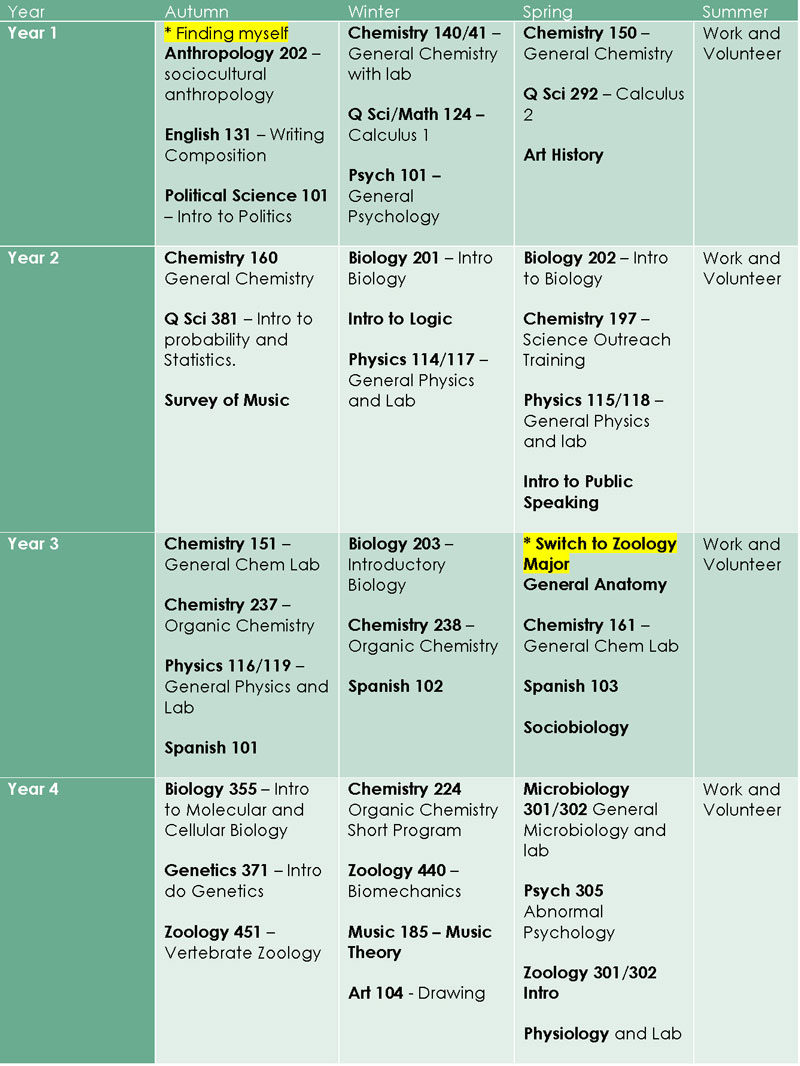
Leaving the pre-med track opened up genetics, physiology, biomechanics and microbiology — courses that both raised my GPA and made a stronger application. Changing direction wasn't a setback. It was the best academic decision I made.
Your next step
Four things, in this order:
- Run the prerequisite planner. Even if your school list is a rough guess, you'll see the pattern in ten minutes. Pay attention to the expiration column.
- Book time with an academic adviser and bring the printout. Ask specifically about your school's course numbering — which series is the upper-level one.
- Sequence the gaps by leverage. Take the course that unlocks the most programs on your list first, not the one that's most convenient next term.
- Check the calendar. The 2026–2027 CASPA cycle opened April 30, 2026 and closes April 1, 2027. Most programs want prerequisites finished — or at most one or two outstanding — by the fall of the application year.
You do not need a perfect transcript. You need a plan, an upward trajectory, and enough foresight that you aren't discovering a missing prerequisite in March.
Now go take a look at where you actually stand. I think you'll find you're closer than you think. 🙂
Thanks for reading — I'm here for you.
— Stephen Pasquini PA-C
Prerequisite figures on this page are drawn from the PA School Finder database, where every program's requirements were read from that program's own admissions page and recorded with the source. Programs revise prerequisites every cycle — always confirm on the program's site before you register for a course. There are 330 ARC-PA accredited entry-level PA programs as of ARC-PA's April 2026 meeting.
View all posts in this series
- How to Write the Perfect Physician Assistant School Application Essay
- PA School Prerequisites: What Programs Actually Require (and What Expires)
- Healthcare Experience Required for PA School: The Ultimate Guide
- Secrets of Successful PA School Letters of Recommendation
- The GRE and PA School: The Pre-PA Advisor Series
You may also like
 The Perfect PA Program Picker: PA School Search, Sort, Match, and ApplyChoosing where to apply is one of the highest-stakes decisions of your pre-PA journey — and the data you use should never …
 200+ PA Schools That Don’t Require the GREAre you like me and looking to dodge the GRE? Does the thought of studying for the GRE exam make your palms …
 PA School Ranking by PANCE Pass Ratesince 1998, US News has been publishing the only known ranking of PA programs. Their rankings are based on subjective peer assessment …


CASPA Personal Statement Help
 We offer comprehensive, start-to-finish personal statement assistance or help to perfect a draft you already have. We have services to fit every budget.
 Schedule a Live Recorded PA School Video Interview

We offer 60-minute mock PA school interviews with post-interview feedback and advice. Includes a recorded video of your interview that you can watch, download, or share with family and friends. There is no better way to prepare!
Schedule an InterviewPre-PA Consulting and Advising
 Our pre-PA coaching service consists of a 1-hour phone consultation focused on addressing your specific questions or concerns about becoming a PA and applying to PA school.


Hi Stephen! I was wondering, is it necessary to take at least 2 science classes per semester to look competitive? Or is 1 okay sometimes?
My next semester looks like this:
Organic Chemistry (5 credits), Chinese (5 credits), Psychology Scientific Inquiry (3 credits), and a General Education World History Class (3 credits).
I’ll only be taking 1 Science class next semester so I’m a little worried it will make my app look weak but I also really want to learn Chinese! I’m of Chinese descent but I don’t know any Chinese so I decided that I’m going to learn it. I’m going to be a sophomore in college next year.
Also, do summer classes look bad? I took a 200 level Bio course this summer and got an A but I’m worried they would look down on summer classes.
Thank you!
Hi Zheng,
What matters is that you complete the necessary prerequisites, they won’t look down on how you do this or if they are taken during the summer, spring, winter or fall or at a community college. So enjoy taking Chinese and work to create the best schedule that fulfills your requirements and your innate desire to learn!
Stephen
Hi Stephen,
Thank you so much. You have greatly explained every single detail.
I am getting my bachelors in Community health and also completing all my pre-requisite for the PA school. But please out of curiosity do you think getting a bachelors in community health is okay as a Pre-PA degree?
Thanks
-Anika
Yes, absolutely!
Stephen
Hello Stephen,
I am in the process of completing all of the science prereqs (face-to-face) but am considering completing my Bachelors in Psychology completely online. Will PA admissions personnel look negatively at an degree completed mostly online? I have 13 years experience as a medic in the U.S. Army, so I think my medical experience should be covered. Thanks in advance for any advise!
-Johnathan
Hi Jonathan,
Some schools (both graduate and undergraduate) do not accept credits from online universities. But if you can do this through a reputable school chances are this is perfectly acceptable. You might want to contact some of the PA schools you are considering just to make sure though before you pull the trigger. It is always better to be safe than sorry and a phone call today could save a lot of misery later on down the road.
I have to congratulate you as well for all your health care experience. You are right, this will take you very far!!
Best of luck!
Stephen
I am majoring in Bachelors of Health science in th fall. I love the P.A. Field and the different aspects of it & I plan on becoming one. I want to know if you have any tips for completing prerequisites ? As a graduate of MDC with an AA degree, I took chemistry w/lab, microbiology w/lab, Anatomy &Physiology 1& 2 w/ lab, English 1 &2. I would like to get them out the way early. I want to complete them in efficient time. Is there any way to complete them online without having to attend a university or college?
^ I would also like to know this
Hey Stephen-
Thank you for maintaining this excellent blog. My question revolves around my Anatomy class. After everything was all said and done, I received a B in the class. I kind of overloaded my schedule this semester and took on a new job so I didn’t devote enough time to studying for Anatomy as I should have. Do you think I should retake it? I know that I can get an A the second time around. Although I got a B, my overall GPA is 3.48. I’ve been asking around and nobody can really give me a clear answer. What do you think? Should I take Anatomy again? Or will a B suffice? Thank you for your time.
-Chad
Hi Stephen
Thank you so much for all your help, your posts are very informative and helpful especially as I am an untraditional student currently two years out of college and applying to PA school this cycle! I have a question regarding GPA. I’m worried that it will hinder my application because it is on the lower side, my cumulative is 3.2, and my science GPA – which I’m not exactly sure if I’m calculating it right- is a 2.7 which is really concerning. I am currently working as a scribe, and have a lot of leadership and volunteer experience I did as an undergrad. Would my GPA deter me from getting into any PA schools? What would you recommend to help improve my application? I was hoping to apply this cycle and am afraid of running out of time in terms of taking classes that could really boost my science GPA.
Thank you so much for all of your help!
Hi S.T.
As you may have read I was accepted into the Rutgers PA Proagram with a GPA that was 0.1 below the minimum required at the time. To do this you have to get their attention. For starters you are going to need an exceptional personal statement, this is a must. The reasons behind your lower GPA should be addressed – maybe you were finding your way in your first two years? Maybe you had a difficult life situation? You need to show an upward and not a downward trajectory, finishing strong is a big plus. If this is flipped you are going to have some troubles. You need to have very strong health care experience – above average. You are going to have to have very strong letters of recommendation – above average. This will make up for your GPA – in fact, I think if you can show that you are creative, highly motivated, willing to make mistakes, kind, compassionate and an all around good guy/gal the GPA can place you in an outlier group, which could be used as an advantage – IF (and this is a big if) you can crush the competition on the other end.
– Stephen
Hey Stephen,
I am currently enrolled in Organic Chemistry and am signed up to take Orgo 2 next semester. Do you think that I should take that class? Will I really need it for PA school?
Thanks!
Hi Sadie,
One thing you want to make sure you do is make a list of some of the PA schools you think you will be applying to and carefully deconstruct their prerequisite course requirements. Many schools don’t require this much O-Chem and let you choose from several different sciences to get your credit hours. It is especially important to look at your top schools and use these requirements as a guide. I aimed to go above and beyond the prerequisites and then mixed that up with courses that excited me and that also fit the bill. Honestly, I wish I had taken one less quarter of O-Chem because I find it detestable in general 🙂 But not everyone feels the same way I do…
If you are still not certain pick up the phone and call the program’s admission’s staff, they are always there to help and can eliminate any doubts you may have.
– Stephen
Hey, question for Stephen…
Is there a length of time before the PA schools say is too long to hold science credits? That is to say I have some credits from 2009 that I fear will be rendered unusable when applying and I have seen a few schools that require that science pre-reqs be within a 7 year time frame when applying. Are there schools that don’t require this a time limit?
Thanks!
Hi Stephen!
First, allow me to say how much I appreciate your blog/site, and all of the heartfelt efforts you have allocated towards sharing your experiences, expertise and insights with the rest of us who are also trying to pursue the PA path 🙂 It is tremendously encouraging and, incidentally, one of the traits I love so much about so many of the PA’s I have encountered and worked with. They tend to be very down to earth, hands on, practical people who don’t take themselves too seriously 😉
I am a 35 year old (returning) junior at the University of Washington-Seattle. I left school 15 years ago when I came to the harsh realization that I simply wasn’t ready for it at the time and didn’t have my head in the game. (I had a lot of maturing and growing up to do.) I always knew I wanted to be in the medical field in some capacity but wasn’t sure which role I would be best suited for. So I put on my big girl pants and hit the work force full on. I have been a Unit Sec, CNA and ER Tech over the last 15 years (in Seattle, Honolulu and Boston) and over that time I fallen in love with the role of the PA. When I realized that that was my calling, I suddenly had the focus and drive that had been missing from earlier academic pursuits. I got myself back in school (and back into UW) and that in and of itself has meant the world to me. I am going into Spring quarter next week and will be finishing the last of my pre-req’s to apply to the Bachelor PA Program through Medex in Tacoma this summer. (I’m also attending the Info Session on the Seattle campus tomorrow for Medex) 🙂
My question is concerning re-taking a particular course. As you know, UW doesn’t have an A&P track, per se. So I took Bio 118 (Physiology) with an AWESOME new prof there last quarter, for which my final grade was (only) a B-. Enough to meet the program minimum requirement, but not indicative of what I know I’m ultimately capable of. I’m a mom to a 3 year old daughter and I found this first quarter back at UW, taking 14 hard science credits, to be particularly challenging (Organic Chem was not my favorite course, either!) I feel like this first quarter was me getting my sea legs back after 15 years and taking the training wheels off of my rusty little academic tricycle (then being shoved down a steep cliff with no brakes….but that’s neither here nor there.) 🙂 Suffice to say, my life now is a lot more complicated than it was when I was 20 years old and I have had to learn to adapt my study habits and time management accordingly. I feel much more confident now going into Spring quarter bc I know what is expected of me and it’s game on. That said, I am taking Anatomy, Microbiology, the accompanying (separate) Lab for Physiology that wasn’t included with last quarter’s course, and Epidemiology. Should I forgo my Epidemiology course (which is not a pre-req for the PA program, but that I’ve heard is actually quite interesting and fun) to retake my Physiology class and try for an A? My understanding is that those two grades would ultimately be averaged and even if I got a 4.0, the most I could expect would be a B+? My grades when I left school 15 years ago were quite crap, and I left my GPA at UW in a shambles. But since then I have maintained a 3.8-4.0 in the classes I have taken at other institutions (whose grades don’t transfer into my cumulative gpa at UW unfortunately). I have spoken to the Medex Admissions advisors extensively, joined a Pre-PA club at UW and from what I gather, they are generally looking for an upward trajectory. I’m just trying to weigh my options for re-taking that course and trying for an A, within the bigger picture of my application?
Thank you in advance for your time and two cents!
Hi Stephen,
I’m 40 years old, with 15 years as a LPN. I’ll graduate next year with a Bachelor’s in Health Administration. Im deciding to go the PA tract vs. NP, which could take 4 more years. I’ve maintained a 3.9 GPA. However my sciences Anatomy and Chemistry are 10 plus years old. My higher level chemistry knowledge is very limited, and my GPA could take a big hit! My question is are there PA programs that will consider my nursing experience in lieu of my lack of sciences? Or at least give consideration to an alternative science path, like higher level anatomy or life sciences?
Hi Keshia,
The truth is you are asking the exact same questions the PA school admissions directors will want answers too, and it will be your job in your application to leave the impression that you are passionate, dedicated,and knowledgeable of the PA profession, that your 15 years of experience has molded you into a caring and empathetic individual, that you are hardworking and capable of handling whatever the PA program throws at you. There are “boxes” that are a part of your CASPA application where you fill in numbers – like GPA, GRE scores and prerequisite coursework, then there is everything else. If you can fill in the boxes and meet the requirements you can check that off the list, but it is outside of the “boxes” that will eventually determine your chances of being asked for an interview. Often, it is “outside of the box” where you have the best chance of succeeding. So yes, having some chemistry knowledge is helpful (but that is a box to check), if you have shadowed, volunteered, gone outside your comfort zone, gotten those excellent references and nailed your personal statement – this will likely be the most important thing you can do.
– Stephen
Thank you so much for creating this page!! I love hearing from experienced people who can give advice on how to achieve my dreams.
And Victoria, I love hearing from passionate people who are on the path to achieving their dreams, so I thank you equally!
– Stephen
Can I substitute human physiology with Exercise Physiology ? It’s my only option for this years summer…here’s a description of the course:
An advanced-level course concerning physiological and biochemical processes associated with human performance. Emphasis is on the integration of organ systems for exercise. Topics include metabolism and fuel utilization, cardiovascular and respiratory dynamics during activity, and the effects of training. Requires a good understanding of basic physiological function and anatomy.
Hi Collin,
If human physiology is a prerequisite course for a school(s) you are interested in I would make sure you check with them directly before registering. Exercise physiology and human physiology are quite different (although there is a significant overlap). It may be that this is an acceptable exchange, but check – you may find yourself having to take both, which isn’t that bad but if you are trying to be time, energy and financially efficient you may find it is better to substitute a non-prerequisite course for one that is definitely on the list if this is an option. Long story short – call the PA program(s) and ask.
– Stephen
Hello,
I just recently changed careers and started as a Community Health Aide Trainee in bush Alaska with the goal of building two years of experience (have some paid EMS experience from work in Public Safety) and then applying to the MEDEX PA program in hopes of earning my PA-C and returning to practice in my village which currently has no PA’s or physicians except for the occasional itinerant that rotates through for a few days here and there.
I have two Masters, but need to pick up the Chemistry, A&P, and biology prereqs. The rub is that we are not on the road system and the nearest college campus is a ~$350 round trip airplane ride away which forces me to do distance learning courses. Do you have any suggestions for how I can mitigate the lack of having lab classes?
Hi Jack,
Wonderful plan and it sounds like you are getting great experience as a community health aid. I assume this must be a common problem for other students in the region. Have you spoken with an academic advisor? If you haven’t I would suggest scheduling an appointment to discuss your distance learning options. I attended the University of Washington where MEDEX has their Seattle campus and I know the UW has many distance learning options as well. The cost will be more through a University though and there may be community college options that would allow you to pick up some of the prerequisites and save some money. This is where an advisor can be of real value, so I would definitely start by making some calls – locally then expanding outward if you need to.
– Stephen
I have a masters in physical therapy but 20 years later would like to go for my PA degree. Thankfully many of my classes from my PT coursework fulfill the PA prerequisites…except the organic chem/biochem requirement. I never took either of these classes to get into PT school and now need one or the other….which one do you think is more beneficial to the actual coursework you did in PA school? I want to take something that will be the most useful and not just check the Prerequisite box…thank so much for your time!
Hi Shannon, I despise organic chemistry so I am biased and would do anything in my power to avoid it, in other words… don’t take my word for it 🙂
– Stephen
Hello Stephen. Thank you for all you information. I am currently an undergraduate really looking into PA school. But I am confused n have a few questions. So in order to get into PA school you need paid clinical experience, n in order to do that you need to attend a 10 month program ( more or less but close to that )(LPN, Paramedic etc.) Gain a certificate and then start working. But most of these programs require you to be present full time. So my question is wouldn’t this whole process hider your graduation because you would have to set aside a year to gain that certificate, so instead of graduating in 4 years it would probably take 5 or 5.5 years to get ur bachelors. Most of these programs are very lengthy. I don’t know whether I’m right or wrong. Can you please give me feedback and what certificate I should go for that will be the quickest, not that expensive, at the same time will fulfill my requirement for direct patient care and wont delay my graduation so I can get a job Asap due to some situations and financial reasons.
Please I need your advice and what I should do, and please correct me if anything I said was wrong.
Thank you very very much
Hi Naseer,
The best advice I can give you is from my own experience. I received my phlebotomy certificate while attending undergrad and began working a paid clinical position (very part time) as a sophomore. Prior to that I was working in medical records which allowed me to get my foot in the door. Both of these were on the job training that was provided for free working into the student health center. I worked as a volunteer in the hospital doing patient transport all four years. Upon graduation I got my EMT in a quarter at the community college but didn’t use it because I was able to continue my work as a phlebotomist for the Seattle Blood Center. For a couple summers I worked with special need youth for Seattle Parks and Rec. As you can see there are many options, if you are a student you may have more options, if not look at phlebotomy as well, and then there are the traditional routes like you mentioned as well as a ton of local/global volunteer opportunities to supplement your work.
– Stephen
Thank you soooo much for all your help, and such a quick response! I might either do EMT or phlebotomy, and hopefully I’ll start to volunteer in mid February.
Thank you once again for all your help and information. I really appreciate it.
I just graduated with a Bachelor’s Degree in Biomedical Laboratory Science. We covered a lot of medical topics, though not necessarily under the class titles that are required as prerequisites. (ex. advanced hematology covers all types of diseases, diagnoses, and other relevant medical info). As I was looking at different schools, I seem to be missing 1 prereq per school (they don’t overlap, all different classes) and I’m starting to get frustrated. Would it be a good idea to just not apply to those certain schools (pick and choose) or apply anyway? I won’t be able to take 5 or 6 more classes before applying this next cycle, so I was just wondering what would be the best move. Thank you!
Thank you so much for this site! I absolutely love reading all of your posts and this one today has been really helpful for me. I have a strong GPA right now (3.86) as a sophomore, but I really struggle with chemistry. I managed an A in general chemistry but I am having a rough time in organic. My friend is a few years ahead of me and just got accepted into my top choice of PA schools, and she said that none of the applicants she talked to at her interview had a GPA below a 3.9. Do you think this is true? I think the possibility of me getting even a B- in organic chemistry is very real, and I’m considering retaking it if so. What are your thoughts on this?
Question: If your undergrad gpa is a little low (3.2) but your Science gpa is reasonable (3.5), how should you make that 3.2 be a “red flag”. I am considering taking some graduate level course (suggestions?) but am still worried they won’t show up and my application will be thrown out because of my undergrad gpa. I am also becoming a Scribe to get further patient and hospital exposure. Thanks – I found your website very helpful.
Hi D.G
As long as you meet the minimum GPA requirements you will not be a “red flag” and with your strong science GPA you are anything but a red flag. Graduate level coursework in the fields of anatomy, epidemiology, public health, physiology, Spanish, or biology would be helpful… But this depends a lot more on what your goals, strengths, weaknesses and interests are. Working as a scribe is an excellent choice of hands on patient care experience! Sounds to me like you are on the right track!
– Stephen
I just want to say thank you, I discovered this website today. It’s very helpful so far, I’m 43 years old with a Bachelors of Science in Health Services Management. I was drawn to the PA field through a failed experience with nursing school, I tried to work 2 jobs & do nursing school, so I had to drop out and not loose my home. But while contemplating to return to school for nursing, I kept hearing the wonderful things about being a PA and no matter how I tried to keep my interest in nursing, the PA field has over shadowing my decision. I have 6 sciences courses to go and possibly need to revisit my math, because it’s been sometime. Where should I start?
Hi Judy,
This is exactly where you start. You begin by seeing what you need, making a list, developing a timeframe and working your way down that list. Prerequisite coursework, healthcare experience, GRE, Letters of Recommendation, as well as an understanding of how you are going to finance your education is all a must. You take it one step at a time and before you know it you will be sitting for your first admissions interview.
– Stephen
I love the medical field. I am a CNA and currently going to school for medical assisting. I really want to be a PA, but I do not want a cookie-cutter degree such as biology. I am really interested in a Spanish major and minoring in biology. I always wanted to be 100% fluent in my family’s native language and to be able to reach out to my spanish-speaking patients. If PA school doesn’t work out, I can be a medical translator.But I am determined to get into PA school. I love science and patient care. It is the only field where I feel I make a difference in someones life. It just seems like alot of Pre-PA students I know choose Biology as their major. Im nervous that my major is not as heavy on science.
Hi Yesenia,
Do you already speak Spanish? If so, you may want to consider pursuing a major that appears more challenging (from an admissions directors standpoint) and then choose Spanish as your minor. If you don’t already speak Spanish (or you only speak very little) I think choosing it as a Major would be a reasonable decision. Also, given your background you may be able to find many opportunities to work and translate doing medical outreach either locally or abroad which would be wonderful healthcare/patient care experience.
And remember, you certainly do not have to choose biology as a major. I think most people go this route simply because it is a very direct route to completing your prerequisites. But, there are so many different majors and, to be honest, no single one is better than another. As long as you are passionate about what you are studying and you don’t have to spend 6-8 years getting your degree you are on the right track.
– Stephen
Hey! Your website is very helpful! I started writing my own prerequisite chart and used the website you suggested however its missing prerequisites for some of schools. When i go on the website how do I know if the course required is upper level or lower level? Also a side question , i never really took any sciences , do u have any ideas for me to test if i wm good snd enjoy it?
Hi Benjamin,
If you go to the website and click on the link to the individual school (here is an example http://directory.paeaonline.org/programs/1019) scroll down and you will see at the top of the table it will specify whether the course required is upper level or lower level. Again, I would suggest always taking upper level science classes as this will give you the most options. If it is not listed on the PAEA directory, follow the link to the specific school’s homepage and see if you can find the info there, if not, simply contact the PA program by telephone or email and they will be more than happy to assist you.
As far as sciences are concerned you won’t know until you try it. But even then, so much depends on your instructor. I had a wonderful instructor for Physics and I did very well because of it, my Organic Chemistry professor was a wretched human being and thus I really did not enjoy the course whatsoever. That being said, I have enjoyed science and biology for as long as I can remember, so sometimes it is just a matter of assessing your interests. If you hate science, you will not want to go to PA school its really that simple. Medicine is science and a lot of it, and you want to pursue a career field you love.
I hope that helps some, feel free to contact me if you have any more questions.
– Stephen