
Part of our Paths to PA School series, exploring the jobs and degrees that can help you become a physician assistant.
Before PA school, I took evening EMT classes at Shoreline Community College while working as a phlebotomist for the Puget Sound Blood Center.
I completed the course and earned my EMT certification. More than 20 years later, I still use skills I learned in that training.
But there is a twist: I got into PA school before I had the chance to put my EMT credential to work. I included the certification on my application, but I had not yet worked as an EMT.
For me, it was an affordable way to learn useful skills and build a fallback plan. If I had not been accepted during my first application cycle, I planned to use that credential to pursue EMT work while preparing to apply again.
That experience shapes how I think about this route. The training can have lasting value, and a backup plan can give you another way forward. But earning a certification and accumulating patient care hours in that role are two different milestones. I cannot tell you how much the certification influenced my admission.
So, should you become an emergency medical technician before PA school? The answer depends on the training, the job you can realistically get, and how both fit your application plan.
My take: EMT can be an excellent pre-PA job when you have access to meaningful patient care, a workable schedule, and schools that accept your experience. I would not choose it simply because an ambulance sounds more impressive than a clinic.
Let's look at what this route actually requires—and when it makes sense to choose something else.
Is EMT a good path to PA school?
Yes. Several PA programs explicitly list EMT among their accepted clinical backgrounds. For example, Duke includes EMT or paramedic work, and MEDEX Northwest identifies emergency medicine experience among its competitive examples.
That makes EMT a legitimate route. It does not make it an admissions shortcut.
A strong application still needs the appropriate degree, academic prerequisites, grades, references, and a convincing understanding of the PA profession. More ambulance shifts will not fix a missing chemistry sequence.
Compared with a professional degree such as sonography, EMT training can offer a shorter route into patient care while you pursue a separate bachelor's degree. It also gives you an opportunity to discover whether you like caring for people when circumstances are unpredictable.
That discovery has value even if it changes your plan.
What does an EMT do—and how is that different from a paramedic?
EMTs assess patients, provide care within their authorized scope, and help transport people safely. Depending on the service, your work may involve emergency calls, transfers between facilities, or other assigned clinical duties. Paramedics receive additional training and have a broader scope of practice. State rules and local protocols matter. The Bureau of Labor Statistics describes the two roles separately.
EMT and paramedic are not interchangeable credentials. Becoming a paramedic is an additional career decision, not a routine box to check before applying to PA school.
If you genuinely want the greater responsibility and a longer career in EMS, investigate that path. If your immediate goal is qualifying patient care while completing college, compare the added training time and cost against what your PA application actually needs.
I would not delay an otherwise strong application just to collect a more advanced job title.
How long does EMT training take, and what will it cost?
There is no single national course calendar or price. Compare approved local programs, including community colleges and hospital or EMS training programs, before paying for the first convenient option.
For a concrete example, UCLA's current EMT page lists a four-week accelerated course and a ten-week format with online lectures and in-person skills sessions. Both list a $1,795 course fee and $392.57 in required materials. That is $2,187.57 for those two listed items, not a national average or an all-inclusive price. Confirm the current cost for your specific start date.
The word “online” deserves a close look. In this example, lectures meet at scheduled times, and hands-on skills still require attendance. You are buying a place in a structured course, not a collection of videos to finish whenever you have a free evening.
The National Registry's EMT pathway requires an approved education program, its certification examination, and the applicable state-approved skills competency requirement. National certification does not itself authorize you to practice; you must also meet the requirements of the state where you will work.
Budget for more than tuition: required equipment and clothing, testing, state or local credentialing, screening requirements, travel, and time away from paid work. Ask which expenses are included. If an employer funds training, read any work commitment or repayment terms before deciding that the course is free.
Most importantly, work backward from your first realistic paid shift. Course completion, testing, authorization to practice, hiring, and orientation are separate steps. A four-week course does not promise a job five weeks from today.
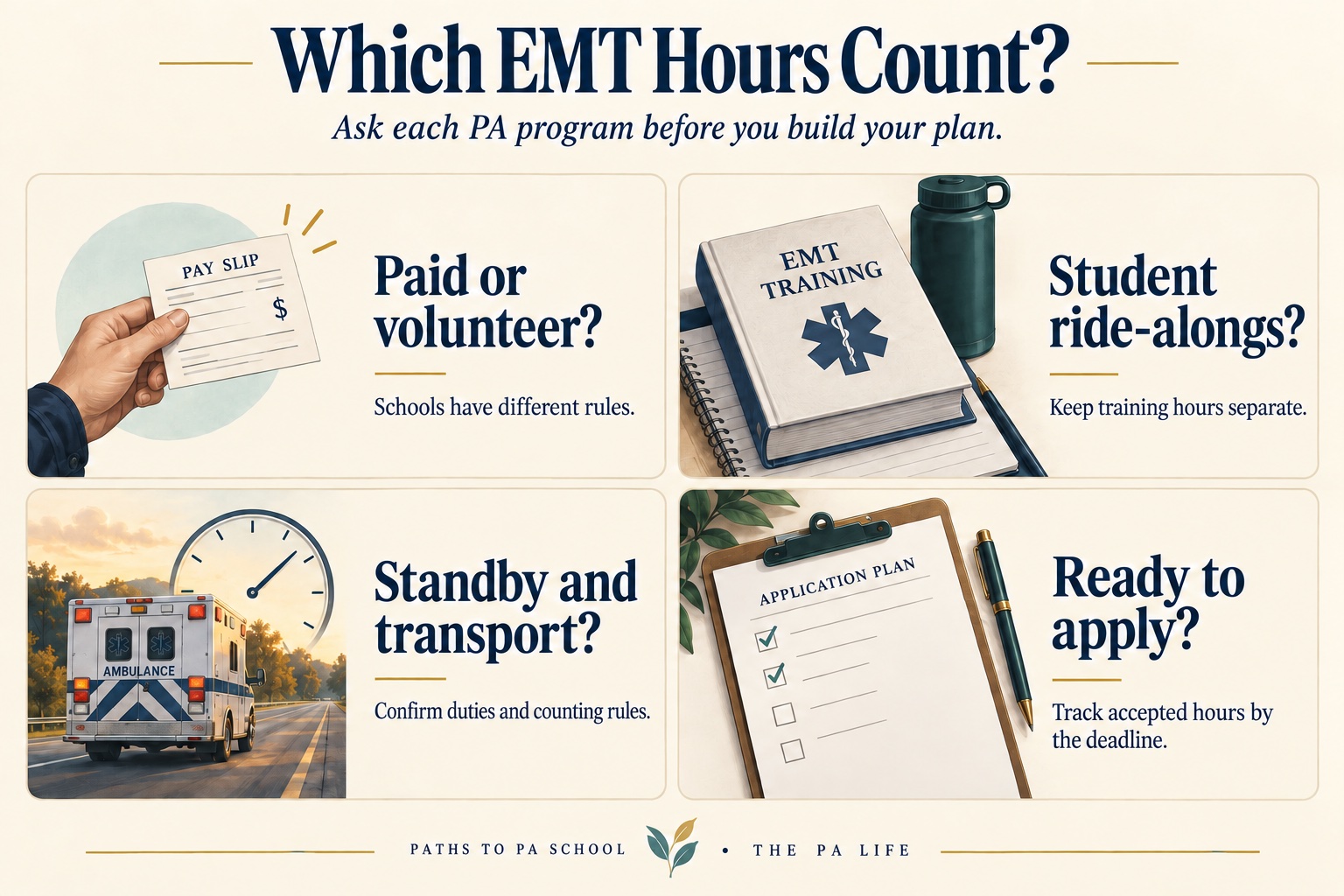
Do paid and volunteer EMT hours both count for PA school?
Sometimes. This is one of the most consequential details in the entire decision.
A volunteer rescue squad may offer excellent experience and serve a real community need. But if your target program requires paid clinical work, the quality of that experience does not automatically erase its paid-work rule.
Here are examples from official policies checked in September 2026. They illustrate differences; verify the requirements for your application cycle.
| PA program | Minimum and timing | What an EMT applicant should notice |
|---|---|---|
| Duke | 1,000 hands-on hours by May 1 of the application year | Lists EMT/paramedic; excludes certificate-training and student clinical hours. |
| MEDEX Northwest | 2,000 hours of paid, recent care by the application deadline | Volunteer EMT/paramedic exception applies when emergency services are provided entirely on an all-volunteer basis. Student training does not count. |
| Pacific University | 1,000 hours at CASPA submission | Accepts paid or volunteer experience; lists EMT and evaluates the described duties. Does not project future hours. |
Notice the deadline column. Having enough hours by the first day of PA school is not the same as having enough hours when a program requires them.
Use our guide to healthcare and patient care experience for the broader definitions. Then build your plan around the individual schools you may actually apply to.
Do ride-alongs, standby time, and transport shifts count?
This is where “I'm an EMT” stops being a complete answer.
Student ride-alongs
Keep training hours separate from subsequent work. Some schools exclude care performed as part of a certificate program or student clinical experience, as the examples above show.
Do not turn that into a universal prohibition, though. The University of South Alabama's 2026–27 policy says patient-contact hours from training, educational, or internship programs will be considered. Ask each school how it treats your particular experience.
Standby and on-call time
A scheduled shift, time available for calls, and time providing direct care are different things. Ask how the program wants your hours calculated when your assignment includes substantial standby time, driving, or nonclinical duties.
Do not assume that every hour on a 24-hour roster qualifies. Do not automatically throw away all non-contact portions of an otherwise accepted clinical job, either. Get the school's counting instructions and keep records that let you follow them.
Interfacility transport
Ask what you actually do during a transport shift: assess patients, monitor changes, obtain histories or vital signs, provide authorized care, document, and give handoffs—or primarily drive and move people?
Pacific, for example, lists EMT as accepted experience but also identifies patient transport among duties that are typically not accepted. That is a reason to send admissions the actual job description, not to declare that every ambulance transfer is disqualified. Its policy emphasizes individual review of duties.
Here is a useful question to send before committing to a job:
“I am considering an EMT position with
. It is [paid/volunteer] and includes [specific duties]. How would your program classify this experience, and how should I calculate hours that include standby, driving, training, and direct patient care?”Service title
Save the response with the policy and date. Keep employer contacts, dates worked, hours, and an accurate duty description. You do not need patient names or identifying details in your personal application tracker.
Can you work as an EMT while completing your bachelor's degree?
You can, if the actual job schedule fits your academic schedule. “Flexible shifts” in an advertisement is not enough information.
Before accepting a position, ask about minimum shifts, mandatory weekends, overtime, orientation, commute time, and whether part-time employees can reduce hours during exams. Ask what happens when a call runs beyond the scheduled end of your shift.
The BLS notes that EMT and paramedic schedules can include nights, weekends, holidays, and extended shifts. Those patterns may open space for classes, but they also require recovery time. An empty square on your calendar after an overnight shift is not necessarily a good place for organic chemistry lab.
My recommendation: start with a workload you can sustain, then increase it if your grades, sleep, and finances allow. Avoid building a semester around the hope that every shift will be quiet enough to study.
EMT is also physically and emotionally demanding work. Ask prospective employers about lifting equipment, orientation, supervision, and support after difficult calls. Those questions belong alongside the hourly rate.
What degree and prerequisites will you still need?
An EMT certificate does not replace a bachelor's degree or college science prerequisites. If you are entering an associate degree or EMS degree program, check how its credits transfer into your intended bachelor's program and how individual PA schools evaluate its courses.
Choose your undergraduate major with degree completion, grades, cost, and your interests in mind. EMT can be the job alongside that degree; it does not have to dictate the major.
Start a school-by-school list of PA prerequisites. Common planning categories include biology, chemistry, anatomy and physiology, microbiology, statistics, and psychology. Requirements for labs, course level, organic chemistry or biochemistry, AP credit, and online coursework vary.
Do not assume that anatomy covered inside an EMT course satisfies a college anatomy requirement. Similar subject matter does not establish course equivalency.
If you are considering a structured EMS degree, ask the academic advisor which electives can be replaced, which courses must stay in sequence, and whether required sciences are available outside the cohort schedule. An advisor can explain degree flexibility; the PA program decides whether a course meets its admissions requirement.
What is a realistic “Goldilocks” schedule for an EMT on the pre-PA path?
There is no universal semester plan that keeps every PA school open. But there is a useful approach: start prerequisite sequences early enough to finish, add clinical work gradually, and keep time-sensitive courses close enough to your intended application.
This is a planning framework for students at any institution, to adapt with their advisors and target programs:
- Before enrolling in EMT training: Identify a preliminary PA school list, map degree requirements, and confirm that local entry-level jobs fit school policies. Price the entire route into employment.
- During early college: Begin foundational courses needed for later science sequences. Put accelerated EMT training into a period with enough protected study time, rather than stacking it onto an already difficult term.
- Once authorized and hired: Begin a manageable work schedule. Track the hours your schools accept. Reassess after your first exam cycle before adding shifts.
- During later college: Complete the required sciences and labs in sequence, fill school-specific gaps, and protect both science grades and course-recency windows. Shadow PAs so you can explain the profession you are pursuing.
- Before your application cycle: Check completed hours against each deadline, review transcript gaps, request references, and leave room for a retake or another cycle if needed.
For a simple planning example, 12 accepted hours a week for 40 weeks equals 480 hours; 24 for 40 weeks equals 960. Those are illustrations, not promised credit or recommended workloads. Missed shifts, training exclusions, and a school's counting rules change the result.
The goal is a credible application you can afford and sustain. It is not the largest possible number on a time sheet.
Can prerequisites expire while you are working?
Yes—and this should be near the top of a working EMT's planning list. A course can remain on your transcript and still become too old for a particular PA program.
For example, Duke currently uses a ten-year prerequisite window measured from January 1 of the application year. Other schools may use different windows or different reference dates.
Record the course completion date, the school's recency rule, the date from which it measures age, and the last cycle in which your course will qualify. Check whether a waiver exists; do not assume clinical employment will earn one.
Then test your plan against a second application cycle. If anatomy is valid for your first attempt but would expire before the next, you want to discover that while you still have registration options.
I would rather see you make that adjustment deliberately than learn, after another year of working, that you need to retake a course you thought was finished.
Should you work for a few years before applying?
Sometimes a dedicated work period is exactly what an application needs. It can provide clinical maturity, stronger references, savings, and enough accepted hours for a broader school list.
But “work for three years” is not a universal recommendation. Apply when your experience and academics support a competitive application to a sensible set of programs. Minimum eligibility and competitiveness are different questions.
Evaluate another year of work against its actual purpose. Will it fix an hours shortfall? Give you time to finish required classes? Help you become a stronger clinician? Or are you postponing because you heard that everyone needs an arbitrary number of years?
Income matters, too. The BLS reports a May 2025 median annual EMT wage of $44,470, compared with $60,600 for paramedics. These are national occupational medians, not starting salaries or a promise about part-time earnings. Build your budget from real local offers, including benefits, commuting costs, and expected hours.
If PA plans change, EMT still gives you a healthcare credential and work experience. Whether that is a satisfying long-term option depends on your local opportunities and interest in EMS. Investigate advancement rather than assuming the entry credential alone provides the career you ultimately want.
Have students actually used EMT experience to get into PA school?
Yes. Northwestern's official student profiles include Vanessa Aguayo, a member of the Class of 2028 with a BA in sports medicine and experience as an EMT and physical therapy aide. The same class includes Emily Monigle, who earned a BS in behavioral science and lists EMT experience.
These examples show that EMT experience can accompany different undergraduate degrees on the way to PA school. They do not tell us that EMT work caused admission, establish a preferred major, or reveal a number of hours that will work for everyone.
That is how I would use success stories: evidence that a route is possible, followed by a careful look at whether it fits your circumstances.
Would MA or CNA be a better choice for you?
Compare actual opportunities, not a ranking of job titles.
- Consider EMT if you want field-based care, can complete the credentialing steps, and have access to an accepted role with a sustainable schedule.
- Consider medical assisting if an available clinic job offers substantial hands-on duties, useful mentorship, and hours that fit your classes. Clarify the clinical versus administrative split.
- Consider CNA work if accessible training and bedside employment fit your plan. Confirm the duties and setting against each PA program's policy.
- Consider a professional degree such as sonography if you want that profession in its own right and understand the time, cost, degree structure, and additional prerequisites.
A good EMT job can be an excellent choice. So can a good clinic or bedside job. I would favor the position that lets you care for patients well, keep learning, and finish the academic work you still need.
What should you do before signing up?
Choose several realistic schools through PA School Finder, then verify their official requirements. Compare local courses and jobs against that list. Put your training dates, degree milestones, accepted hours, application deadlines, and prerequisite expiration dates into one plan.
The PA Life Applicant Toolkit can help you organize your application planning. Keep the official school policy and any admissions clarification alongside your notes so you can revisit the decision when a requirement changes.
My recommendation: Choose EMT because the work interests you and the particular opportunity fits your PA plan. Give yourself enough time to become useful to your patients and your team. Protect your grades. Watch those expiration dates. Then apply when the whole application is ready.
Explore the rest of the Paths to PA School series to compare your options.
You may also like -
 CNA to PA School: Is It the Right Path for You?Is CNA a good path to PA school? Compare accepted patient care hours, training costs, work schedules, prerequisites, and when to apply.
- Medical Assistant to PA School: Is It the Right Path for You?Is medical assisting a good path to PA school? Compare training, accepted patient care hours, pay, prerequisites, and the timing of your application.
- Sonography to PA School: Is It a Smart Major Choice?Is sonography a good major for PA school? Explore prerequisite gaps, patient care hours, real career paths, and whether to work before applying.



CASPA Personal Statement Help
 We offer comprehensive, start-to-finish personal statement assistance or help to perfect a draft you already have. We have services to fit every budget.
 Schedule a Live Recorded PA School Video Interview

We offer 60-minute mock PA school interviews with post-interview feedback and advice. Includes a recorded video of your interview that you can watch, download, or share with family and friends. There is no better way to prepare!
Schedule an InterviewPre-PA Consulting and Advising
 Our pre-PA coaching service consists of a 1-hour phone consultation focused on addressing your specific questions or concerns about becoming a PA and applying to PA school.


Leave a Reply