
Sonography can give you a meaningful career, hands-on patient care, and a strong foundation for PA school. But you need a separate plan for your PA prerequisites—and for when you actually want to apply.

While dropping off my daughter at Seattle University, I met a freshman who was studying sonography with the goal of eventually becoming a PA.
I liked the idea. Learn a useful clinical skill. Earn a degree that leads to a profession. Spend time caring for actual patients before deciding what comes next.
Then she mentioned something that stuck with me: she wasn't going to be able to complete all of her PA school prerequisites within her ultrasound degree path.
Wait. A healthcare degree that doesn't automatically cover the requirements for another healthcare degree?
Welcome to pre-PA planning. Bring a spreadsheet—or let our PA Life Applicant Toolkit help you get organized.
Her situation raises two questions worth asking before you choose your major: Is sonography a good path to PA school? And does it make sense to train for one profession, work for a few years, and then train for another?
My answer is yes—with a little homework up front. I would encourage this path for someone who wants to be a sonographer and may later become a PA. I'd be more cautious if the only attraction is a supposed shortcut into PA school.
This article is part of our Paths to PA School series, comparing healthcare backgrounds, prerequisites, and patient care experience. Also explore medical assisting as a path to PA school.
Can you go from sonographer to PA?
Yes. A sonography background can fit a PA school application. For example, the University of Washington's MEDEX Northwest accepts bachelor's degrees in any field, provided applicants meet its other requirements. A particular major does not replace prerequisite coursework.
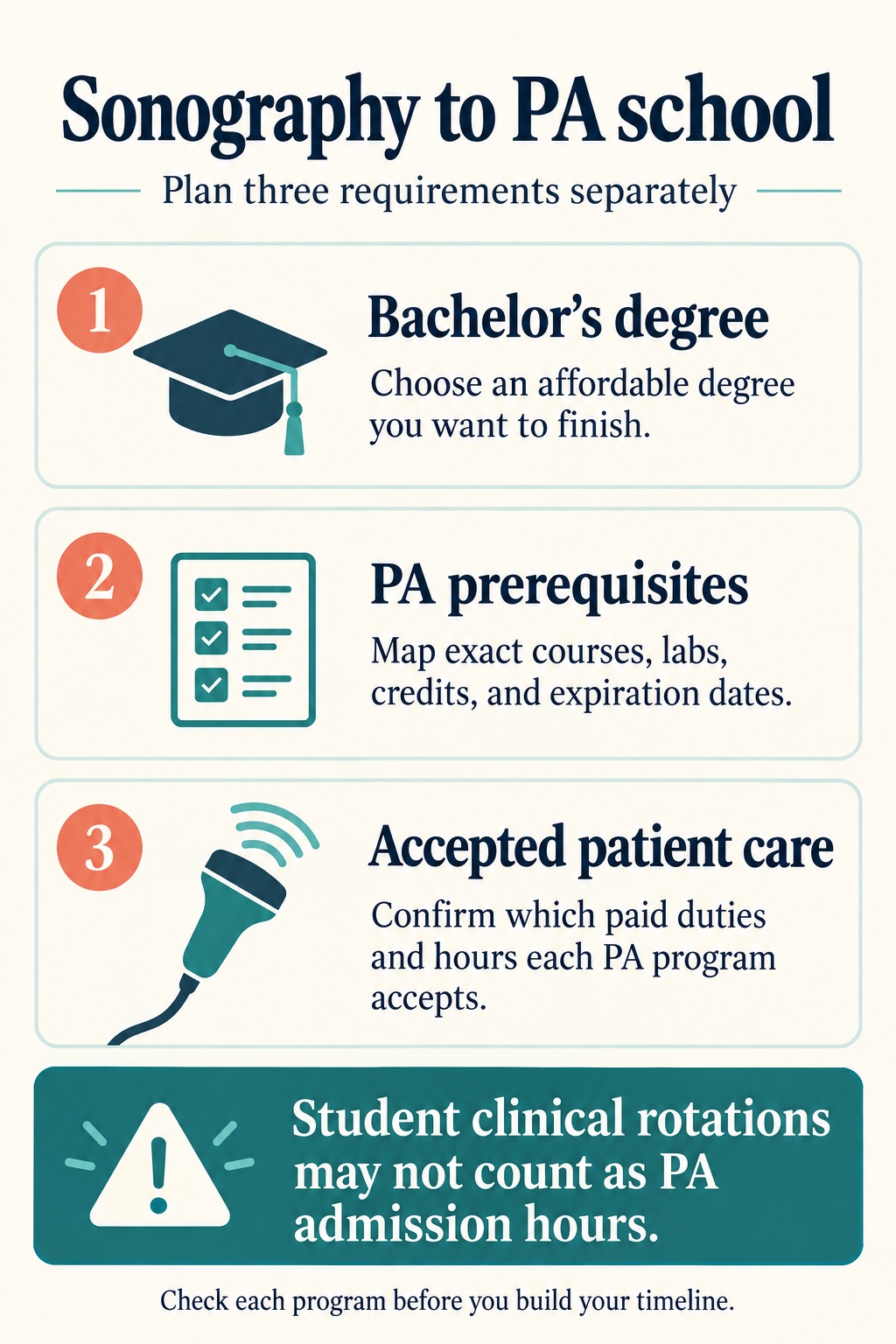
Think of your preparation as three separate jobs:
- Meet the degree requirement. A bachelor's in diagnostic ultrasound can do that for programs requiring a bachelor's. An associate degree or certificate alone generally leaves additional degree planning to do; check the individual PA program for exceptions.
- Complete the exact PA prerequisites. Course content, credits, labs, grades, and age of coursework all matter.
- Build the experience your target programs accept. The duties you perform and the circumstances in which you earn the hours matter—not just the job title.
The first two points are reflected in MEDEX's academic requirements; the experience differences become especially important below.
If you're still choosing a major, start with my broader guide to choosing an undergraduate major for PA school. This article is about the particular tradeoffs of sonography.
Why sonography can be excellent preparation
Sonography asks you to understand anatomy while working with a person who may be uncomfortable, frightened, or very sick. You need technical skill, judgment, and the ability to explain what you're doing without stepping outside your role.
The Society of Diagnostic Medical Sonography's scope of practice describes a profession built around skilled examinations, professional judgment, communication, and providing images and findings to an interpreting physician or other authorized provider.
That is a useful place to start learning how a healthcare team works.
As a future PA, I would want you to notice more than the scan. How do you help an anxious patient cooperate? How do you recognize the limits of your examination? How do you communicate a concern to the appropriate clinician? Those are experiences you can reflect on long after you've entered the hours into CASPA.
But being skilled at ultrasound doesn't mean you've already learned the PA role. Becoming a PA adds broader training in evaluating patients, making diagnoses, and managing treatment. Shadow PAs so you understand whether that additional responsibility is what you actually want.
What I found about Seattle University's prerequisite gap
I checked Seattle U's published curriculum because I didn't want to turn one student's experience into a blanket statement about the university.
Its four-year diagnostic ultrasound plan separates students entering before summer 2027 from those entering in summer 2027 or later. For the earlier cohort, the quarter plan shows:
- Anatomy and physiology: BIOL 2200 and 2210.
- General biology: BIOL 1610/1611.
- A chemistry choice: CHEM 1500/1501 or CHEM 1200, Chemistry of Life.
- Specialty ultrasound coursework followed by a full-time clinical year extending through summer.
Microbiology, statistics, and organic chemistry/biochemistry aren't named requirements in that sample quarter plan. Nor does it show a full general chemistry series. The later semester plan differs, so incoming students need the plan for their own cohort.
That supports a prerequisite-planning concern. It does not prove that every ultrasound student is unable to complete PA prerequisites at Seattle U.
The distinction matters: a course can be available at a university without fitting conveniently into your major. Whether it fits your schedule takes an individual degree audit, including transfer credit, course sequencing, lab times, summer availability, and any extra tuition.
I haven't reviewed this student's transcript or an advisor-approved plan, so I wouldn't prescribe a solution for her. For another student, the fix might be an elective. For someone else, it might be summer classes or coursework after graduation.
How much room is there to customize a sonography degree?
A structured sonography degree does not necessarily prevent you from completing PA prerequisites during college. The flexibility may be in approved foundational-course choices and electives, while the professional and clinical sequence follows a prescribed schedule.
Seattle U describes its sample plan as one possible route and calls for individualized planning with an advisor. In its quarter plan, students can choose General Chemistry I with lab instead of Chemistry of Life. It also shows a five-credit sophomore elective opportunity, although that space may be needed for an unfinished core requirement. Meanwhile, its cohort-based ultrasound courses must be taken in order, and clinical study is full-time. The semester plan for students entering summer 2027 onward differs. See Seattle U's sample plans and curriculum notes.
The question is whether the specific courses you need can fit—not simply whether you can take something “higher level.” An advanced professional course is not automatically an acceptable substitute for a PA program's required science course. Nor does an elective slot guarantee that a particular lab science will fit its credit limit, scheduling, or degree requirements.
Meet with both sonography and pre-health advisors early. Ask which approved courses can satisfy both goals, which PA prerequisites can fill electives, and which science sequences you need to start now. Have them identify anything that would require summer study, an overload, or an extra term, including the cost. Confirm course acceptance with your target PA programs before enrolling. Do this before assuming you must finish all the gaps after graduation—or that they will all fit within four years.
Compare actual PA requirements before choosing those electives
Here are two regional examples, checked in September 2026. These are selected requirements to illustrate the issue, not complete admissions checklists.
| PA program | Requirements to plan around |
|---|---|
| UW MEDEX Northwest | A&P, organic chemistry or biochemistry, microbiology, and statistics/biostatistics. Prerequisites must be completed within seven years of applying. A&P labs are waived for the 2026–2027 cycle but required for 2027–2028. |
| Pacific University, Oregon | A&P, a year of general chemistry with labs, organic chemistry or biochemistry, microbiology, statistics, and psychology or sociology. Its A&P recency rule is tied to matriculation. |
Sources: MEDEX academic prerequisites and Pacific prerequisite coursework. Requirements can change before a current freshman applies.
Notice what happens with chemistry. A class that satisfies your ultrasound degree may not satisfy a PA program's general chemistry sequence or get you into the next organic chemistry course.
Also, don't assume professional coursework automatically substitutes for a standalone science class. MEDEX specifically distinguishes its prerequisites from coursework embedded in professional training. Ask admissions to evaluate the actual course and syllabus.
My recommendation: map backward from a preliminary list of PA programs before you register. Start with five to eight realistic options, then compare their requirements. That list can change; its job now is to reveal expensive surprises while you still have room to plan.
A “Goldilocks” prerequisite plan: keep your options open without overloading your degree
Wherever you study sonography, the planning question is the same: how can you keep PA school options open while completing your professional training? I would aim for courses that serve both goals, while protecting your grades and clinical preparation.
Use this as a flexible framework to adapt with your advisors, rather than a fixed course schedule. Sonography programs differ in length, degree requirements, elective space, and clinical timing, so the stages below may overlap or fall before or after professional training. Your advisors can help check course availability, prerequisite sequences, credit limits, and the requirements for your cohort. Confirm acceptance with your target PA programs; not every prerequisite will necessarily fit within your degree.
| Stage | What to prioritize with your advisor |
|---|---|
| Early planning and foundational courses | Choose an accepted general chemistry course with lab when your major permits it. Map the remaining chemistry sequence and the biology foundation needed for later sciences before choosing electives. |
| Before intensive professional or clinical training, when feasible | Plan an accepted A&P sequence with labs, using overlap with your degree where available. Look for workable openings for statistics and microbiology after checking their prerequisites, lab requirements, and course availability. |
| Available electives or summers | Address the gaps that matter most to your target schools: remaining general chemistry, organic chemistry or biochemistry where accepted, additional biology, or psychology/sociology. Confirm that an elective can count toward the degree and that summer is actually available. |
| During professional and clinical training | Protect the required sonography sequence and your GPA. Add another science only if the actual schedule and workload support it; don't build the plan around free time you may not have. |
| First working year, if needed | Finish remaining verified gaps while building accepted patient care hours. Recheck course expiration and application deadlines before extending the timeline. |
The chemistry sequence deserves an early look. Choosing General Chemistry I with lab may help, but that one course does not complete a year-long requirement or automatically qualify you for organic chemistry or biochemistry. Map the entire chain of prerequisites with your advisor.
You don't need to prepare for every PA school in the country. Start with programs you would seriously consider, and ask of each additional course: How many schools on my list does this help me qualify for—and what will it cost in tuition, time, and workload? Include any earlier courses you must complete to get into that class when you calculate the cost.
I would rather see a student complete a manageable, carefully chosen set of courses with strong grades than overload a clinical term trying to cover every possible requirement. Review the plan each year, including course expiration, so your school list and your timeline still work together.
Turn your major into a PA school plan. Start researching programs on PA School Finder, then choose My Schools in the menu to continue into the PA Life Applicant Toolkit. Use it to organize your school list, coursework, and patient care experience. Bring that plan to your academic advisor, and confirm course requirements directly with each PA program.
Does sonography count as patient care experience for PA school?
It can—and some programs explicitly list it. Pacific University includes ultrasound technologist/technician among previously accepted roles. Its current minimum is 1,000 hours by CASPA submission, and it evaluates how applicants describe their responsibilities.
But there is a catch that deserves its own paragraph:
Your sonography clinical rotations may not count toward PA school admission hours.
Pacific excludes hours earned to obtain another degree, license, or certificate. MEDEX requires at least 2,000 hours of qualifying paid, recent experience by its application deadline and excludes student training hours. See Pacific's patient care policy and MEDEX's clinical experience policy.
Those rotations are valuable education. Their value and their eligibility for an admissions minimum are separate questions.
Before you count a single clinical-school hour toward your PA application plan, get the target program's answer. Keep student rotations separate from employment in your records. Don't enter the same hours twice under different experience categories.
And describe your actual work: patient preparation, histories, examinations, communication, and other responsibilities you personally perform. Don't add duties because they sound more impressive. My patient contact hours guide explores the questions to ask; each school's current policy controls.
What do people who actually made the transition say?
I wanted more than a theoretical pathway, so I looked for people who had done it.
A named example: seven years in vascular sonography
In a Global Ultrasound Institute account, Agnes Lovell, PA-C, RVT, describes a background that included seven years in vascular sonography before PA school.
Her experience highlights both a benefit and an adjustment. Ultrasound expertise carries forward, but focused point-of-care ultrasound answers a different kind of question from a comprehensive diagnostic study. Becoming a PA means learning how to use that skill within a broader clinical role.
That's a useful example of professional growth. It isn't evidence that you should wait seven years.
Working while completing a bachelor's
In a public sonographer-to-PA discussion, a commenter identifying themselves as a sonographer in PA school reported completing an online bachelor's in radiation and imaging sciences through Bellevue College while working.
That illustrates one possible route for someone who already has an associate degree. It doesn't establish that a particular degree-completion program covers your remaining PA prerequisites.
The paycheck alone may not justify going back
In another public discussion about moving from ultrasound to PA school, a commenter identifying themselves as a former ultrasound tech and current PA student emphasized wanting a broader role on the care team rather than making the decision purely for money.
The Reddit accounts are anonymous, self-reported experiences, not independently verified credentials or admissions outcome data. They help identify questions to ask; they cannot tell us how likely this pathway is to succeed.
I did not find comparative evidence establishing an ideal number of years to work as a sonographer before PA school—or showing that this major itself improves admission odds over other majors. There is no sound reason to turn somebody else's timeline into your requirement.
Should you work as a sonographer for a year or two first?
For a freshman who likes sonography and expects to need paid patient care after graduation, I think one to two years of work is a reasonable initial planning scenario. That's my recommendation, not an admissions rule or a proven optimum.
It gives you a concrete period in which to develop as a clinician, finish missing courses, build relationships with supervisors, save what you can, and test whether the PA role still fits.
Then reassess based on readiness, rather than waiting for an arbitrary anniversary.
- Apply sooner if you already meet the requirements, have a strong academic record and accepted experience, understand the PA role, and can explain why you want it.
- Work longer if you need more accepted hours, science preparation, savings, or time to make a confident career decision.
- Stay in sonography if you discover that it gives you the work and life you want. That is a successful outcome, too.
A little planning arithmetic helps. At 36 qualifying hours a week for 48 weeks, you would accumulate 1,728 hours. At 40 hours for 50 weeks, you would reach 2,000 hours. These are illustrations, not guarantees: employment start dates, leave, duties, and program rules affect your actual count.
Also distinguish time before applying from time before starting PA school. Applying after your first working year may mean you continue working through much of a second year before matriculation. You don't necessarily need to wait two years just to submit an application.
Plan for the deadline as well as the total. Pacific counts experience at submission; MEDEX's policy addresses experience through its deadline. Don't assume a future year's work is available for a requirement assessed today.
Working for a few years? Put prerequisite expiration near the top of your plan
Your clinical experience can grow while your prerequisite courses become too old for a PA program to accept. If you plan to work as a sonographer before applying, checking PA school prerequisite requirements and expiration rules should be one of your first planning steps. Otherwise, you could find yourself paying to retake a course you already passed.
There is no single expiration rule across PA schools. Check which courses have a recency limit, how many years each program allows, and whether it measures course age at application or at matriculation. As the examples above show, those dates are not interchangeable.
For each target school, record when you completed the course and the latest application or start date that would keep it within the school's current policy. Review that list before deciding to work another year, and recheck it for your intended application cycle. If a course may fall outside the limit, ask admissions about your options before paying to repeat it. Do not assume that working as a sonographer automatically keeps an older science course eligible. An exception, if available, needs confirmation from the program.
When would I choose a different major?
If you have little interest in ultrasound itself and your priority is reaching PA school with the least additional training, compare other routes before committing.
| Your situation | A route worth comparing | What to check |
|---|---|---|
| You want sonography as a real career option | Bachelor's in sonography, planned PA prerequisites, then paid clinical work. | Total net cost, extra courses, clinical schedule, and accepted hours. |
| You want PA school and don't particularly want to scan | An affordable major you enjoy, plus a separately planned patient care role such as EMT, CNA, or medical assistant. | Training time, local hiring requirements, and whether target PA programs accept the duties. |
| You're already a working sonographer | Keep earning while filling verified gaps; add a bachelor's completion route if needed. | Transfer credit, lab access, workload, and each school's degree deadline. |
These are planning options, not a ranking of professions. Biology does not automatically win because it sounds premedical. Sonography does not automatically win because it sounds clinical. Compare the complete route you can afford and perform well in.
Protect your GPA. Adding a science sequence on top of a demanding clinical schedule can backfire if it leaves you with weak grades in both. A slower, sustainable plan may serve you better than an overloaded semester and a long repair project afterward.
Does the financial side make sense?
Sonography is an established profession with its own earning potential. That changes the decision to leave work for another degree.
The Bureau of Labor Statistics reports national median annual wages of $96,590 for diagnostic medical sonographers and $135,880 for physician assistants in May 2025. These are occupation-wide medians, not starting salaries or Seattle job offers. Sources: BLS sonographers and BLS physician assistants.
That national difference doesn't tell you the return on your particular decision. Compare local jobs, actual benefits, hours, tuition, scholarships, and the income you would give up while in school.
For a simple illustration, leaving a $95,000 job for a 27-month PA program means about $213,750 in forgone gross wages, before tuition or fees. That is not a loan balance and not a personalized cost estimate. It's a reminder that tuition isn't the only cost.
Make two budgets:
- Becoming a sonographer: net tuition after aid, living expenses, clinical travel, credentials, and extra PA prerequisites.
- Moving from sonography to PA: PA school tuition and fees, living costs, forgone earnings and benefits, and borrowing costs.
Also budget for the cost of applying to PA school, including applications, required tests, and interviews.
Don't build a PA-school budget that requires you to keep a full sonography work schedule. Check the program's employment policy and make the plan work without depending on substantial outside employment.
I love being a PA. I still want you to run the numbers before you leave a career you enjoy.
Questions to ask before enrolling in sonography
A sonography program deserves the same careful evaluation as a PA program.
- What is the exact program's accreditation and credentialing pathway? Verify the program and specialty through CAAHEP's directory, and check ARDMS eligibility requirements. Institutional accreditation and sonography program accreditation are different. Under ARDMS Prerequisite 2, qualifying accredited-program graduates do not need additional clinical experience beyond that pathway's training requirements.
- What are the real clinical logistics? Ask about placement arrangements, travel, relocation, attendance, and how much scheduling flexibility exists for additional classes.
- What do graduates actually do? Request recent credentialing and employment outcomes, and speak to alumni about starting work.
- Do I enjoy the physical work? Shadow a sonographer. Ask about positioning, equipment, repetitive scanning, and workload. The SDMS publishes ergonomic standards addressing work-related musculoskeletal injury; this belongs in a career decision, too.
My favorite question is personal: If PA school took longer than expected—or I changed my mind—would I still be glad I had become a sonographer?
If the answer is yes, that tells you something useful.
A practical plan for the freshman I met
Here's the plan I would suggest discussing with her advisors, without pretending I know her full academic or financial situation.
- Start a preliminary PA school list. Include several programs you might realistically attend. Record courses, labs, minimum credits, grades, experience policies, and deadlines.
- Meet with both the ultrasound advisor and pre-health advising. Bring that list and ask for a term-by-term degree plan with the missing courses clearly marked.
- Get questionable courses evaluated before paying for them. A similar title isn't enough. Ask the PA program about the course description and syllabus, especially for chemistry and professional science courses.
- Price the gaps. Compare approved summer, community college, and postgraduation options. Confirm acceptance before enrolling and don't assume financial aid covers every additional term.
- Separate training from employment. Budget postgraduation time for accepted paid patient care if the target programs require it.
- Set a reassessment date. Review the plan near graduation and during the first working year. Apply when the application is ready; revise the plan when the evidence changes.
Here's a message you can adapt for an admissions office:
I'm completing a diagnostic ultrasound degree and planning for your PA program. Would [course number, title, credits, lab format, and syllabus] meet your [specific prerequisite]? Separately, would paid work as a [job title] performing [actual duties] meet your patient care requirement? Do you exclude clinical rotations completed for my ultrasound degree, and when must the qualifying hours be finished?
Save the reply with the date and application cycle. Written clarification is much more useful than a vague reassurance that your major is “good for PA school.”
Common questions about sonography as a pre-PA major
Do all sonography programs leave PA prerequisite gaps?
No universal answer applies. Sonography curricula differ, PA requirements differ, and your prior coursework matters. Compare the exact combination rather than assuming every health science degree includes the same preparation.
Can I take missing prerequisites at a community college?
Some PA programs allow this; MEDEX and Pacific both describe accepting coursework from regionally accredited community colleges. Verify the specific course, credit, lab, and timing rules with each target program before you enroll.
Do I need to work several years before applying?
No universal rule says you must. Meet the experience requirements for your schools and assess the strength of your whole application. Extra years should have a purpose: better preparation, financial breathing room, or clarity about the work you want.
Is there a shortcut or automatic bridge from sonography to PA?
Don't plan on one. Unless a specific PA program publishes an applicable pathway, assume you will apply through its regular process and complete its PA curriculum. Sonography experience can strengthen your preparation; it doesn't automatically waive admission or training requirements.
What I'd tell a student—and a parent
What I liked about that freshman's plan was that it led somewhere meaningful even before PA school.
The part I would want to tighten was the course map.
Choose sonography because you want the skills and would value the career. Then build the PA prerequisites and application timeline around the actual requirements.
A professional degree followed by a few years of work can be a thoughtful choice. So can a more direct route. You don't need to copy somebody else's timeline to build a good one.
Your next step: build a plan for your own schools. Start on PA School Finder and open My Schools to use the PA Life Applicant Toolkit. Keep your target programs and preparation organized as your coursework and clinical experience grow.
For a quick reference alongside that plan, use my PA school prerequisite cheat sheet. Confirm final course equivalencies and accepted patient care hours with each program before making enrollment or application decisions.
And if you've made the move from sonography to PA, I'd love to hear what you would tell the next student: Which courses surprised you, how long did you work, and what would you do differently?
Thanks for reading!
Stephen Pasquini, PA-C
Research checked September 22, 2026. Linked program policies are examples, not a substitute for the requirements in your application cycle. Career recommendations are my interpretation of those policies and the experiences described above; they are not a guarantee of admission.
You may also like -
 Phlebotomist to PA School: Do Your Patient Care Hours Count?Is phlebotomy good experience for PA school? Learn how programs evaluate blood-draw duties, donor-center work, training, and your application timeline.
- RN to PA School: Should a Nurse Become a Physician Assistant?Can an RN become a PA? Compare degree requirements, patient care experience, prerequisite expiration, and the decision between PA and NP training.
- EMT to PA School: Is It the Right Path for You?Is EMT a good path to PA school? Compare paid and volunteer hours, training costs, transport duties, prerequisites, and a realistic application timeline.



CASPA Personal Statement Help
 We offer comprehensive, start-to-finish personal statement assistance or help to perfect a draft you already have. We have services to fit every budget.
 Schedule a Live Recorded PA School Video Interview

We offer 60-minute mock PA school interviews with post-interview feedback and advice. Includes a recorded video of your interview that you can watch, download, or share with family and friends. There is no better way to prepare!
Schedule an InterviewPre-PA Consulting and Advising
 Our pre-PA coaching service consists of a 1-hour phone consultation focused on addressing your specific questions or concerns about becoming a PA and applying to PA school.


Leave a Reply