
Medical assisting can be a practical way to earn patient care experience before PA school—provided the job's duties count, the training makes financial sense, and you keep your degree and prerequisites on track.

After looking at sonography as a path to PA school, I wanted to explore a different question: What if you want to start working with patients without first committing to another lengthy professional degree?
Medical assisting belongs in that conversation. You may be able to work alongside PAs, get comfortable talking with patients, and earn a paycheck while finishing college or preparing your application.
But before you sign up for the first certification course that appears in your search results, let's slow down for a minute.
A medical assistant certificate, a medical assistant job, and patient care experience accepted by a PA program are three different things. Your plan needs all the pieces to fit.
This article is part of our Paths to PA School series, comparing the real tradeoffs of different healthcare backgrounds. Start with the profession you are considering, then build a plan around the PA programs you would actually attend.
Is medical assistant a good job before PA school?
Yes—when it gives you meaningful, accepted patient care experience at a cost and schedule you can manage. I would put it on the short list for someone who wants outpatient experience, enjoys working with people, and can find an employer offering appropriate training and supervision.
I would be more cautious about paying for an expensive program before checking local job openings, or accepting a mostly administrative position because someone promised that anything inside a medical office counts.
Here is the quick version:
- The opportunity: patient interaction, clinical teamwork, possible PA mentorship, and paid experience.
- The catch: duties vary widely. Front-desk work and hands-on clinical work may receive different treatment from PA programs.
- The academic reality: MA training does not automatically supply a bachelor's degree or the laboratory sciences your target PA programs require.
- My recommendation: investigate the job and the admissions rules before buying the credential.
What does a medical assistant actually do?
Medical assistants support healthcare teams through a combination of clinical and administrative responsibilities. Depending on training, state rules, delegation, and the employer, that may include preparing patients for visits, recording information, obtaining vital signs, assisting with examinations, and performing permitted clinical tasks. Scheduling, billing, and other office work may also be part of the role. The Bureau of Labor Statistics' occupational profile describes that range.
This makes the job title less useful than the job description.
Two applicants can both write “medical assistant” on an application. One spends most of the day working directly with patients. The other spends most of the day scheduling appointments and handling insurance paperwork. Both contribute to patient care delivery. A PA admissions committee may evaluate their experience differently.
Also, a medical assistant is not a physician assistant. MA training prepares you for a support role within its authorized scope. PA education prepares you for a different clinical role and requires its own admissions process. There is no automatic promotion from one to the other.
Does medical assisting count as patient care experience for PA school?
It can, but you need an answer about your actual responsibilities from each program.
Start with the distinction between healthcare experience (HCE) and patient care experience (PCE). CASPA's experience guidance distinguishes direct responsibility for patient care from other work in healthcare. Medical assisting appears among its HCE examples, while individual PA programs may accept hands-on MA duties toward their patient care requirement.
That is why “my friend listed it as PCE” is not enough. Follow the current CASPA instructions and the program's own policy. If the guidance seems inconsistent for your job, ask admissions how it wants the role documented.
These two programs illustrate why the details matter. Requirements were checked in September 2026; this is a comparison of selected experience rules, not a complete admissions checklist.
| Program | Selected experience requirements | What an MA applicant should notice |
|---|---|---|
| UW MEDEX Northwest | At least 2,000 hours of qualifying paid, recent medical care by its application deadline. | Lists medical assistants in clinical settings as examples. Specifically excludes front-office MA work and student training hours. |
| Pacific University, Oregon | At least 1,000 hours by CASPA submission; qualifying paid or volunteer experience may be accepted. | Lists medical assistant among previously accepted roles, evaluates responsibilities case by case, and excludes hours earned toward a degree, license, or certificate. |
Sources: MEDEX clinical prerequisites and Pacific patient care experience.
Your externship may teach you valuable skills without counting toward a PA program's required hours. Keep training and employment records separate. If an apprenticeship includes paid training, ask specifically how those hours are treated; a paycheck alone does not resolve a program's training exclusion.
Keep a log of dates, actual hours, responsibilities, and supervisor contact information. For a mixed clinical/administrative role, ask whether the program counts the whole position or only particular duties. Do not count the same hours twice under different CASPA categories or invent a percentage to make the arithmetic work.
For the broader framework, see my guide to patient contact hours for PA school.
A short email can prevent a very long detour
I'm considering a medical assistant position in [setting]. My expected duties are [specific duties], with approximately [hours] per week. The role includes [administrative work or training, if applicable]. Would this experience qualify toward your patient care requirement? How should I document mixed duties and distinguish training from employment hours?
Attach or link the actual job description if the program welcomes it. Save the reply, and recheck the policy for your application cycle.
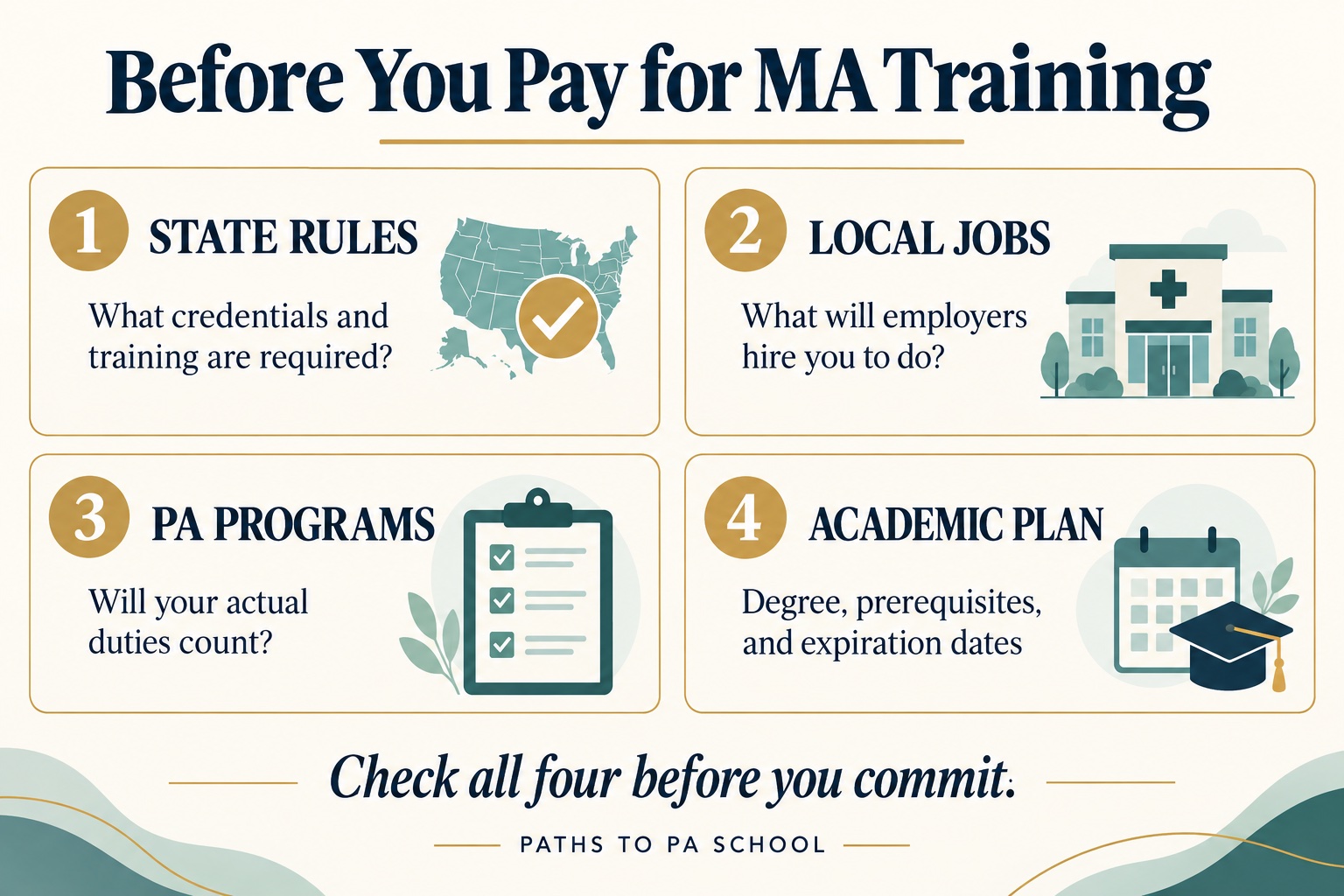
Do you need medical assistant certification first?
Sometimes. The answer depends on your state, your employer, and the route into the job.
The BLS reports that many MAs complete a certificate or associate program, often taking about one or two years, while others enter with a high school diploma and learn through employer training or an apprenticeship. That does not mean every employer hires applicants without credentials—or that every state permits the same pathway.
For example, Washington sets state credentialing requirements for medical assistants. California describes medical assistants as unlicensed personnel and does not generally require national certification, while still imposing training, supervision, and task limits. An employer can set hiring standards beyond the legal minimum.
So begin with three separate questions:
- What does my state require for this role and these duties?
- What do nearby employers actually require or accept?
- Will my target PA programs accept the work I will perform?
CMA, CCMA, RMA: which letters should you pursue?
You will encounter credentials such as CMA (AAMA), CCMA through NHA, and RMA through AMT. They have different eligibility pathways. A state credential can be a separate requirement, and similar initials do not make credentials interchangeable.
The AAMA's CMA eligibility page, for example, includes routes for students and graduates of CAAHEP- or ABHES-accredited programs as well as other eligibility categories. Read the current requirements for the exact credential before paying a school that advertises “certification preparation.”
I would choose the credential that qualifies you for appropriate local work. I would not collect credentials simply to decorate a PA application. Ask employers which credentials they accept, then verify the training program actually makes you eligible for the relevant exam and state credential.
Which training route makes the most sense?
Compare the full route into a job, including the time between finishing a course and actually getting hired.
- Employer training or apprenticeship: worth investigating where available and permitted. Ask about pay during training, supervision, exam eligibility, employment commitments, and any repayment obligation if you leave.
- Certificate program: potentially useful when employers expect formal training. Check accreditation where relevant, clinical placement arrangements, completion outcomes, total costs, and accepted credentials.
- Associate degree: may fit your broader education plan, but examine how credits transfer toward a bachelor's. More credits are only helpful if they move you toward a goal you actually need.
As one concrete example, Seattle Central's medical assisting certificate is advertised as a three-quarter, 48-credit program. This is Seattle Central College, a different institution from Seattle University in our sonography article. It illustrates one option—not a national timetable or a personal recommendation.
Before enrolling, get a written total for tuition, fees, supplies, examinations, required screening, travel, and any unpaid clinical placement. Ask who secures the externship and what happens if a placement is delayed. For online coursework, verify how hands-on training and local employer acceptance are handled.
Then compare that cost with real job postings. A national salary statistic cannot tell you whether a particular training bill makes sense in your town.
How much do medical assistants earn?
The BLS reports a national median annual wage of $45,690, or $21.97 per hour, in May 2025. That is an occupation-wide median, not a starting salary or a guarantee of full-time work.
For your own decision, compare actual wages, benefits, commute, paid training, predictable hours, and flexibility for classes. A slightly higher hourly rate may be less useful if the schedule makes it impossible to attend the chemistry lab you need.
I would also ask: If PA school takes another application cycle, can I afford to keep doing this job? A sustainable plan matters more than a perfect-looking timeline.
Will MA classes cover your PA prerequisites?
Do not assume they will. A course called anatomy, pharmacology, or medical terminology in an MA program does not automatically satisfy a PA program's prerequisite with a similar name.
Compare course level, content, credits, laboratory requirements, minimum grades, and institutional requirements. Ask PA admissions to evaluate a syllabus when equivalency is unclear. Separately, ask your college which credits count toward your degree.
Most applicants also need a bachelor's degree for their chosen graduate PA programs. An MA certificate does not supply that degree; an associate degree may require a transfer or completion plan. See the MEDEX academic requirements for one program's distinction between degree and prerequisite requirements, and use our PA school prerequisite guide to begin your own comparison.
If you already have a bachelor's, the question is usually which verified course gaps remain. If you are still in college, choose an affordable major you can do well in and build MA work around a realistic academic schedule.
A “Goldilocks” plan for work and prerequisites
There is no universal semester-by-semester schedule. The useful middle ground is enough work to learn and accumulate accepted hours, with enough room to earn strong grades. Adapt this framework to your college, training route, and target PA programs.
- Before paying for MA training: compare five to eight plausible PA programs, local hiring requirements, your degree status, and missing courses. Identify any science sequences that take multiple terms.
- During college or MA training: protect required coursework and clinical training. Add employment only at a level your real schedule supports. Check whether summer is truly available before assigning a lab science to it.
- Once working: establish the job routine before adding another demanding course. One lab science at a time may be a reasonable starting point for a full-time worker; it is a planning suggestion, not an admissions rule.
- Before choosing an application cycle: check completed hours against each deadline, remaining courses, degree completion, recommendations, and prerequisite expiration.
Do not postpone an entire chemistry sequence until the last minute because the final course is the only one named on a PA school's list. You may need earlier courses to enroll in it.
And please don't trade a strong science GPA for a few extra shifts without thinking through the consequences. Hours can accumulate next month. Repairing a damaged transcript can take much longer.
Put prerequisite expiration near the top of the list
Working longer can strengthen your experience while making an older prerequisite ineligible. Programs differ in which courses expire, the time allowed, and whether course age is measured at application or matriculation.
MEDEX, for example, currently requires its prerequisites within seven years of applying. That is a program-specific rule, not a universal seven-year clock. Check the current academic policy for the cycle you intend to enter.
Record each course's completion date and each target school's recency deadline. Review that list before deciding to work another year. Do not assume clinical employment automatically renews an old science course or qualifies you for an exception.
Use the PA Life Applicant Toolkit to organize your application plan, and keep program-specific expiration notes with your school and coursework records. Confirm the rules directly with admissions before paying to repeat anything.
What can we learn from people who took this route?
I looked for named examples rather than relying only on anonymous “this worked for me” posts.
In a University of Toledo profile, PA student Michelle Zilberman describes working as an urgent care medical assistant while completing her undergraduate education and working closely with PAs. Her background also includes Army medical laboratory experience. It is a useful example of combining college with clinical employment, not evidence that MA experience alone secured admission.
UTMB's PA student ambassador profiles include Casey Ferniz, whose experience includes medical assisting in dermatology and family medicine. Those profiles show that MA experience can form part of an admitted student's background across different clinical settings.
What these examples cannot tell us is that medical assisting produces better admission odds than CNA, EMT, nursing, or sonography—or that there is an ideal number of years to work. I did not find comparative evidence establishing either conclusion.
My takeaway is simpler: medical assisting is a real route used by PA students, and the rest of the application still matters.
Which specialty is best for a pre-PA medical assistant?
I would evaluate the work before ranking the specialty.
A primary care office may offer exposure to a range of ages, concerns, and follow-up visits. A specialty practice may offer repeated experience with a narrower group of conditions and procedures. Either can be useful when your responsibilities are appropriate, accepted, and well supervised.
Ask these questions in the interview:
- What does a typical shift actually involve, and how much is clinical versus administrative?
- Who trains and supervises new MAs?
- Which duties will I personally perform after training?
- Will the schedule work with my remaining classes?
- Are there PAs on the team, and opportunities to understand their role?
- What commitment is expected, especially if training is employer funded?
Be honest about your plans. You can be serious about PA school and still be a dependable MA who takes the current job seriously.
Mentorship and recommendation letters are possible benefits, not included accessories. Earn trust through reliable work. Separately arrange PA shadowing when needed; working in the same building does not automatically document shadowing.
Should you work for a year or two before applying?
Use readiness and deadlines to choose the timing. For someone starting without accepted experience, a working year can be a reasonable first planning scenario. It is not a guarantee that you will meet every program's expectations.
The arithmetic is straightforward: 20 qualifying hours a week for 50 weeks equals 1,000 hours; 40 qualifying hours for 50 weeks equals 2,000. The word qualifying is doing important work. Training exclusions, administrative duties, time off, and the school's counting rules can change your total.
Apply when your academic preparation, accepted experience, understanding of the PA role, and overall application are ready. Continue working if you need more preparation, income, or confidence in the decision.
Remember that meeting a minimum makes you eligible for consideration; it does not guarantee you are competitive. Also distinguish the date you apply from the date you would start PA school. You may continue working through much of an application cycle.
When would I choose a different path?
I would compare another role if MA training is expensive locally, the available jobs are mostly administrative, or the work schedule conflicts with your degree.
CNA and EMT are useful next comparisons for applicants choosing an initial patient care role. Nursing, LPN/LVN, radiologic technology, respiratory therapy, and sonography deserve a different conversation: do you want that profession itself, and does its education fit your longer plan?
If you are already established in one of those fields, don't assume switching to MA work will improve your application. First ask whether your existing responsibilities meet your target programs' requirements.
Our sonography-to-PA guide explores the professional-degree decision in detail. The point of this series is to make the tradeoffs visible, not crown one job the winner for everyone.
Frequently asked questions
Can I become a PA after being a medical assistant?
Yes. Medical assisting can contribute relevant experience, but you still need to meet the PA program's degree, prerequisite, experience, and other admissions requirements, then complete PA education. MA employment does not create an automatic bridge.
Can I work as an MA without certification?
Some employers and jurisdictions allow qualifying training routes without national certification; others require credentials. Check your state's rules and the exact employer's requirements before buying a course or accepting a position.
Does front-desk work count as PCE?
Do not assume it does. Administrative work may be healthcare experience without meeting a direct patient care minimum. MEDEX explicitly excludes front-office MA work. Ask each target program about your duties.
Does an MA externship count toward PA school hours?
Not necessarily. Programs such as Pacific and MEDEX exclude specified training experiences. Keep externship hours separate and request a program-specific answer, including for paid apprenticeships.
Is CMA better than CCMA for PA school?
There is no universal PA admissions preference established here. First choose a credential and training route accepted by your state and intended employer, then verify the job's duties with PA admissions.
Is MA better than CNA or EMT?
Compare the actual jobs: accepted duties, training expense, hiring opportunities, supervision, schedule, and fit with your academic plan. A useful, sustainable role that meets your target programs' rules is more valuable than winning an internet argument about job titles.
My recommendation
If you can enter a well-supervised clinical MA role without taking on disproportionate training costs, and your target PA programs accept the duties, it is a path worth serious consideration.
Start with the job, work backward through the training requirements, and keep your academic plan beside it. Check prerequisite expiration before adding another working year. Give patients your attention while you are there; they are people who need help today, not hours for a future application.
Build your school list with PA School Finder, organize the details in the PA Life Applicant Toolkit, and take the uncertain parts directly to admissions.
You don't need the fanciest route to PA school. You need one you can afford, learn from, and finish well.
Are you working as a medical assistant while preparing for PA school? Share the setting, training route, and scheduling lesson you wish you had known earlier. Please leave out identifying patient information.
Sources and admissions examples checked September 2026. Requirements, credentialing rules, and job conditions can change. Confirm the policies for your state, employer, and intended PA application cycle.
You may also like -
 Phlebotomist to PA School: Do Your Patient Care Hours Count?Is phlebotomy good experience for PA school? Learn how programs evaluate blood-draw duties, donor-center work, training, and your application timeline.
- RN to PA School: Should a Nurse Become a Physician Assistant?Can an RN become a PA? Compare degree requirements, patient care experience, prerequisite expiration, and the decision between PA and NP training.
- EMT to PA School: Is It the Right Path for You?Is EMT a good path to PA school? Compare paid and volunteer hours, training costs, transport duties, prerequisites, and a realistic application timeline.



CASPA Personal Statement Help
 We offer comprehensive, start-to-finish personal statement assistance or help to perfect a draft you already have. We have services to fit every budget.
 Schedule a Live Recorded PA School Video Interview

We offer 60-minute mock PA school interviews with post-interview feedback and advice. Includes a recorded video of your interview that you can watch, download, or share with family and friends. There is no better way to prepare!
Schedule an InterviewPre-PA Consulting and Advising
 Our pre-PA coaching service consists of a 1-hour phone consultation focused on addressing your specific questions or concerns about becoming a PA and applying to PA school.


Leave a Reply