
Part of our Paths to PA School series, comparing the training, work, and coursework behind different routes to becoming a PA.

Before you spend thousands of dollars on a healthcare credential, I want you to look at a job that is easy to underestimate: certified nursing assistant.
CNA work puts you close to patients. You help people through parts of their day they may no longer be able to manage alone. You learn to listen, notice changes, communicate with nurses, and preserve someone’s dignity when they feel vulnerable.
Those are lessons worth bringing to PA school.
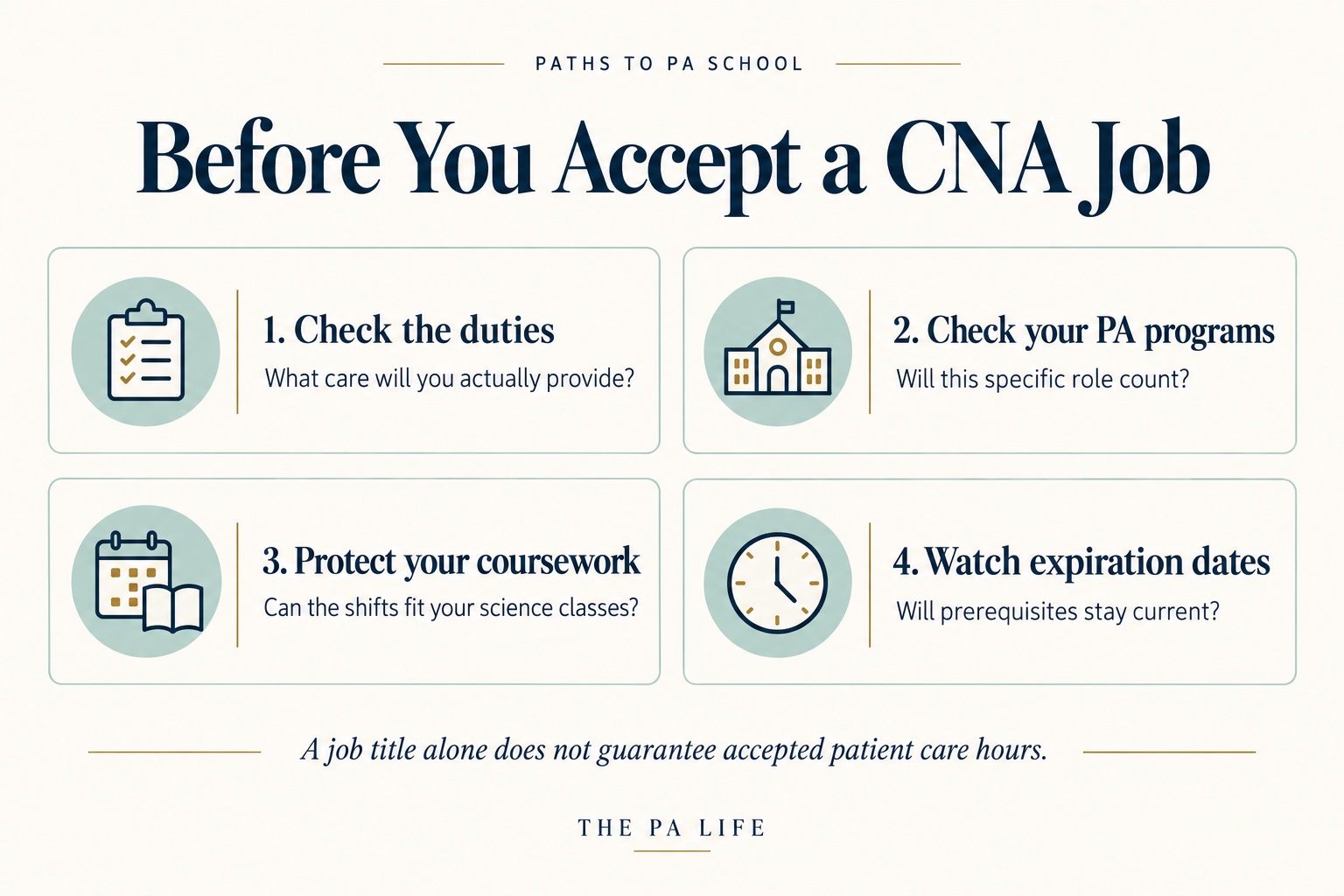
But there is a catch: a CNA certificate does not automatically make every hour you work acceptable patient care experience. The duties, the PA program, and the timing matter. So does whether you can hold the job while earning the grades you need.
My recommendation? CNA can be a practical route for a college student or career changer who wants bedside experience without committing to a separate professional degree. Choose the actual job carefully, keep your academic plan moving, and don’t work extra years simply because someone told you more hours are always better.
Is CNA a good choice before PA school?
Yes, when your target programs accept your duties and the job fits your academic and financial needs. It is particularly worth considering if you want to start caring for patients while completing a bachelor’s degree, or already have a degree and need clinical experience.
I would be more cautious if the only available jobs have duties your preferred PA programs exclude, the training costs more than you can reasonably recover, or the schedule would damage your science grades.
Think of this as four separate requirements: qualify for the CNA job, earn acceptable experience, complete the required college education, and build a competitive application. Finishing one does not finish the other three.
- What you gain: paid work, repeated patient interaction, exposure to nursing teamwork, and opportunities to develop bedside confidence.
- What you still need: each PA program’s degree requirements, prerequisite courses, GPA standards, application materials, and any other admissions requirements.
- What you must verify: whether your specific responsibilities count, which hours are excluded, and when your hours and courses must be complete.
What does a CNA actually do?
Nursing assistants help with bathing, dressing, eating, toileting, and mobility. They may measure vital signs and report patients’ concerns to nurses. The work takes place under nursing supervision, with responsibilities determined by training, state rules, and the employer. Hospitals, nursing facilities, and residential care settings all employ nursing assistants. See the Bureau of Labor Statistics occupational overview.
The less glamorous parts of this work are part of the education. Asking permission before helping someone dress, explaining what you are doing, and responding respectfully when someone is frustrated are skills you will use throughout a clinical career.
You are also learning the limits of your role. Recognizing a concern and promptly telling the nurse matters. Describing yourself as independently diagnosing or managing illness would misrepresent the job.
Look carefully at related titles such as patient care technician, nurse aide, and patient care assistant. Ask what training the employer requires and what you would actually do. Similar titles can describe different jobs; different titles can describe similar work.
Does CNA experience count as patient care hours for PA school?
Often, yes. But read the entire policy, including its exclusions. Here are three examples from official program pages reviewed in September 2026.
| PA program | What its policy says | What to check before taking a job |
|---|---|---|
| Duke | Lists CNA among accepted roles. Requires 1,000 hands-on hours by May 1 of the application year; excludes certificate-training and student clinical hours. | Your duties and your hours by the stated cutoff, not just by the CASPA deadline. |
| UW MEDEX Northwest | Lists CNA among commonly accepted roles for its 2,000 paid, recent hours, but excludes nursing assistant work strictly limited to activities of daily living. Student training does not count. | Whether your job includes qualifying medical care. MEDEX evaluates the job descriptions in CASPA. |
| Pacific University | Requires 1,000 hours at CASPA submission and lists nursing assistant/aide among previously accepted roles. Reviews duties individually. Training toward a credential does not count. | Its separate caregiver policy requires CNA certification, facility-based work, and substantial medical responsibility; basic assistance alone is insufficient as sole PCE. |
The distinction between CNA work and work limited to activities of daily living is especially important. A school can list CNA as acceptable and still reject a particular position. Another program may evaluate the same experience differently.
That is an admissions distinction, not a judgment about the value of helping someone bathe, eat, or get dressed. Those patients need skilled, dependable care regardless of what an admissions office calls the hours.
Before paying for training or accepting a questionable role, send the program a real job description. Explain the setting, supervision, typical duties, and approximate time spent on them. Ask whether the role meets that program’s patient care requirement for your intended cycle. Save the reply and recheck the published policy when you apply.
Do not stretch your job description or take on duties outside your authorized scope to make the position sound more clinical. A PA school’s examples of acceptable experience do not authorize a CNA to perform a procedure.
For the broader distinctions, use our guide to healthcare experience and patient care hours.
Is a hospital CNA job better than a nursing home job?
I would compare duties, supervision, staffing, and learning opportunities before comparing building names.
A hospital position may expose you to several illnesses and a large clinical team. A long-term care position may let you develop sustained relationships and notice how a resident’s function changes over time. Either setting can offer meaningful experience. Neither setting guarantees that every PA program will accept the job.
Ask these questions at the interview:
- What does a typical shift involve, and how much of it is direct patient care?
- Which tasks can a newly hired CNA perform, and what additional training is required?
- Who supervises me, and what does orientation look like?
- How are patient assignments, breaks, lifting assistance, and unexpected absences handled?
- Are the advertised shifts actually available to a new employee? What weekend, holiday, and minimum-shift commitments apply?
- Can my schedule change when the college semester changes?
Be especially precise with assisted living, home care, and companion positions. Those labels can cover substantially different responsibilities. “I work with patients” is not enough information for an admissions office to judge the role.
A supportive team and a schedule you can sustain may be more useful to your preparation than a prestigious employer whose shifts leave you exhausted.
How long does CNA training take, and what does it cost?
There is no single national course length or price. Start with your state’s approved training options and certification or registry requirements, then compare local programs and employers. Course completion, exam eligibility, certification, and getting hired are separate steps.
For a concrete example, Calhoun Community College’s October–November 2026 course runs six weeks. Its listed $899 course fee includes a textbook and one set of scrubs. The page separately lists an $85 certification exam fee, health-screening requirements, and background/drug screening. Its evening schedule also includes a required clinical rotation.
That is one program’s offering, not a nationwide price estimate. It illustrates why “tuition” and “what it will cost me to start work” are different numbers.
Before enrolling, ask for an itemized budget covering tuition, books, uniforms, required health documentation, screening, testing, supplies, transportation, and any retest fees. Include income you may lose while attending mandatory sessions.
Also ask about the next available class, clinical placement, exam scheduling, and how soon you could realistically start a job. A short advertised course can still lead to a longer wait before your first paid shift.
If an employer offers paid or sponsored training, read the employment commitment and repayment terms. Keep training hours separate in your records; being paid during training does not automatically make those hours acceptable to your future PA programs.
Does CNA training replace a college major or PA prerequisites?
No. CNA training prepares you for a nursing assistant role. It does not confer a bachelor’s degree, make you an RN, or create an automatic bridge into PA school.
For many pre-PA students, that separation is useful. You can choose an undergraduate major that fits your interests and academic strengths while using CNA work to gain experience. Our guide to choosing a pre-PA major walks through that decision.
But introductory anatomy in a CNA course is not automatically equivalent to a college anatomy prerequisite. For example, MEDEX requires standalone college prerequisite courses separate from certificate training or professional degree programs.
If you take CNA training through a college, ask whether it awards academic credit and exactly how that credit applies to your degree. Then separately verify any proposed PA prerequisite substitution with the PA program. A college accepting a course toward graduation does not mean a PA school accepts it toward admission.
For students in structured health-profession programs, course substitutions and electives depend on the institution. With the CNA route, the clinical training is generally a separate commitment; your room to fit PA sciences comes mainly from the degree plan you choose. Required CNA attendance and clinical sessions still need their own space in your calendar.
What is a sensible “Goldilocks” prerequisite schedule for a working CNA?
My aim would be to keep several reasonable PA options open while protecting your grades and avoiding unnecessary repeats. There is no universal semester-by-semester schedule. The following is an illustrative planning framework for students at any institution; adapt it with your academic adviser and each PA program’s requirements.
- Start with a manageable school list. Compare required subjects, lab rules, minimum grades, course age limits, degree deadlines, and accepted experience. Use actual program requirements rather than collecting every science course you have heard of.
- Map course sequences early. General chemistry or introductory biology may unlock later classes. Identify those sequences before work commitments crowd out a once-a-year course.
- Fit CNA training into a realistic opening. A summer or lighter term may work, provided the entire classroom, lab, clinical, and testing schedule fits. Don’t assume “evening course” means no other required attendance.
- Begin with a sustainable work schedule. Learn how the job affects your sleep and study time before adding shifts. During a demanding lab-science term, fewer hours may be the more effective application strategy.
- Complete remaining sciences with expiration dates in view. Plan anatomy, physiology, microbiology, and any required chemistry or other courses around sequencing, availability, and the strictest relevant age limits on your list.
- Audit the plan before each registration period. Recheck course equivalencies, accepted hours, prerequisites still outstanding, and the next application cycle. Adjust before a missed course forces another year.
Our PA school prerequisite guide is a starting point for the course discussion. Final decisions belong to the programs you will apply to.
I would not prescribe a fixed number of lab sciences for every student. A full-time student working one shift and a parent working three shifts have very different calendars. Choose a load you can complete well.
Can PA prerequisites expire while you work as a CNA?
Yes. Put course expiration near the top of your plan, especially if you expect to work for several years. Your experience can grow while your eligibility for particular schools shrinks.
The rules differ. MEDEX currently requires its listed prerequisites within seven years of application. Duke’s current policy uses a ten-year lookback from January 1 of the application year. Those are examples, not a universal seven- or ten-year rule. See the linked MEDEX and Duke requirements.
For each target school, record the course, completion term, age limit, date used to calculate that limit, and whether exceptions are available. Ask about exact cutoff dates when a course is close to the boundary.
Then check your proposed application cycle and the following cycle. Leaving a margin can prevent a reapplication year from becoming an unexpected semester of retakes.
Do not assume continued clinical employment keeps older science credits valid. If a school offers an exception, find out how it is evaluated. CNA credential renewal and PA prerequisite expiration are also separate requirements; meeting one does not satisfy the other.
This is where I would use the PA Life Applicant Toolkit to organize your application planning, with PA School Finder to research programs. Keep the official admissions pages and any written course decisions alongside your plan.
How many CNA hours can you earn during college or a gap year?
Start with your actual availability, not an impressive-looking annual total. Here is simple planning math:
- 12 countable hours per week for 48 working weeks: 576 hours.
- 24 countable hours per week for 48 working weeks: 1,152 hours.
- 36 countable hours per week for 48 working weeks: 1,728 hours.
These are illustrations, not guaranteed schedules or admissions credit. Use hours actually worked in accepted duties, account for unpaid breaks and time off, and apply each program’s rules. Keep separate records of training, shadowing, and work.
Notice that three nominal 12-hour shifts per week do not automatically produce 2,000 hours in a year. At 36 countable hours weekly, 2,000 hours takes about 56 working weeks, before additional time away.
Also notice that a school’s hour cutoff may come earlier than its final application deadline. Work backward from the relevant date, then leave room for orientation, canceled shifts, illness, and exams.
Record dates, duties, hours, employer, and supervisor contact information as you go. Write your experience description honestly. If you need to distinguish direct care from other work, follow current application instructions and the program’s guidance; never count the same hour twice.
What have students who took this route actually done?
Published student histories offer useful examples, although they cannot tell us which single experience caused an acceptance.
In Case Western Reserve’s Class of 2023 profile, Katherine Trudeau describes obtaining her CNA credential during college and working in memory care and assisted living. She also worked as a hospital patient care technician and later as a cardiology medical assistant during a gap year.
In Methodist University’s Class of 2024 testimonials, Sarah Blackwood describes earning her CNA credential before sophomore year, working nights at Vidant Medical Center for two years, and subsequently working in primary care.
My takeaway is that CNA can be an early source of experience alongside a degree, and that your work may evolve as your interests and opportunities change. Neither example proves you need several different jobs, that night shifts are advisable for everyone, or that every hour in those histories was accepted.
I would borrow the habit of building experience deliberately. I would not copy someone else’s schedule without checking whether it fits your life.
Should you work for a few years before applying?
Work long enough to become dependable in the role and meet the requirements of a sensible school list. Beyond that, make the decision around what your application still needs.
If you need accepted hours, savings, stronger recommendations, or time to finish courses, an additional year may be useful. If your grades are suffering because you are taking every extra shift, more hours may be solving the wrong problem.
Once you have the required education, current prerequisites, appropriate experience, and a well-prepared application, I would not delay solely to reach a round number someone posted online. Minimum eligibility and competitiveness are different, but there is no universal number that guarantees admission.
A planned gap year should have a purpose and a review date. Decide what you need to accomplish, what it costs to wait, and which prerequisites would need repeating if you postponed another cycle.
What are the pay and workload tradeoffs?
The BLS reports a $42,260 median annual wage for nursing assistants in May 2025. That is a national occupational median, not a new-graduate offer or a promise of what a part-time pre-PA student will earn.
Compare local offers using take-home pay, benefits, commute, guaranteed hours, and required availability. A higher hourly rate does not help much if the position cannot accommodate your classes.
The physical demands deserve equal attention. BLS describes substantial lifting and moving demands and high injury rates in this work. Ask about safe patient-handling equipment, assistance, orientation, and staffing. Night and weekend work may fit around classes, but sleeping and recovering still require time.
I would treat a job that consistently leaves you unable to study, recover, or provide attentive care as a reason to reassess the plan. Your patients and your future application both deserve a sustainable schedule.
Should you choose CNA, medical assistant, or sonography?
Consider CNA if you want bedside work that you can potentially begin through a short training program while pursuing your college education. Confirm local hiring requirements and accepted duties first.
Compare medical assisting if you are drawn to outpatient care and clinic teamwork. Training requirements and the mix of clinical and administrative duties vary, so compare actual opportunities using our Medical Assistant to PA School guide.
Consider sonography if you want that profession on its own merits and are comfortable with the training commitment. It offers a different technical career, with its own curriculum and prerequisite-planning challenges. Read Sonography to PA School before choosing a degree primarily as a stepping stone.
If you already have an accepted patient care job, do not assume collecting another credential will improve your application. First identify what you would gain: better duties, a workable schedule, needed income, or a career you would want even if PA school took longer.
What would I recommend before you enroll?
Find a few real local jobs. Compare the training they require, the care you would provide, the pay, and the schedule. Check those duties against your intended PA programs before committing to a course.
Then put work, degree requirements, remaining sciences, and course expiration dates on the same calendar. You should be able to explain how the plan gets you to an application without depending on perfect grades after sleepless nights or a school overlooking a published rule.
CNA can help you become comfortable doing necessary work for people who need you. If the role fits your life and your target programs, that is a worthwhile foundation for a future PA.
Continue the Paths to PA School series: compare medical assisting and sonography, then build your own plan in the PA Life Applicant Toolkit.
Program policies and training prices were reviewed in September 2026. Follow the official requirements for your application cycle; the examples above are not individual admissions determinations.
You may also like -
 Phlebotomist to PA School: Do Your Patient Care Hours Count?Is phlebotomy good experience for PA school? Learn how programs evaluate blood-draw duties, donor-center work, training, and your application timeline.
- RN to PA School: Should a Nurse Become a Physician Assistant?Can an RN become a PA? Compare degree requirements, patient care experience, prerequisite expiration, and the decision between PA and NP training.
- EMT to PA School: Is It the Right Path for You?Is EMT a good path to PA school? Compare paid and volunteer hours, training costs, transport duties, prerequisites, and a realistic application timeline.



CASPA Personal Statement Help
 We offer comprehensive, start-to-finish personal statement assistance or help to perfect a draft you already have. We have services to fit every budget.
 Schedule a Live Recorded PA School Video Interview

We offer 60-minute mock PA school interviews with post-interview feedback and advice. Includes a recorded video of your interview that you can watch, download, or share with family and friends. There is no better way to prepare!
Schedule an InterviewPre-PA Consulting and Advising
 Our pre-PA coaching service consists of a 1-hour phone consultation focused on addressing your specific questions or concerns about becoming a PA and applying to PA school.


Leave a Reply