
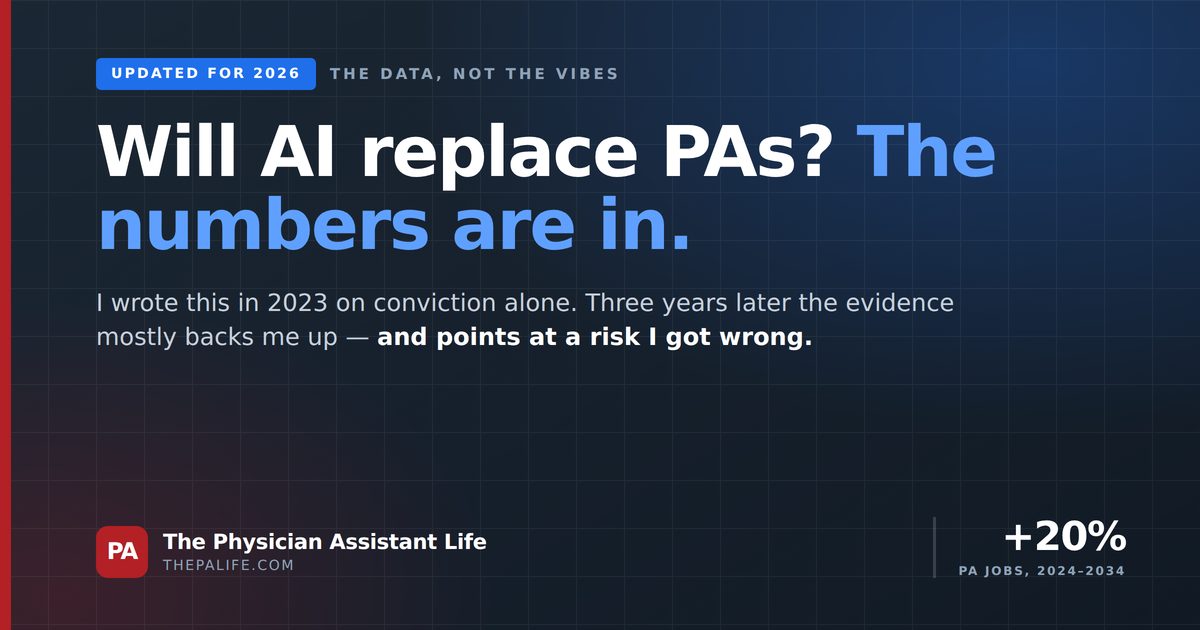
I wrote this post in 2023 on conviction alone. Three years later, the data is in, and it mostly backs me up — but it also points to a risk I got wrong. Here's the honest version.
I first wrote this in October 2023, a few months after ChatGPT convinced half the internet that every knowledge job was about to evaporate. Students were emailing me genuinely frightened, asking whether it was still worth applying to PA school.
My answer then was a gut answer: AI is a tool, not a replacement, and PAs were uniquely positioned to benefit from its innovations. No citations, no numbers, just twenty years of practice and a strong feeling.
Three years on, the numbers exist. Most of them say I was right. One of them says I was worried about the wrong thing.
So let's do this properly.
The question everyone asks, answered with actual numbers
If AI were eating PA jobs, the labor data would show it first. It doesn't.
The Bureau of Labor Statistics projects employment of physician assistants to grow 21 percent from 2025 to 2035 — described in their own words as "much faster than the average for all occupations." That's a move from 168,900 jobs to 204,600, with about 11,500 openings each year over the decade. Median pay was $135,880 in May 2025.
Twenty-one percent is not a profession being automated away. Twenty-one percent is a profession that cannot hire fast enough.
You are welcome to distrust a government projection. I'd just point out that these are the same models that flagged the decline in occupations that actually did get automated, and they are not flagging us.
The test case nobody wants to talk about
Here's the part I find genuinely persuasive, and it has nothing to do with PAs.
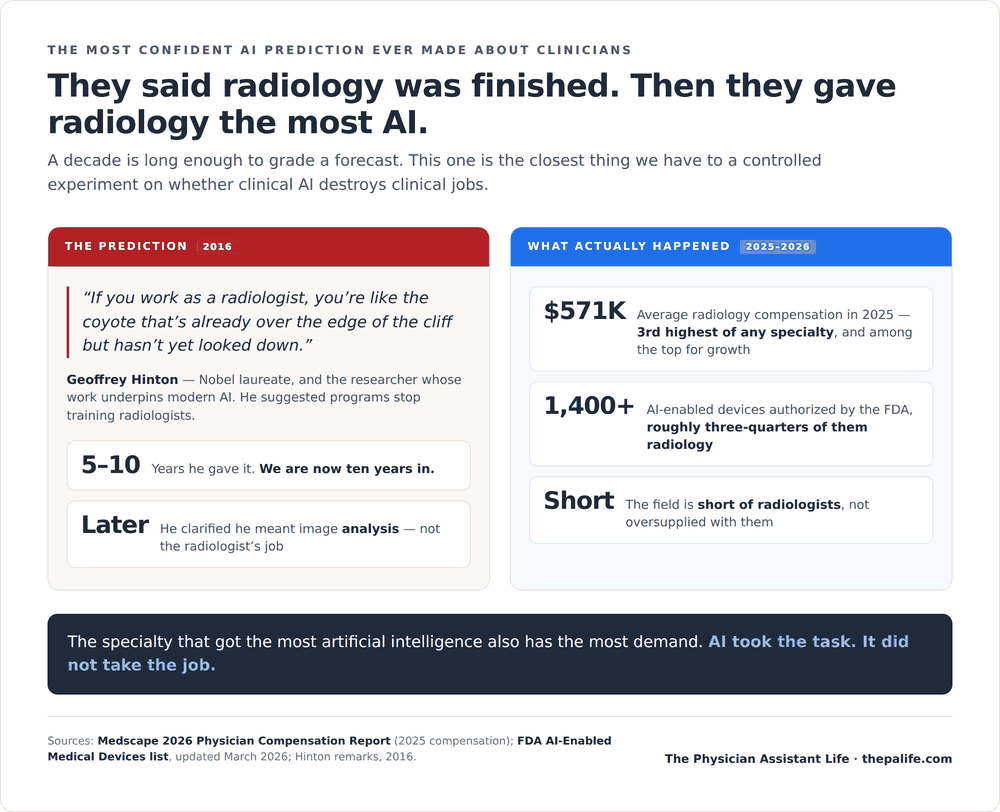
In 2016, Geoffrey Hinton — the man who won a Nobel Prize for the research underneath modern AI — said this about radiologists:
"If you work as a radiologist, you're like the coyote that's already over the edge of the cliff but hasn't yet looked down."
He suggested we stop training them. Within five to ten years, he said, AI would do the job better.
That was the single most confident, most credentialed prediction of AI replacing a group of clinicians that anyone has ever made. It is now a decade old, which means we can grade it.
Radiology ranked third among all specialties for compensation in 2025 at $571,000, according to Medscape's 2026 Physician Compensation Report — and it was also among the top specialties for compensation growth. The field is short of radiologists, not drowning in surplus ones.
Meanwhile, radiology really did get the AI. The FDA's list of AI-enabled medical devices passed 1,400 authorizations by its March 2026 update, and roughly three-quarters of them are radiology devices. No other specialty is close.
Sit with that for a second, because it's the whole argument:
The specialty that received by far the most artificial intelligence is also the specialty with the most demand and the fastest-rising pay.
Hinton later clarified that he'd been talking about image analysis, not the radiologist's job. That clarification is the entire lesson. He was actually right about the task. He was wrong about the person — because he'd quietly assumed the job was the task, and it never was.
Reading the image is a piece of what a radiologist does. Deciding what the image means for this patient, arguing with the ordering clinician about whether the study was the right one, sitting in a tumor board, knowing when the scan is technically clean and the patient is still sick — that's the job.
Ask yourself what percentage of your clinical day is the part a model could do. Then ask what the other percentage is made of. That's your answer, and it's a better one than mine.
What actually happened instead
AI didn't replace clinicians. It came for the paperwork — and even there, the honest results are more modest than the marketing.
Ambient AI scribes are the most widely adopted clinical AI tool in existence. They listen to your visit and draft the note. If anything was going to change the shape of a clinical day, it was this.
Mass General Brigham ran the most rigorous test I've seen: five hospitals, more than two years, 1,800 clinicians using ambient documentation compared against 6,770 who weren't.
The result:
- 13 fewer minutes per day in the EHR — a 3% relative decrease
- 16 fewer minutes per day on documentation — a 10% relative decrease
- About half an extra patient visit per week, worth roughly $167 per clinician per month
- And only 32% of users ran it on more than half their encounters
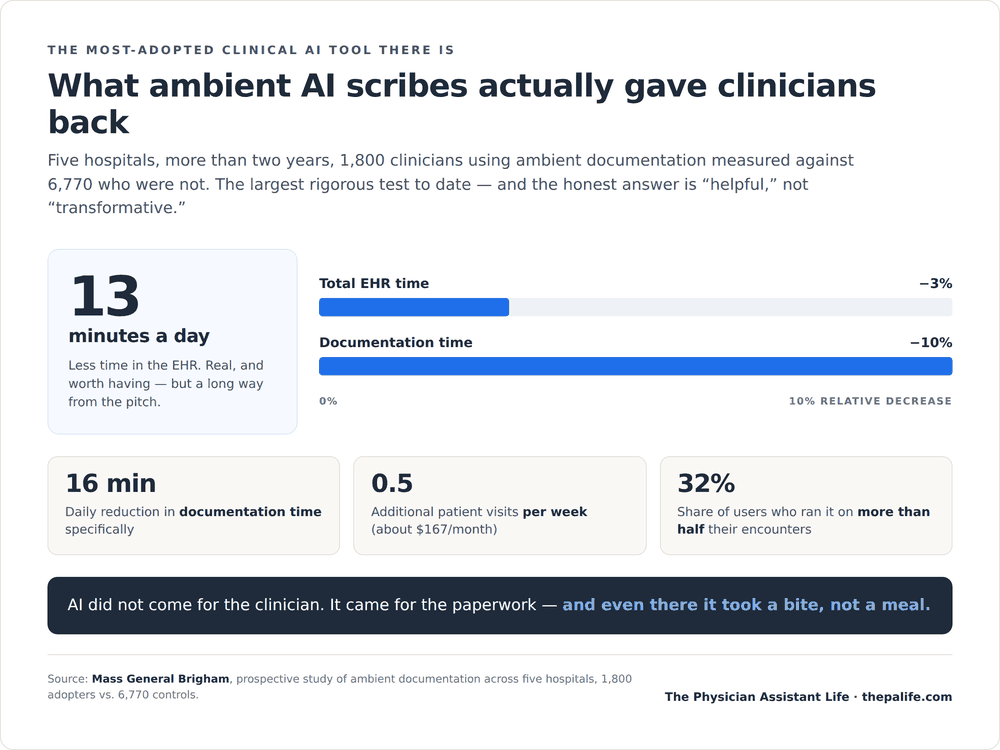
Thirteen minutes a day is real. I would take thirteen minutes a day. It is also nowhere near the revolution the vendor decks promised, and it's worth knowing that before you build a career theory around it.
Adoption, though, is not modest at all. In the American Medical Association's 2026 survey of nearly 1,700 physicians, 81% reported using AI professionally — more than double the 2023 figure.
So: near-universal adoption, genuinely useful, and a long way from replacing anyone. That is what a tool looks like when it's working.
The risk I got wrong in 2023
Here's where I have to correct my own post.
In 2023 I framed the danger as replacement. Would the machine take the job? That was the wrong question, and I spent a whole essay answering it.
The actual risk showed up in that same AMA survey, and it's not subtle: 88% of physicians reported at least some concern about AI-related skill loss. Eighty-eight percent. That is not a fringe worry. That is nearly everyone who uses these tools telling you what it feels like from the inside.
The mechanism is easy to describe and easy to fall into. The tool drafts your note, so you stop composing your own assessment. It suggests a differential, so you stop generating one first. Researchers call the failure mode automation bias — trusting the output more than it has earned — and the literature is clear that it gets worse in exactly the settings where you can least afford it: high-pressure, fast-paced, understaffed.
Nobody deskills on purpose. You deskill by accepting good suggestions, one at a time, for two years.
The countermeasure is unglamorous and it works: form your own impression before you look at the machine's. Write your assessment, then compare. Build your differential, then check it. Use the tool to audit your thinking, never to replace the step where the thinking happens.
That habit is the difference between a PA who gets sharper with AI and one who slowly gets hollowed out by it. It costs about ninety seconds a patient.
The risk nobody is talking about
And now the part that matters most to me personally.
I practice at a county health department clinic and at our county's Homeless Persons' Health Project. Which means I spend my week with exactly the patients these tools are worst at.
That's not a hunch. It's in the research. A 2026 review in npj Digital Medicine on scaling ambient AI scribes lays out where they break down, and the list reads like a description of safety-net medicine:
- Accents and dialects. The authors warn plainly that "underrepresented groups may be excluded or misunderstood if ambient AI scribes are not trained on diverse linguistic patterns, accents, and dialects."
- Languages other than English, where usable coverage thins out fast.
- Noisy, high-acuity rooms — alarms, overlapping conversations, traffic — where accuracy degrades.
- Social history getting filtered out. The review specifically flags that "nuanced patient history, pertinent social history, pre-hospital event details" are often dropped by current tools.
Read that last one again. The housing situation. The transportation problem. Who else lives in the home. Whether they have a place to keep insulin cold.
For my patients, that is the clinical picture. A tool that trims it as noise hasn't made a small error — it has deleted the diagnosis.
So here is the version of this concern I actually hold, and it isn't the one in the headlines. I am not afraid AI will replace PAs. I am afraid it will quietly work beautifully for well-resourced, English-speaking patients in quiet exam rooms, and poorly for everyone else — and that we will roll it out anyway and call the gap a rounding error.
That's not a technology problem. It's a values problem, and it belongs to the clinicians in the room, which increasingly means us.
Every PA who adopts one of these tools should be able to answer one question: who does this work worse for, and what am I doing about that? If the vendor can't tell you, that's your answer about the vendor.
What this means if you're applying to PA school
If you're pre-PA and you found this post because you're scared, take the plain reading: twenty percent growth, twelve thousand openings a year, and the most-automated specialty in medicine currently short-staffed and paying record numbers. Apply.
But don't stop at reassurance, because programs are asking about this now. CASPA added a whole new question to the 2026–2027 application about using emerging technology thoughtfully while keeping care human-centered — including in settings where the technology isn't available. That clause is not decoration. It's the thing I just spent two sections on.
And if you're wondering where the line sits on using AI to write your application itself, I broke the current CASPA rules down here.
Still not on my watch
Three years later I'd change my emphasis, not my conclusion.
AI is not coming for your job. It is coming for your tasks, and if you let it, for some of your skill — and it will arrive in your clinic already working better for some of your patients than for others.
None of those are reasons to stay out of this profession. They're reasons to enter it with your eyes open, because the people who decide how this technology gets used at the bedside are going to be clinicians who understood it early and refused to be passive about it.
We are trained to ask good questions, to sit with a person, and to notice the thing that isn't in the chart. That was always the job. It's still the job. The machine just made it more obvious.
So — will AI phase out physician assistants?
Not on my watch. And now I've got the footnotes.
I'd still love to hear from you: where has AI genuinely helped you take care of someone, and where has it gotten in the way? That second answer is the one I learn the most from.
Stephen Pasquini, PA-C
Sources
- U.S. Bureau of Labor Statistics — Occupational Outlook Handbook: Physician Assistants — 21% projected growth 2025–2035, 168,900 to 204,600 jobs, ~11,500 annual openings, $135,880 median pay (May 2025)
- Mass General Brigham — AI scribes linked to modest reductions in EHR and documentation time — 1,800 clinicians vs. 6,770 controls across five hospitals
- American Medical Association — More than 80% of physicians use AI professionally — 2026 survey of nearly 1,700 physicians; 81% adoption; 88% report concern about AI-related skill loss
- npj Digital Medicine — Barriers and opportunities of scaling ambient AI scribes across diverse healthcare settings — accent, dialect, language, noise and social-history limitations
- Medscape 2026 Physician Compensation Report, via AuntMinnie — radiology third at $571,000 for 2025
- U.S. FDA — Artificial Intelligence-Enabled Medical Devices — authorization list, updated March 2026
- Fortune — A decade after the "Godfather of AI" said radiologists were obsolete — Hinton's 2016 prediction and its aftermath
You may also like
 The New CASPA Situational Decision Making Essay: How to Write It (2026–2027)CASPA retired the COVID-19 essay and replaced it with a new 2,500-character question about technology and the human side of medicine. The …
 Can You Use AI on Your PA School Personal Statement? CASPA’s 2026–2027 RulesCASPA lifted its blanket ban on generative AI for the 2026–2027 cycle. Here is where the line actually falls: what is allowed, …
 ChatGPT Answers the Top 46 PA School Applicant Interview QuestionsJust be yourself! This is the one piece of interview advice we have all heard a gazillion times. Maybe you heeded this …
CASPA Personal Statement Help
 We offer comprehensive, start-to-finish personal statement assistance or help to perfect a draft you already have. We have services to fit every budget.
 Schedule a Live Recorded PA School Video Interview
We offer 60-minute mock PA school interviews with post-interview feedback and advice. Includes a recorded video of your interview that you can watch, download, or share with family and friends. There is no better way to prepare!
Schedule an InterviewPre-PA Consulting and Advising
 Our pre-PA coaching service consists of a 1-hour phone consultation focused on addressing your specific questions or concerns about becoming a PA and applying to PA school.


Leave a Reply