
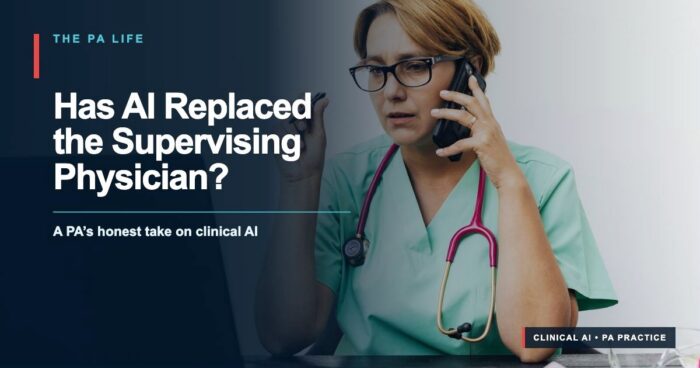
Confessions of a PA who consults AI almost every clinical day
Somewhere between double-checking an antibiotic dose, reviewing a possible medication interaction, and having AI politely point out that I had typed naloxone when I meant naltrexone, I had a slightly uncomfortable realization:
I consult AI. A lot.
Seriously.
It is available 24/7. It answers on the first try. It never makes me feel foolish for asking a basic question at the end of a long clinic day. It can move from dermatology to addiction medicine to orthopedics to a medication interaction without rolling its eyes or reminding me that this is technically not its specialty.
It is kind. It is patient. It is relentlessly patient-centric.
And unlike at least one of my colleagues (who shall not be named 😉), it has never once replied to my question with, “Did you read my last note?”
So, has AI replaced the supervising physician?
No. Not even close.
But it has become a remarkably useful new member of my clinical team—and I think we need to talk honestly about that.
What Consulting AI Actually Looks Like
When people hear “AI in medicine,” they often imagine a glowing machine diagnosing a rare disease while frightened clinicians back slowly out of the room.
My reality is much less dramatic and much more useful.
I use AI to help me:
- Turn a messy pile of history, medications, labs, and prior notes into an organized clinical picture;
- Write patient letters! (maybe my favorite thing on this list);
- Compare what is new with what is merely copied forward in the chart;
- Review differential diagnoses and make sure I have not ignored an important alternative;
- Double-check dosing, contraindications, and medication interactions;
- Identify missing red flags, follow-up instructions, or emergency precautions;
- Draft a clean SOAP note from the visit I actually performed;
- Compose referral comments that make me sound like a certified genius!;
- Help get insurance approval for prior authorizations;
- Make patient instructions clearer and more compassionate; and
- Think through the administrative and social details that can determine whether a treatment plan succeeds in the real world.
That last item matters. A “perfect” plan is not perfect if the patient cannot afford it, cannot get transportation, cannot read the instructions, or has nowhere safe to store the medication.
AI can remind me to zoom out. But I still have to know the patient sitting in front of me.

The World’s Most Available Curbside Consultant
Medicine has always depended on consultation. We ask colleagues. We call specialists. We search guidelines. We check a trusted reference. We walk down the hall and say, “Can I run something by you?”
AI is not the same as a physician consultant, but it has made that first cognitive pass unbelievably accessible.
At 7:10 a.m., it is there. During lunch, it is there. When I am finishing a note after the clinic has gone quiet, it is still there. I can ask a follow-up question, challenge the answer, add a new lab value, or say, “You missed the fact that the patient is pregnant—rethink the plan.”
That availability matters because many errors do not happen from a total lack of knowledge. They happen when we are rushed, interrupted, tired, anchored to our first idea, or juggling too many small details at once.
A second pass can be powerful—even when that second pass comes from silicon.
It Never Judges Me—or My Patients
One of the surprisingly valuable things about AI is that it has no social friction.
I can ask the “obvious” question. I can admit uncertainty. I can explore an uncomfortable differential. I can ask for a simpler explanation, then a more technical one, then a version written at a sixth-grade reading level.
And when the clinical story includes substance use, mental illness, housing instability, transportation barriers, or missed appointments, AI can help me organize those factors without the sighs, labels, or moral shortcuts that sometimes sneak into healthcare.
Of course, AI systems can still reflect bias. They are trained on human-created data, and humans have supplied plenty of bias to work with. “It never judges” does not mean “it is automatically fair.” It means I can use the interaction as a private space to slow down, examine my own assumptions, and rewrite a plan in a more respectful, patient-centered way.
Can AI Really Improve Clinical Reasoning?
The early evidence is interesting—and more nuanced than either the evangelists or the doom crowd would have you believe.
The American Medical Association calls this “augmented intelligence,” a phrase I like because it keeps the human clinician in the driver’s seat. In a 2025 randomized clinical trial involving 92 physicians, clinicians using GPT-4 scored an average of 6.5 percentage points higher on simulated patient-management reasoning than clinicians using conventional resources alone. The AI-assisted group also took about two minutes longer per case—an important reminder that better deliberation is not always faster. You can read the study in Nature Medicine via PubMed.
Another study published in JAMA Internal Medicine compared physician and chatbot responses to 195 health questions posted online. Independent evaluators preferred the chatbot responses 78.6% of the time and rated them substantially higher for empathy.
That does not mean a chatbot is a better clinician. It means something narrower and useful: a language model can be very good at producing thorough, readable, emotionally considerate answers.
Those are real clinical skills. They just are not the only clinical skills.
Now for the Giant, AI-Generated Elephant in the Room
AI can be confidently, beautifully, spectacularly wrong.
It may invent a citation. Misread the timeline. Treat an old medication list as current. Miss a contraindication. Flatten a complicated patient into a tidy textbook case. Or produce a note that sounds so polished you almost forget to ask whether it is true.
A polished fabrication is worse than a blank space.
Here is the necessary caveat: sometimes AI quite literally is in the room—because I invite it in.
Ambient AI scribes can listen to a live patient encounter and turn the conversation into a remarkably organized clinical note. In that sense, AI may hear the history, capture the plan, and preserve details I might otherwise struggle to document at the end of a busy day.
AI may be in the room. But it is not present in the room the way we are.
It still did not auscultate the patient’s lungs, palpate the abdomen, assess the gait, appreciate the expression on a spouse’s face, or feel the shift in the room when the conversation became difficult. It may record the pause—but it does not necessarily understand the pause.
And giving AI a seat in the room creates additional responsibilities. Patients should know when it is being used, applicable consent and privacy requirements must be followed, and every generated note still needs careful human review.
AI may hear the encounter. It does not own the encounter.

The Most Important Part of My Workflow: I Correct It
I do not hand AI a chart and accept whatever comes back. I work with it.
I say:
- “That lab is from last year.”
- “The patient is actually here for the shoulder.”
- “I already gave the injection.”
- “That medication name is wrong.”
- “You are missing the transportation barrier.”
- “This plan needs clearer emergency precautions.”
- “Show me the source.”
Then it revises, and I review again.
This is not a minor detail. The moment I stop correcting it is the moment it becomes dangerous.
Used well, AI is not an oracle. It is a tireless junior consultant, medical editor, safety checker, and cognitive sparring partner rolled into one. It can surface possibilities and organize complexity. I remain responsible for deciding what is accurate, relevant, ethical, and safe.
My Rules for Using AI in Clinical Practice
1. Protect patient privacy
I do not paste identifiable patient information into a general consumer AI tool. Clinical use must follow my organization’s policies, applicable law, and the privacy and security requirements that govern the specific platform. The U.S. Department of Health and Human Services remains the place to start for HIPAA responsibilities—not a chatbot’s privacy promise.
2. Treat every answer as a draft
AI output is the beginning of review, not the end of thought. I verify doses, interactions, guidelines, contraindications, citations, and anything else that could change patient care.
3. Give it context—but only appropriate context
Better inputs usually produce better outputs. I provide the clinically relevant facts, ask a specific question, and clearly separate current information from old chart material. I also leave out details the tool does not need.
4. Ask it to disagree with me
One of my favorite prompts is essentially: “What am I missing?” I may ask for dangerous alternatives, reasons my plan could be wrong, or findings that would change management. AI is most valuable when it challenges my anchor—not when it simply congratulates me for having one.
5. Never outsource the relationship
Empathetic wording from a machine can help me communicate better. It cannot perform empathy on my behalf. The patient deserves my eyes, ears, presence, honesty, and accountability.
6. Own the final decision
If my name is on the chart and my patient is living with the outcome, “the AI said so” is not a clinical defense. I own the note. I own the plan. I own the follow-up.
So, Has AI Replaced the Supervising Physician?
No.
A physician colleague brings lived clinical experience, accountability, institutional knowledge, physical examination skills, procedural judgment, and the kind of human pattern recognition that develops after caring for thousands of real people. AI does not replace that.
It also does not replace PA training, teamwork, professional standards, or the physician–PA collaboration required by an individual practice setting and state law.
But AI may replace some of the friction that used to stand between a question and a useful first answer. It may catch the medication slip, expose the stale lab, improve the discharge instructions, widen the differential, or help me see a patient’s story more clearly.
That is not replacement. That is augmentation.
And our profession is already part of the policy conversation. In 2026, the American Academy of Physician Associates urged HHS to include PAs in future reimbursement rules for AI technology. The question is no longer whether PAs will encounter AI. It is whether we will use it thoughtfully, safely, and in a way that preserves what patients actually need from us.
The New Clinical Team
My preferred equation is not:
AI > PA > physician.
It is:
Patient + PA judgment + human collaboration + AI assistance
The patient remains the center. Human clinicians remain responsible. AI helps us think, organize, communicate, and check our work.
That is less cinematic than a robot replacing the healthcare team. It is also far more interesting—and far more likely to improve care.
And yes, I used AI to help me develop this article. Then I challenged it, fact-checked it, corrected it, removed the parts that did not sound like me, and took responsibility for the final result.
Which, come to think of it, is exactly how I use it in medicine.
Now I want to hear from you: Are you using AI in clinical practice? What has it caught for you—and where has it led you wrong? Share your experience in the comments.
Thanks for reading!
Stephen Pasquini, PA-C
Editor’s note: The clinical examples in this article are generalized composites of routine workflow and contain no patient-identifying information. AI use must follow employer policy, applicable law, and the privacy and security requirements of the specific platform. This article reflects the author’s experience and is not medical or legal advice.
You may also like -
 The PA Profession by the Numbers: 2026 Data on Salary, Schools, and the Job MarketThe ultimate guide to the PA profession - Navigate every aspect from certifying bodies like NCCPA and PAEA to data on applicants, programs, rotations, certification, salary, and the growth of PAs. Learn critical stats on PA schools, the […]
- How Long Does It Take to Become a Physician Assistant/Associate?How Long does it take to become a PA?
It's a common question and one that I am often asked, so let me try to answer it.
Whether you are in undergrad, figuring out your career path, or looking into your second career, thinking about […]
- Why We Really Need PAs in the UK: The British Physician Associate
Welcome to part three of this nine-part miniseries by documentary filmmaker Adam Halbur on the PA model around the world.
Growing the Physician Associate in the UK
In the United Kingdom, PA stands for physician […]


CASPA Personal Statement Help
 We offer comprehensive, start-to-finish personal statement assistance or help to perfect a draft you already have. We have services to fit every budget.
 Schedule a Live Recorded PA School Video Interview

We offer 60-minute mock PA school interviews with post-interview feedback and advice. Includes a recorded video of your interview that you can watch, download, or share with family and friends. There is no better way to prepare!
Schedule an InterviewPre-PA Consulting and Advising
 Our pre-PA coaching service consists of a 1-hour phone consultation focused on addressing your specific questions or concerns about becoming a PA and applying to PA school.


Leave a Reply