
Which exam you're actually taking, what's really on the blueprint, and the five-step plan I used to pass my own PANRE-LA.
A great many PAs recertifying right now will never sit in a Pearson VUE testing center.
They will take the PANRE-LA — 25 questions a quarter, five minutes per question, at their own kitchen table, with their references open. No proctor. No fluorescent lights. No five-hour block of your life you will never get back.
The traditional PANRE is still there if you want it, and some PAs genuinely prefer to get it over with in one morning. Both are legitimate. Both cost the same. The one thing you can't do is drift. The PANRE-LA application window opens in year six of your cycle and closes in December — miss it, and the choice is made for you.
So let's start there, then build the study plan.
Which exam are you taking?
Option 1
PANRE-LA (longitudinal)
- Apply in year 6 of your certification cycle
- Runs across years 7–9 — 12 quarters total
- 25 questions each quarter, 5 minutes per question
- Open reference. Published references — books and online journals
- Complete at least 8 of 12 quarters; your best 8 count
- Immediate feedback after every question
- Earns 2 Category 1 self-assessment CME per completed quarter
- Passing scaled score: 1150 (1000–1500 scale)
Option 2
Traditional PANRE
- Eligible in years 9 and 10
- 240 questions in four blocks of 60
- 60 minutes per block — 4 hours of testing
- Plus 45 minutes allotted for breaks between blocks, and a 15-minute tutorial
- Proctored at Pearson VUE. Closed book
- Up to 2 attempts in year 9, up to 3 in year 10, 4 maximum
- One attempt per 90-day period — waived for one final attempt if fewer than 90 days remain in year 10 and you have attempts left
- Passing scaled score: 379 (200–800 scale)
The 379 trap. A lot of study sites list the PANRE passing score as 350. That's the PANCE cut score. PANRE is 379, and PANRE-LA runs on an entirely different 1000–1500 scale with a cut of 1150. The two aren't comparable — don't try to convert one to the other.
The dates and the money
Two separate fees catch people every cycle, so let's separate them cleanly.
| What | How much | When |
|---|---|---|
| Exam fee — PANRE or PANRE-LA | $350 | At registration |
| Certification maintenance fee | $180 per two-year CME cycle | By 11:59 p.m. PT, Dec 31 of your expiration year |
| CME | 100 credits per two-year cycle, at least 50 Category 1 | Five cycles across your 10 years |
Current windows:
- Traditional PANRE: January 2 – December 18, in both 2026 and 2027.
- PANRE-LA application: July 1 – December 18 of your sixth year. PAs due to recertify in 2030 can apply now, through December 18, 2026. The 2031 cohort applies July 1 – December 18, 2027.
- PANRE-LA quarterly windows in 2026: Jan 2 – Mar 10 · Apr 1 – Jun 10 · Jul 1 – Sep 10 · Oct 1 – Dec 10.
Self-assessment and performance-improvement CME are no longer required. They still count for more — self-assessment credits carry a 50% bonus, and your first 20 PI-CME credits each cycle are doubled. If you take the PANRE-LA, each completed quarter earns 2 Category 1 self-assessment credits, which become 3 with the bonus. You're earning CME while you test.
Source: NCCPA, Maintain Certification and Key Dates. Fees and windows are reviewed here every January.
What is actually on the exam
The PANRE and PANRE-LA share one content blueprint, effective January 2023 and built on NCCPA's 2021 practice analysis. It hasn't changed since.
Here's the part almost nobody states correctly. The blueprint enumerates 333 diseases and disorders across 14 organ systems, plus an "Emergent Topics (Legal, Ethical, DEI)" category that carries 2% of the exam and lists no individual topics at all.
Each of those 333 topics is flagged at one or more performance expectations — the level at which you're expected to handle it:
| Performance expectation | Topics | What it means |
|---|---|---|
| History & Physical | 333 | Given the condition, you know the signs, symptoms, history, exam findings, complications, and risk factors. |
| Diagnosis | 331 | Given the findings and study results, you can name the most likely diagnosis. |
| Intervention (Basic) | 214 | You can manage a straightforward presentation, including when to refer. |
| Intervention (Complex) | 30 | You can manage the case that's complicated by other factors or escalating in severity. |
Read those last two rows again. Only 30 of the 333 topics are flagged for complex management — nine percent of the topic list. (NCCPA doesn't publish how many questions target each level, so don't read that as nine percent of your exam.) That's a very short list, and it's where a lot of PAs waste months of study they didn't need. Know the 30. Don't treat all 333 as if they were.
The organ-system weightings, which sum to exactly 100%:
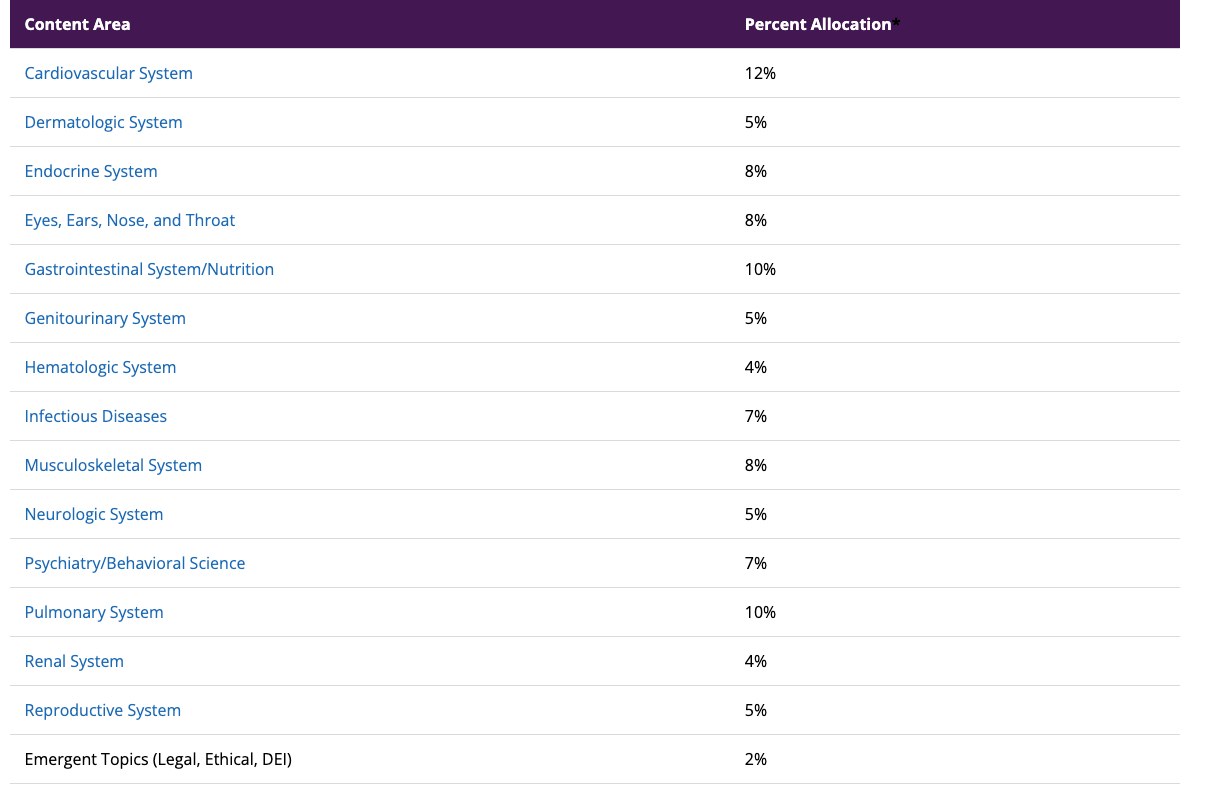
Click into any system and you get the topic list with the performance expectations marked, every topic linked to its lesson, and a system-specific search bar sitting on top of it:
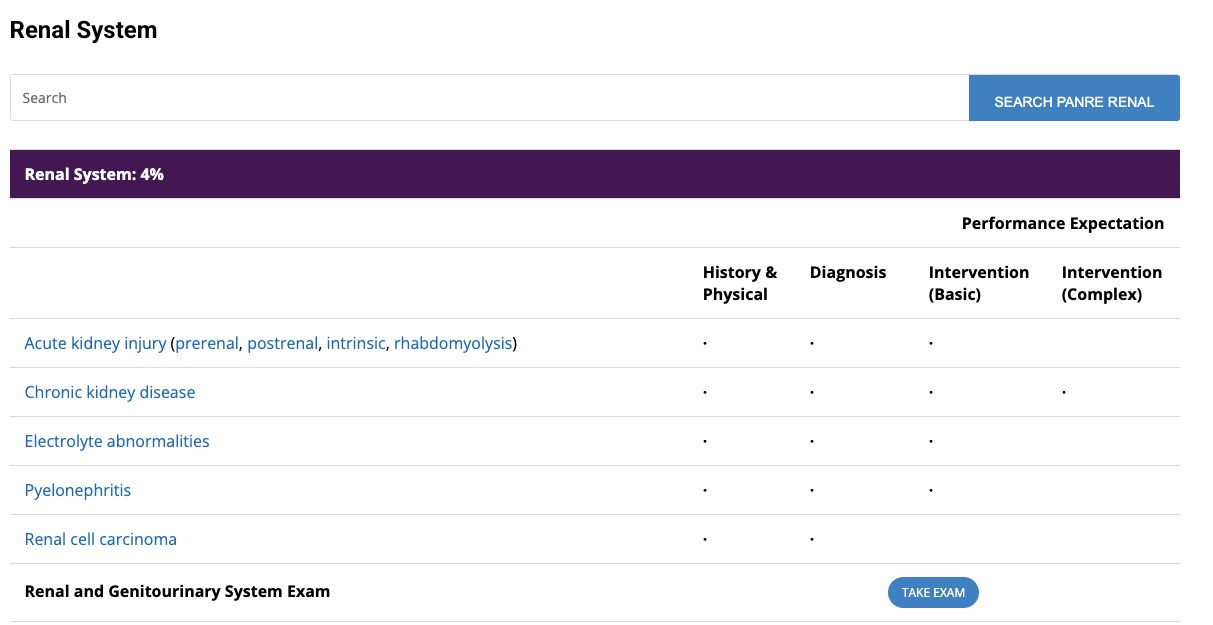
Source: NCCPA Content Blueprint for PANRE and PANRE-LA, effective January 2023. Topic counts are our own count of the published table; NCCPA doesn't print a total. Two topics — macular degeneration and hydrocephalus — are flagged for History & Physical only, which is why Diagnosis reads 331 rather than 333.
Five steps to pass your PANRE or PANRE-LA
Step 1: Work from the blueprint, not from a book
A review book is somebody's opinion about what matters. The blueprint is the actual contract. Almost every question on your exam comes from those 333 topics, and each one tells you the depth you're responsible for. The only exception is that 2% Emergent Topics slice, which NCCPA does not itemize for anybody.
Start at the interactive PANRE and PANRE-LA blueprint, work down one system at a time, and mark topics complete as you go. If you want it in a spreadsheet or a Word doc to annotate yourself, both are linked on that page.
Step 2: Study what you don't see at work
This is the single highest-yield change you can make, and it's the opposite of what feels natural.
NCCPA researchers, with a UC Berkeley co-author, published a study in 2025 using real PANCE and PANRE-LA data, tracking how PA knowledge changes over a career. The finding: anything outside your daily domain was roughly twice as likely to decline as the knowledge you use constantly — and it made almost no difference whether you saw it occasionally or never at all.
Which means the orthopedic PA isn't losing orthopedics. She's losing endocrine. The derm PA isn't losing derm. He's losing cardiology — 12% of the exam.
That last part is the trap. It's tempting to circle only the systems you haven't touched since PA school — but the occasional ones decayed just as fast, and there are far more of them. So open the blueprint and be honest about everything outside your daily lane. That's where your study hours belong.
Eliminate the essential. Yes, you read that right. Don't spend your Saturday reviewing what you already do forty times a week. You have deep working knowledge of your own specialty and you won't lose those points. The exam gets you on the things you've quietly stopped seeing.
Source: Liu Y, Jiang Y, Dallas AD, Bruza-Augatis M. "Medical knowledge decline: the role of active usage." Adv Health Sci Educ Theory Pract 2025;31(2):561–571.
Step 3: Practice with questions that are actually tagged to the blueprint
Generic board questions won't tell you where you're weak on this exam. You want a question bank that knows the difference between a PANRE H&P/Diagnosis topic and a PANRE Intervention (Basic) topic, because your report should point you back at the blueprint.
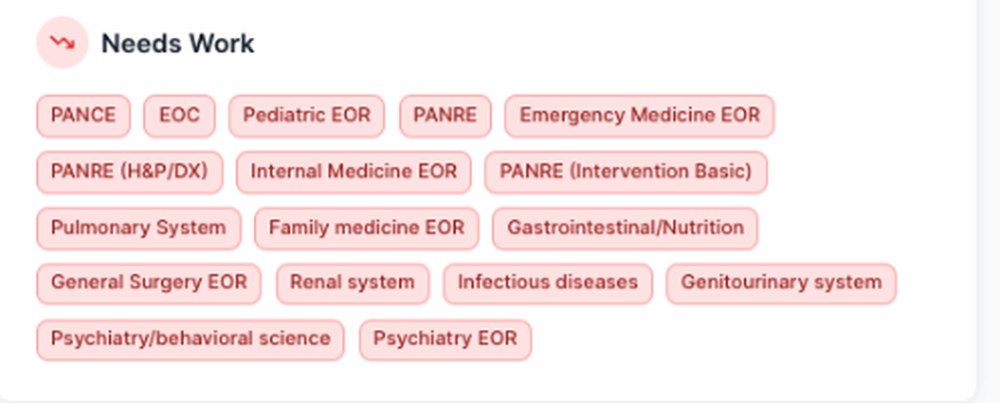
The Smarty PANCE QBank holds over 5,200 board-style questions across PANCE, PANRE, EOR and EOC, and it's included free with every membership. Four ways to run it:

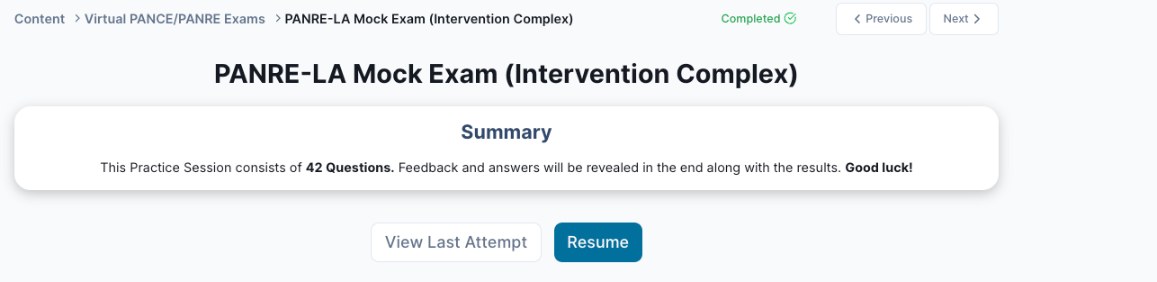
For PANRE-LA takers there are dedicated mock exams built around the performance-expectation levels — including one that drills only the Intervention (Complex) topics:
It runs the way the real thing runs
That matters more than it sounds. A question bank that hands you fifty questions on one page teaches you a rhythm you'll never use on test day. The PANRE-LA has its own peculiar cadence — one question at a time, a clock you can see, and an answer you can't take back — and the first time you meet it shouldn't be during a quarter that counts.
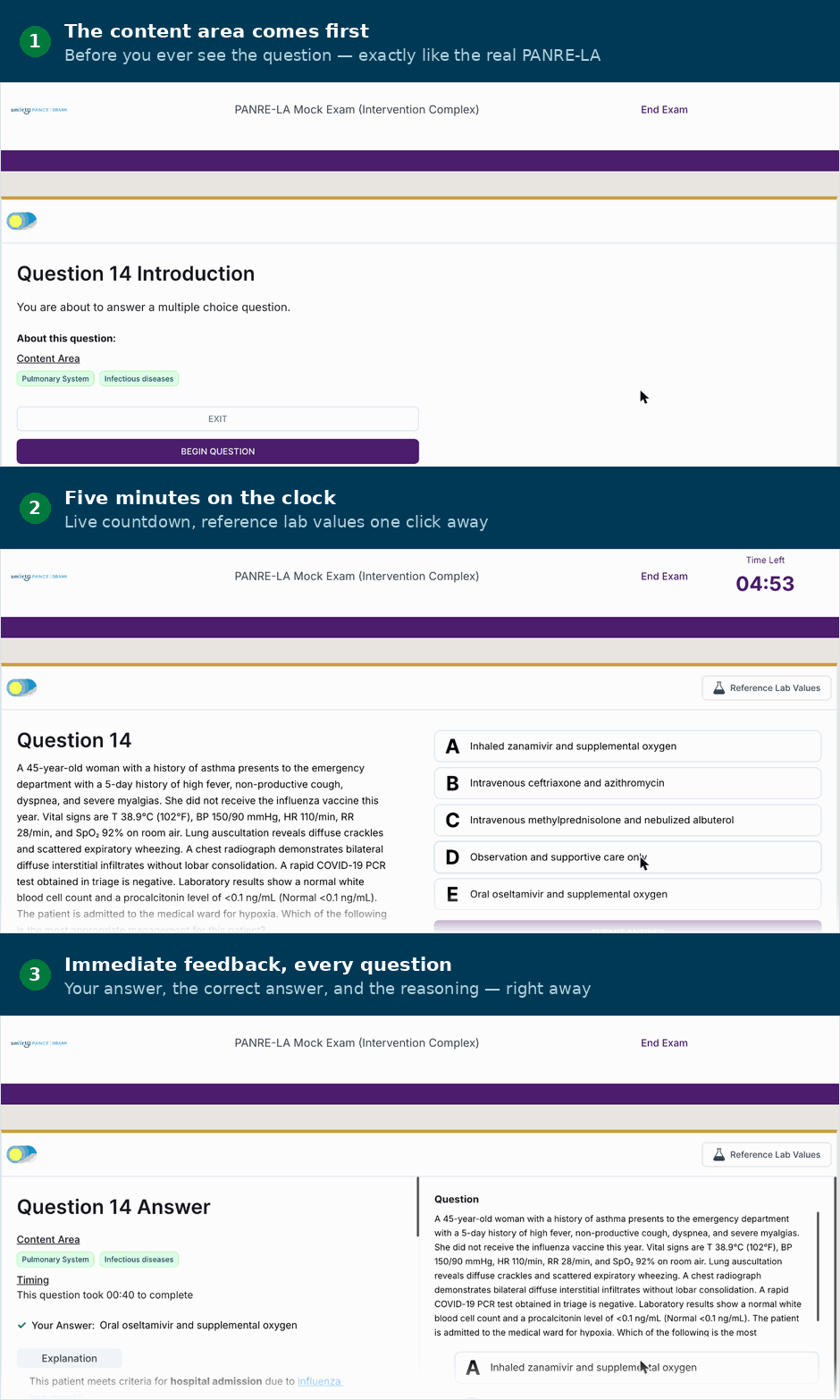
| On the real PANRE-LA | In the Smarty PANCE mock |
|---|---|
| The content area is shown with the question — the exam tells you which system you're in | Same. A tagged intro screen before every question, so you can practice checking the system first |
| Five minutes per question | Same. A live 5:00 countdown in the corner, and it records how long each question actually took you |
| Open reference — published references while the clock runs | Same. Reference lab values built in, and nothing stops you keeping the blueprint open on your second screen — which is the habit you want |
| Immediate feedback — the correct response, an explanation, and references after each question | Same, and then some. Correct answer, full reasoning, why each distractor is wrong, and clinical pearls |
| One question at a time, answered and gone | Same. Submit, learn, move on — no scrolling back to second-guess yourself |
Left column: NCCPA, Maintain Certification, except the content-area display, which is from my own PANRE-LA quarters. The mock exam uses Smarty PANCE questions only — no PANRE-LA content, which we could not use even if we wanted to.
Practice it enough times and the format stops costing you anything. All five of your minutes go to the medicine.
Step 4: One question every morning
The hardest part of recertifying as a working PA isn't the material. It's opening the laptop at all after a full clinic day and a family dinner.
So make the commitment small enough that you can't talk yourself out of it. My free Daily PANCE and PANRE Blueprint email series sends one board question every morning — two minutes a day. The questions are good. But the real value is the daily nudge that keeps the habit alive between now and your test date.
If you commute, the Audio PANCE and PANRE podcast covers the same blueprint in the car.
Step 5: Simulate the real thing before the real thing
Reading is recognition. Testing is retrieval. They're different skills, and only one of them is what happens on exam day.
- 225-question comprehensive exams — five of them, for full-length endurance work.
- The Virtual PANCE/PANRE simulation room — four timed blocks, the way the real PANRE runs. It won't predict your score — nothing honestly can — but sitting four blocks back to back before exam day is the closest thing to a dress rehearsal.
- NCCPA's own practice exams — two PANRE-specific exams, 120 questions each, $50 apiece, 180 days to complete. Worth it for the interface alone. Fair warning: NCCPA states plainly that these are not intended to predict your performance, so treat a good score as reassurance, not a guarantee.
If you're taking the PANRE-LA: the open-book rules people get wrong
These rules are recent enough that most PANRE-LA advice floating around online predates them entirely. They are the most important thing on this page.
The PANRE-LA is open reference, and that is a real, useful allowance. But read NCCPA's actual sentence, because the second half governs the first: "Although I may consult published reference materials such as books or online journals if time allows, my answers will represent only my own knowledge and abilities."
What it's not is open-AI, and it's not open-colleague.
Straight from the PANRE-LA Acknowledgement: you agree that you "will not, by any means whatsoever, enter or upload exam content (i.e., test questions, answers, rationales, or substantial portions of the same) other than discrete keywords to any website, search engine, or chatbot that may or may not incorporate generative Artificial Intelligence (AI) or Large Language Models (LLM), whether during or after" your sessions.
You also agree not to "seek or receive assistance from other individuals," discuss question content with anyone before, during, or after, or test anywhere another person could see the items.
Read that carefully, because the distinction is precise and it matters:
- Pasting a question stem into ChatGPT is out. So is a screenshot, an answer choice, or a rationale. During or after — the obligation doesn't expire when the quarter closes.
- Searching a few discrete keywords is expressly allowed. "fever flank pain dysuria CVA tenderness" is keywords. The question isn't.
- Asking a colleague is out. Even the well-meaning "hey, what's the most common organism in…" text message.
So the practical question becomes: how do you search fast, from keywords only, and land on something you can actually verify?
The tool I built for exactly this
Here's my own workflow, and it's the reason I scored 1384 on my PANRE-LA against a cut score of 1150.
Two screens. The exam on one. The PANRE-LA Rapid Blueprint Search on the other. Before I read a single word of the question, I look at the content area the exam displays — Renal, Cardiovascular, whatever it says — and I set the finder to that system. The exam has just told me where the answer lives.
Then I read the lead-in first, pull two to eight distinctive clues out of the vignette, choose what I'm trying to confirm, and search.
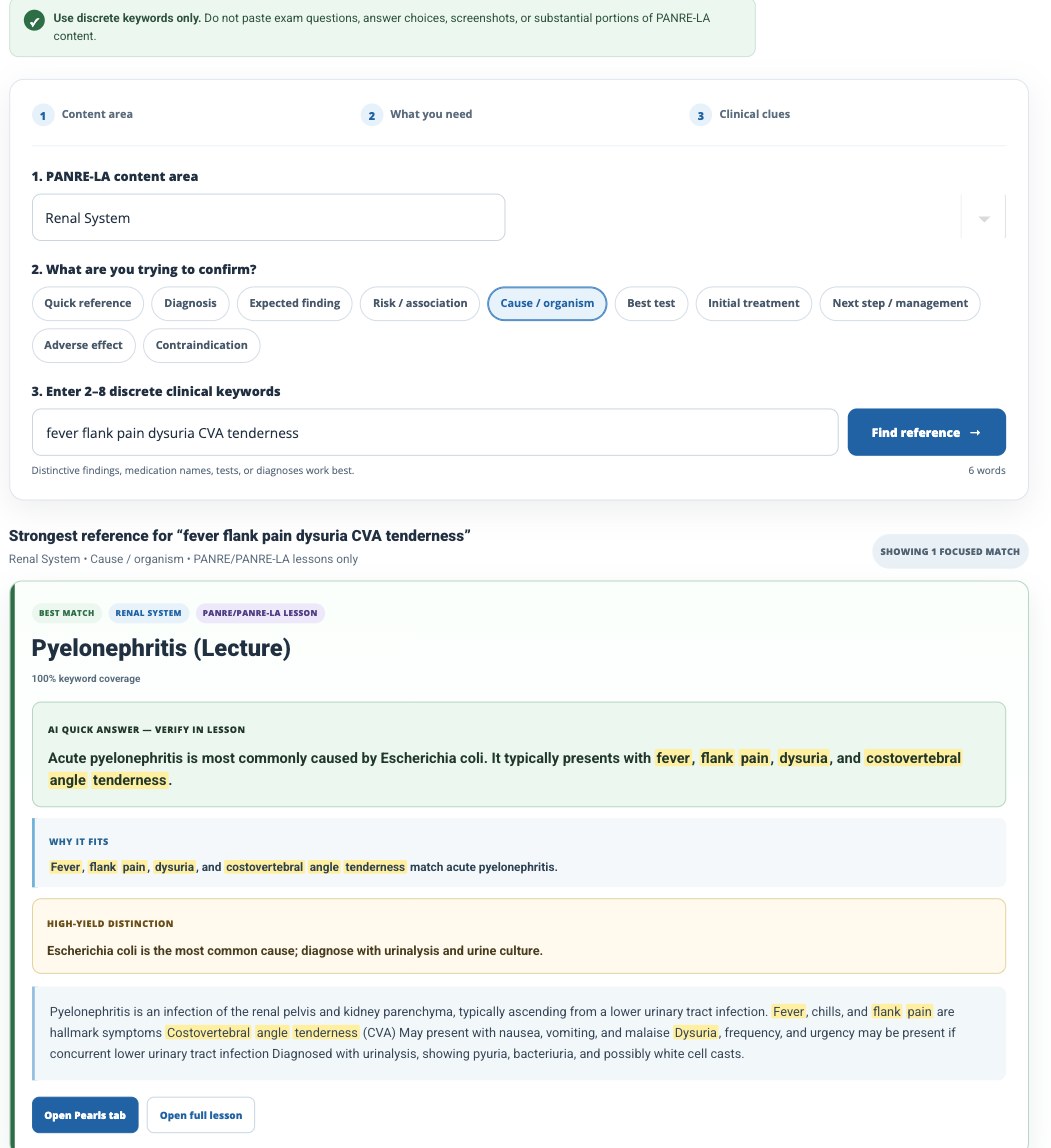
Three choices, one focused result. Not a chat window. Not a general web search that dumps forty tabs on you while your five minutes bleed away.
Use it the right way. Discrete keywords only. Never paste a question stem, an answer choice, a screenshot, or a substantial portion of exam content into the finder or anywhere else. The finder points you back to the supporting Smarty PANCE lesson so you can confirm the answer against the source — that verification step is the whole point.
My exact process
See it done, quarter by quarter
I wrote up the whole workflow with screenshots — the dual-screen setup, reading the lead-in first, pulling the breadcrumbs out of the vignette, and confirming the answer against the lesson before you submit.
The Rapid Blueprint Search is included with every Smarty PANCE membership. There's also a full step-by-step PANRE-LA walkthrough with screenshots of the whole process, quarter by quarter.
About that 97% pass rate
You've seen that number quoted everywhere. It deserves a caveat.
97% is the first-time pass rate for the 2018 due-year cohort, published in an NCCPA document dated January 2019. It's still the most recent PANRE pass rate NCCPA has made public. The table has sat untouched for more than seven years, and NCCPA has not said why. Note too that the 2018 denominator deliberately excluded PAs enrolled in the Pilot Alternative to PANRE.
The only PANRE-LA figure NCCPA has published comes from the 2019–2020 pilot: more than 18,000 PAs participated, over 98% stayed through the full two years, and 97.5% passed. That's a pilot statistic, not a PANRE-LA pass rate. Nobody outside NCCPA has one.
What all of that tells you is simple enough: the overwhelming majority of PAs who prepare, pass. It doesn't tell you that you can skip the preparation.
Sources: NCCPA PANRE pass rate; NCCPA PANRE-LA announcement. See also our breakdown of what the national PANCE and PANRE numbers actually say.
One more thing, from someone who has done this
You're going to walk out of that exam certain you failed.
I've walked out of every board exam I've ever taken convinced I had blown it. Every single one. Then the score comes back and it's fine, and the whole cycle starts again a decade later.
That feeling isn't a signal. It's what a well-built exam is supposed to feel like — every question sits right at the edge of what you know, because that's where the test is calibrated. If it felt easy, it wouldn't be measuring anything.
You've been practicing medicine for ten years. You know more than you think you do. Study the systems you've stopped seeing, do the questions, set the date, and go.
PANRE and PANRE-LA questions I get asked most
Can I switch from PANRE-LA to the traditional PANRE?
If you don't pass the PANRE-LA by the end of your 12 quarters, you get up to three attempts at the traditional PANRE in year 10 before your certification expires. You're not left without a path. You do have to keep meeting your CME requirements the whole time you are enrolled in PANRE-LA — that obligation does not pause.
What happens if I skip a PANRE-LA quarter?
You may skip up to four of the 12 quarters, as long as you complete at least one quarter in year 7 and at least one in year 8. Your score is calculated from your best 8 quarters, and it's recalculated each time you complete another one. More quarters means more chances to pull your score up — there's no downside to doing all 12.
Do I really get five minutes per question?
Yes. Five minutes per question, 25 questions per quarter. If you've read somewhere that it's five seconds, that's simply wrong. Five minutes is enough time to read carefully, pull your clues, search a reference, and verify — if you have your workspace set up before you start.
Can I use ChatGPT during the PANRE-LA?
No. NCCPA's acknowledgement specifically prohibits entering exam content into any website, search engine, or chatbot incorporating generative AI or large language models — during or after your sessions. Discrete keywords are expressly carved out, which is why keyword-based reference tools are fine and pasting a question isn't. Violations can put your certification at risk.
Does working in a specialty hurt my chances?
It changes what you need to study, not whether you can pass. A 2025 study by NCCPA researchers found that knowledge outside your daily domain is about twice as likely to decline, and that the pattern follows your practice profile. Specialty PAs should deliberately study outside their daily scope — that's where the points are hiding.
How many CME credits do I need, and are self-assessment credits still required?
100 credits per two-year cycle, at least 50 of them Category 1, across five cycles in your 10-year period. Self-assessment and performance-improvement CME are no longer required, but both still carry bonuses: self-assessment credits earn 50% extra, and your first 20 PI-CME credits per cycle are doubled.
When should I register?
Now. Set the date, pay the $350, and put it on the calendar where your family can see it. The worst outcome in this whole process isn't failing — it's running out of runway in year 10 with a 90-day wait between attempts and no room left.
Your next step
Open the blueprint right now and spend ten minutes on one thing: circle every organ system you haven't thought about since PA school. That list — not a review book's table of contents — is your study plan.
Then, if you want the lessons, the PEARLS, the QBank, the mock exams, and the Rapid Blueprint Search behind it, Smarty PANCE has all of it in one membership. I built it because I was staring down my own recertification and couldn't find what I wanted.
You've got this. I'm rooting for you.
Stephen Pasquini PA-C
You may also like
 Overview of the PANCE, PANRE and Pilot Alternative BlueprintsNew 2019 PANCE, PANRE and Pilot Alternative to PANRE blueprints. With a look at the new PANRE three-tier assessment system.
 The 4 Best PANCE and PANRE Study Guides and Review BooksWhat are the best PANCE and PANRE board review books? Here are my picks for the top PANCE and PANRE review books …
 The Perfect PA Program Picker: PA School Search, Sort, Match, and ApplyChoosing where to apply is one of the highest-stakes decisions of your pre-PA journey — and the data you use should never …


CASPA Personal Statement Help
 We offer comprehensive, start-to-finish personal statement assistance or help to perfect a draft you already have. We have services to fit every budget.
 Schedule a Live Recorded PA School Video Interview

We offer 60-minute mock PA school interviews with post-interview feedback and advice. Includes a recorded video of your interview that you can watch, download, or share with family and friends. There is no better way to prepare!
Schedule an InterviewPre-PA Consulting and Advising
 Our pre-PA coaching service consists of a 1-hour phone consultation focused on addressing your specific questions or concerns about becoming a PA and applying to PA school.


is all of the info posted here still relevant in June 2020? about to make some decisions based on what i’ve just read. wanna see if anyone would add or subtract anything before i proceed.