
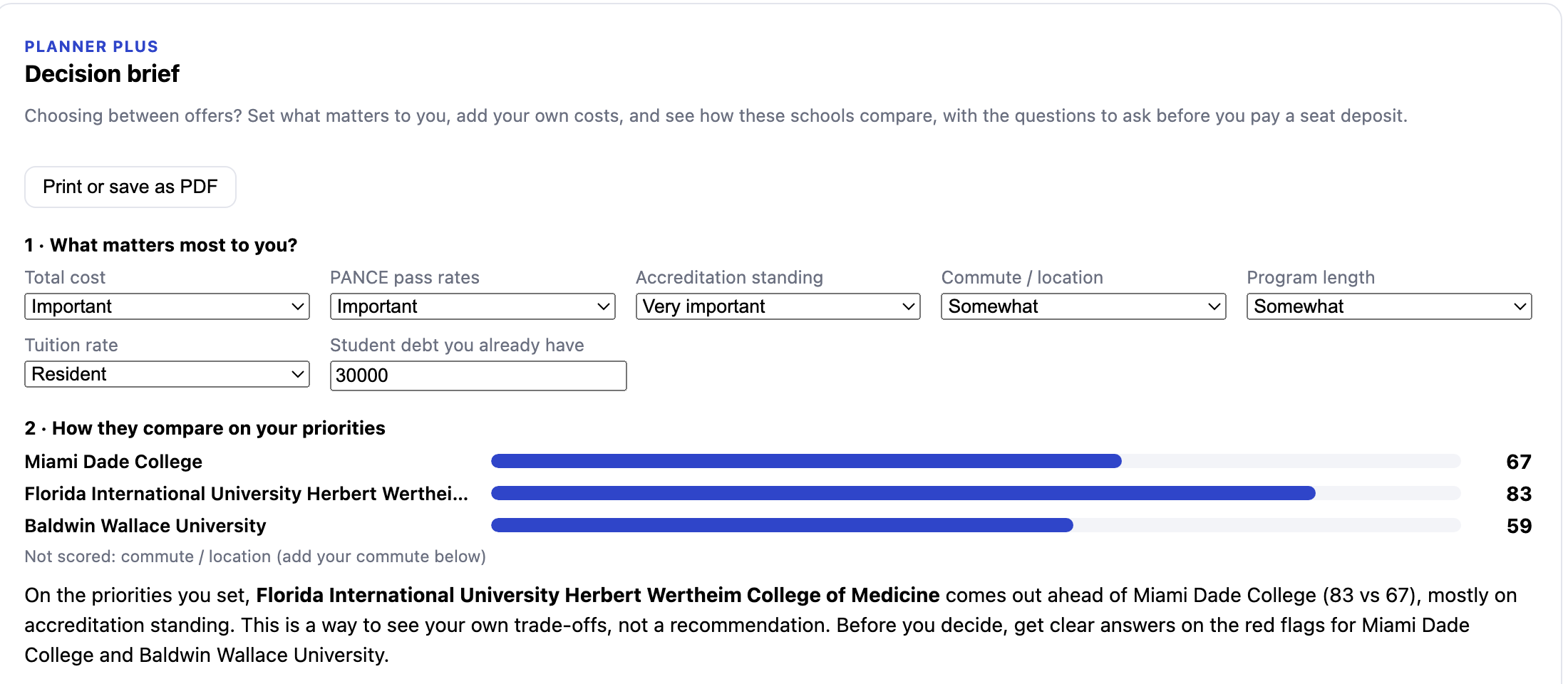
The Decision Brief in My PA School Planner puts your offers side by side, scored on the priorities you choose. Click any image in this post to see it full size.
You applied, you interviewed, and now you have more than one yes. Congratulations. That is a big deal, and you earned it.
When I applied to five PA schools back in 2001, there was no CASPA, and my whole system was a manila folder and a lot of sticky notes. I was admitted a week after my interview, and some of the 4.0 Ivy League students I met that day went to the waiting list. I tell you that because the numbers on paper never tell the whole story, in admissions or in choosing where to go.
It also brings a new kind of stress. Seat deposits come due fast, sometimes within two weeks of an offer, and the deposit is usually nonrefundable. So you have a short window to make one of the biggest decisions of your career, and most of the advice out there is a pile of opinions.
Here is a calmer way to do it: line up the same facts for every school, understand what each one really means, then ask each program the questions the facts can't answer.
Step 1: Put the same facts side by side
Start a simple table with one column per school. Fill in the same rows for each one, from the program's own website:
- Accreditation status and the date of the next ARC-PA review
- First-time PANCE pass rates for the last few years, with how many graduates took the exam
- Attrition (students who left or were decelerated) for the last few classes
- Total cost: tuition plus required fees for the whole program
- The degree you graduate with
- Length and start date
- Class size and seat deposit
- Clinical rotations: how many, where, and who arranges them
If a row is blank for one school, that blank is information too. It tells you what to ask.
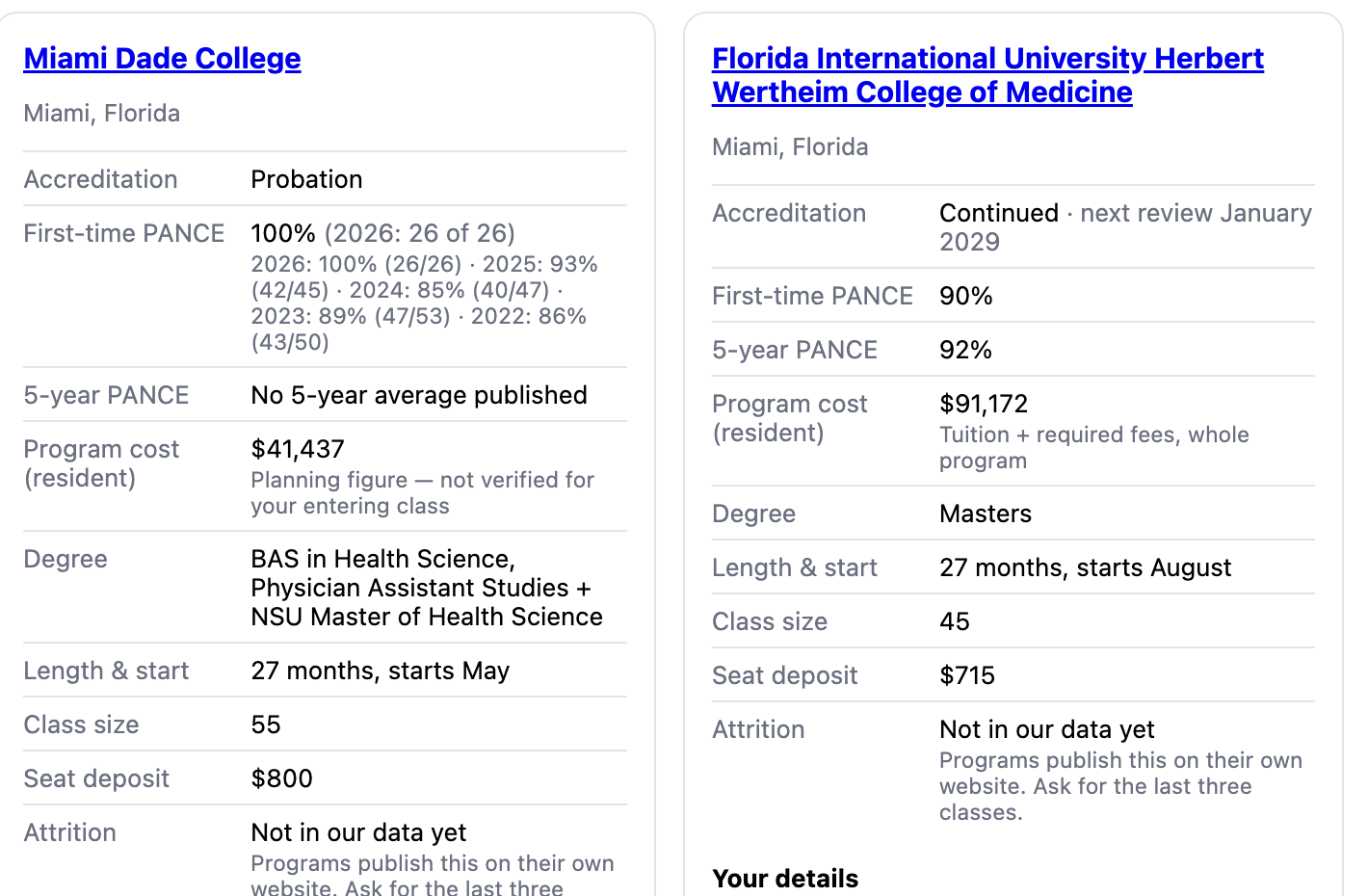
Here is what that table looks like for two real programs. Notice the attrition row: it is blank for both. That blank is your first question.
Step 2: Understand accreditation, especially probation
ARC-PA, the accrediting body for PA programs, publishes a status for every program. The ones you'll see most:
- Continued: the program has met the standards over time. It stays in place unless the program closes or loses accreditation.
- Provisional: a newer program that looks on track to meet the standards but hasn't graduated enough classes to prove it yet. There's no long track record to judge.
- Probation: a temporary status for a program that isn't meeting the standards, or whose ability to give students an acceptable education is at risk. It usually lasts at least two years and can be extended. The program is still accredited during probation, but it has to fix the problems by a deadline or it can lose accreditation.
- Administrative Probation: a different, narrower status for missing an administrative requirement, such as fees or required reports. It is not the same thing as Probation.
Probation is not automatically a deal breaker, but the reason matters a lot. Paperwork problems are one thing. Not enough clinical sites, preceptors, or faculty is another, because those are exactly the things that shape your clinical year. Programs on probation are expected to tell applicants about it, and they should be able to explain it plainly.
If a school on your list is on probation, ask:
- What did ARC-PA cite, and what has changed since?
- When is the next review?
- What happens to enrolled students if accreditation is withdrawn?
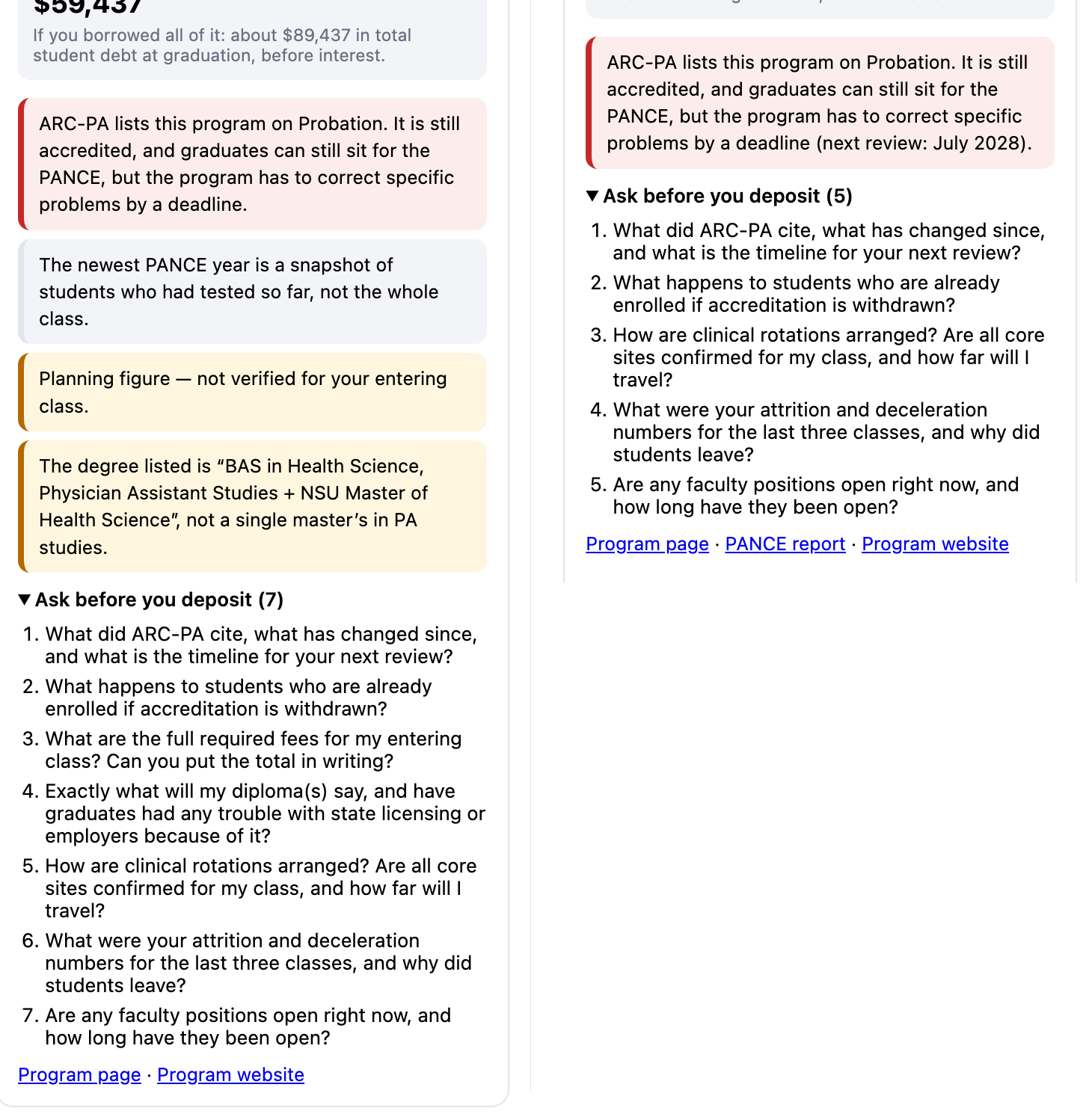
Probation flagged in plain language with the next review date, plus each program's own questions to ask before you pay a deposit.
You can see every program currently on probation, and what each status means, on PA School Finder's list of PA schools on probation.
Step 3: Read PANCE results the right way
A pass rate is only as solid as the number of people behind it. A program where 26 of 26 graduates passed shows 100%, but a single student changes that number by almost four points. A program with 90% across 40 graduates a year, for five straight years, is telling you something more stable.
So look at three things together:
- First-time pass rates for several years, not just the best one
- How many graduates took the exam each year
- Whether the newest year is complete, or only a snapshot of the students who had tested so far
Programs post their results using the NCCPA's report. If you can't find a recent one, ask the program to send it. You can also compare programs on the PA school PANCE pass rate rankings.
Step 4: Ask about attrition
Attrition tells you how many students didn't finish with their class. Some leave for personal reasons, some are decelerated, some are dismissed. A single high year can have a good explanation. A pattern is worth a conversation. Ask for the last three classes, and ask what support the program offers students who start to struggle.
Step 5: Figure out your real cost
Tuition alone can fool you. Compare tuition plus required fees for the whole program, then add what only you know:
- Will you have to move? Add moving costs and any difference in rent.
- How far is the commute, and what will gas, parking, or transit cost for 2+ years?
- How much student debt do you already have?
Add it up as a rough total you would borrow by graduation. A cheaper program that requires a move to an expensive area can end up closer in cost than it first looks. A more expensive program near family and a lease you already have can end up closer too. If a school only publishes tuition and not its required fees, ask for the full number for your entering class, in writing.
Debt is personal for me. When I started PA school at Rutgers (then UMDNJ) in 2001, tuition was about $10,000 a year before fees. I still carried about $20,000 in undergraduate debt, plus the cost of my first year of PA school before a National Health Service Corps scholarship kicked in. I paid off my last college loan six years after graduation. Graduates today owe far more than I did. My worry is that big debt pushes new PAs toward the highest bidder instead of the medicine they actually want to practice. If cost is weighing on your decision, read how I paid for PA school through the NHSC before you sign anything.
Step 6: Check the degree you'll graduate with
Most PA programs award a master's degree in PA studies or medical science. A few use a different structure, such as a bachelor's degree from one school combined with a master's from a partner institution. Ask exactly what will be printed on your diploma, and whether graduates have had any trouble with state licensing or employers because of it. You want a clear, confident answer.
Step 7: Dig into clinical rotations
This is the part no table captures well, and it may matter more than anything above. Your clinical year is where you learn to practice, and it is often where your first job offer comes from.
The best clinical education of my life did not come from a big academic center. It came from my first job, at a National Health Service Corps site in Greenfield, California, a farmworking town in the Salinas Valley about an hour from anywhere you have heard of. I learned to work without a specialist down the hall and to do a lot with a little. So when you compare programs, ask where students actually rotate and what they see there, not just which hospital name is on the brochure.
- Does the program arrange all core rotations, or will you be asked to find your own preceptors?
- Are sites confirmed for your class?
- How far will you travel, and will you need housing in another city?
- Are there sites in the area where you hope to work after graduation?
Step 8: Weigh the things that are only about you
Once the facts are lined up, the rest is personal, and that is fine. Where will you have support? Where can you sleep, eat, and study well for 27 months? Did one program feel like a place where people wanted you to succeed? Those answers belong in your decision too. Just let them sit next to the facts, not replace them.
Questions to ask before you pay a seat deposit
- What is your current accreditation status, and when is your next ARC-PA review?
- Can you send me your most recent NCCPA PANCE report?
- What were your attrition and deceleration numbers for the last three classes?
- What are the total required fees for my entering class, in writing?
- Exactly what degree will I graduate with?
- Who arranges clinical rotations, and are core sites confirmed for my class?
- Are any faculty positions open right now?
- Is the seat deposit refundable, and does it count toward tuition?
Ask by email when you can, so you have the answers in writing to compare.
A faster way to compare your offers
This is the tool I wish I had back when my planning lived in that manila folder. So we built this exact process into My PA School Planner. Pick the schools you're deciding between and the planner's Decision Brief lines them up for you: accreditation status and next review date, first-time PANCE results with test-taker counts, total cost with your own moving and living costs and existing debt, the degree you'll graduate with, and plain-language red flags like probation. You choose what matters most to you, and every school comes with its own list of questions to ask before you pay a deposit. You can print it or save it as a PDF to talk it over with your family. The Decision Brief is part of Planner Plus.
See it in action
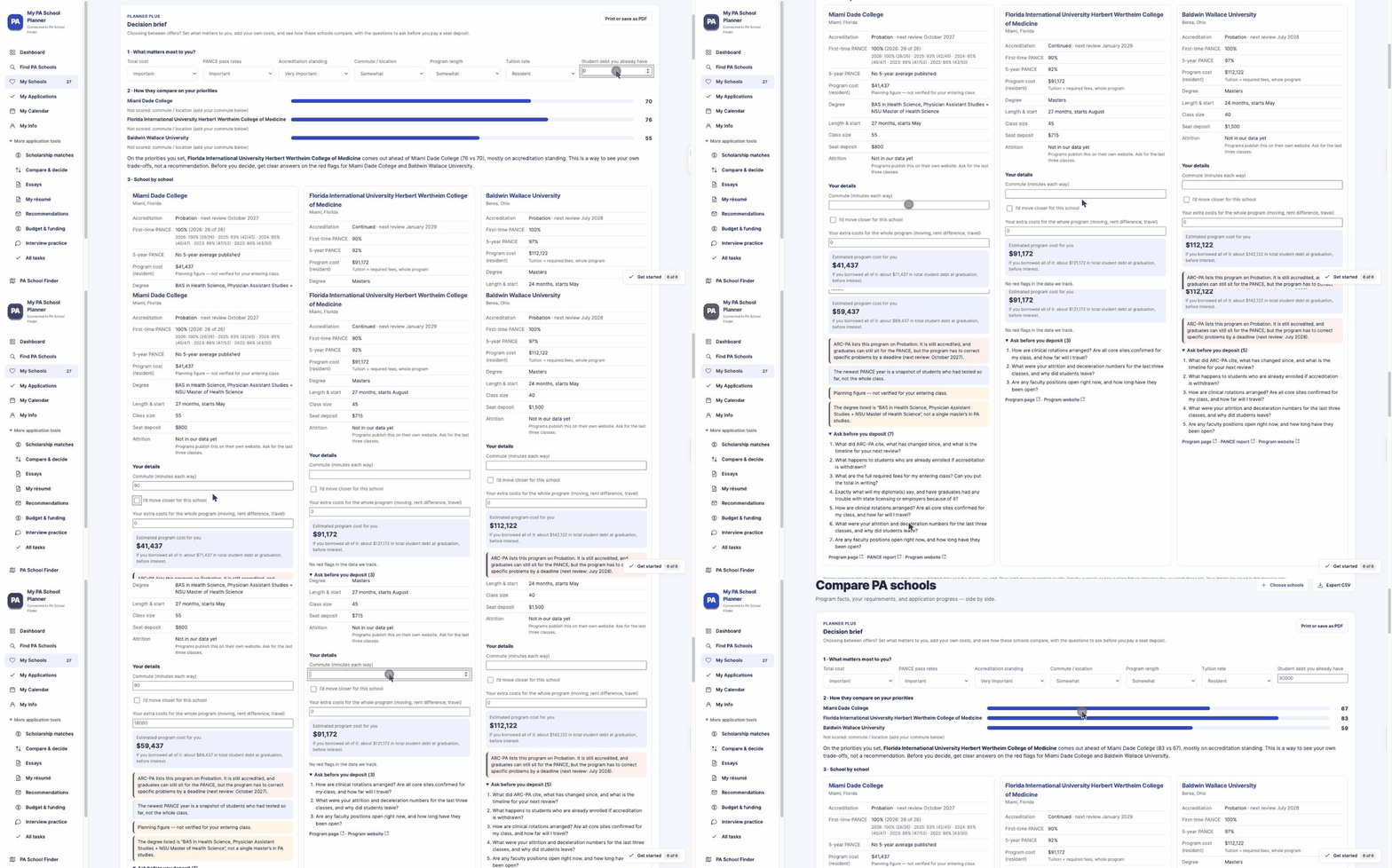
Watch it work: set what matters to you, add your commute and moving costs, and the scores and your estimated total update as you type.
Here is the full Decision Brief for three programs. In this example, a student cares most about accreditation, then cost and PANCE results. She lives 90 minutes from one school and would need about $18,000 for moving and rent to attend it. The brief adds that to the program cost, includes her existing student debt, and shows roughly what she would owe at graduation. It also catches things that are easy to miss, like a degree that is a bachelor's plus a partner master's instead of a single PA master's.
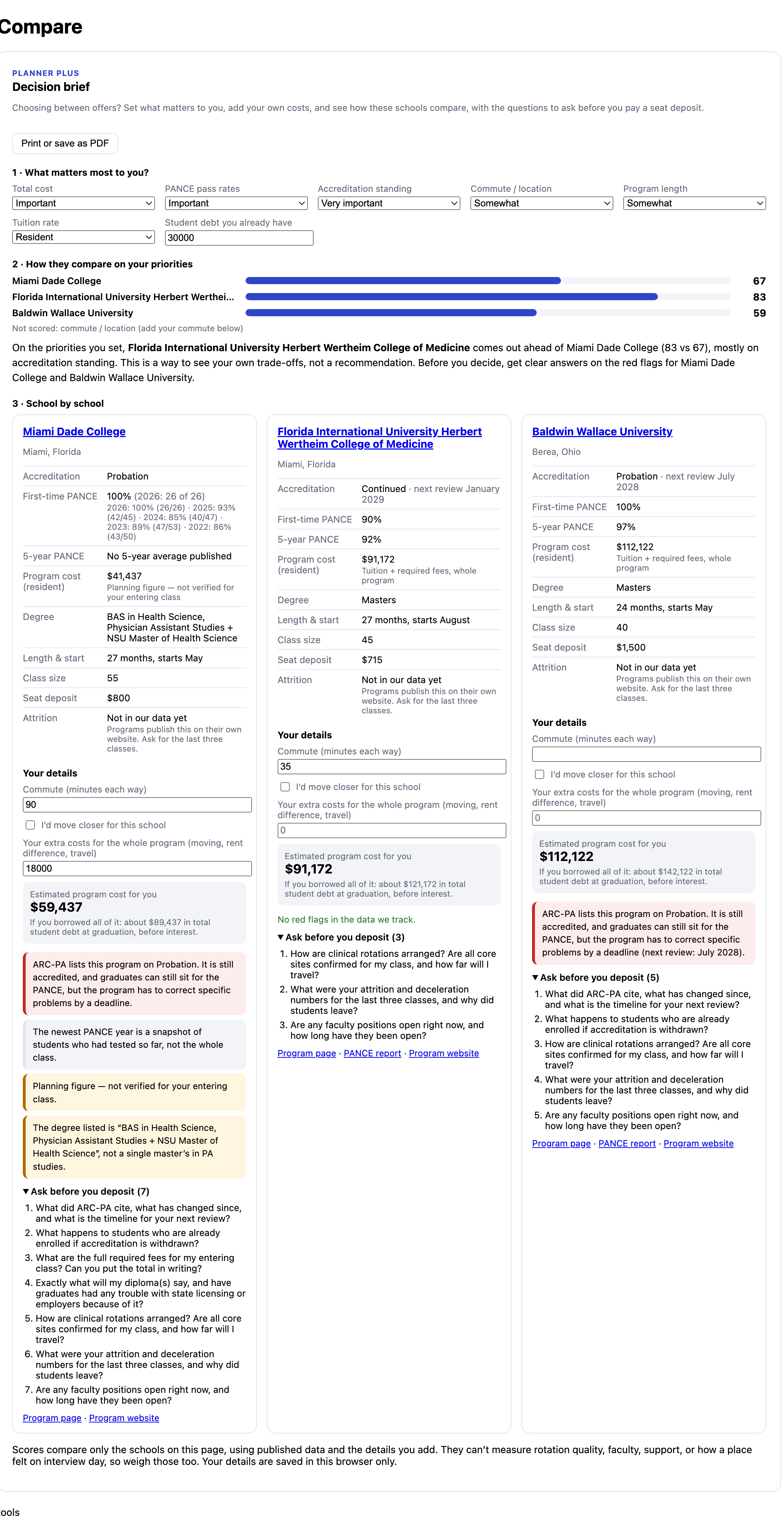
The whole brief on one page, ready to print or save as a PDF and talk over with your family.
The scores are a way to see your own trade-offs, not a ranking of schools. The brief says so right on the page, and it reminds you that it can't measure rotation quality, faculty, or how a place felt on interview day. Those are still yours to weigh.
Compare your schools in My PA School Planner →
Whatever you choose, remember what got you here. You built an application strong enough to earn more than one yes. Take a breath, get the facts, ask your questions, and pick the program where you'll do your best work. Then go become a great PA. I'm rooting for you.
View all posts in this series
- PA School Finder – The Ultimate Physician Assistant School and Program Directory
- Physician Assistant Programs Offering Part-Time Options
- Which State Has the Largest Number of Physician Assistant Programs?
- Physician Assistant School and Program Directory eBook
- 2017 Physician Assistant Program Tuition and Cost Comparison Table
- Made by PA: The Applicant’s Manual of Physician Assistant Programs
- The Perfect PA Program Picker: PA School Search, Sort, Match, and Apply
- Choosing Between PA School Acceptances: How to Decide (and What Probation Really Means)
You may also like
 The Perfect PA Program Picker: PA School Search, Sort, Match, and ApplyChoosing where to apply is one of the highest-stakes decisions of your pre-PA journey — and the data you use should never …
 Made by PA: The Applicant’s Manual of Physician Assistant ProgramsThe 2018 Applicant's Manual of Physician Assistant Programs The Applicant's Manual of Physician Assistant Programs written by Mark Volpe, MPH, MMSc, PA-C …
 2017 Physician Assistant Program Tuition and Cost Comparison Table2017 Physician Assistant Program Tuition and Cost Comparison Tuition and cost data of resident and nonresident tuition including length and duration of all US …


CASPA Personal Statement Help
 We offer comprehensive, start-to-finish personal statement assistance or help to perfect a draft you already have. We have services to fit every budget.
 Schedule a Live Recorded PA School Video Interview

We offer 60-minute mock PA school interviews with post-interview feedback and advice. Includes a recorded video of your interview that you can watch, download, or share with family and friends. There is no better way to prepare!
Schedule an InterviewPre-PA Consulting and Advising
 Our pre-PA coaching service consists of a 1-hour phone consultation focused on addressing your specific questions or concerns about becoming a PA and applying to PA school.
Leave a Reply