
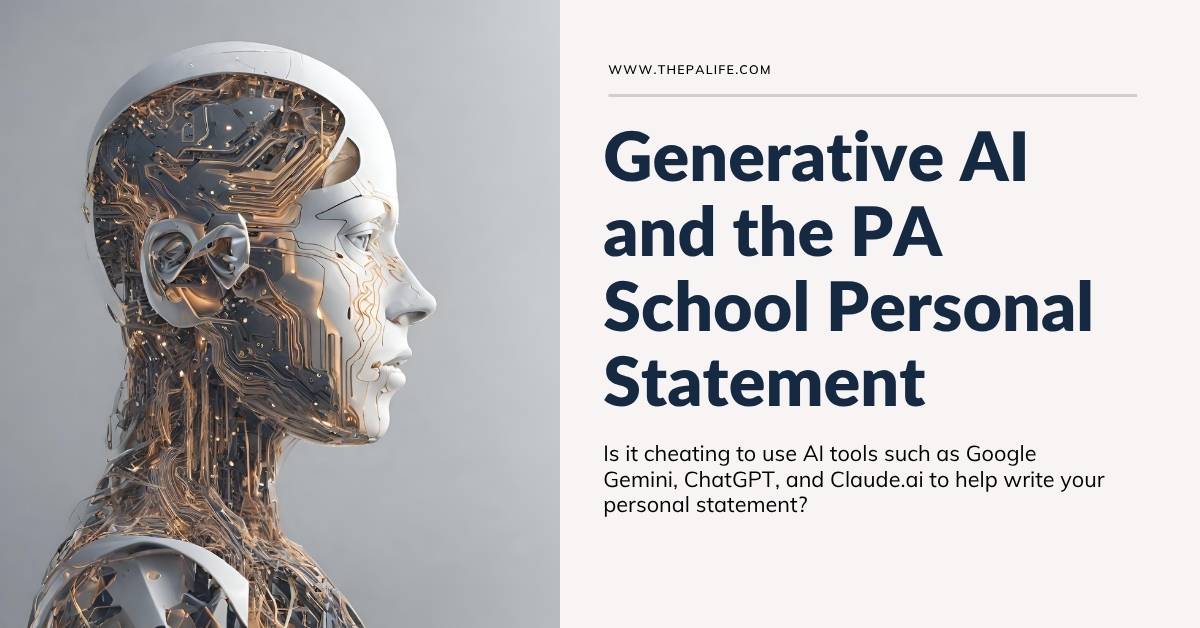
CASPA changed its mind. The blanket ban on generative AI is gone — replaced by a rule about what the finished essay has to be. Here's where the line actually falls, plus the new CASPA essay that's literally about AI.
If you've been reading anything about AI and PA school applications for the last two years — including the earlier version of this very post — you learned one rule: don't touch it.
CASPA said so in about as blunt a sentence as an application service can write. You were "strictly prohibited" from using generative AI to create, write, or modify any content in your application. Full stop.
That rule was still in force last cycle.
It isn't anymore.
For the 2026–2027 cycle, CASPA rewrote the whole section. The heading used to read "Policy on Use and Detection of Generative AI." It now reads "Guidance on Generative AI." The prohibition is gone. So is the line reserving the right to run your essay through AI detectors.
This is the kind of change that gets garbled on Reddit within a week and then repeated for a year. So let's go straight to the source, read exactly what it says, and then talk about the essay you're actually trying to write.
What CASPA's 2026–2027 AI rule actually says
Here it is, word for word, from Policies & Procedures for the PAEA Admissions Suite of Products, effective April 9, 2026:
I certify that all written content in my CASPA application is my own work. This includes, but is not limited to, personal statements, essays, and descriptions of work, educational activities, and events. While consulting personal and professional resources, including artificial intelligence (AI) tools, for non-substantive changes such as correction of spelling and grammar is acceptable, my final submission accurately represents my own writing, work and experiences.
It is my responsibility to review and abide by the institutional policies regarding the use of artificial intelligence tools to any program to which I apply.
Read that first sentence again, because it's doing all the work: all written content in my CASPA application is my own work.
The rule didn't get loose. It got specific.
The old rule policed the process — did an AI touch this at any point? The new rule polices the product — does the finished essay accurately represent your writing, your work, and your experiences?
And in PAEA's own guidance, a few lines above the certification, they say the quiet part out loud:
Generative AI provides users with opportunities to enhance efficiency, brainstorm topics and ideas, and proofread their writing for grammar and spelling.
Brainstorming. Proofreading. Named by CASPA as legitimate uses. That's a real shift from where we were twelve months ago, and pretending otherwise doesn't serve you.
What disappeared, for the record: the sentence saying you were "strictly prohibited" from using generative AI to create, write, or modify any content, and the one reserving PAEA's right to run detection software on your writing. Both were in the guide as recently as April 2025. Both are gone.
So what's actually allowed now?
Here's what makes this easy to reason about: stop asking "which app am I allowed to open?" and start asking "what am I asking it to do?"
That's how the rule is written, and it's the only version of this that will still be true next year when there are six new tools none of us have heard of.
| What you're asking AI to do | Where you stand | Why |
|---|---|---|
| Fix spelling and grammar | Fine | Named in the certification as acceptable |
| Help you brainstorm topics before you write | Fine | Named in PAEA's own guidance |
| Help you organize your notes, shadowing log, or journal | Fine, with care | You're consulting a resource; the writing stays yours |
| Rewrite your paragraph to "sound better" | No | That's substantive. It stops being your writing |
| Write a hook, a closing line, or a draft | No | Same problem, bigger |
| Any of the above, if your program says no | No | Program policy beats CASPA's floor |
That last row is the one almost nobody tells you, and it might be the most important line in this post.
CASPA's rule is a floor, not a ceiling. You are certifying that it's your responsibility to find out and follow each individual program's AI policy. Some programs are stricter than CASPA. Some have written policies on their admissions pages. Some will ask you about it at the interview. That burden is yours, and "CASPA said it was okay" is not a defense if a program said otherwise.
Check the programs on your list. Actually check.
Where the line really is — the two-question test
When a student writes and asks me "is this allowed?", I ask two things back:
1. Did the sentences come out of you?
Not the idea. Not the polish. The sentences. If you typed them and a tool fixed a comma, they came out of you. If a tool typed them and you fixed a comma, they didn't. There's no gray zone in the middle, no matter how much you rearranged it afterward.
2. Could you defend every word of it in an interview, out loud, with no notes?
Because you might have to. Programs have gotten wise to this. Some now do on-site writing samples, some do proctored short answers, and plenty of interviewers will simply pick a line out of your essay and ask you to say more about it. If your stomach drops at that idea, that's your answer.
Pass both questions and you're clear. Fail either one and it doesn't matter what tool you used.
What about spell-check and grammar-check?
Use them. This is the one CASPA answered directly — "correction of spelling and grammar is acceptable" is about as explicit as policy language gets.
So yes — your word processor's spell-check is fine. The squiggly red line is fine.
But pay attention to the feature, not the brand name — because these tools are not what they were when you started your prerequisites.
The proofreading apps you grew up with have quietly become writing apps. Nearly all of them now ship generative features right beside the spell-check — rewrite this, improve this paragraph, make this more compelling. Your word processor has them. Your browser has them. Your phone keyboard is heading there. Several of the best-known grammar tools were bought, merged, or rebranded over the last two years and came out the other side as full AI writing assistants.
So don't go looking for an approved-apps list. There isn't one, and anyone selling you one is guessing. The line no longer runs between apps. It runs between buttons.
- Red squiggle under a misspelled word → fix it. That's what CASPA blessed.
- "Rewrite this paragraph to sound more compelling" → don't. That's the tool writing, and you'd be certifying something untrue when you submit.
If a feature offers to make your writing better rather than correct, close it. Those are different things, and the second one is the whole ballgame.
Do this before you start: go into your writing tool's settings and switch the generative features off, not just "don't click them." Leave spelling and grammar on. It takes two minutes, and it removes the temptation entirely on the night when you're tired, it's late, and that one paragraph still isn't landing.
Can readers really tell if AI wrote it?
Often, yes — and I want to separate two things that get mashed together here, because one of them should worry you and the other one shouldn't.
The thing that should worry you: AI-written essays read like AI-written essays.
They're competent. They're organized. They hit every beat. And they are completely interchangeable — swap the name at the top and nobody would notice. They reach for the same vocabulary, the same tidy three-part structure, the same closing paragraph about a passion for serving others.
An admissions reader goes through hundreds of these. By November they can feel the difference the way you can feel a fever without a thermometer. They may not be able to prove it. They don't need to prove it — they just move to the next file.
The thing that shouldn't worry you: AI detectors.
CASPA addressed this directly, and it's genuinely good news — especially if you're a formal writer, a second-language writer, or someone whose prose just happens to be tidy:
Given the significant risk presented by current AI detection software as of the date this policy is being issued, PAEA will not initiate a CASPA investigation where the sole basis for the investigation request is that an AI detection tool tagged a personal statement or evaluation submitted in CASPA.
PAEA knows these tools have a high false-positive rate. They will not open an investigation on a detector flag alone.
So don't write defensively. Don't rough up your grammar to seem more human. Don't run your essay through five detectors at 2 a.m. and spiral. Write like yourself, and the detector problem takes care of itself — because the thing detectors are worst at spotting is exactly the thing that's easiest to produce when you're telling the truth about your own life.
Is it cheating to work with a human editor?
No. It never was, and the new rule doesn't change that — it clarifies it.
A good editor does not write your essay. A good editor asks you the question that makes you finally say the true thing, tells you your third paragraph is where the essay actually starts, and points out that you spent 200 words on your GPA and 40 on the patient who changed your mind.
The words stay yours. That's the whole distinction the new certification is built on: my final submission accurately represents my own writing, work and experiences. An editor who works that way keeps you squarely inside it.
This has always been how medicine works, by the way. Nobody writes a manuscript, a grant, or a discharge summary in a vacuum. You draft, someone who knows more reads it, you make it better. That's not cheating. That's how good writing has always happened.
Okay — so what am I actually supposed to use?
Fair question. It's the one every "don't use AI" article forgets to answer, and it's the reason so many applicants end up using it anyway: they're staring at a blank page at 11 p.m. with no idea what the first sentence is supposed to be, and the chatbot is right there.
So let me answer it plainly. The thing that gets you unstuck isn't a tool that writes for you. It's better questions.
That's the entire reason we built the PA School Personal Statement Builder, and I want to be explicit about what it is and isn't, because on a post like this you deserve that.
It is not AI. It doesn't generate a single word of your essay. It's a guided drafting tool that walks you through the seven sections these essays actually follow, and at each one it asks you the kind of question a good editor would ask — the question that makes you stop generalizing and write the specific true thing. There's a live CASPA character counter so you're never guessing at length, and it saves as you go.
Drafting is free. If you get to a paragraph that won't cooperate, you can send that one section to a human editor for $29, or your finished essay for a full review at $149. Real people, every time. No AI-generated feedback — which, as of this cycle, is a promise that actually means something.
Blank page, ten o'clock at night, no idea where to start? That's what it's for.
Stop staring at a blank page. Draft your CASPA essay one guided section at a time with our free builder — no AI, just the questions that pull the real story out of you.
What about NotebookLM and all the other new tools?
I get this question constantly now, and I'm going to answer it in a way that will still be useful after these tools have been renamed twice.
Tools like NotebookLM work differently from a chatbot: you feed them your own material — your shadowing log, your journal, the notes you took after a shift — and they help you find what's in there. Ask what themes keep recurring across two years of your own writing and you'll get a real answer, drawn from your life, not from the internet's average idea of a PA essay.
That's the useful version of this technology, and it lands on the right side of the line — you're organizing your own material, not generating new material. Same category as a highlighter, a legal pad, or a very patient friend.
But here's my honest opinion, and it's why I'm not going to hand you a list of apps:
The hard part of this essay was never the writing. It's the remembering.
It's sitting still long enough to figure out which of the last four years actually changed you. No tool does that part. A tool can help you sort what you've already written down — but if you haven't written anything down, there's nothing to sort, and the fanciest AI in the world will hand you back a beautifully organized nothing.
Use the tools to find your material. Never to supply it.
One more thing — there is a brand-new CASPA essay on this exact topic
While you are here: CASPA retired the COVID-19 Impact Essay for this cycle and replaced it with a 2,500-character question called Situational Decision Making. It asks how future PAs should use emerging technologies thoughtfully while keeping strong, human-centered relationships with patients — even in settings where technology may be limited.
Two things worth knowing this minute. First, it is not in the Essay section — it is filed under Personal Information → Other Information, which is why most applicants do not find it until October. Second, it is the one question on the entire application where having a chatbot write it would mean answering a question about judgment by demonstrating a lack of it.
I broke the whole thing down separately — the exact prompt, where it hides, the answer 90% of applicants are about to give, and a structure you can steal: The new CASPA Situational Decision Making essay: how to write it.
Let me show you what I mean, using my own rejected essay
I want to make this concrete, and the fastest way is to embarrass myself a little.
I applied to five PA schools in 2001, back before CASPA existed. My first essay was, I thought, extremely good. It laid out my strengths. It brown-nosed a bit. It established that I had the pedigree to be a wonderful healthcare provider. It opened with a William James quote.
Here's a piece of it:
I became involved in health care four years ago to help finance my college education. I worked as a medical record clerk in the University of Washington health clinic… I desired more direct patient care and in January 1998, when a student position opened in the lab, I jumped at the opportunity.
Four rejections.
Now — read that paragraph again and ask yourself an honest question: is there anything in it a machine couldn't have produced?
There isn't. It's competent. It's organized. It's completely interchangeable. Swap my name for yours and nobody would notice. That essay is what AI writes, and I managed it all by myself in 2001, because I was writing what I thought a committee wanted to hear instead of what was actually true about me.
I got my fourth rejection while I was filling out the application for UMDNJ — Rutgers now. I was demoralized. That night I sat down and wrote 625 different words. Here's the middle of them:
A woman smiled at me one day, her name was Margaret. The wrinkles on her face told a story and, in her hands, there played a motion picture. She sat crouched in a wheelchair; I sat on a stool beside her… Everybody liked Margaret; she used to tell us stories of her childhood and her husband who had given his life to the war. She had grown especially fond of me because "I had freckles like her grandson."
Her daughter looked tired and spoke softly, "The best vein is in her hand" she explained, "it doesn't hurt her there." I gently placed my hand on hers, and it was cold… I realized that Margaret was unable to speak. "Margaret, can you make a fist for me?" "Just like last time." She clenched tightly… I looked again to her eyes while placing a bandage on her hand. It was warm now… Without a word, she made perfect sense.
I never saw Margaret again.
I was 0.1 points below the minimum GPA UMDNJ required to even open my application. They opened it anyway. I was admitted a week after my interview — and some of the 4.0 Ivy League students I met that day went to the waiting list.
I hadn't read either essay in eleven years when I finally went back and compared them.
Here's what I want you to take from it: no system trained on the internet can write the Margaret paragraph. It doesn't know the clock rang six. It doesn't know her hand was cold going in and warm coming out. It doesn't know about the freckles. That paragraph exists in exactly one place — the memory of a twenty-something phlebotomist who kept showing up on Wednesdays and paid attention.
You have a Margaret. I'd bet the house on it. The work of this essay isn't generating language — it's being brave enough to put the real one on the page instead of the impressive one.
The bottom line
CASPA relaxed the rule. That is not the same as CASPA not caring.
The certification you sign still says the finished essay is your own work, in your own words, about your own life. What changed is that CASPA stopped pretending you'd never open a spell-checker, and started asking the question that actually matters: is this you?
And honestly? The rule change doesn't move the needle much on what you should do — because the strongest reason not to let AI write your personal statement was never the rule.
It's that it won't work.
An AI can write a competent essay about wanting to help people. It cannot write about the specific patient whose name you still remember. It doesn't know what your hands were doing. It doesn't know what you thought about on the drive home. Nobody can compete with you on being you — and that's the only real advantage you've got in a pile of two thousand applications.
Use the tools to fix your commas and jog your memory. Then get out of the way and tell the truth about your life.
Your next step: set a timer for ten minutes and answer one question on paper — when have I seen a piece of technology help a patient, and when have I seen it get in the way? Write both. Don't organize them. Don't make them good.
Whichever one you wrote faster is your opening — for the new essay, and probably for your personal statement too.
That's the part no tool can do for you, because it isn't in any dataset. It's in your memory, and it only got there because you showed up and paid attention. Which, as it happens, is the exact quality this whole application is trying to measure.
I'm here for you. And I can't wait to read what you come up with.
Stephen Pasquini, PA-C
Free Interactive Tool
Write it yourself — with a little help that isn't a robot
Our free Personal Statement Builder walks you through the essay one section at a time with prompts designed to pull your story out of you — with a live CASPA character counter, automatic saving, and the option to have a real human editor revise any paragraph the moment you hit a wall. No AI-generated feedback, ever. Every word you send us is read and revised by an experienced PA school admissions editor.
Sources
- Policies & Procedures for the PAEA Admissions Suite of Products, effective April 9, 2026 — pp. 15–16
- PAEA — Admission Suite of Products Updates (2026–2027 changes)
- CASPA Applicant Help Center — Other Information — Situational Decision Making prompt, updated June 9, 2026
- CASPA Applicant Guide 2025–26 — p. 13, the prior certification language
You may also like -
 The New CASPA Situational Decision Making Essay: How to Write It (2026–2027)CASPA retired the COVID-19 essay and replaced it with a new 2,500-character question about technology and the human side of medicine. The exact prompt, where it's hiding, and how to answer it.
- Will AI Replace Physician Assistants? Not on My Watch — and Now I Have the DataI wrote this in 2023 on conviction alone. Three years later the data is in: the Bureau of Labor Statistics projects PA jobs to grow 21% through 2035, and the real risk turns out to be something else entirely.
- ChatGPT Answers the Top 46 PA School Applicant Interview QuestionsJust be yourself!
This is the one piece of interview advice we have all heard a gazillion times.
Maybe you heeded this advice but failed to get into PA school.
Or, maybe, like many, advice to "just be oneself" while examining one's […]
CASPA Personal Statement Help
 We offer comprehensive, start-to-finish personal statement assistance or help to perfect a draft you already have. We have services to fit every budget.
 Schedule a Live Recorded PA School Video Interview
We offer 60-minute mock PA school interviews with post-interview feedback and advice. Includes a recorded video of your interview that you can watch, download, or share with family and friends. There is no better way to prepare!
Schedule an InterviewPre-PA Consulting and Advising
 Our pre-PA coaching service consists of a 1-hour phone consultation focused on addressing your specific questions or concerns about becoming a PA and applying to PA school.


Leave a Reply