
Are you ready to get started? Choose your package, and we will begin today!
Single Edit One-on-one Service Supplemental Essays
Your success is our passion. (See just some of our 100's of testimonials and comments below). We are ready to help. Our current PA school essay editing service status (26th October 2026): Accepting New Submissions

(Photo: Me circa 1987, just thinking about my future PA School Essay)
- Are you struggling to write your physician assistant personal statement?
- Are you out of ideas, or just need a second opinion?
- Do you want an essay that expresses who you truly are and grabs the reader's attention in the required 5,000-character limit?
We are here to help perfect your PA school essay
I have written countless times on this blog about the importance of your personal statement in the PA school application process. Beyond the well-established metrics (GPA, HCE/PCE hours, requisite coursework, etc.), the personal statement is the most crucial aspect of your application.
This is your time to express yourself, show your creativity, skills, and background, and make a memorable impression in seconds. This will be your only chance, so you must get it right the first time.
For some time, I had been dreaming about starting a physician assistant personal statement collaborative.
A place where PA school applicants like yourself can post their PA school essays and receive honest, constructive feedback followed by an acceptance letter to the PA school of your choice!
I have been reviewing a ton of essays recently, so many in fact that I can no longer do this on my own.
To solve this problem, I have assembled a team of professional writers, editors, and PA school admissions specialists who worked to revise and perfect my PA school application essay.
 Beth Eakman has taught college writing and worked as a professional writer and editor since the late 1990s. Her projects have involved a wide range of disciplines and media, from editing scientific research and technical reports to scriptwriting for television. Her writing has appeared in academic, professional, and popular publications. Beth lives with her family just outside Austin, Texas. She enjoys the unique opportunity that The PA Life offers to combine her training as a writer and editor with her experience teaching in order to support PAs and aspiring PAs in achieving their professional goals.
 Carly Hallman is a professional writer and editor with a B.A. in English Writing and Rhetoric (summa cum laude) from St. Edward's University in Austin, Texas. She has worked as a curriculum developer, English teacher, and study abroad coordinator in Beijing, China, where she moved in 2011. In college, she was a Gilman Scholar and worked as a staff editor for her university's academic journal. Her first novel, Year of the Goose, was published in 2015, and her first memoir is forthcoming from Little A Books. Her essays and creative writing have appeared in The L.A. Review of Books, The Guardian, LitHub, and Identity Theory, among other publications.
Read more client testimonials or purchase a revision
We Work as a Team
Our team of professional editors is wonderful at cutting out the "fluff" that makes an essay lose focus and sets people over the 5,000-character limit. Their advice is always spot-on.
Sue, Sarah, and Carly are amazingly creative writers who will take your "ordinary" and turn it into entirely extraordinary.
I mean it when I say this service is one-of-a-kind! We have spent countless hours interviewing PA School admissions directors and faculty from across the country to find out exactly what it is they are looking for in your personal statement.
We even wrote a book about it.
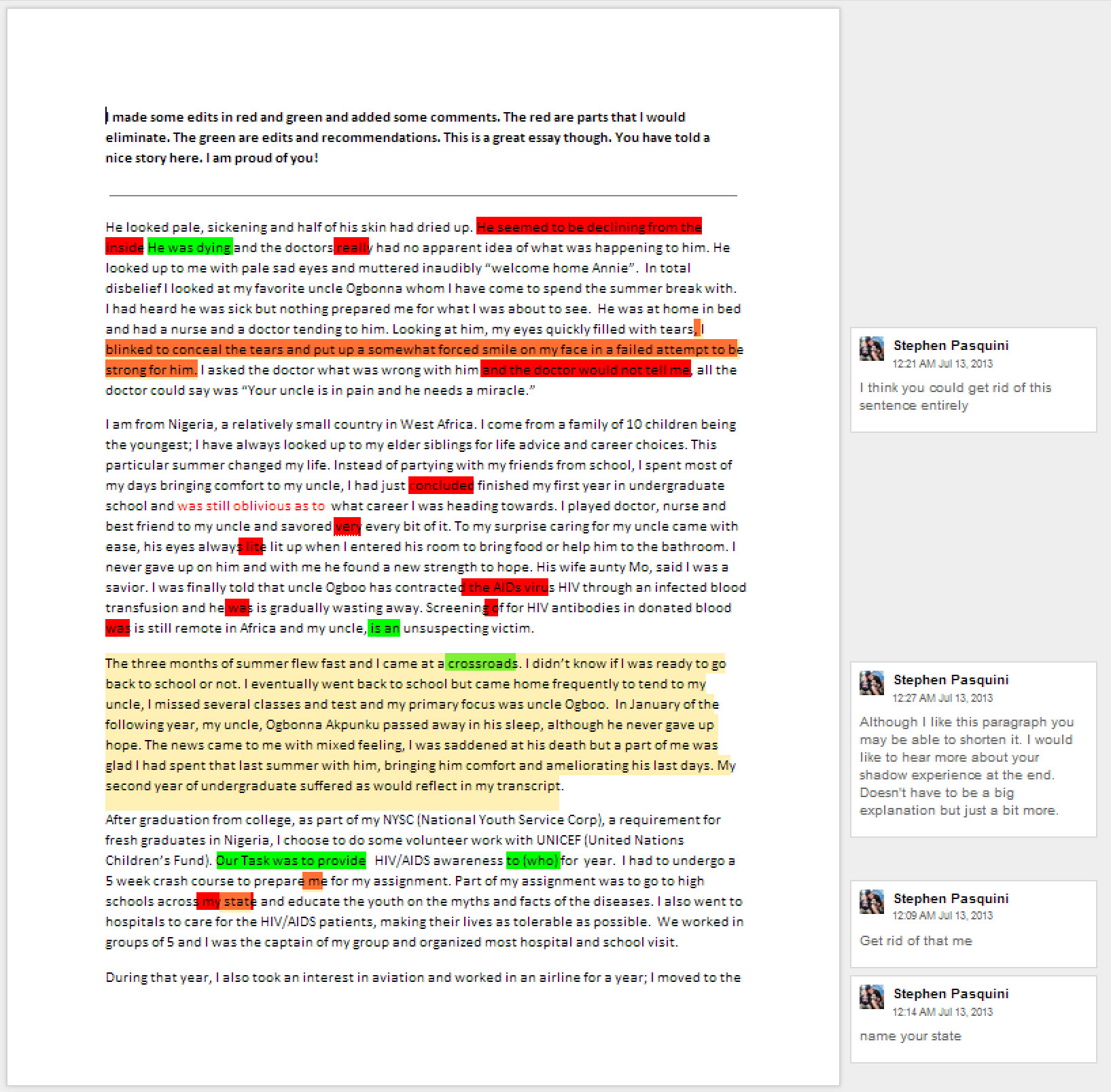 To collaborate, we use Google Drive. Google Drive is free, has an intuitive interface with integrated live comments in the sidebar, the ability to have a real-time chat, to collaborate effortlessly, and to compare, revise, or restore revisions on the fly. Google Drive also has an excellent mobile app that will allow you to make edits on the go!
Our team has worked with hundreds of PA school applicants within the Google Drive environment, and we have had enormous success.
The Physician Assistant Essay and Personal Statement Collaborative
I have set up two options that I hope will offer everyone a chance to participate:
- One-of-a-kind, confidential, paid personal statement review service
- A collaborative, free one (in the comments section)
Private, One-On-One Personal Statement Review Service
If you are interested in the paid service, you may choose your plan below.
The Personal Statement Review Service is:
- Behind closed doors within a private, secure network using Google Drive.
- It is completely interactive, meaning we will be able to provide real-time comments and corrections using the Google Drive interface.
- Telephone consultations are included with all edits above the single edit level. It’s often hard to communicate exactly what you want hundreds of miles away; for this reason, we offer the option to edit right along with us over the telephone while sharing in real-time over Google Drive. This is an option available to all our paid clients who purchase above the single edit level.
- We provide both revision and editing of all essays. What’s the difference? See below
- We will provide feedback, advice, and help with brainstorming and topic creation if you would like.
- We will help with a “final touch-up” before the big day, just in case your essay needs a few minor changes.
Why Choose Our Service?
- It’s not our opinion that matters. We have gone the extra step and personally interviewed PA school administrators from across the US to find out exactly what they think makes a personal statement exceptional.
- We are a team of PAs and professional writers, having worked over ten years with PA school applicants like yourself, providing countless hours of one-on-one editing and revision.
- Our clients receive interviews, and many go on to receive acceptance into their PA School of choice.
Because we always give 100%, we will open the essay collaborative for a limited number of applicants each month and then close this depending on the amount of editing that needs to be done and the time that is available.
Our goal is not quantity but quality. We want only serious applicants who are serious about getting into PA school.
Writing is not a tool like a piece of software but more like how a photograph can capture your mood. It’s more like art. The process of developing a unique, memorable personal statement is time-intensive, and it takes hours to compose, edit, finalize, and personalize an essay.
As Antoinette Bosco once said:
And this is why I am charging for this service. We love helping people find stories that define their lives, and we love helping individuals who have the passion to achieve their dreams. It’s hard to describe the feeling I get when an applicant writes back to tell me they were accepted into PA school.
There is no price tag I can place on this; it’s the feeling we get when we help another human being. It’s just like providing health care. But this takes time.
Interested? Choose your plan below.
Read more client testimonials.
Free Personal Statement Review
Post your essay in the comments section for a free critique
We want to make this opportunity available to everyone who would like help with their essay, and that is why we are offering free, limited feedback on the blog.
You post your essay in the comments section, and you will get our critique. It is that easy. We will try to give feedback to every single person who posts their COMPLETE essay here in the comments section of this blog post.
Also, by posting your comment, we reserve the right to use your essay.
We will provide feedback on essays that are complete and fit the CASPA requirements (View CASPA requirements here). We will not provide feedback on partial essays or review opening or closing statements. Your essay will be on a public platform, which has both its benefits and some obvious drawbacks. The feedback is limited, but we will try to help in any way we can.
Note: Comment Rules: Remember what Fonzie was like? Cool. That’s how we’re gonna be — cool. Critical is fine, but if you’re rude, I will delete your stuff. Otherwise, have fun, and thanks for adding to the conversation! And this should go without saying: if you feel the need to plagiarize someone else’s content, you do not deserve to go to PA school.
* Also, depending on the time of year, it may take me several weeks to reply!
We love working with PA school applicants, but don't just take our word for it!
How to submit your essay for the paid service
If you are serious and would like to have real, focused, and personalized help writing your personal statement, please choose your level of service and submit your payment below.
After you have submitted your payment, you will be redirected to the submissions page, where you can send us your essay as well as any special instructions. We will contact you immediately upon receipt of your payment and essay so we may begin work right away.
Pricing is as follows:
Choose your plan, then click "Buy Now" to submit your essay, and we will get started right away!
Every purchase includes a FREE digital copy of our new 100-page eBook, How to Write Your Physician Assistant Personal Statement, Our 101 PA School Admission Essays e-book, the expert panel audiobook, and companion workbook. This is a $65 value included for free with your purchase.
All credit card payments are processed via PayPal over a secure HTTPS server. Once your payment is processed, you will be immediately redirected back to the essay submission page. There, you will submit your essay along with some biographical info and all suggestions or comments you choose to provide. You will receive immediate confirmation that your essay has been securely transmitted as well as your personal copy of "How to Write Your Physician Assistant Personal Statement." Contact [email protected] if you have any questions, comments, or problems - I am available 24/7.
The hourly service includes your original edit and one-on-one time over Google Drive. It is simple to add more time if necessary, but you may be surprised at what a difference just a single edit can make. We find our four-hour service to be the most effective in terms of time for follow-up and full collaboration. We are open to reduced-rate add-ons to suit your individual needs.
Writing and Revision
All writing benefits from rewriting when done well.
When you are in the process of writing a draft of an essay, you should be thinking first about revision, not editing.
What’s the difference?
Revision refers to the substantial changing of text. For example, it may include re-organizing ideas and paragraphs, providing additional examples or information, and rewriting a conclusion for clarity.
Editing, on the other hand, refers to correcting mistakes in spelling, grammar, and punctuation.
We perform both revision and editing on all submissions.
How to submit your PA school essay for the FREE editing service
Follow the rules above and get to work below in the comments section. I look forward to reading all your essay submissions.
– Stephen Pasquini PA-C
View all posts in this series
- How to Write the Perfect Physician Assistant School Application Essay
- The Physician Assistant Essay and Personal Statement Collaborative
- Do You Recognize These 7 Common Mistakes in Your Personal Statement?
- 7 Essays in 7 Days: PA Personal Statement Workshop: Essay 1, “A PA Changed My Life”
- PA Personal Statement Workshop: Essay 2, “I Want to Move Towards the Forefront of Patient Care”
- PA Personal Statement Workshop: Essay 3, “She Smiled, Said “Gracias!” and Gave me a Big Hug”
- PA Personal Statement Workshop: Essay 4, “I Have Gained so Much Experience by Working With Patients”
- PA Personal Statement Workshop: Essay 5, “Then Reach, my Son, and Lift Your People up With You”
- PA Personal Statement Workshop: Essay 6, “That First Day in Surgery was the First Day of the Rest of my Life”
- PA Personal Statement Workshop: Essay 7, “I Want to Take People From Dying to Living, I Want to Get Them Down From the Cliff.”
- Physician Assistant Personal Statement Workshop: “To say I was an accident-prone child is an understatement”
- 9 Simple Steps to Avoid Silly Spelling and Grammar Goofs in Your PA School Personel Statement
- 5 Tips to Get you Started on Your Personal Essay (and why you should do it now)
- How to Write Your Physician Assistant Personal Statement The Book!
- How to Write “Physician Assistant” The Definitive PA Grammar Guide
- 101 PA School Admissions Essays: The Book!
- 5 Things I’ve Learned Going Into My Fourth Physician Assistant Application Cycle
- 7 Tips for Addressing Shortcomings in Your PA School Personal Statement
- The #1 Mistake PRE-PAs Make on Their Personal Statement
- The Ultimate PA School Personal Statement Starter Kit
- The Ultimate Guide to CASPA Character and Space Limits
- 10 Questions Every PA School Personal Statement Must Answer
- 5 PA School Essays That Got These Pre-PAs Accepted Into PA School
- 7 Questions to Ask Yourself While Writing Your PA School Personal Statement
- 101 PA School Applicants Answer: What’s Your Greatest Strength?
- 12 Secrets to Writing an Irresistible PA School Personal Statement
- 7 Rules You Must Follow While Writing Your PA School Essay
- You Have 625 Words and 2.5 Minutes to Get Into PA School: Use Them Wisely
- What’s Your #1 Personal Statement Struggle?
- 31 (NEW) CASPA PA School Personal Statement Examples
- How to Prepare for Your PA School Interview Day Essay
- Should You Write Physician Associate or Physician Assistant on Your PA School Essay?
- Meet the World’s Sexiest PA School Applicants
- PA School Reapplicants: How to Rewrite Your PA School Essay for Guaranteed Success
- How to Write a Personal Statement Intro that Readers Want to Read
- PA School Reapplicant Personal Statement Checklist
- How to Deal with Bad News in Your Personal Statement
- Inside Out: How to use Pixar’s Rules of Storytelling to Improve your PA Personal Statement
- Ratatouille: A Pixar Recipe for PA School Personal Statement Success
- Personal Statement Panel Review (Replay)
- Mind Mapping: A Tool for Personal Statements, Supplemental Essays, and Interviews
- Start at the End: Advice for your PA School Personal Statement
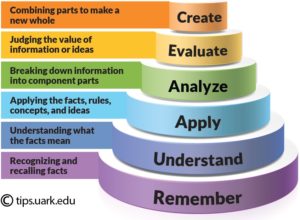
- Elevate Your Personal Statement: Using Bloom’s Taxonomy for Impactful Writing
- How to Write a Captivating Hook for Your PA School Personal Statement
- 3 Surprising Truths About the New CASPA Life Experiences Essay (And Why You Can’t Ignore It)
- 3 PA School Personal Statement Mistakes Our Editor Sees Again and Again
You may also like
 Elevate Your Personal Statement: Using Bloom’s Taxonomy for Impactful WritingThe most common advice writers often give pre-PAs is to "show, don't tell" in your essays. (Though we like to encourage showing …
 Who Gets Into PA School in 2026? Here’s What You Need to KnowLeslie Mean is a 23-year-old single white female who presents to the PA school admissions committee on her second attempt to get …
 Start at the End: Advice for your PA School Personal StatementNot sure what to include in your personal statement? Start at the End! The conclusion should summarize your entire essay. Consider the …


CASPA Personal Statement Help
 We offer comprehensive, start-to-finish personal statement assistance or help to perfect a draft you already have. We have services to fit every budget.
 Schedule a Live Recorded PA School Video Interview
We offer 60-minute mock PA school interviews with post-interview feedback and advice. Includes a recorded video of your interview that you can watch, download, or share with family and friends. There is no better way to prepare!
Schedule an InterviewPre-PA Consulting and Advising
 Our pre-PA coaching service consists of a 1-hour phone consultation focused on addressing your specific questions or concerns about becoming a PA and applying to PA school.


Good morning. This is my essay from last year. I would love another opinion about how to improve for the next cycle. Thanks!
The breeze carried a clump of thick hair across the kitchen floor, and a girl named Wendi reached her wet hands from a bin of turbid water to her bare head. She looked away with tears in her eyes and hastily rinsed the next dish. “I thought that was a mouse coming to steal our leftovers!” I whispered as I passed the next plate her way. Wendi’s dark eyes were bright when she looked back at me and touched her forehead to mine. I felt an ache starting inside me during those summers I spent in the Teresa Toda Hogar, a large girls’ home in the Dominican Republic.
I came with other Americanas lugging suitcases of toothbrushes and white tennis shoes to prepare the girls mentally and physically for the upcoming school year. Girls would return from the streets looking malnourished and with a range of poverty-related illnesses. Shaving a few girls’ heads was a courtesy where everyone shared bunks and brushes. Our goal was not to provide lifesaving care, but to rescue these girls’ dignity and to create autonomous young women through meaningful relationships. Following my experiences in the Dominican, I have desired a career that will mirror the fulfilling connections I made with those strong girls. My decision to pursue a career as a PA has grown from observations of countless healthcare providers interacting with patients and through my own clinical experience.
One year after my last day in the Dominican, I had my first shadowing experience with a PA. Andrew was eager to show me how his position in orthopedics impacted patient’s health. We met a farmer in clinic who had torn his rotator cuff while prodding cattle. Andrew was careful to show the patient and me the limitations from the injury and discuss the options to return him to farming, this man’s vitality. All of the PAs that I have shadowed agree that their job satisfaction comes from grateful patients. The flexibility to pursue new specialties continually excites me as new PAs teach me the tricks of their trade.
My turn for teaching came when I was hired as a naturalist at an outdoor school, and the lessons were never far from my passion for health and wellness. I urged fifth graders to use biomimicry to invent items for protecting winter campers from hypothermia; first graders would learn precautions against tick-borne illness before a “bug dig” to look for insects. When I found a group of Kindergarteners collecting scat, I took matters into my own hands with a quick review of proper handwashing. Even on simple wildflower walks with community members or visiting professors, I would find myself talking about the benefits of aerobic activity as we identified native medicinal species. I valued those interactions with various age groups, but I wanted to apply my Biology degree to a position that required more critical thinking.
Through total immersion and long hours as an ER scribe, I became a sponge for assessments and bedside manner. This early work alongside healthcare providers allowed me to observe physicians perform critical procedures while simultaneously communicating with patients and their families. Providers had to rely on brief interactions to develop trusting relationships. I collected instances of their empathetic gestures, and my concurrent EMT training further deepened my understanding of patient interaction.
When patient-centered communication became second nature to me, I earned my current place on a healthcare team. My formal job description includes taking vitals and prepping patients for injections, among other responsibilities that keep clinic running smoothly. Informally this position involves reassuring nervous patients before an MRI or surgery. I work one with one physician and one PA, and my support to them is integral in efficient and effective treatment to improve patients’ quality of life. We can get a diabetic patient back to low-impact exercise with a total knee replacement or enable an aging patient to care for their spouse through physical therapy and strengthening. I am envious of our PA, Nick, who will follow the patients from their initial visits to annual rechecks. Each patient is a new success story in the making, and I am eager to have patients of my own.
My passion for service started in the Dominican and blossomed into an aspiration for a career in healthcare. When I think back, I can see a pack of young girls running around the patio in oversized nitrile gloves, pretending to check each other’s throats with a flashlight. During my work alongside healthcare providers in various settings, I discerned that becoming a PA would allow me a profession where I could make a significant difference in the wellbeing of individuals through inspiring improvements to their everyday health.
Hi Kate,
I didn’t recognize your essay, so I don’t believe I reviewed it previously. The policy is one free review, though, for future reference.
The essay is quite good — the writing is engaging, the grammar excellent and you’ve tied it all together. There are two things that gave me pause. The first is the aspect of a connection being the driving force behind your desire to be a PA. You write, “Following my experiences in the Dominican, I have desired a career that will mirror the fulfilling connections . . .” This happens early in the essay before you get to the other parts about being a PA that appeal. You could do a million things that would allow you that personal connection, most of which have nothing to do with medicine/healthcare. You might want to consider another conclusion to draw from that powerful experience that’s more healthcare/PA focused.
The other thing I’d consider changing is the paragraph about teaching. While it’s endearing, it doesn’t have much relevance. I can’t even tell when you did it. I’d omit or seriously shorten it and use the space instead to focus more specifically on why you wish to become a PA. You have some specifics, but the essay could use more detail. You have a wealth of healthcare experiences with PAs to draw from.
One thing that’s critical — be sure that this year’s essay is not a repeat of last year’s. Include any new experiences and insights. When I interviewed Admissions Directors and faculty across the country about writing these essays for our book, “How To Write Your Physician Assistant Personal Statement,” all said it was key to include the updates.
I hope this helps and wish you the best of luck.
Sue Edmondson
http://www.thepalife.com
Thank you for your critique. Plenty of work to do. I’m glad to have found this blog.
Good luck to everyone applying this year!
I really appreciate the time taken in reviewing my essay. Thank you for your comments!
There are pictures in my house of me dressed up in a clown suit. I was young thankfully so I can always excuse my ridiculous behavior on being naïve. It is true that a picture is worth a thousand words, and for me many of my family photos could be a whole novel. My mother always recalls me being the child that wanted to make her laugh and happy when she was sad. I took great pride in cheering people up as a child. Hence the marvelous clown picture that sits on my bookshelf would say if it could. My family wasn’t the only one subjected to my frivolous behavior. When I was growing up I had a nanny who suffered from lupus, she was constantly in severe pain and often telling me she couldn’t go on like that. Though at the time too young to really know the seriousness of her condition, I just thought of the instant gratification of laughter. I would attempt to cheer her up and tell her she would be fine and she could make it. These mindless words coming from a 4 year old wouldn’t mean much to most people, but to her they were enough. She still tells me to this day that I helped her through some of her toughest sick days.
With time nothing has changed though I am no longer donning the clown suit to cheer people up, I am there with an open mind and empathic heart. Family, friends and more recently strangers for some reason just tend to share with me. In the first moments of admitting a patient we listen to everything they are willing to tell something I have been doing my whole life. We don’t just absorb this information and click the appropriate boxes we hope to gain that patients trust in us to care for them. The work I do currently involves caring for people with acute trauma injuries like motor vehicle collisions and before that individuals from all different medical backgrounds in need of intermediate critical care like those suffering from liver failure. The stories I have heard and the plethora of people I have seen over my year and a half of being a patient care assistant, have made me a different person than that child in a clown suit so many years ago.
Today instead of a costume I wear scrubs. Instead of listening to those closest to me complain about their life, I get to hear about how someone felt their life was no longer worth living. The consequences of my responses and actions are more serious and I couldn’t be more prepared for that. Recently a patient I worked with had a small bowel obstruction, he was feeling worthless and told me he was going to die. Every day I came in with the attempt to empower some positivity on this patient. He let me do my job but would never converse with me or attempt to see the value in the life he had. Eventually he got worse and was sent to a higher-level floor; a week later he was back in my care. I came into his room with my same attitude, expecting him to be negative about his situation. Yet at the end of my shift he told me he appreciated the care that I had given him. He was able to smile and crack a joke with me. It was such a small victory for me but I do not value it any less.
My victories have come by determination and taking action. I wasn’t always confident in my decisions, often didn’t ask for help and would let stress get the best of me. Overcoming that started regrettably in my final years of college, I was able to take on more accountability for what I was doing wrong and learn to correct it through trial and error. It resulted in more interest in my classes and improvement in my grades along with my GPA. This behavior change has helped me immensely in working in healthcare. I am more confident, able to better problem solve and have no trouble asking for assistance when needed. I have trained some fellow employees on my floor and am able to work efficiently with all staff members. That means helping to check vitals for a nurse while they are preoccupied with another patient or assisting physical therapy with patient mobility. I am still listening to my patients and hearing their stories it is just now I want to be more involved in them. I want to be involved in their diagnosis and treatment and take on more responsibility for their well- being.
My job as a PCA has reaffirmed and energized my desire to give back to the community through healthcare. As a Physician Assistant I will be able to care for patients by more than fixing a problem but by supporting their needs beyond a diagnosis. While I am fascinated by the medical puzzle, it is the human, the patient that inspires me to write this letter, to study hard and to purse the ability to help others by becoming a Physician Assistant.
Hi Kristin,
Your essay is heartfelt, and your kind, giving personality comes through. You’ve done a good job of explaining your grade issues, too. Still, it needs work. The opening is cute, but cute is not the objective here. I’m going to show you how I’d recommend changing it in a moment, but first I want to address a couple of other issues.
The words “physician assistant” aren’t capitalized except in a proper name such as “Brown School of Physician Assistant Studies.” You’ll also want to make sure your grammar is correct. It may not seem like a big deal, but to the Admissions Directors and faculty I interviewed across the country for our book, “How To Write Your Physician Assistant Personal Statement,” all said there shouldn’t be any grammar errors, that it was a red flag that people didn’t pay attention to details. In healthcare, missing the details can lead to death! Even commas matter. This sentence is missing one: “With time nothing has changed though I am no longer donning the clown suit to cheer people up.” Do you see where it’s needed? You have the same problem throughout your essay. Also, here, the tenses are wrong: “. . . someone felt their life . . .” “Someone” is singular and “their” is plural. You’ve left words out, too. Take a look at your first paragraph. The details do matter.
The essay is missing crucial points — specifics about why you want to be a PA. You mention a few things generally, but you need more. You’ll have space after you cut much of the first paragraph. You can cut more from other paragraphs, too. Okay, back to the first paragraph now with this caveat — I’ve changed/added a couple of words to demonstrate my point:
“There are pictures in my house of me in a clown suit. My mother says I was the child who wanted to make her laugh and be happy when she was sad. I took great pride in cheering people up as a child and with time nothing has changed. Though I am no longer donning the clown suit to cheer people up, I am there with an open mind and empathic heart.”
Skip the next sentence and start that second paragraph with the sentence “The work I do . . .”
Give the rest of your essay the same close scrutiny.
I hope this helps and wish you the best of luck.
Sue Edmondson
http://www.thepalife.com
Thank you so much so taking the time to read and review my personal statement!!
He was smiling at me, although I could still see the pain written on his face and in his eyes. I did not want to reposition him, but he needed it in order to prevent further damage to his already fragile body. As he tried to reassure me through his facial expression, I felt my own pain for him deep in my chest. After many months of suffering, and after countless reassurances that it is okay to let go, he finally passed. This was my first of many encounters with death and the process of dying. Through my work as a certified nursing assistant, I have learned many things about the care of a patient and the relationship the members of a medical team.
My initial interest in the world of medicine was sparked by a high school anatomy course that focused on working through case studies and developing “plans of action” for hypothetical patients. Through coursework, such as case studies, I realized that I enjoyed puzzles, especially diagnostic puzzles, which reinforced my growing devotion to medicine. After this turning point, I started to research medicine as a lifestyle, not just a job, and started shadowing in the field.
After shadowing both physicians and physician assistants in different fields of medicine, including dermatology and family practice, I noticed the nature of the patient-provider relationship and, in particular, what it meant to give medical care as a physician assistant. In my experiencing shadowing, I have found that being a PA is a very important bridge between many patients and their physicians. They are counted on to become advocates for the patients and help close the communication gap that may exist between patient and physician. I believe this role is critical to the medical team because it promotes more accurate and efficient healthcare- while also easing the shortage of much needed primary care medical workers. In addition to this, I noticed, while shadowing in the family practice clinic, that many patients would come to the physician assistant with questions regarding orders from a physician. This made me realize that not only are physician assistants an important asset in bridging patients and physicians, but also that they serve as educators- explaining the medical plan in a way that may have been overlooked previously.
While shadowing, I have also observed that the relationship between the provider and patient is very unique and strong I was lucky enough to experience this bond myself, when I worked as a certified nursing assistant. The relationship I developed with my patients was unlike any other relationship I’ve had before. This job gave me a unique opportunity to witness life in a way not many people get to. I have experienced the last days with my patients, I have cared for them after they had passed, and I have witnessed the process of healing. This has given me a new perspective on how fragile and amazing life really is. I have had firsthand experience with comforting the patient and helping with palliative measures leading up to their passing and I have spent many hours with family members, helping them cope with the decline or passing of their family member. In addition to this, another bond I discovered was that between a medical team. Every one that I observed or worked with had such great respect for the people they worked with and every one worked with each other to achieve a common goal: to better the patient’s care plan. Each member of the team worked collaboratively to become better as a whole. This bond is also truly unique- there is something distinctive about going through the ups and downs of caring for a patient that makes the team you work with more like a family, a close support system that can be relied on. I think this type of relationship is very important in the medical field. I admire the way medical staff comes together to create one large team to care for a patient, even across specialties and departments.
I am specifically drawn to the physician assistant profession because the importance of this role in the medical field. It is crucial to close the gap that may exist between the patient and their physician, but it is also incredibly important to be there to help educate the patients- especially if this has not been done properly before. In addition to this, the ability to work in a multitude of different settings and fields is something that is very significant to me. Being able to move between fields and being able to move from clinics to large hospitals with the option of completing a one year physician assistant residency is very appealing. Because of these reasons, becoming a physician assistant has become what I strive for and what I have become avid about. I look forward to the opportunity to learn and grow in this field by making it my career and passion.
Hi Megan,
I thought I recognized your essay, so I went back and found the version you posted a month ago and my comments.
I only give one free review, though. If you want additional feedback, you’ll need to sign up for a paid edit.
Best regards,
Sue Edmondson
Can I get feedback on how I can develop this essay into something that will help me in my pursuit of acceptance to a PA school?
………………………………………..
Even as a young child I vividly remember pretending to be a doctor or nurse during playtime. At four years old I told my mother on a drive home that I would like to have a knife when we got home. When she inquired as to what I might do with this knife I answered nonchalantly that I would cut myself open with it to see how I work inside. My desire to see and understand how the human body works didn’t stop then, though the knives in the house suddenly disappeared, so I had to take a different route.
Books became my new ticket to learning about the human body. I would sit and stare for hours at pictures in books. At twelve I decided I would become a pediatrician and arranged my entire room to be a doctor’s office, I even elicited a brother to be my receptionist. Though most of my “patients” were stuffed with fur and couldn’t tell me “where they hurt”, I knew one day it would be much more real.
My passion to help those that don’t have a voice, especially in pediatrics, continued as I began to volunteer in the local delivery ward during high school and early college. My first scrub in for a cesarian- section viewing found me pale faced and shaky. I can still remember the sterile smell of the operating room as my eighteen year old self had to coach myself internally out of fainting. I laugh now at how far I have come since those early days as I currently work as an emergency medical technician in high stress environments.
After my first year of college, which was spent playing more sports than studying, landed me on academic probation I had to re-think my career choice. I reflected over the previous year and decided that since I had devoted so much more time to sports over academics, maybe I wasn’t serious about pursuing a medical career. So I took a semester off of school and for the first time actually wrote down why I wanted to practice medicine. I realized that I was completely coasting on my ideas from the past and hadn’t done research and discovered what it was that I wanted to be as an adult, not basing it on my desires from the past.
There were a few things that I was sure of and wrote those down; to practice medicine, to work as a team with other medical professionals, to be able to pursue different specialties depending on need and interest, to help the less fortunate get the medical care they desperately need, but also to have time to raise a family. I was sure I would have to settle with giving up at least a couple of those desires to have an actual career. Luckily, through research and questions to multiple medical professionals, I discovered the physician’s assistants profession. They were working all over and I had even been seeing one every time I visited my doctor’s office and had no idea. During a visit to my doctor’s office to remove a piece of metal from my finger, I inundated the physician’s assistant and a PA student working with her with many questions about the profession and I decided it was definitely the path for me.
My desire for helping the less fortunate led to me living in Zimbabwe, Africa for five months in 2010. Armed with my first aid kit, we would go to very poor villages where most people, especially children, have never seen a doctor and I would be swarmed with requests for band aides and triple antibiotic ointment. During an outing I met a man noticeably in pain and as I inquired about it, he pulled up his pant leg to reveal a terribly swollen calf with infected stitches made of fishing line. I realized that I desperately needed more medical training and as soon as I got back from Africa I finished my Bachelors degree.
In 2014, desiring to pursue of my love of medicine and travel, I began an 11 month journey visiting 11 third world countries to help meet practical needs of disadvantaged individuals. My motivation for this trip was also to develop relationships and possibly come back with medical teams to bring medicine to these unreached areas of the world.
I am currently pursuing that with a non-profit that I have started, Medical Care for the Nations. We have plans to begin building clinics in Zambia this year. These clinics will have healthcare volunteers spending time there throughout the year. I have been able to network with providers in many different specialties who are interested in volunteering time to bring their expertise to an area of the world that would never see that kind of provider.
As a result of my experiences domestically and internationally, whether in a clinical or non-clinical setting, I feel that the physician assistant profession is the ideal route for my career and personal goals. If given the opportunity, I plan to use my physician assistant training to continue working in emergency medicine state-side, while facilitating the flow of providers to these unreached areas domestically and internationally. There are so many opportunities to practice the skills I have and will learn and develop as a physician assistant.
Hi Brittany,
The first thing you want to do is get the name of the profession right! It’s “physician assistant,” not “physician’s assistant.” When I interviewed Admissions Directors and faculty across the country about writing these essays for our book, “How To Write Your Physician Assistant Personal Statement,” all said getting the name wrong was a big red flag that the applicant may not be familiar with the profession. Check your spelling, too. Incorrect spelling, particularly of medical terms (cesarian instead of cesarean) is another red flag, as is poor grammar. Spelling/grammar mistakes show a lack of attention to detail, and in medicine that can be fatal.
Okay, on to the substance of the essay. The first paragraph is engaging. While I often recommend people don’t go back to childhood experiences, yours is funny and reveals a bit about your personality that will likely draw readers in. You could eliminate the second paragraph, though. The space can be used later to talk more specifically why you wish to become a PA. You talk generally, but you could definitely flesh that out with details.
Your essay lays out the great work you’ve done. It’s all very impressive. Good job on explaining the grades issue, too. I wouldn’t mention wanting time to have a family, though. It makes it seem as if you’re picking the PA profession because it doesn’t require the time and dedication of other careers in medicine.
Otherwise, you have a solid essay.
I hope this helps and wish you the best of luck.
Sue Edmondson
http://www.thepalife.com
Thank you so much for this feedback, it is very helpful! I really appreciate it and will be revising it!
I have been revising this essay since the feedback you gave me and just wanted to thank you again for the help! I has really helped me recreate an essay I can be proud of!
HI Brittany,
I wish you the best of luck on the upcoming applications cycle. You will have to stop by again and let us know how it all goes!
Stephen
Would you possibly be willing to review a medical school personal statement? I know this is a PA website, but these reviews seem to be the most helpful critics I have read on the internet!
Hi Dee,
Stephen will be in touch with you about it.
Glad you find the reviews helpful.
Best regards,
Sue Edmondson
http://www.thepalife.com
Absolutely Dee, we have worked with several medical school applicants over the years.
You can submit your essay using the regular submission form and when you do just specify that you are a medical school applicant.
– Stephen
Hi!
Thank you for offering this service, this is my essay for my first PA school application.
Ask any small child around, where is the happiest place on earth and likely ninety percent will say Disney World. I was no different as a child except my idea of a perfect day at Disney was riding around on the back of my cousin, Kim, wheelchair. I never saw the disability associated with Kim’s form of Muscular Dystrophy when I looked at her. I only saw the excitement of cutting to the front of the line, speeding through the crowd and spending the perfect day with someone who shared the same love for Disney as myself. I look back at a picture from this day on my dresser and wonder, how do I get back to this time of pure bliss? A time less complicated when wheelchairs were fun and Muscular Dystrophy was only a storybook monster I overheard my mother speaking of after treating patients.
Unfortunately we can never go back and my bliss came to a devastating halt the fall of my junior year of college when Kim died from complications due to Spinal Muscular Atrophy. Leaving behind a wake of immeasurable sadness on myself and everyone else who had the pleasure of knowing her. Kim was an extraordinary women and her death had a profound impact on my life, temporarily crippling me. It took some time, but I finally learned how to turn that pain into motivation to move on so that I can learn to help others and possibly prevent another from having to feel this pain. While we learn from our life experiences, it is important to look forward and strive to find similar bliss through our work and life passion. There is one particular passion of mine that has allowed me to help others while finding happiness and myself at the same time. This passion is volunteering with the Muscular dystrophy Association.
I volunteer a weak of my time each year at the Greater Detroit Muscular Dystrophy Association summer camp at Camp Cavell. At camp each volunteer or attendant is paired with a child or camper, age six to seventeen, suffering from some form of Muscular Dystrophy to take care of for the week. My assigned camper this past year was a twelve year old girl named Allison, who suffers from Charcot-Marie-Tooth or CMT. She clinged to her mothers side as she introduced herself to me. Allison and I have never met and I am now her primary caretaker for the week, allowing her parents much needed time off. As an attendant you are much more then just a caretaker, you become an adventure partner, best friend and one more person in the world who sees these kids as something more then having a disability.
We bond after a little work getting her to open up and it is an exciting week for us both, consisting of activities such as tree climbing, sand castle constructing, horseback riding, baseball, some exceptional arts and crafts projects and creating life-long friendships. It is a place where campers can focus on ability rather then disability and this ability is to participate in activities surrounded by peers, in an environment without judgment. No child has to be the odd one out, exempted from certain activities by their wheelchair or braces. Here everyone has the chance to participate and be their own normal for a week and it is a beautiful thing. The last night, the entire camp gathers around the wishing tree to hang a glow stick to symbolize all of our wishes and say goodbye to those that have lost their fight. For years I have made the same wish, to find a cure for muscular dystrophy. This year my wish included a goodbye and blessing to Kim. Allison and I hug, her knowing the pain I am feeling at this moment and me knowing the pain and battle she faces every day of her life.
If you were to ask any child at camp where is the happiest place on earth, they would not think twice before saying MDA camp. It is in the memory of Kim and every camper I have had the privilege to meet throughout my time volunteering with the Muscular Dystrophy Association at camp and in clinic that is guiding my future. Being involved in the health care community and having the opportunity to be apart of a person’s day brings a sense of bliss to my life; this is why I want to be a Physician Assistant. I have found my passion through medicine and am excited for what more the future holds.
Hi Linne,
I’m very sorry about your cousin, and it shows great character that you turned your sadness into something so positive.
That being said, your experiences with Kim and MDA are the entire essay. You’ve got to talk about the PA profession, and why specifically, the role is right for you. There are dozens of ways to help people and 99% of them have nothing to do with medicine, much less the specific profession of physician assistant (which by the way, shouldn’t be capitalized unless it’s part of a formal name, such as Brown School of Physician Assistant Studies).
Also, there are a lot of kids who never had the privilege and who never will have the privilege of going to Disney World or Disneyland. So temper your opening by relating it to you only and take out the generalizations (90% would say, etc.). Generalizations are always dangerous — they come from our life experiences to date, which don’t always reflect the real world. But otherwise, the image of you riding around on the back of Kim’s wheelchair is an excellent way to open the essay.
Beware, too, of grammar errors. For example, you wrote “back of my cousin, Kim, wheelchair.” It should read, “back of my cousin Kim’s wheelchair.” When I interviewed Admissions Directors and faculty across the country about writing these essays for our book, “How To Write Your Physician Assistant Personal Statement,” all said there shouldn’t be any grammar errors, that it was a red flag that the applicant doesn’t pay attention to details. That can be deadly for patients! I realize this is a rough draft, but it’s never too early to proof-read for errors.
You’ll need to rewrite this essay, but believe me, you’re not alone! Take some time and read other essays posted here and some of the comments. That may help you understand what I’m suggesting.
I wish you the best of luck.
Sue Edmondson
http://www.thepalife.com
In 2010, upon moving to the Dominican Republic, it took just three days before I broke down into tears. I had just joined the Peace Corps and was placed with a family that spoke only Spanish. At this point my Spanish knowledge was limited to a handful of college courses. The Dominican dialect is very different. I wanted so badly to communicate with my community and express myself. I was assigned to help implement more effective teaching methodologies in the public school system, but could barely speak the language. The frustration was overwhelming. I dedicated all my time to learning and spent hours poring over language books and speaking with my host family to perfect my accent. Fluency in Spanish allowed me to be successful and effect change in my community.
I was afforded the unique opportunity to translate for various medical missions during my time in the Dominican Republic and was voted by my peers as the Chairman of the Medical Mission Committee in association with the Peace Corps. My main responsibility became coordinating logistical and linguistic services between national health posts and visiting American medical teams. Exposure to the healthcare deficiencies and overall lack of health education I experienced in schools, communities, and during medical missions motivated me to take action. In 2012, shortly after the Peace Corps, I was hired on as a Field Operations Manager with the Foundation for International Medical Relief of Children (FIMRC). They assigned me the task of determining a site for a community-based health education program and building it from the ground up. I used the motivation previously acquired and focused all my efforts on positive change in the community of Restauracion, on the Dominican-Haitian border. We employed health education campaigns, built deep-pit latrines to stem cholera outbreaks in Haiti and reached the most rural communities by means of horse-drawn mobile clinics.
From primary care in rural Haiti to orthopedic surgery in Santo Domingo, and resuscitating cardiac alerted patients in a Tampa emergency room, I have been exposed to a wide array of healthcare settings. The common thread among all of these experiences is that I love providing a service that will positively affect a person’s health outcome. During my time translating, patients would often ask me direct medical questions as if I were a doctor. All I could do was repeat these symptoms so the doctor could plug them into a formula that would equal a solution. The language of healthcare fascinates me and just as with Spanish I am aware of the significant contributions that can be pursued with a knowledge of the healthcare language, more specifically, an education as a Physician Assistant.
My passion for becoming a Physician Assistant is rooted in unique life experiences as well as exposure to healthcare systems in underserved communities. My focus is pediatrics/primary care but I appreciate the idea of being able to change specialties if I feel I can be more effective in another area. In my personal experience PAs spend more time educating patients than traditional Physicians in a variety of settings, especially with chronic patients. I have seen the gaps in patient education and plan on making it a cornerstone of my practice. I have taken steps towards my goal of becoming a PA since returning from my international post in May of this past year. With my certification as a Nursing Assistant and Emergency Medical Technician I am employed as an ER tech at a level 2 trauma center pediatric emergency room at St. Joseph’s Hospital in Tampa, Florida. The emergency setting allows me to experience all fields of medicine from cardiology to oncology. I have seen patients come back from the brink of death and also seen many patients succumb to their illnesses and injuries.
My undergraduate GPA is reflective of my level of maturity at that time in my life, but an era of unbelievable experiences and real-world education has realigned not only my career goals but my priorities in general. This is most evident in my post graduate science-focused coursework. Taking
science pre-requisites during the day and working overnight at the hospital also serves to strengthen my resolve and allow me to take advantage of every resource available to me.
I work with a PA who, upon entering every patient’s room, takes a medical glove and blows it up like a balloon. He draws eyes and a mouth on it, uses the thumb as a nose, and hands it to the patient with a huge smile on his face as he introduces himself to the parents and child. “Up high, down low, oops too slow!” His behavior is infectious and plays a big factor in patient comfort and healing. That is the kind of difference I hope to make in the life of a patient. With fluency in the language of healthcare, that is the kind of difference I hope to make during my career as a Physician Assistant.
Hi Joe,
You’ve had a lot of great experiences, and your heartfelt interest in helping people comes through loud and clear. Overall, your essay is well-done, but I still have a few suggestions. First a technical point — don’t capitalize physician assistant (or physician for that matter) unless it’s part of a formal name, such as Brown School of Physician Assistant Studies.
I got bogged down by some of the unnecessary details in your essay, and they take away from the impact of your journey. So, for example, I’d shorten the first paragraph as follows:
“In 2010, upon moving to the Dominican Republic, it took just three days before I broke down in tears. I had just joined the Peace Corps and was placed with a family that spoke only Spanish. My Spanish was limited to a handful of college courses and I wanted so badly to communicate with them and the community. Worse, I was assigned to help implement effective teaching methodologies in the public school system, but could barely speak the language. The frustration was overwhelming. I spent hours poring over language books and speaking with my host family. My eventual fluency in Spanish allowed me to effect change in my community.
Then you need a transition to the next paragraph, otherwise the first paragraph is a big “so what?” For example, you could say something as simple as “My Spanish skills allowed me to translate for various medical missions . . .
The rest of your essay also has extra, unnecessary details that weigh it down, and you need transitions throughout, especially to the paragraph where you discuss your undergrad grades.
I really like the last paragraph, but you need to say where this takes place. I hope it’s only at the pediatric ER or the guy sounds like a nut. And maybe most people know what “up high, down low, oops too slow” means, but I don’t. You could leave it out and the impact would be the same.
Hope this helps and I wish you the best of luck.
Sue Edmondson
http://www.thepalife.com
Quality articles or reviews is the key to attract the viewers to pay a visit the
website, that’s what this website is providing.
Here is the personal statement I submitted last year. I have not had any interviews, so I’d like to revise it to be the best it can be before the application cycle this year! Thanks in advance!
As I walked into a small church in Costa Rica, a painted quote on a cinder block wall read: “Do not withhold good from those to whom it is due, when it is in your power to do it”. I kept these words in mind throughout the next two weeks as I served as a healthcare volunteer in the small, impoverished community of La Carpio. I was anxious yet excited to not only begin volunteering, but to also immerse myself in the culture. As I stepped foot onto the single, unpaved road that led into La Carpio, I was in awe of the condition of the community: houses were constructed of sheet metal, gang graffiti daubed the streets, and massive landfills overflowed into the road. A small church was made into a makeshift clinic and as we began seeing patients I felt comfortable as they graciously welcomed us and were eager to share their culture. The immense struggle for people of La Carpio to obtain basic health care needs due to the extreme poverty of the area became rapidly apparent. There were no medical offices in the community and patients could not afford to travel to see doctors routinely, resulting in various severe illnesses. I often heard of developing countries having adverse health conditions, but seeing these patients made it a reality for me. These patients suffered from parasites, infections, and illnesses I never encountered in the United States. As I treated these patients, I knew in my heart I wanted to spend my life helping others, regardless of their background, religion, or any other belief. It was then I decided I would work to help protect, serve, and improve the physical and mental health of every individual I had the ability to care for.
Upon returning from Costa Rica, I was determined to uphold my decision of serving every individual I could. I incorporated extra Spanish classes into my curriculum to improve my ability to communicate with Spanish speaking individuals. I embarked on a month long Summer International Health Fellowship program to Peru as a healthcare fellow to provide healthcare and education to impoverished communities. Again, I was astonished at the severity of health and living conditions in these communities. During our service opportunities, we traveled to remote towns to hold health clinics, observe doctor rounds and surgeries in Peruvian hospitals, and educated the public on proper personal hygiene techniques. Treating and educating the patients provided the same gratifying and humbling feeling I felt in Costa Rica, which deepened my desire to spend my life as a healthcare provider.
When I returned from Peru, I began work as a scribe in an Emergency Department. Here, I coupled my knowledge of sciences from school with new knowledge about medical terminology, effectively treating patients, and healthcare in the United States. I had the privilege of working directly under physicians, allowing me to carefully observe not only the physician’s interactions with patients, but also how physicians and physician assistants work as a team to treat patients in the safest and most effective way. I saw how crucial PAs are in patient care and how they work with great finesse as an extension between the patient and physicians. I envisioned myself working as a part of this team and felt that being a PA would be an excellent fit for me to serve others. As a PA, I will have the ability to not only diagnose and treat patients in the most efficient manner, but to also join my passion for science with my desire to build relationships and trust with those I serve.
While I have gained much knowledge through my education and clinical experiences, I have learned even more about life and myself. I found I not only have a love for medicine and science, but also a deep love for culture and people. Through my various clinical experiences, each patient I have had the to privilege to interact with has had a different life story, allowing me to distinguish between treating a patient and treating a unique individual. I have seen the need for an increase in healthcare providers in developing countries, but there is also a need for committed healthcare professionals here in the United States. There are many impoverished people in the United States who have serious medical conditions and need treatment, and I want to concentrate on serving these underprivileged individuals by providing diagnosis, treatment, and education. By seeing the enhancement of patient care through the use of PAs, I am driven to serve as an extension between the doctors and patients to provide the best possible care and continue serving those around me. By becoming a PA, I can continue to serve others when it is in my power to do so.
Hi Alex,
Actually, your essay is very good. There are some drawbacks, though, starting with the fact that it’s the same essay you sent the first time you applied. When I interviewed Admissions Directors and faculty across the country about writing these essays for our book, “How To Write Your Physician Assistant Personal Statement,” all said tell us what has changed since you last applied. Let the Admissions folks know in your essay that you have added to your skills/experience/education or whatever applies. You definitely do not want to send the same essay.
It could also be tighter. The first paragraph is so lengthy, the Admissions folks might have gotten bogged down in the details. Yes, it’s well-written with excellent descriptions — you really painted the picture, a skill you can use to your advantage in the essay when you rewrite. However, both the first and second paragraphs could be consolidated into one paragraph to give you more room to focus on the reasons the PA profession appeals to you and why you’re right for the profession. The first two paragraphs essentially have the same message, and so you’ve used the space to repeat yourself rather than expand on other topics.
Have you shadowed PAs? Worked directly with them. If so, add something about those experiences to show you have a true understanding for what the profession entails and requires. Admissions folks will be more interested in that then they will with general statements about your opportunities to “carefully observe the physician’s interactions with patients.”
Use your writing skills to describe work/shadowing with PAs the way you did your medical missions, and you’ll have a winning essay. There’s always the option of professional editing, which would definitely help sharpen your essay 🙂
I hope this helps and wish you the best of luck.
Sue Edmondson
http://www.thepalife.com
Dear Mrs. Edmondson,
Thank you so much for offering such a service! I am not ruling out the possibility of using the paid service, but I figured I would try this first to see if I really need it. If I do, please do not hesitate to let me know.
A few issues. I am worried about not explaining MD vs. PA school differences in greater detail after I bring them up in my intro. But I explain the difference between the two professions later and why I chose PA, so I was thinking that may be enough. Also, I am worried some parts of my essay come off as platitudes/cliche. But I cannot really tell since it is all true to me and seems relevant from my POV. I did not want to take anything out prematurely, so I left it as is for now. Anything you have to say would be greatly appreciated!! Thank you very much for your time:
So what does a PA do? When I first told my friends I wanted to become a physician assistant, this was the question they asked me. If I wasn’t going to be a doctor then I must be a nurse, as those were the only two healthcare professions they were familiar with at the time. I could tell them I am going to medical school, because I basically will be. But to them, med school is synonymous with training to become a physician and that is not what I want to do. Even my Mom said, “Why don’t you just become a doctor?” Yes, a physician and a PA are both medical professionals, but they contribute to the healthcare team in very different ways. So I tell them I want to go to PA school, and teaching them the difference is well worth it.
My biggest role model growing up was my aunt, who is a physical therapist and athletic trainer. She motivated me towards athletic training because of my interest in medicine and my love of sports as a child. Because of these reasons, she felt athletic training would be a good career for me; and so did I. But about a year and a half through the athletic training program, I lost interest in the sports side of sports medicine. I still loved the medical aspects, and wanted so much more of that, so I began researching other healthcare professions. It was around this time that I also met my first physician assistant: Brian.
Brian worked with the team physician for a high school where I interned during college. I observed him when he would come to the school to perform evaluations and follow-up with post-op athletes. His assessments were so calm and thorough, leaving no area unchecked. He knew exactly how to manage each case and explained every detail to each patient. I was amazed at not only how confident and professional he was, but how compassionately he dealt with each individual. This was the kind of professional I wanted to be.
I became interested in the PA profession after meeting Brian, but I wanted to know for sure that this was the career for me before going back to school. So I finished my undergraduate degree and decided to work for a few years before going back to school. I took this time to grow as a clinician and make sure that this profession was for me. I am far more prepared for PA school because of it.
As a collegiate athletic trainer, I have the privilege of treating athletes everyday as an autonomous provider while still being part of a healthcare team. I manage and am responsible for my athletes, and I am trusted to handle that patient load. But the great part about working at a college is having other professionals around me for advice, or to collaborate with on a plan of care. There is the opportunity to work with my supervising physician, a physical therapist and four other athletic trainers at the university. They have many years of experience and I can always bounce ideas off of them if I have a question. I love that I can to treat my patients independently while still having other providers around to show me how to be a better clinician. We can also work together when an athlete needs more than what I can provide alone.
In most instances, I am able to handle cases on my own and the patient may never see the doctor. But some patients need to be referred to my supervising physician. He may make the decisions in those cases; but I am always the first one to see the athlete’s injury, the one who coordinates the referrals and treatment plans, and the one who is there to send them back to participation post-injury. I still want to be that autonomous provider working as part of a team who, even if I don’t always get to make the final call, is involved with every step of a patient’s care. So it is really not a surprise why I am choosing this profession: because this is exactly what a PA does.
Back when I was shadowing Brian, he let me come observe him in the OR for a day. He was the first one to see the patient in the morning before surgery and the one who would check with them post-surgery. The surgeon was only present during the surgery; but so was Brian, ready to help as needed. The doctor is an essential part of the healthcare team, maybe even the most important part. But personally, having the title and expertise of an MD didn’t seem worth it if you interact less with the actual patient. I continued to see this trend across every PA specialty.
What does a PA do: helps people get better one day at a time by putting patients first in every aspect of their job. I take pride in explaining how a PA is different than any other profession. They possess a combination of compassion and medical expertise as a skilled provider. PA’s are in the unique position not only to deliver high-quality medical care, but to also function as patient advocates as well. After assessing the traits and attributes I already possess, I realized they fit perfectly into one medical profession best. What does a PA do: the only thing I can see myself doing for the rest of my life.
Thanks again!
Hi Rob,
I’m glad you find the comments helpful. That’s my goal!
You have some great experience, and tying what you do as an athletic trainer to a PA is great. There are similarities that will help you transition from trainer to the PA profession easily and highlighting those similarities is excellent.
You’re right about the platitudes, though. You’ve got a lot of generalities which don’t help educate Admissions folks about you. Almost the entire first paragraph is what writers call “throat clearing.” You’re getting ready to write what you plan to write about. Remember, you’ve got 5,000 characters and spaces to show the things about you that aren’t part of a resume or GPA. This essay has to be personal and specific, not general.
The paragraph about your aunt could be much stronger. I’d probably start it with something more along the lines of, “When I started college, I intended to follow the footsteps of my aunt, a physical therapist and athletic trainer.” It’s a more adult way of expressing what led you to the profession. I hope you won’t take this as an insult because none is intended, but when you say the reason you became an athletic trainer is because your aunt thought it was a good career, you sound immature. I’m not discounting that it’s true — as 18-year old kids, we often do what people think is right for us when starting college. It just isn’t the best way to explain things in your essay.
The paragraph about the watching the surgery with Brian needs work, too. You don’t want to minimize the importance of the doctor. But to go into detail about how I’d edit it is more than I do here in these comments.
Be careful about grammar — overall it’s good in your essay, but don’t make the common mistake of using plural and singular in the same sentence. For example in your conclusion you write, “What does a PA do: helps people get better one day at a time by putting patients first in every aspect of their job.” (By the way, you should have a question mark: What does a PA do?), but the first part of the sentence refers to “a PA” but then you write “helps” and “their.” You can be one of those people who shows you not only know better, you take the time to get it right.
I hope this helps and wish you the best of luck.
Sue Edmondson
http://www.thepalife.com
Here is my first attempt. Thank you for the feedback!
Shortly after 7:00 A.M., Dr. Fleming walked into the operating room to give us our briefing on the first patient of the day. He told us the patient was a 90 year old female with an abdominal aortic aneurysm and there was a high possibility she would not leave the operating room alive. The plan was to do an endovascular procedure where a stent graft would be placed in the location of the aneurysm. It was my first week rotating through vascular surgery as a surgical assistant student, and I quickly realized this case was not going to be routine.
The patient’s aneurysm was so close to her superior mesenteric artery that she normally would not be a candidate for an endovascular procedure. However, due to her age and other medical conditions, she would most likely die if we had to convert to an open procedure. The staff finished getting ready and my preceptor asked if I wanted to bring the patient back. I agreed to do that, but little did I know that the short conversation I would have with the patient would impact me for the rest of my life.
I walk into the pre-operative area to greet the patient. Her name was Rosemary, or Rose as she preferred. She was as sweet as could be, but I could tell she was scared. I ask if she had any questions before we go to the operating room and she looks at me with tears in her eyes and says, “Please don’t let me die!” This was the first time someone had said that to me and I froze for a second. I quickly assured her that she is in good hands and we will do our very best no to let that happen. My mind was racing the entire walk back to the operating room. I keep thinking if what I said to her was enough, or what happens if she does die and I am the last one to talk to her?
The procedure lasted about three antagonizing hours, but was successful. The graft was placed and Dr. Fleming was very happy with the outcome. Rose left the operating room and all of us celebrated the success before we started preparing for the next case.
I realized a couple things that day. One was that all life is precious and can be taken away from you in an instant, whether you are 20, 60, or 90 years old. Another thing I realized was that I will never see Rose again, nor will I ever know her prognosis. I came to the conclusion that I will never know the outcomes of most of my patients if I continue my career as a surgical assistant.
This led me to pursue a career as a physician assistant. A career in which I can help patients throughout their entire medical journey. One where I can build relationships with patients and gain their trust as their provider. I have worked with physician assistants multiple times and have always been intrigued with what they do and their flexibility. I have worked with them in the emergency room, operating room, and have had them as my primary care provider. I chose to become a PA over a doctor due to the ability to work in any clinical setting. I have also noticed that physician assistants tend to spend more time with their patients getting to know them better. I have noticed this through personal experience and from shadowing. I believe this is an extremely important aspect as it gives patients the feeling that their provider truly does care about them.
I enjoy my time working in the operating room and it is something that I would look into continuing as a PA. However, I have a special interest in rural medicine. Growing up in a small community, I understand the hardships rural communities face when it comes to healthcare. For example, the nearest Level I Trauma center is located approximately 80 miles from my hometown in southwestern Minnesota. This is also where many residents go to receive specialty care for chronic diseases such as diabetes and congestive heart failure. Driving this far, especially during the fierce Minnesota winter months, puts a lot of strain on these patients as they have to take a full day to go meet with their provider and then drive back home.
My goal as a physician assistant is to be able to give back to the people of this community by providing them with quality medical care. I hope to lessen the burden on these patients by reducing the amount of trips they have to take to receive special care. If a diabetic patient comes into the clinic with an elevated A1c, I want to be able to help them make adjustments so they can lower their blood glucose levels to within normal limits. Through all the hard work to be put in with classes and clinicals, I know I can achieve my goals.
Hi Kyle,
This is a very good start to a final essay. Your opening is engaging and it’s great that you expressed your understanding of and interest in filling the healthcare provider gap in rural areas.
You could cut back on the details about Rose and her surgery. It’s more important to spend the characters/space on your specific experiences with PAs. Details about those experiences — what you observed, what impressed you, how your specific personality/traits/skills make you right for the profession and vice versa are more important than those about Rose. You touch on all that, but not in detail. If you wrote as much detail about those things as you did about Rose, you’d have a winning essay. For example, in the second paragraph, I’d edit it as follows:
“My preceptor asked if I wanted to bring the patient back and I agreed. Little did I know that the short conversation I would have with the patient would impact me for the rest of my life.”
You can do more of the same throughout.
You also have some grammar issues — using present tense when it should be past. Also, when you’re writing ages add a dash after the number. It’s 90-year old, not 90 year old. You left a “t” off the “not” here: “very best no to let that happen.” They may seem like insignificant details, but when I interviewed Admissions Directors and faculty from across the country for our book, “How To Write Your Physician Assistant Personal Statement,” all said there shouldn’t be any grammar errors. It’s a sign that you’re not paying attention to details and we all know what that can mean when you’re assessing a patient, writing a prescription, etc.
I hope this helps and wish you the best of luck.
Sue Edmondson
http://www.thepalife.com
What do you want to be when you grow up? Children most commonly answer this question with answers like an astronaut, a singer, a police officer, or even a cowboy. As we grow older our answer to that question typically changes. From the time I was five years old I was unwavering of my decision to become a lawyer. It was not until a few days before my fourteenth birthday that my once absolute career choice would begin to shift towards the strong desire to become a physician assistant that I possess to this day.
There haven’t been many times in my life that I can say I was confirmedly uncommunicative. The day I was told that there was a possibility that I may have cancer was most certainly one of those days. For three years I had been suffering from an incessant pain in my lower abdomen. Finally in 2004 I was ordered to have a CT scan performed. The results from the scan revealed that I had a mass with a diameter of close to 4.4 inches completely surrounding my right ovary. Due to the fear of the possible cancer having the opportunity to spread, my doctor performed surgery that afternoon. After the operation I was informed that the tumor was benign, but my ovary was irremediable and had to be removed. Along with the news of my ovary being extracated I was also told that I suffer from endometriosis and polycystic ovarian syndrome. After recieving all of that overwhelming news I spent the next nine years transferring from doctor to doctor, enduring numerous surgical procedures, all while still coping with the fact that the full experience of motherhood was a journey I would never get to take.
At this point in my life I was disheartned and hopeless. I was struggling in almost every aspect of my life, including school. It wasn’t until a couple years ago that my attitude finally started to change. As I was sitting in the exam room of yet another medical provider’s office I tried telling myself to be positive, but the the negativity I had grown accustomed to remained. A few minutes after the nurse practitioner had entered the room I started to once again feel hope. I left the office that day with a new found level of confidence and joy. I felt like I had been truly listened to and that someone else understood me. From that day on I knew that I wanted to help others feel this way as well.
While it was a nurse practitioner who helped me find hope again, I have found through shadowing and working in the laboratory of a doctor’s office that a career as a physician assistant would allow me the flexibility to branch out into different areas of expertise and provide me the opportunity to touch more lives. I also believe that being a physician assistant also requires a large level of commitment, which I have proved during my last four quarters by improving my grade point average tremendously. I also possess the passion and dedication needed by a physician assistant to provide patients with outstanding care. Being given the chance to pursue the career of a physician would be an honor and a privilege that would provide me the opportunity to constantly learn and grow throughout life.
Hi KC,
You have been through a lot! After nine years of trying to find a provider who you felt comfortable with, it’s no wonder you’re so focused on your health in your essay.
However, by doing so, you’ve missed the opportunity to focus on what’s truly important to Admissions folks (other than explaining your GPA, which is good to do) — why you want to be a PA (other than a brief mention in your closing paragraph), detailing any experiences you’ve had as a healthcare provider/volunteer or with PAs, whether shadowing, working with, or being treated by.
Eliminate the entire first paragraph. It doesn’t help your essay at all. Frankly, at this stage of your life, it doesn’t matter that you wanted to be a doctor as a child or that at 14 you changed your mind (especially since there’s no reason given for the change or why/how you developed an interest in healthcare). Your second paragraph is a much stronger place to open. But after the first two sentences, summarize the journey of your illness in a brief paragraph and shift the focus from illness. The size of your tumor isn’t relevant in the essay, in fact, most of the details in your second paragraph could be summarized in a few words — multiple surgeries over nine years took its emotional toll. Then move on to the things that are more relevant. Talk about your shadowing experiences in detail to show why the profession impresses you. Highlight any personality traits you may have that will make you a good PA.
I don’t mean to minimize your illness — certainly it’s been a horrific experience. Just keep in mind that the purpose of the essay is to show things that Admissions folks can’t learn from your GPA or resume that would be a reason to consider you for their PA studies program.
I hope this helps and wish you the best of luck.
Sue Edmondson
http://www.thepalife
Here is my first attempt… Thank you for any feedback! I’m sure it needs some work.
My initial fascination with the human body began in an art studio, charcoal dust smudged over my hands and arms, trying to get the angle of the young woman’s back correctly sketched on paper. I was surprised by how much I learned on those hard wooden stools drawing the models in front of me. Although I made an early transition from an art major to a major in medical laboratory science, I believe that a creative way of thinking, an attention to detail, and a desire to relentlessly pursue my passions are some of what has drawn me to the physician assistant profession.
While I will always hold a love for the arts, I had a desire to more directly affect the lives of people through healthcare. I began to pursue medical laboratory science at the Ohio State University knowing the program would allow me to learn the theory behind medical testing to gain a clinical overview of disease states. After graduation, this program enabled me to use my skills and knowledge of medical testing to help patients as a medical technologist in the transfusion services lab at the OSU Wexner Medical Center.
My work has given me a look into the hospital environment and shown me the vital importance of collaboration to facilitate great patient care. While we must have the ability to work with autonomy in the lab, we are taught the great significance of working as a team. We rely on others in order to provide efficient and effective patient care. When a trauma comes through and an emergent massive transfusion is needed, we must work together to ensure fast preparation of products as minutes lost can cost the life of a patient in a critical situation. A seamless partnership between those of us in the lab and those of other patient care teams is essential. I thrive in the collaborative relationship we have in the lab, and I believe this translates well to the PA profession.
While the science behind transfusion medicine is fascinating, I desired to know more about the patients behind the samples. I started volunteering at the OSU Davis Heart and Lung Research Institute after I learned that a professor needed someone with a medical background and a patient-centered interest. I collected vitals and information from control subjects, processed samples, and edited papers. I also got a taste of patient interaction on the job when I began to do transfusion audits to observe the administration of our blood products to patients. This reaffirmed my desire to work with patients through all aspects of their care leading to me to further volunteer and continue classes while working full time.
Volunteering at Nationwide Children’s Hospital I began to further understand the need of personalized care. I learned to not only treat a patient’s body but to provide for their emotional needs as well. Working in the hematology clinic, it is my role to provide support, comfort, and diversion to patients receiving infusions. Talking and listening to the families of these patients has lent me a different view of their struggles. I learned to care for the needs of the family as well as the patient.
Shadowing PAs has allowed me a closer look at the knowledge and compassion that these professionals hold and confirmed my wish to treat and diagnose. While shadowing oncology in the James Cancer Center I was in awe of the continued enthusiasm of the PA I was following. After introducing me she began to sing “Me and My Shadow” with a patient while doing her physical exam. She was not only committed to providing the best care to her patients, but to being a kind healer, bringing laughter to those who had not felt a smile in a long time. I wish to do the same and to use my skills as part of the diagnosing team.
Like many, I considered medical school but have found that the PA profession holds advantages that I have not seen in the profession of a physician, such as the flexibility to pursue more than one specialty. I enjoyed shadowing in primary care and working with pediatrics while volunteering but may wish to work in other areas for some time. Speaking with PAs in the emergency department and getting a glimpse of surgery through my work in transfusion services has shown me that I may wish to pursue working with traumas. Nurse practitioners, while more mobile than physicians, show specialization as well.
Working in the transfusion services lab at a Level I trauma center has given me an experience that I will never forget. I have gained the ability to be calm under immense stress, to relentlessly work to improve my skills, and have reached a maturity level I would not have had without this opportunity, but I would like to put my skills into use outside of the lab as a PA. My path to the PA profession has not been straight, but my artistic sensibilities, my medical technologist expertise and my varied volunteer and shadowing experiences have prepared me well. It would be an honor for me to have the opportunity to become a different kind of artist in the PA profession.
Hi M,
For a first attempt, this is a very good start. The opening is engaging — the idea of transitioning from artist to PA is intriguing.
Of course, I have some suggestions, starting with this sentence: “Although I made an early transition from an art major to a major in medical laboratory science, I believe that a creative way of thinking, an attention to detail, and a desire to relentlessly pursue my passions are some of what has drawn me to the physician assistant profession.” It’s a good sentence, but you don’t carry through with the point — the connection between your creativity, attention to detail and desire to pursue your passions and your draw to the PA profession is missing. If you’re going to make a statement like that, you have to carry out the promise and connect the dots. This sentence, too, has the same type of problem: “While I will always hold a love for the arts, I had a desire to more directly affect the lives of people through healthcare.” If you used something other than “more directly affect,” maybe something like “affect the lives of people in a more concrete way, and for me, that way was through healthcare,” you’ll have linked the two.
Try not to start paragraphs with the same word. You have two that start with “While.” Sure, it’s not the end of the world, but you don’t want to lull your readers into complacency, which is what repetition does.
After the opening paragraph, the essay gains traction and strength. When you link your passion, creativity, etc. to the PA profession in the first paragraph, then it will tie better to your conclusion to make as strong as it should be.
I hope this helps and wish you the best of luck.
Sue Edmondson
http://www.thepalife.com
When I was ten years old my parents handed me a suit case and told me everything I wanted to keep needed to go inside of it. The items I put in my suitcase were a reflection of what was important to me and it had worth. After my family arrived in Nanning, China I started to unpack what I brought from my old life into my new one. When unpacking, the items that were just toys back in the United States, were now memories that reminded me of where I came from. The one barbie-doll that I packed had particular significance to me. It was a gift from my grandmother who spent an hour with me every day after school to keep me at grade-level. At a very young age, I was evaluated by a professional who told my parents that I would never make it to college. However, the memory of that doll stands as a reminder that anything is possible for me.
I have always believed that it is the little things in life that make a difference in the lives of those who cross our paths. However, it was during my time at the Life Care Centers working as a nursing assistant where I realized that it is the little things that my patients did for me that left a greater mark on my life. One particular patient deeply touched my heart. He taught me that you can still have joy in the midst of terrible circumstances. The first day John Doe was admitted to Life Care Centers, I did not fully understand what Amyotrophic Lateral Sclerosis was. The first time I met him he was unable to move his body and can only mumble words. Although it was laborious for him to talk, after I finished giving him his bed bath and dressing him, he always made sure he told me thank you before I left the room. He always wanted to see me smile. As the months went on, he started to communicate with me less. Words that once sounded crystal clear, were now hard to understand. I cared for him as his meals changed from solid food to mechanical soft then to puree. Eventually, John would not take anything but small sips of thickened liquids. I could see the sadness in his eyes because he knew his time was near. I took his hand and held it for a couple minutes. I asked John if he would like me to pray for him. After I received permission, we prayed for comfort and peace as the final stages of the disease started to take hold of him. Before I went home that day, I stopped by John’s room. We had a moment where we stared into each other’s eyes, he smiled at me and tried to say thank you. I just smiled at him and said, “I’ll see you next weekend.” I never saw him again.
My memory of John is one of the many patients that are theoretically being packed away in my suitcase for my journey towards becoming a Physician Assistant. One day I will open my suitcase, unpack it, and remember those who have touched my life. I have been working directly with the elderly for over a year. It has brought me joy and sadness; however, my experience working at Life Care Centers has allowed me the opportunity to bring warmth to those who are at the end-stage of their life. As a Physician Assistant, I will have the opportunity to extend the healing touch of the physician, educate patients on healthcare, and I will provide quality healthcare to those who do not have access to a physician.
—————————————————————————————–
I am having trouble tying in the “Why I will make a great physician Assistant” at the end of my essay. I want it to flow without it being too wordy.
When I was ten years old my parents handed me a suit case and told me everything I wanted to keep needed to go inside of it. The items I put in my suitcase were a reflection of what was important to me and it had worth. After my family arrived in Nanning, China I started to unpack what I brought from my old life into my new one. When unpacking, the items that were just toys back in the United States, were now memories that reminded me of where I came from. The one barbie-doll that I packed had particular significance to me. It was a gift from my grandmother who spent an hour with me every day after school to keep me at grade-level. At a very young age, I was evaluated by a professional who told my parents that I would never make it to college. However, the memory of that doll stands as a reminder that anything is possible for me.
I have always believed that it is the little things in life that make a difference in the lives of those who cross our paths. However, it was during my time at the Life Care Centers of Orlando working as a nursing assistant where I realized that it is the little things that my patients did for me that left a greater mark on my life. One particular patient deeply touched my heart. He taught me that you can still have joy in the midst of terrible circumstances. The first day John Doe was admitted to Life Care Centers of Orlando, I did not fully understand what Amyotrophic Lateral Sclerosis was. The first time I met him he was unable to move his body and can only mumble words. Although it was laborious for him to talk, after I finished giving him his bed bath and dressing him, he always made sure he told me thank you before I left the room. He always wanted to see me smile. As the months went on, he started to communicate with me less. Words that once sounded crystal clear, were now hard to understand. I cared for him as his meals changed from solid food to mechanical soft then to puree. Eventually, John would not take anything but small sips of thickened liquids. I could see the sadness in his eyes because he knew his time was near. I took his hand and held it for a couple minutes. I asked John if he would like me to pray for him. After I received permission, we prayed for comfort and peace as the final stages of the disease started to take hold of him. Before I went home that day, I stopped by John’s room. We had a moment where we stared into each other’s eyes, he smiled at me and tried to say thank you. I just smiled at him and said, “I’ll see you next weekend.” I never saw him again.
My memory of John is one of the many patients that are theoretically being packed away in my suitcase for my journey towards becoming a Physician Assistant. One day I will open my suitcase, unpack it, and remember those who have touched my life. I have been working directly with the elderly for over a year. It has brought me joy and sadness; however, my experience working at Life Care Centers of Orlando has allowed me the opportunity to bring warmth to those who are at the end-stage of their life. As a Physician Assistant, I will have the opportunity to extend the healing touch of the physician, educate patients on healthcare, and I will provide quality healthcare to those who do not have access to a physician.
—————————————————————————————–
I am having trouble tying in the “Why I will make a great physician Assistant” at the end of my essay. I want it to flow without it being too wordy.
Hi Crystal,
Yes, it is a challenge to tie essays all together. It takes not only patience, but lots of rewriting. So don’t be discouraged by my comments — hopefully they’ll help you make rewriting less of a challenge.
The essay is disjointed, I think because you haven’t settled on a main theme. You open with one concept — you can do anything, then switch to it’s the little things that count. Then it drifts off to what your patients do for you, which by the way, is not really a particularly compelling point to make. If anything, it should be more about what you can offer your patients.
Half your essay focuses on John Doe, so you miss the opportunity to show Admissions folks who you are, and why the PA profession is right for you. You only have 5,000 characters and spaces to attract their attention by telling them things they can’t tell by a resume or GPA.
I’m not sure I’d start an essay by writing that a professional didn’t think you’d make it to college without explaining why someone would say that about you. It casts a doubt (unwarranted, I’m sure given all you’ve done so far) about your abilities.
Usually I don’t make this recommendation for obvious reasons, but I think you’d really benefit from professional editing. However, I understand that may not be possible money-wise. So here are some suggestions:
First develop a central theme. If it’s anything is possible for you, that’s fine. Stick with what challenges you’ve overcome, the traits you possess that helped you overcome them and how those traits and experiences will help you be a great PA. Keep any patient examples short. In the context of your theme, give insight into why you’re interested in the PA profession (by the way, don’t capitalize physician assistant unless it’s part of a formal name, such as Brown School of Physician Assistant Studies)
Outlining helps — read the posts listed above about writing personal statements and read some of the essays people have posted and the comments that go with them. The more you know about the direction these essays should take, the easier it will be to write your own.
I hope this helps and wish you the best.
Sue Edmondson
Thank you! Yes, it does help!
Defining moments often come at critical times in life. Sometimes these moments are heralded by dramatic revelations of personal insight, and other times they are quiet realizations. These moments influence our lives, inform our decisions, and shape our futures. Defining moments can happen alone, with others, or in my case, at 19,000 feet above sea level on a mountain in South America.
I was working as a lead international mountain guide, something I had put years of work and dedication into. This was one of the first significant expeditions that I was leading. I felt energized by the responsibility each time I shouldered my heavy backpack and clipped myself into the rope. This night, our team was attempting to climb a glaciated volcano called Cotopaxi. I mentally inventoried the risks and potential outcomes of various scenarios as I guided my clients toward the summit, over yawning crevasses and through icy caves.
At just under 19,000 feet, our group came upon a lone climber, unconscious and slumped over his ice axe. My medical training kicked in, and I revived him, assessed his medical condition and administered the appropriate medication to treat his condition. I made the confident decision to abort our summit attempt, clipped him into my rope, and descended through the thin, cold air toward safety.
While this story is certainly dramatic and memorable, it was also personally transformative. My training and work as an EMT kicked in, and high up on the side of a volcano, I realized that I excelled at leadership, decision-making under pressure, and communication—and it was specifically the medical field that brought out the best of those traits in me.
The physician assistant (PA) field is a perfect fit for my skills and passion. As affirmed on the mountain, I am a leader, can make sound decisions in less-than-ideal circumstances with limited resources, and have a passion for the health and well-being of others. I also learned through guiding that one of the most important aspects of leadership is being a good follower. I dedicated myself to learning from those who came before me and worked well with upper level management. This gives me complete confidence that that the PA profession embodies my calling; humbly collaborating and learning from doctors, while also being a confident leader.
My 3 years of working as a medical assistant alongside both PAs and doctors has reaffirmed this. I respect and value the knowledge and experience that doctors bring to the medical field, yet appreciate and resonate with the patient-care and can-do attitude of the PAs I worked with. Whether working alongside PAs in an interventional pain management clinic, or working with doctors, NPs and PAs at a family practice, I was constantly inspired by the skill and style of the PA position. This, along with my time spent shadowing PAs in an Emergency Room setting, consistently reaffirm my ambition: I will be a PA.
My international leadership experiences combined with exposure to the medical field makes me a unique candidate. I firmly believe that PAs have an incredibly important role in remote, rural, and wilderness medicine. I have seen firsthand the remote clinics in Alaska, accessible only by float plane. I have seen the clinics in Eastern Africa, staffed by passionate providers with limited resources. Closer to home, I have seen the difficulties in accessing definitive care in rural mountain communities in my home state of Colorado. Doctors cannot be everywhere, and PAs cannot do everything, but finding a creative solution to highlight the assets of both can help make medicine accessible to those who need it.
I still climb mountains. I like the challenge and the immediacy of consequential decisions. However, the feeling of summiting a mountain pales in comparison to the fulfillment of professionally providing healthcare to those who need it: whether in a rural clinic in Alaska, an underfunded hospital in the city, or on the side of a volcano at 19,000 feet in South America.
Hi Tim,
This essay is excellent in every respect. It opens with a gripping tale, and concludes in a manner that summarizes the points you make in an equally compelling way. You talk about the role of the PA and demonstrate that you’re familiar with the profession and why it’s right for you and vice-versa.
I would probably ditch the phrase, “While this story is certainly dramatic and memorable,” in favor of something like “This incident was personally transformative.” It’s a small point, but the opening of that sentence assumes all your readers will find it dramatic and memorable. Actually, it wasn’t all that dramatic in the telling (which is good, by the way, because it could have been melodramatic). If you leave that part out, the message is stronger that this was a turning point.
Picky grammar thing — write out numbers one through nine, so 3 should be three.
Finally, this phrase, “I was constantly inspired by the skill and style of the PA position” is vague. You could be a little more specific.
All that being said, those are minor things, and with a few strokes of the keyboard, this will be ready to go.
I hope this helps and wish you the best.
Sue Edmondson
http://www.thepalife.com
I am choosing to apply to the physician assistant program at MCPHS because I have always had a deep passion for caring for the human body. In fifth grade, my class began to learn about the systems of the human body. It fascinated me how the systems were like puzzle pieces, all fitting and working together to sustain life. I would go home to my grandparents and read them the notes I took that day about our anatomy. The skeletal system captured my interest the most. My grandpa asked me what I wanted to do when I grew up, and my answer was that if I could look at and work with bones every day of my life, I would do it. From that point on, I put heavy focus on my science and math courses.
Working at the New Hampshire Veterinary Diagnostic Laboratory has shown me the importance of communication, multitasking, and working with a team. I have become familiar with many different types of opportunistic pathogens, as well as how and where they cause disease. Problem solving has been an extremely important part of my job, as there is a limited amount of sample that the veterinarian has sent and the cases are time-sensitive. Microbiology does not usually yield quick results, so I have become proficient at setting up the correct media and performing the most effective biochemical tests. I embrace the critical and diagnostic thinking that healthcare demands.
When I began college, I entered into the Medical Microbiology program, where I began the rigorous coursework. The fall semester of my junior year, my mom was diagnosed with stage III colon cancer. I was working two jobs to support myself financially through college and combination of stress from my jobs and about my mom’s well-being had an impact on my academics. Rather than losing my determination in becoming a physician assistant, I became a different student in the spring semester of junior year. I began to apply every class I was taking to each other, as opposed to compartmentalizing them. Doing this has made excel in my most difficult courses and go the extra mile. I am prepared to take on the coursework that the physician’s assistant program requires and I have a yearning for the knowledge MCPHS will introduce me to.
My experiences earning a Medical Microbiology degree have fueled my interest in becoming a physician’s assistant. One of my favorite courses was an infectious diseases course that taught me the importance of getting a thorough patient history as well as having a comprehensive knowledge about disease transmission and pathogenesis. A course in molecular diagnostics has exposed me to the ever-changing techniques used to diagnose infectious and genetic diseases. I am currently and undergraduate TA for a large microbiology course where I help organize laboratories, present material to the class, and assist students develop laboratory skills. I work directly with the professor to develop the best way to engage the students and encourage learning. In my spare time, I enjoy learning Greek and Latin based medical terminology and I often find myself reading an ASBMB magazine. Every day I am shown how thrilling and innovative the medical field is, and I cannot wait to be a part of it.
As I was leaving the Deerfield fair in October, there was a man wearing a neon orange vest directing the pedestrians to the parking lot. As soon as I walked past him, it looked like he was bending down to get something off the pavement. I will never forget the sound his cranium made when he fell head-first onto the pavement. I leapt back to him, pulling the scarf off my neck to slow down the profuse bleeding from his head as he was seizing. I remained calm and helped turn the man to his side. This reaffirmed my passion for becoming a physician’s assistant because I don’t want to be a bystander when an injured or sick person needs help. I want to be part of the solution.
After I graduate in May, I am enrolled to begin an EMT course. The patients that I will treat and care for as an EMT will be just the beginning for me. A career as a physician assistant is the perfect career for me because I can work in many different specialties. Radiology is my ideal and desired specialty, and a specialty in urgent care draws my attention as well. In addition to my experiences and academic background, I have high level of intellectual curiosity and thirst for knowledge which I believe will make me an excellent physician assistant.
Hi Alyssa,
First, I’m very sorry about your mom’s illness. It’s no surprise that your academics suffered for a time and the way you turned things around speaks volumes about your determination and strength of character. It’s also good that you addressed those things in the essay.
Overall, though, the essay has problems. The biggest one is getting the name of the profession wrong. In two separate places you write “physician’s assistant” instead of “physician assistant.” When I interviewed Admissions Directors and faculty across the country about writing these essays for our book, “How To Write Your Physician Assistant Personal Statement,” all said that was a huge red flag and made them doubt the applicant was actually familiar with the profession.
That’s what I wondered after reading your essay. Your essay is missing the crucial information needed to help Admissions Directors and faculty know why you the profession is right for you and why you’re right for the profession. It’s not enough to have an interest in medicine. And every person who does a good job in any aspect of health care is part of the solution. What experience have you had with PAs? Have you ever been treated by one? Was there a PA on your mom’s treatment team? How did you learn about the profession? Use your contacts/experiences/research to help explain why you want to be a PA. Be specific.
Back to your opening — the last half first sentence is very good. I’d open your essay like this: “I have always had a deep passion for caring for the human body.” (Although passion is way overused in these essays and I usually recommend people don’t use it at all, it works here). The problem becomes that the rest of the paragraph doesn’t fulfill the promise you’ve made to your reader, which is to talk about your deep passion for caring for the human body. Instead you talk about when and how your interest developed in the workings of the human body. Those are two very different things.
In general, it’s okay to open with a childhood reference, but not preferable — Admissions folks would rather hear about your adult experiences. What you decided in the 5th grade isn’t particularly important in your overall journey to this point (unless it relates to your deep passion for caring for the human body). I’d keep scrap the rest of the paragraph after the amended opening sentence. Instead write about the things that led to your passion to caring for the human body and how that passion plays into your decision to become a PA. For example, that passion must have led you to pursue a Medical Microbiology degree, so that might be one of the things you write a sentence about. (Be sure to tie how your degree with furthering that passion).
Of course, you may have not meant that you have a deep passion for caring for the human body. Maybe you meant you have a deep and long-standing interest in learning about the human body and how it works. There’s nothing wrong with that, it’s just different from how you open now. If that’s the case, you’ll change your opening.
Another issue — the essay lacks transitions — you don’t take us smoothly from one paragraph to the next except from the third to fourth paragraph. They just seem to be plopped randomly into the essay. In the conclusion, I’d leave out these sentences: “A career as a physician assistant is the perfect career for me because I can work in many different specialties. Radiology is my ideal and desired specialty, and a specialty in urgent care draws my attention as well. In addition to my experiences and academic background, I have high level of intellectual curiosity and thirst for knowledge which I believe will make me an excellent physician assistant.” Again, follow through on the promise that the paragraph opens. Why is becoming an EMT just the beginning for you? You have a perfect opportunity to tie this to your opening line about passion.
I’ve made a lot of suggestions, which I hope will help and not discourage you. If you get stuck, consider professional editing or one-on-one work with Duke.
Best of luck.
Sue Edmondson
The one thing I have come to value most in my 23 years, is time. I’ve learned that the most important time is that which is spent with loved ones, that any time is the right time to go after what you want, and that there is never a good time to say goodbye. In the chaos of every day life it is easy to lose sight of just how quickly time passes by, and how quickly it runs out.
The day I met Keith Borum was the day I stopped taking time for granted. Keith was admitted onto my Oncology Unit at Good Samaritan Hospital with untreatable Hodgkin’s Lymphoma. As a Nursing Assistant, I wasn’t initially aware of the exact details of Keith’s condition or prognosis, all I knew was that he was the guy I spoke to at 3am about his experiences in culinary school and which contestant should next be voted off on the television series, Chopped. Keith was someone that everyone loved and looked forward to seeing. He always had a smile on his face when I took his vitals in the morning, and joked around with the nurses and nursing assistants. Over time though, Keith’s sense of humor dwindled, and it became increasingly harder for him to do things on his own.
Two months after caring for Keith, he became entirely dependent on the staff of my Oncology Unit. I had never seen such an independent and lively person decline in health so quickly, it broke my heart to see him like this. I spent most nights doing hourly vital checks on Keith and continuously bathing and repositioning him to prevent pressure ulcers. Despite this, I truly felt helpless. I wanted to do so much more to help this man who had become a friend to me. Luckily, the entire Oncology staff figured out a way to do much more in Keith’s final days.
It was in room 118 that Keith Borum married the love of his life. The staff had joined together to assemble decorations, a wedding cake, and had purchased rings for the bride and groom. After weeks of hardly responding to any kind of activity, Keith’s smile shined with a type of vibrancy that was brighter than we had ever seen. Donned in blue isolation gowns and sterile gloves, the nurses and nursing assistants watched with tears in our eyes as Keith’s fiancé said the words “I do,” and kissed our friend to seal their marriage and life together. It was clear to see that no matter how long they had, the time they spent married to one another was going to be the happiest time of their lives.
Some days have a darkness that seems to be never-ending, with an all-encompassing wave of gloom that crashes down to Earth and wipes away everything that once stood strong. The day that Keith died was one of those days. I was re-positioning him with another nursing assistant when his breathing became much more shallow and his eyes began to roll back. In my head and my heart I knew what was happening, and I gripped his hand as I watched his final moments pass before me. Nothing will ever make me forget that day, or the feeling of his grasp loosen around my hand as he slipped away.
My experience with Keith was the most tragic thing I have experienced so far in my life, but I will never regret a single day I cared for him, from the day he was admitted until the day he passed away. I learned that our time on Earth is fragile and should never be taken for granted. I learned that in spite of inevitable darkness and bad days, you could make your own happiness and bliss, just as Keith did when he married his wife even with the knowledge he wouldn’t have long with her.
As a Physician Assistant I hope to change patient’s lives, and have them change mine just as my journey with Keith did. I want to be there from the diagnosis of disease and follow through until the end of treatment, knowing I’ve done everything I could to help someone. I have been inspired to give back with the time that I have, and I hope to experience that as a Physician Assistant one day.
Hi!, I’m a fellow student applying to PA school, so I am no expert. Very passionate essay! However, I did not get the sense of why you want to be a PA versus a nurse practitioner, or something along those lines. I believe PA schools want to hear about your passion for being able to diagnose a person like Keith before he becomes seriously ill. A passion for devising a treatment plan for a patient like Keith so that the least amount of people possible go through the pain you did when he passed away.
Hi Jenn,
First, a technical point. The words “physician assistant” aren’t capitalized unless they’re part of a formal name, such as Brown School of Physician Assistant Studies.”
Your essay shows your compassion, empathy and warmth. The opening is great, and gives you a perfect opportunity to tell why it’s time for you to pursue a career as a physician assistant. However, you never take advantage of that opportunity. In fact, you never mention the words, “physician assistant” until the conclusion of your essay. The main purpose of this essay is to show Admissions Directors and personnel not only who you are, but why (specifically) you want to become a PA. So write impresses you about the profession and why it’s the right one for you.
Normally, I’d pick a paragraph or two in an essay and edit those here. But in this case, I’d need to do a complete edit to make sure the essay still flows after the cuts, and that’s the level of editing people pay for.
Don’t be discouraged — you’re off to a good start. Now you have to find places to shorten Keith’s story and add the information that’s missing.
I hope this helps and wish you the best of luck.
Sue Edmondson
http://www.thepalife.com
Being young is all about making mistakes, brushing the mud off your knees and moving on.
The bleeding did not matter because it would stop in a few minutes. The bruise would disappear in a few days. Any resulting scar could be so small and visible only under magnification. We continue to run around happily in the sunlight, wearing nothing but a t-shirt and a pair of shorts in the hot August weather.
But as we get older, we learn to be more careful. Gone are the days of ignorance as we learn about the many ways the human body could go wrong. Skin heals slower and scarring becomes more likely. After a fall, the bleeding may not stop, and you may be unable to stand back up on your own.
Ray was a 45 year old man in the Emergency Room one busy Friday afternoon after suffering from a fall earlier in the morning. He only spoke Spanish, and Cara, the PA I was shadowing, quickly took his medical history and helped him onto a bed, gently placing a paper gown over his dirty, worn out clothes. I asked him if he was in a lot of pain, and he solemnly nodded. Cara was quick to implement a plan of treatment for Ray, setting up a tray of sutures and anesthesia for the gaping wound on his right leg. She frantically searched for an available nurse to help, but Fridays were the busiest and no one was around. Finally, she said “The man has waited over five hours to be seen. Just close the door.”
She explained to Ray what she would be doing and confidently told him that he would feel only the anesthesia and nothing else. Cara instructed me to blot his blood, and when I looked concerned, she reassured me and said it would be very simple. In less than ten minutes, she sewed his leg back together using eight stitches. “Thank you for keeping me going,” Ray told Cara in a broken English accent as she cleaned up the blood on his leg. She warmly smiled at him, touching his arm and teaching him how to care for his leg from that point onward. As we were exiting the room, I noticed that Ray’s face looked exhausted and weak. Our eyes met, and he whispered a quiet thank you to me. Cara had many more patients to see in the ER, so I scurried out the door after her. Both of us would never see Ray again.
“When does it all end?” Rahim, who has been under the care of Dr. Vogel for decades, asked as he came in for what would be his 17th biopsy, 9 of which had turned out to be skin cancers.
I was a surgical assistant for Dr. Vogel and was setting up the anesthesia and instruments, all the while thinking about how to best answer his question. I could tell him that continued protection from sunlight would lower his risk for more skin cancers, or I could tell him that his fair skin and light colored eyes are genetic risk factors for developing melanoma. I could even say that if he had had more knowledge of UV damage in his youth and used sun block, perhaps he would not have to be there for his 17th surgery.
But I realized those were not the words he wanted to hear at that moment. He had heard, read, and breathed those words for the past decades with Dr. Vogel. Instead, I told him the surgery would be very quick, that we will do our best to minimize any bleeding, and that he could even walk his dog Leo at Central Park afterward, just like he did every afternoon.
Rahim’s eyes lit up at the thought of Leo, and a sad smile formed on his face. Suddenly, we heard Dr. Vogel’s knock on the door, and in he strode, eagerly ready to start the surgery. I gave Rahim a look of reassurance as Dr. Vogel told him the risk factors, just like he did before every procedure. As Dr. Vogel started cutting, I helped him blot the blood and handed him the instruments as he called for them. I also looked up at Rahim’s face every ten seconds to make sure he was doing okay. His eyes were closed, and his face appeared very relaxed. As we were finishing up, Rahim asked his question again, this time to Dr. Vogel. “I’m 71 now. Does this ever end?”
Dr. Vogel paused for two seconds before answering him. “No, and that is the sad truth. It never ends. If it’s not your skin, it’s your colon or your heart.” Rahim opened his eyes at that moment, as Dr. Vogel continued. “The only thing we can do is prevention when possible. This is the thinnest your skin has been for the past twenty years, but we still do everything we can to get rid of what’s bad because your skin will only be thinner tomorrow.”
I finished cleaning up Rahim’s wound on his arm and prepared a pressure dressing, reminding him to wear sunscreen and sunglasses at Central Park later. He left the office happily, excited to move on with life. Ignorance may be bliss when we are young, but we do not always get second chances when it comes to health. The power of knowledge is that it can determine our health many years down the road, and while we cannot undo our past, I want to educate and take care of those in need. I want to remind them that there is always hope as long as they seek care.
edit- I realized my conclusion seemed weak and did not mention enough of why I want to be a PA. Here is a revision:
I finished cleaning up Rahim’s wound on his arm and prepared a pressure dressing, reminding him to wear sunscreen and sunglasses to protect himself from the sunlight at Central Park later. He left the office happily, excited to move on with life. Ignorance may be bliss when we are young, but we do not always get second chances when it comes to health. The power of knowledge is that it can determine our health many years down the road, and while we cannot undo our past, I want to educate and care for those who take the most important first step of seeking aid. As a physician assistant, I want to grow and branch out with the patients I encounter, tailoring treatment plans based on their individual circumstances and needs. In an office setting, PAs are able to build a foundation of trust and hope over many years, whereas in the ER, they are able to comfort and ease the tensions of patients in a short, stressful amount of time. In both settings, effective teamwork and an empathetic heart are what deliver quality care. As a PA, I hope to provide the knowledge that patients need in order to take care of their bodies so that they can continue doing what they love, whether that is running in the sun or walking their dogs.
Hi Yvonne,
First, I agree — this is a much better conclusion. It ties back to your opening and that’s what you want in an essay. Which brings me to the first issue — your opening.
The first couple of sentences are engaging. It tells a bit about who your are and how you view the world. But it goes on too long. Remember, you have 5,000 characters and spaces to convince Admissions Directors and personnel that you are a great candidate for their program. So, stay focused on you and keep philosophy to a minimum. This is how I’d edit the first three paragraphs:
“Being young is all about making mistakes, brushing the mud off your knees and moving on. The bleeding did not matter because it would stop in a few minutes. We continue to run around happily in the sunlight, wearing nothing but a t-shirt and a pair of shorts in the hot August weather.
But as we get older, we learn about the many ways the human body could go wrong. After a fall, the bleeding may not stop, and you may be unable to stand back up on your own.”
Cut way down on the details about Rahim so you have room to write about how the experience impacted you and why Rahim, Ray and the other patients you encounter make you want to become a PA. Your new conclusion does help with the issue that Alyssa raised, that is, why pick PA as opposed to other health care professions, but you could write even more. You’re good at story-telling, and so use that skill to weave all the info in. Keep the tone the same — it shows your heart and that’s great.
Watch for grammar errors. There’s no room for them in these essays. (That’s straight from the mouths of Admissions Directors and personnel I interviewed for our book). You left the comma after said in this sentence: Finally, she said “The man has waited over five hours to be seen. Just close the door.”
I hope all this helps and wish you the best of luck.
Sue Edmondson
http://www.thepalife.com
“Goodbye my Friends. I Love You All.”
I awoke on a crisp Saturday morning to the gentle oscillations of my cell phone. Fighting the urge to roll back over and fall gently back to sleep, I reached beneath my pillow to see who was disturbing the serenity of my autumn slumber. Immediately, the only thing that surprised me was that my roommate, a chronically late sleeper, would be texting me at such an early hour. Moments later, the gravity of the message began to sink in. “Goodbye my friends. I love you all.” I had no way of knowing then, but the moment I read that obscure text message would become the exact start point of my journey leading me to where I am today.
Two groggy roommates, and a few quick decisions later, we were breaking down the door of our roommate, and dear friend, who was attempting to commit suicide. I only have two distinct memories of what happened next. First, I remember that despite the first real life threatening crisis I had ever experienced unfolding in front of me, I was able to remain calm, think clearly, and understand quickly what needed to be done. The second thing I remember is the skillfulness and compassion demonstrated by the EMS team who came to save my friend’s life, and the psychiatric staff at the hospital that gave my friend the help he needed not only to recover physically, but to go on to live a full life where he would engaged to be married, buy a house and care for the daughters of his fiancée as if they were his own.
Although this experience is responsible for my passion for mental health and healthcare, my desire to become a physician assistant is based less upon my intrinsic aptitudes, and more on the experiences and lessons I have learned healthcare field. I learned to have compassion and empathy from the patients I had the opportunity to treat; the most profound of whom being a patient with psychosis secondary to a urinary tract infection. Over the course of a few weeks I watched as this woman went from a violent, nasty patient that all of the nursing staff resented having on their assignment, to one of the kindest, gentlest people I have ever met. For the first time I was able to see beyond a patient’s diagnosis to who they are on the inside, and to see each patient in a similar manner; as an individual that deserves my respect and attention. Most importantly, I learned how to work as an effective team member through my time spent shadowing physician assistants. I had the opportunity to see how physician assistants integrate all of their own experiences and training with those of a physician to provide a level of care to patients that none of the individuals would be able to achieve individually. During a mitral valve replacement, I watched as the physician assistant tied sutures, securing the replacement valve in place, as the surgeon operated the endoscopic equipment. The procedure went perfectly due to the zen-like collaboration between the surgeon and his assistant.
All of the experiences I have been blessed with were backed by the support of an amazing hospital staff, and it has become my goal to become an even more instrumental part of that team. As a co worker, student, or athlete, I work best as a part of a team. By using my knowledge and experience, and combining it with that of my colleagues, I find that I am a much more effective decision maker, problem solver and innovator. As a physician assistant, I would use my teamwork skills and personal experience to practice as a healthcare provider to the best of my ability, and to achieve my goal of providing someone else with the same opportunity that was given to my roommate and most memorable patient: the chance to live a full, happy life.
Hi Adam,
Overall, you’ve done a great job on this essay. Of course, I have a few suggestions :).
There’s a bit of overwriting at the beginning of the essay. This type of writing distracts from the content, which is the last thing you want in these essays. I’d edit your second couple of sentences as follows: I awoke on a Saturday morning to the vibration of my cell phone. Fighting the urge to roll back over, I reached beneath my pillow to see who was disturbing my sleep.”
This sentence doesn’t make much sense to me: “Although this experience is responsible for my passion for mental health and healthcare, my desire to become a physician assistant is based less upon my intrinsic aptitudes, and more on the experiences and lessons I have learned healthcare field.” The first part of the sentence doesn’t apply to intrinsic aptitudes, which is how it reads. I’m guessing the experience wasn’t entirely responsible for your passion, rather it fueled your interest in healthcare. I also think it’s dangerous to suggest you don’t have the intrinsic aptitude for the work of a PA. Find another way to say those things that both make sense and don’t minimize or negate your inherent talents.
I’d like you to be a bit more specific about why the role of the PA suits you. You talk generally about the profession, but could use more detail that is personal to you. Why not be a doctor? A PN? Those use the general skills you’ve outlined. You’ve got the room to add more — your essay only uses around 3,700 characters/spaces.
One grammar point. It’s a common mistake, but there’s no reason to make it, and that’s using a both singular and plural pronouns together — “For the first time I was able to see beyond a patient’s diagnosis to who they are on the inside . . .” You do it more than once in the essay.
I hope this helps and wish you the best.
Sue Edmondson
http://www.thepalife.com