
Are you ready to get started? Choose your package, and we will begin today!
Single Edit One-on-one Service Supplemental Essays
Your success is our passion. (See just some of our 100's of testimonials and comments below). We are ready to help. Our current PA school essay editing service status (25th October 2026): Accepting New Submissions

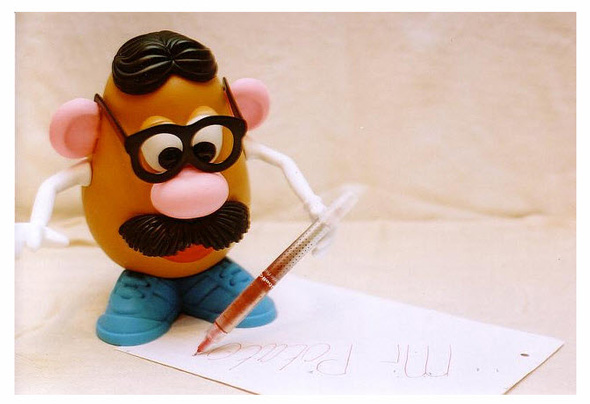
(Photo: Me circa 1987, just thinking about my future PA School Essay)
- Are you struggling to write your physician assistant personal statement?
- Are you out of ideas, or just need a second opinion?
- Do you want an essay that expresses who you truly are and grabs the reader's attention in the required 5,000-character limit?
We are here to help perfect your PA school essay
I have written countless times on this blog about the importance of your personal statement in the PA school application process. Beyond the well-established metrics (GPA, HCE/PCE hours, requisite coursework, etc.), the personal statement is the most crucial aspect of your application.
This is your time to express yourself, show your creativity, skills, and background, and make a memorable impression in seconds. This will be your only chance, so you must get it right the first time.
For some time, I had been dreaming about starting a physician assistant personal statement collaborative.
A place where PA school applicants like yourself can post their PA school essays and receive honest, constructive feedback followed by an acceptance letter to the PA school of your choice!
I have been reviewing a ton of essays recently, so many in fact that I can no longer do this on my own.
To solve this problem, I have assembled a team of professional writers, editors, and PA school admissions specialists who worked to revise and perfect my PA school application essay.
 Beth Eakman has taught college writing and worked as a professional writer and editor since the late 1990s. Her projects have involved a wide range of disciplines and media, from editing scientific research and technical reports to scriptwriting for television. Her writing has appeared in academic, professional, and popular publications. Beth lives with her family just outside Austin, Texas. She enjoys the unique opportunity that The PA Life offers to combine her training as a writer and editor with her experience teaching in order to support PAs and aspiring PAs in achieving their professional goals.
 Carly Hallman is a professional writer and editor with a B.A. in English Writing and Rhetoric (summa cum laude) from St. Edward's University in Austin, Texas. She has worked as a curriculum developer, English teacher, and study abroad coordinator in Beijing, China, where she moved in 2011. In college, she was a Gilman Scholar and worked as a staff editor for her university's academic journal. Her first novel, Year of the Goose, was published in 2015, and her first memoir is forthcoming from Little A Books. Her essays and creative writing have appeared in The L.A. Review of Books, The Guardian, LitHub, and Identity Theory, among other publications.
Read more client testimonials or purchase a revision
We Work as a Team
Our team of professional editors is wonderful at cutting out the "fluff" that makes an essay lose focus and sets people over the 5,000-character limit. Their advice is always spot-on.
Sue, Sarah, and Carly are amazingly creative writers who will take your "ordinary" and turn it into entirely extraordinary.
I mean it when I say this service is one-of-a-kind! We have spent countless hours interviewing PA School admissions directors and faculty from across the country to find out exactly what it is they are looking for in your personal statement.
We even wrote a book about it.
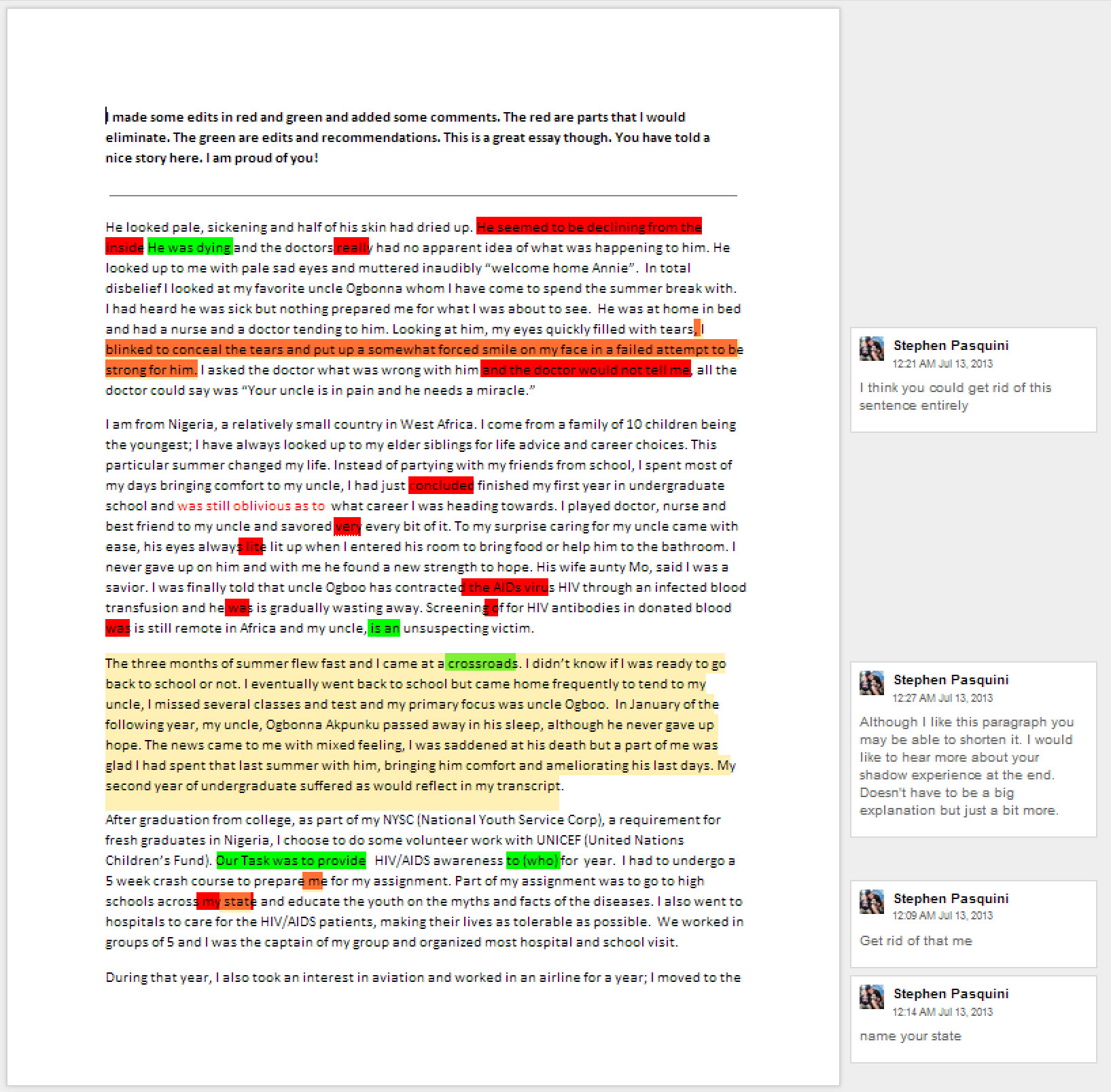 To collaborate, we use Google Drive. Google Drive is free, has an intuitive interface with integrated live comments in the sidebar, the ability to have a real-time chat, to collaborate effortlessly, and to compare, revise, or restore revisions on the fly. Google Drive also has an excellent mobile app that will allow you to make edits on the go!
Our team has worked with hundreds of PA school applicants within the Google Drive environment, and we have had enormous success.
The Physician Assistant Essay and Personal Statement Collaborative
I have set up two options that I hope will offer everyone a chance to participate:
- One-of-a-kind, confidential, paid personal statement review service
- A collaborative, free one (in the comments section)
Private, One-On-One Personal Statement Review Service
If you are interested in the paid service, you may choose your plan below.
The Personal Statement Review Service is:
- Behind closed doors within a private, secure network using Google Drive.
- It is completely interactive, meaning we will be able to provide real-time comments and corrections using the Google Drive interface.
- Telephone consultations are included with all edits above the single edit level. It’s often hard to communicate exactly what you want hundreds of miles away; for this reason, we offer the option to edit right along with us over the telephone while sharing in real-time over Google Drive. This is an option available to all our paid clients who purchase above the single edit level.
- We provide both revision and editing of all essays. What’s the difference? See below
- We will provide feedback, advice, and help with brainstorming and topic creation if you would like.
- We will help with a “final touch-up” before the big day, just in case your essay needs a few minor changes.

Why Choose Our Service?
- It’s not our opinion that matters. We have gone the extra step and personally interviewed PA school administrators from across the US to find out exactly what they think makes a personal statement exceptional.
- We are a team of PAs and professional writers, having worked over ten years with PA school applicants like yourself, providing countless hours of one-on-one editing and revision.
- Our clients receive interviews, and many go on to receive acceptance into their PA School of choice.
Because we always give 100%, we will open the essay collaborative for a limited number of applicants each month and then close this depending on the amount of editing that needs to be done and the time that is available.
Our goal is not quantity but quality. We want only serious applicants who are serious about getting into PA school.
Writing is not a tool like a piece of software but more like how a photograph can capture your mood. It’s more like art. The process of developing a unique, memorable personal statement is time-intensive, and it takes hours to compose, edit, finalize, and personalize an essay.
As Antoinette Bosco once said:
And this is why I am charging for this service. We love helping people find stories that define their lives, and we love helping individuals who have the passion to achieve their dreams. It’s hard to describe the feeling I get when an applicant writes back to tell me they were accepted into PA school.
There is no price tag I can place on this; it’s the feeling we get when we help another human being. It’s just like providing health care. But this takes time.
Interested? Choose your plan below.
Read more client testimonials.
Free Personal Statement Review
Post your essay in the comments section for a free critique
We want to make this opportunity available to everyone who would like help with their essay, and that is why we are offering free, limited feedback on the blog.
You post your essay in the comments section, and you will get our critique. It is that easy. We will try to give feedback to every single person who posts their COMPLETE essay here in the comments section of this blog post.
Also, by posting your comment, we reserve the right to use your essay.
We will provide feedback on essays that are complete and fit the CASPA requirements (View CASPA requirements here). We will not provide feedback on partial essays or review opening or closing statements. Your essay will be on a public platform, which has both its benefits and some obvious drawbacks. The feedback is limited, but we will try to help in any way we can.
Note: Comment Rules: Remember what Fonzie was like? Cool. That’s how we’re gonna be — cool. Critical is fine, but if you’re rude, I will delete your stuff. Otherwise, have fun, and thanks for adding to the conversation! And this should go without saying: if you feel the need to plagiarize someone else’s content, you do not deserve to go to PA school.
* Also, depending on the time of year, it may take me several weeks to reply!
We love working with PA school applicants, but don't just take our word for it!
How to submit your essay for the paid service
If you are serious and would like to have real, focused, and personalized help writing your personal statement, please choose your level of service and submit your payment below.
After you have submitted your payment, you will be redirected to the submissions page, where you can send us your essay as well as any special instructions. We will contact you immediately upon receipt of your payment and essay so we may begin work right away.
Pricing is as follows:
Choose your plan, then click "Buy Now" to submit your essay, and we will get started right away!
Every purchase includes a FREE digital copy of our new 100-page eBook, How to Write Your Physician Assistant Personal Statement, Our 101 PA School Admission Essays e-book, the expert panel audiobook, and companion workbook. This is a $65 value included for free with your purchase.
All credit card payments are processed via PayPal over a secure HTTPS server. Once your payment is processed, you will be immediately redirected back to the essay submission page. There, you will submit your essay along with some biographical info and all suggestions or comments you choose to provide. You will receive immediate confirmation that your essay has been securely transmitted as well as your personal copy of "How to Write Your Physician Assistant Personal Statement." Contact [email protected] if you have any questions, comments, or problems - I am available 24/7.
The hourly service includes your original edit and one-on-one time over Google Drive. It is simple to add more time if necessary, but you may be surprised at what a difference just a single edit can make. We find our four-hour service to be the most effective in terms of time for follow-up and full collaboration. We are open to reduced-rate add-ons to suit your individual needs.
Writing and Revision
All writing benefits from rewriting when done well.
When you are in the process of writing a draft of an essay, you should be thinking first about revision, not editing.
What’s the difference?
Revision refers to the substantial changing of text. For example, it may include re-organizing ideas and paragraphs, providing additional examples or information, and rewriting a conclusion for clarity.
Editing, on the other hand, refers to correcting mistakes in spelling, grammar, and punctuation.
We perform both revision and editing on all submissions.
How to submit your PA school essay for the FREE editing service
Follow the rules above and get to work below in the comments section. I look forward to reading all your essay submissions.
– Stephen Pasquini PA-C
View all posts in this series
- How to Write the Perfect Physician Assistant School Application Essay
- The Physician Assistant Essay and Personal Statement Collaborative
- Do You Recognize These 7 Common Mistakes in Your Personal Statement?
- 7 Essays in 7 Days: PA Personal Statement Workshop: Essay 1, “A PA Changed My Life”
- PA Personal Statement Workshop: Essay 2, “I Want to Move Towards the Forefront of Patient Care”
- PA Personal Statement Workshop: Essay 3, “She Smiled, Said “Gracias!” and Gave me a Big Hug”
- PA Personal Statement Workshop: Essay 4, “I Have Gained so Much Experience by Working With Patients”
- PA Personal Statement Workshop: Essay 5, “Then Reach, my Son, and Lift Your People up With You”
- PA Personal Statement Workshop: Essay 6, “That First Day in Surgery was the First Day of the Rest of my Life”
- PA Personal Statement Workshop: Essay 7, “I Want to Take People From Dying to Living, I Want to Get Them Down From the Cliff.”
- Physician Assistant Personal Statement Workshop: “To say I was an accident-prone child is an understatement”
- 9 Simple Steps to Avoid Silly Spelling and Grammar Goofs in Your PA School Personel Statement
- 5 Tips to Get you Started on Your Personal Essay (and why you should do it now)
- How to Write Your Physician Assistant Personal Statement The Book!
- How to Write “Physician Assistant” The Definitive PA Grammar Guide
- 101 PA School Admissions Essays: The Book!
- 5 Things I’ve Learned Going Into My Fourth Physician Assistant Application Cycle
- 7 Tips for Addressing Shortcomings in Your PA School Personal Statement
- The #1 Mistake PRE-PAs Make on Their Personal Statement
- The Ultimate PA School Personal Statement Starter Kit
- The Ultimate Guide to CASPA Character and Space Limits
- 10 Questions Every PA School Personal Statement Must Answer
- 5 PA School Essays That Got These Pre-PAs Accepted Into PA School
- 7 Questions to Ask Yourself While Writing Your PA School Personal Statement
- 101 PA School Applicants Answer: What’s Your Greatest Strength?
- 12 Secrets to Writing an Irresistible PA School Personal Statement
- 7 Rules You Must Follow While Writing Your PA School Essay
- You Have 625 Words and 2.5 Minutes to Get Into PA School: Use Them Wisely
- What’s Your #1 Personal Statement Struggle?
- 31 (NEW) CASPA PA School Personal Statement Examples
- How to Prepare for Your PA School Interview Day Essay
- Should You Write Physician Associate or Physician Assistant on Your PA School Essay?
- Meet the World’s Sexiest PA School Applicants
- PA School Reapplicants: How to Rewrite Your PA School Essay for Guaranteed Success
- How to Write a Personal Statement Intro that Readers Want to Read
- PA School Reapplicant Personal Statement Checklist
- How to Deal with Bad News in Your Personal Statement
- Inside Out: How to use Pixar’s Rules of Storytelling to Improve your PA Personal Statement
- Ratatouille: A Pixar Recipe for PA School Personal Statement Success
- Personal Statement Panel Review (Replay)
- Mind Mapping: A Tool for Personal Statements, Supplemental Essays, and Interviews
- Start at the End: Advice for your PA School Personal Statement
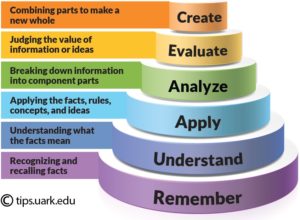
- Elevate Your Personal Statement: Using Bloom’s Taxonomy for Impactful Writing
- How to Write a Captivating Hook for Your PA School Personal Statement
- 3 Surprising Truths About the New CASPA Life Experiences Essay (And Why You Can’t Ignore It)
- 3 PA School Personal Statement Mistakes Our Editor Sees Again and Again
You may also like
 Elevate Your Personal Statement: Using Bloom’s Taxonomy for Impactful WritingThe most common advice writers often give pre-PAs is to "show, don't tell" in your essays. (Though we like to encourage showing …
 Who Gets Into PA School in 2026? Here’s What You Need to KnowLeslie Mean is a 23-year-old single white female who presents to the PA school admissions committee on her second attempt to get …
 Start at the End: Advice for your PA School Personal StatementNot sure what to include in your personal statement? Start at the End! The conclusion should summarize your entire essay. Consider the …


CASPA Personal Statement Help
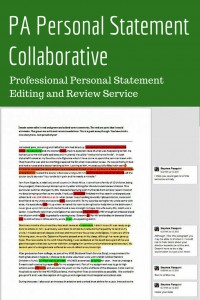 We offer comprehensive, start-to-finish personal statement assistance or help to perfect a draft you already have. We have services to fit every budget.
 Schedule a Live Recorded PA School Video Interview
We offer 60-minute mock PA school interviews with post-interview feedback and advice. Includes a recorded video of your interview that you can watch, download, or share with family and friends. There is no better way to prepare!
Schedule an InterviewPre-PA Consulting and Advising
 Our pre-PA coaching service consists of a 1-hour phone consultation focused on addressing your specific questions or concerns about becoming a PA and applying to PA school.


This is a very rough draft of my essay. I would love your advice on what I can do to further improve this essay. I am aware that character count is currently over the CASPA limit
Even as a young girl, I was always drawn to the medical field, whether it was watching dramatized medical TV shows and movies or playing “doctor” at play dates. As I have matured, my interest in medicine still persists, and the dreams of that little girl are moving closer and closer to reality. My experiences both inside and outside of medical settings have influenced my decision to follow my heart toward medicine and confirmed my decision to become a physician assistant.
After my senior year of high school, I spent the summer volunteering at the Denver Children’s Hospital. My experience there sparked my pursuit of a career in the medical field. From my interactions with in-patients to making rounds on outpatient floors, I enjoyed knowing that I was making a difference in their treatments and lives, even if it was just by making them smile. Furthermore, after my time at the hospital I found myself fully appreciating my own good health, which further drove me to give back to those with less fortunate circumstances.
My most poignant experience at the hospital was during my time working on the oncology floor. To my left, one child was in remission and being discharged and to my right, another was newly diagnosed and being admitted for treatment. When I walked into a patient room and saw a girl my own age, I realized that cancer truly knows no boundaries. She remained in the hospital for the entire 8-week period of my stay, and I would often bring her coloring books and movies, always receiving an enormous smile in return. Her bravery and optimism inspired me to be brave for the patients who didn’t have her strong will. I was moved not only by these incredibly resilient children, but also by the amount of hope instilled within their families—I immediately wanted to be a part of these patients’ experiences.
The following summer, after my freshman year of college, I shadowed an oncological radiologist specializing in breast cancer. During this experience I saw for the first time the relationship and collaboration required by the physician and the physician assistant. I shadowed appointments and treatment sessions as well as attended weekly support meetings dedicated to patients who were either going through chemotherapy and radiation or who were in remission. I listened intently to the patients’ stories, in awe of their strength and hopeful that some day I could help people like them. Through this experience I adopted a greater understanding of proper patient care and learned what it takes to be a physician assistant.
My experience shadowing physician assistants at St. Luke’s Hospital in the fall semester of my senior year truly solidified my plan to pursue a career in medicine. Each week I looked forward to entering the hospital and truly loved the environment and people who surrounded me. Whether I was on the pediatric floor or in the ER, I was always learning. This externship allowed me to understand the physician assistant role in a hospital setting and to explore many different fields of medicine, helping me to discover my areas of interest: emergency medicine, OB/GYN, pediatrics, and oncology
My most recent experience being a medical assistant at Planned Parenthood has continued to push me into the medical field. Being the first person that a young boy has told that he is homosexual, to being the first to hear that a young woman had just been sexually abused, to being the first person to tell a teenager that she is pregnant was not only extremely challenging but also extremely rewarding. Knowing that I was directly impacting these people’s lives has led me to not give up on my dream job and continue perusing a career as a physician assistant. Over the past year I have grown not only as a health care professional but, also as an individual.
Though my passion for medicine has always been clear, it was not until after my shadowing and clinical experiences that I realized there was a role within the field that was perfect for me: physician assistant. Firstly, I greatly admire the flexibility available to physician assistants. It is both exciting and comforting to know that I can follow my passion even if my specialty changes half way down the road due to various career options and opportunities
However, although the job may be flexible, it is by no means easy, as working alongside a physician requires an immense aptitude for teamwork. For the majority of my life, I have been on some sort of team for which I have had to collaborate with others to achieve a common goal. From playing on soccer teams to working with other students in the research lab, teamwork is a skill that I have developed in my day-to-day life since childhood. As a physician assistant, I look forward to having the opportunity to work with others in order to maintain proper patient care.
I have spent most of my life acting as a caregiver in some capacity. From helping a classmate with Down syndrome overcome his daily struggles, to helping my mom though multiple bouts of interstitial cystitis, I have constantly tried to improve the lives of those around me. This field is right for me, as helping others is something that not only feels natural, but also makes me happy. I know that there are many opportunities for one to make a difference in the medical field, but I believe I have found the right niche for myself as a physician assistant.
Hi Katie,
It is a challenge to keep these essays within the CASPA limit. So I’ll start by suggesting a place to cut — your opening sentences. “Even as a young girl, I was always drawn to the medical field, whether it was watching dramatized medical TV shows and movies or playing “doctor” at play dates. As I have matured, my interest in medicine still persists, and the dreams of that little girl are moving closer and closer to reality.” They’re what I call throat clearing — you’re getting ready to say what you want to say. Truly, Admissions folks aren’t too interested in the typical childhood story (and yours is very typical) — that’s what they told me when I interviewed Admissions Directors and faculty across the country about writing these essays for our book, “How To Write Your Physician Assistant Personal Statement.” Just by cutting those sentences, you’re almost at your 5,000 character/space limit.
The promise in the next sentence is that your will tell us about your experiences in and outside of medical settings that led you to this point. Yet it’s not until near the conclusion that you mention any experiences outside medical settings. Weave those things in earlier. You have good examples (although I’m sure you and your mother would have preferred not to have her as an example) that show you have great empathy, compassion and humanity. I would also rework that sentence since it will likely be your opening to something like this: “My experiences, both inside and outside of medical settings, convinced me to follow my heart to a career as a physician assistant.” You want a strong, actively written opening that captures your reader’s attention. Now people will wonder, “What experiences led her to this?” They will keep reading to find out.
You also want a strong, convincing conclusion. Your very last sentence is anything but that — it’s not the place to say you “believe” you’ve found your niche.
A lot of your writing is terrific. But there are things that don’t work. This sentence for example: “Firstly, I greatly admire the flexibility available to physician assistants. It is both exciting and comforting to know that I can follow my passion even if my specialty changes half way down the road due to various career options and opportunities.” The word “firstly” is not used frequently, so it stopped me. Halfway should be one word. It’s also passive and vague. More importantly, there’s no secondly. That is you never get to the second thing about PAs that make it your perfect career, well, except for mentioning teamwork in the next paragraph. You set up a golden opportunity to explain exactly why you want to be a PA, and you don’t take advantage of it to convince your readers that this is the career for you. Find other places to cut some of the details and expand on the specifics that appeal to you about the profession.
I hope all this helps and wish you the best of luck.
Sue Edmondson
http://www.thepalife.com
I was sitting in the back of the classroom, focused on my assignment when I heard a loud commotion. I quickly analyzed the situation and found a student lying on the ground. I ran over to him while everyone else remained motionless. I determined that he was having a seizure. My instincts took over as I held him in my arms. I kept him on his side and protected his head. Paramedics arrived shortly after and thanked me for acting so quickly. The feeling of helping a person in need was unlike any other. Little did I know, my kind-heart and scientific background would lead me on my career path to becoming a physician assistant.
In college, I was proficient in science courses, especially when it came to analyzing data and coming to a conclusion. Therefore, my goal was to become a research scientist. While in school, I worked as the head veterinary technician at an animal hospital. During this time, I formed a respectable and valuable relationship with the doctor. Working for him was like getting paid for learning. He took every opportunity to explain and teach the details of a disease or diagnosis. I learned something new every day and I loved it. While treating the animals at the hospital was the main priority, forming relationships with the clients was also of vital importance. A favored responsibility of mine was client education. This gave me a chance to have direct human interaction by teaching clients how to care for their sick pet at home. Demonstrations included diabetes management, medication administration, subcutaneous fluid therapy and physical therapy. Clients appreciated my ability to clearly explain treatment or procedures in a way that was easily understood. I cherish the skills and experience I gained from the animal hospital. However, becoming a veterinarian was not my goal.
Upon completion of my bachelor’s degree, becoming a research scientist was still my objective so I took an office job while preparing my application to graduate school. I began to doubt my career choice due to my longing for human interaction and a sense of purpose. Since I loved working in the animal hospital, I decided to start shadowing to see if human health care would be as appealing to me as animal care. I put my researching skills to use and learned about the different roles of health care providers. I concluded that being a nurse was not for me due to my interest in the diagnostics and analytical aspects of medicine. Upon further research, the PA profession’s versatility sparked my interest. I contacted a local family care doctor who had a PA working at his practice and they mutually agreed to let me shadow.
My nerves began to creep up on me as I drove to the doctor’s office on my first day of shadowing. However, upon arrival, I was instantly relieved. The environment was very similar to the animal hospital, except with no animals. Days consisted of accompanying the PA and/or the medical doctor in exam rooms to observe how patients were diagnosed and treated. I admired how the PA worked with patients and made every diagnosis easy to understand. The relationship between the PA and MD was similar to my relationship with the veterinarian. The PA could ask the MD any questions in which he would explain the details thoroughly. I was only able to spend one day a week shadowing at the doctor’s office due to the necessity of working a full-time job. However, the MD recognized my potential and offered to pay me to shadow to teach and prepare me as much as possible for my future as a PA. What started off as a shadow experience turned into a part-time job and I could not have been happier partaking in such an amazing opportunity. I spent three days a week at the doctor’s office, working as a team with either the MD or PA. I began appointments by asking the patient general questions about their current illness and documenting the findings into the EMR. The MD or PA would then review orders and give explanations while I continued to document. Notes were then reviewed and edited as necessary by the MD or PA. Once again, I received payment to learn and obtain experience that would help me towards my goal of becoming a PA.
While shadowing, I also volunteered at a free health care clinic called Volunteers in Medicine, Community Hospice and at UF Health in the emergency department. These opportunities allowed me to gain experience in different areas of medicine. My passion for helping others and being involved in the health care field is immense. Becoming a PA will allow me to use my analytical mind to effectively diagnose and treat patients. My creativity will be utilized by thinking outside of the box to come up with innovative treatment plans for patients. Having a physician above me to look to for guidance is ideal to me. My mind is always open to other opinions and will always value the input of the supervising physician. The versatility of the PA career is ideal for me and will satisfy my forever-growing urge to learn something new.
I accidentally posted twice!! Please disregard!
My name is Kelly not Jessica. I am logged into her computer and her name and email auto populated into the boxes.. sorry for any confusion.
I was sitting in the back of the classroom, focused on my assignment when I heard a loud commotion. I quickly analyzed the situation and found a student lying on the ground. I ran over to him while everyone else remained motionless. I determined that he was having a seizure. My instincts took over as I held him in my arms. I kept him on his side and protected his head. Paramedics arrived shortly after and thanked me for acting so quickly. The feeling of helping a person in need was unlike any other. Little did I know, my kind-heart and scientific background would lead me on my career path to becoming a physician assistant.
In college, I was proficient in science courses, especially when it came to analyzing data and coming to a conclusion. Therefore, my goal was to become a research scientist. While in school, I worked as the head veterinary technician at an animal hospital. During this time, I formed a respectable and valuable relationship with the doctor. Working for him was like getting paid for learning. He took every opportunity to explain and teach the details of a disease or diagnosis. I learned something new every day and I loved it. While treating the animals at the hospital was the main priority, forming relationships with the clients was also of vital importance. A favored responsibility of mine was client education. This gave me a chance to have direct human interaction by teaching clients how to care for their sick pet at home. Demonstrations included diabetes management, medication administration, subcutaneous fluid therapy and physical therapy. Clients appreciated my ability to clearly explain treatment or procedures in a way that was easily understood. I cherish the skills and experience I gained from the animal hospital. However, becoming a veterinarian was not my goal.
Upon completion of my bachelor’s degree, becoming a research scientist was still my objective so I took an office job while preparing my application to graduate school. I began to doubt my career choice due to my longing for human interaction and a sense of purpose. Since I loved working in the animal hospital, I decided to start shadowing to see if human health care would be as appealing to me as animal care. I put my researching skills to use and learned about the different roles of health care providers. I concluded that being a nurse was not for me due to my interest in the diagnostics and analytical aspects of medicine. Upon further research, the PA profession’s versatility sparked my interest. I contacted a local family care doctor who had a PA working at his practice and they mutually agreed to let me shadow.
My nerves began to creep up on me as I drove to the doctor’s office on my first day of shadowing. However, upon arrival, I was instantly relieved. The environment was very similar to the animal hospital, except with no animals. Days consisted of accompanying the PA and/or the medical doctor in exam rooms to observe how patients were diagnosed and treated. I admired how the PA worked with patients and made every diagnosis easy to understand. The relationship between the PA and MD was similar to my relationship with the veterinarian. The PA could ask the MD any questions in which he would explain the details thoroughly. I was only able to spend one day a week shadowing at the doctor’s office due to the necessity of working a full-time job. However, the MD recognized my potential and offered to pay me to shadow to teach and prepare me as much as possible for my future as a PA. What started off as a shadow experience turned into a part-time job and I could not have been happier partaking in such an amazing opportunity. I spent three days a week at the doctor’s office, working as a team with either the MD or PA. I began appointments by asking the patient general questions about their current illness and documenting the findings into the EMR. The MD or PA would then review orders and give explanations while I continued to document. Notes were then reviewed and edited as necessary by the MD or PA. Once again, I received payment to learn and obtain experience that would help me towards my goal of becoming a PA.
While shadowing, I also volunteered at a free health care clinic called Volunteers in Medicine, Community Hospice and at UF Health in the emergency department. These opportunities allowed me to gain experience in different areas of medicine. My passion for helping others and being involved in the health care field is immense. Becoming a PA will allow me to use my analytical mind to effectively diagnose and treat patients. My creativity will be utilized by thinking outside of the box to come up with innovative treatment plans for patients. Having a physician above me to look to for guidance is ideal to me. My mind is always open to other opinions and will always value the input of the supervising physician. The versatility of the PA career is ideal for me and will satisfy my forever-growing urge to learn something new.
Hi Kelly,
I thought your essay sounded familiar (I have a pretty good memory). I went back and found your post from five months ago. Sorry, I only give one free review per person.
Best of luck, though, in your application.
Sue Edmondson
http://www.thepalife.com
I would love your input on my (very) rough draft. I am looking to cut a lot out (currently 740 characters over the 5000 limit) but I was not able to include a lot about my experiences that developed my leadership and teamwork skills. Could you please tell me if I’m going in the right direction with this? Thank you so much for your time!
In a study completed by the city commission in 2014, 34% of residents in Kalamazoo, Michigan live at or below the poverty line. Due to limited resources, there are hundreds of people in my hometown that have restricted access to healthcare. These barriers are partly due to the shortage of medical providers available to the poorer neighborhoods in my city. I believe that physician assistants are the solution to this problem. By completing medical training within two to three years, PAs are able to get out into the community and provide quality healthcare, as opposed to physicians who take seven to ten years of training before they are able to see their own patients. As a PA I want the privilege of providing healthcare to underserved areas similar to the city I grew up in.
Towards the end of my undergraduate career, I was unsure of what career in healthcare I wanted to pursue while knowing that I wanted to practice medicine. After discussing my concerns with my mom she told me about her experience with the PA profession, which sparked my interest in the career. After doing more research, I discovered that becoming a physician assistant was a better fit for me and decided to see what the people who dedicated their lives to the profession said about their experiences. I was surprised, and pleased, to see that the PAs I shadowed exercised autonomy while diagnosing and treating patients both in clinical and hospital settings. During rounds, physician coworkers chimed in to say that they wished they had the flexibility to switch between specialties as PAs did. I was particularly interested when one PA I shadowed mentioned that he switched from being in the ER to working in a university health clinic after he had children to support his family. This flexibility would allow ability to broaden the scope of my medical knowledge by practicing medicine in various fields.
Teaching was an overarching theme I observed while shadowing physician assistants at the University of Michigan Health System and at Bronson Hospital. Here, I was able to see that great PAs also made great teachers. Their eagerness to mentor me and encourage me to pursue my dream was inspiring. They showed me interesting cases they have come across as clinicians, taught me how admit patients into the hospital, and had me ask patients questions I believed were relevant for a diagnosis. Their enthusiasm for the PA profession was evident in the way they interacted with patients and I realized that I had found the career for me. After reflecting on my experience of shadowing doctors versus PAs, I noticed that physician assistants were able to spend more time with patients and family members. This was confirmed by several conversations I had with patients who recognized that physician assistants never seemed rushed and always took their time educating the patient and their answering their questions. The most meaningful part of healthcare for me is ensuring that patients understand their diagnosis and learn how to take better care of their bodies in regards to a disease, which I am able to do by working as a Cardiac Technician at Bronson Hospital. I often find myself explaining what it means when a patients heart rhythm converts to atrial fibrillation, how that would lead to the shortness of breath they were experiencing, and why being on a blood thinner would lessen the risk of having a stroke. I draw pictures of the heart and their respective heart rhythms and ask them to “teach back” what they learned to me so I see they are confident with their new diagnosis. I recall the joy I receive from their gratitude and it makes me look forward to when I will be able to explain diagnoses and treatment options in greater detail as a physician assistant in the future.
As with any extraordinary teacher, one develops a relationship through communication in order to build their trust. I believe that the same goes for patient-provider relationships in healthcare. I have been humbled by the amount of trust a patient has placed in me as a patient care assistant by sharing their deepest fears on some of the scariest days of their lives. By showing the patients and their family members that I was listening to what they had to say, I gained their trust and I look forward to the day when I can do this while being responsible for bringing patients back to health as a physician assistant, with the support of the patient care team.
Working in hospitals over the past two years has proved to me that providing quality care is a team effort. Being an excellent PA means working with the supervising physician along with other members such as nurses and patient care assistants. As with any great team, having a leader can promote teamwork and drive the group in the right direction. In the medical profession, the PA and supervising physician take on the role of guiding the care management plan with the team of pharmacists, therapists, and discharge planners. By being a leader and team player both during undergrad and in the hospital, I will excel as the physician assistant on a patient’s care team.
In five years, I envision myself providing healthcare in underserved areas in cities much like my hometown of Kalamazoo as a Cardiology PA, educating my patients on heart disease and prevention. In 20 years, I hope to use my leadership and teaching skills that I have developed over the years in order to educate the PA students of the future. The combination of having solid teamwork and leadership skills, and years of patient care interaction and hospital experience makes me an exceptional candidate for PA school. As a practicing physician assistant, I am looking forward to always advancing and promoting the PA profession.
Hi Sherin,
You’re kind of on the right path, but it takes you a while to get there. Start by eliminating the first paragraph, which will save you a lot of characters and spaces. While parts of it could work in other parts of the essay, such as this sentence: “As a PA I want the privilege of providing healthcare to underserved areas similar to the city I grew up in,” most of it is unnecessary. As an opening paragraph, it fails to engage.
The first thing to remember about these essays is their purpose — to introduce you to Admissions folks and show them why they’d want you in their program apart from the tangible things such as grades, test scores, etc. Citing statistics about poverty puts a huge distance between you and the people reading the essay. Instead, you could start with your experience of growing up in an area that has significant poverty, and the impact of healthcare barriers on you, your family or friends. Personalize it in some way if that’s how you decide to start your essay. This sentence, too, does nothing to help Admissions folks know anything about you: “By completing medical training within two to three years, PAs are able to get out into the community and provide quality healthcare, as opposed to physicians who take seven to ten years of training before they are able to see their own patients.” You’re preaching to the choir!
I’d be leery about projecting what you’d like to be doing in 20 years. To those of us who have been around for a while, it reads unrealistically. If you had a degree in education and/or spent time teaching, then you could get away with saying some day you’d like to combine your skills as a PA with your teaching skills. Otherwise, stick to your the near future — working in underserved areas, educating patients, etc. Also, if you have leadership skills, you should explain how you acquired them rather than making blanket statements like this: “By being a leader and team player both during undergrad and in the hospital, I will excel as the physician assistant on a patient’s care team.” You might also want to soften the last phrase and other similar things you’ve said in the essay by saying you believe you will excel, etc.
You have quite a bit of PA related experience and good insights, and those are great to include in the essay. To make them really shine, the writing needs some finessing. Since it’s a rough draft, I’m sure you’ll be doing just that.
I hope this helps and wish you the best of luck.
Sue Edmondson
http://www.thepalife.com
Hi Sue,
I will be re-applying this cycle and would greatly appreciate any inisight you had to offer. This is my paper from last time around. Thank-you
“Championship Lifestyle” was a phrase coined by my collegiate wrestling coach, and one that I took to heart. It means to not take the easy way out of any situation life may throw at you. Not skipping a workout because you are too sore from morning sprints. Not studying as hard as you should to keep that A, because “a B doesn’t sound too bad.” Or not getting the full eight hours of sleep you need so you can give your best for tomorrow. This mentality that I have made my own has been the catalyst that has served me well to this point in my life. To go along with my “Championship Lifestyle,” I live by the saying, “Deserve Victory.” Personally, this means that if you want to succeed at something, you have to put in the effort to deserve it. This motto transcends all. It can be put into use in every aspect and situation in life. If one works hard enough, they will earn, and in turn, deserve that victory. My next and most arduous victory that I am striving for is to have the opportunity to learn to become a physician assistant.
I wish that I could say that the heavens opened up or a miraculous event occurred where instantly I knew that becoming a physician assistant was my calling. There was never an instance through my Division One wrestling career when a physician assistant worked with me, restored me to health, and returned me to the mat stronger than ever. My path was not that clear. It came through deep reflection of myself, my intrinsic values, motivations, and through much research.
Health and healthcare have always been a part of who I am. It came from all aspects of my life: my career in athletics, my lifestyle and personal motto, and from my undergraduate studies. But the seeds were planted by my mother and father who worked in healthcare all their lives as an x-ray technician and a firefighter paramedic respectively. I recall growing up and seeing how much time and effort my parents devoted to their careers. I will never forget seeing the satisfaction they had, and the respect and admiration others had for what they did day in and day out. They were more than willing to work long and hard for what they loved to do. At the end of the day it was about helping people, not just another career.
I am looking forward to interacting with patients, hearing their stories, and being with them through every step of their health and wellness journey. From taking health histories, to running tests, diagnosing, implementing health plans and being there when they return to health; I want to be the one who has had a positive impact on their journey. Currently I work as a Fitness Specialist at Edward Hospital in Naperville, Illinois. I interact directly with patients and members on a daily basis; from the young and healthy, to seniors and special populations such as special needs, diabetics, cancer patients, survivors, as well as high cholesterol and blood pressure patients. I learn about them through health histories and personal stories, I monitor their vitals, and perform comprehensive fitness tests and assessments. With all of my accumulated results and notes, I then design an individualized plan to get them back on track towards their health goals and a healthy lifestyle. This is a job that gives me joy and satisfaction. Meeting new people, interacting with them, and helping them become well is what I strive for. The next step in my career is to take on a larger role in the health of people’s lives.
All of the prior experiences and knowledge I have gained has provided the foundation for health and well-being in my life. My approach toward health has grown into a drive to further my education and continue to help people in a more clinical, in-depth way. Observing members of a team of clinicians, working towards helping a patient achieve optimal health makes me want to be a part of that team. I want to be able to give one hundred percent to my future patients and provide the best possible healthcare that I can while being challenged and educated continuously. I want to help fill the gap between patient and doctor and be an asset to more people as a mid-level practitioner. I am more than willing to do whatever it takes to make this dream become a reality. If given the opportunity, I know that I will succeed and provide a great service to the less fortunate, and to countless others who need their health back. I have pushed myself further than I thought possible through athletics and my current work and class schedules. In this next stage of my career I am ready to put in the maximum effort and to “Deserve Victory,” in the grandest and most fulfilling battle of my life, physician assistant school.
Hi Dan,
This is a very accomplished essay. It’s well organized, interesting and the writing is lively. I like your theme, too.
If you didn’t get any interviews, assuming everything else in your application is solid, it may be because the essay lacks specific details about why you’ve chosen the PA profession. You refer to it generally, but it’s still fairly vague. You’re at 4,667 characters/spaces, so you still have some room to weave in the info.
Since it’s your second time around, be sure to include anything new — shadowing, volunteer work, education, work. Your essay is unique enough so Admissions folks may remember it, and if it’s the same as last year’s, that will be a problem. When I interviewed Admissions Directors and faculty across the country about writing these essays for our book, “How To Write Your Physician Assistant Personal Statement,” this issue arose. They said they did not merely want a repeat of last year’s essay. They wanted to read about any updates.
Even if nothing concrete is new, you can be creative and include any insights you’ve gained in the past year that confirmed your decision to continue to pursue PA school.
If you need more space, you can cut a bit of detail about your current work. It’s all well-written, but it’s not critical to the flow of the essay. This for example is essentially repeated later in the paragraph, “From taking health histories, to running tests, diagnosing, implementing health plans and being there when they return to health; I want to be the one who has had a positive impact on their journey.” You’d save 197 characters/spaces if you deleted it. You can find other places to cut more if needed.
I hope this helps and wish you the best of luck.
Sue Edmondson
http://www.thepalife.com
Thank you for taking the time to review my personal statement. I omitted the names of specific organizations for privacy’s sake.
How can one expect to learn anything about a person, or a patient, without listening first and only then following with questions? How can one expect to diagnose without observing the subtleties of each individual? I am first an observer and a listener, often mistaken for being “too quiet”. In the PA profession both are central and celebrated. I had these insights when I was first investigating the profession in high school and found how well suited I was for it.
By becoming a certified nurse assistant I have been able to start at the most basic care level for my patients. This knowledge of a person’s fundamental needs will benefit every future patient entrusted into my care. Through my work as a CNA I gained a solid foundation for a path of service that will culminate in a career as a PA. I feel that by pleasantly and patiently helping a person to get ready in the morning I am making a difference in their day. By maintaining respect for patients, I am doing what I want to do most. While it is rewarding to care for and be a part of people’s lives I would love to have a larger role in their overall well-being without losing the types of relationships I have with them. Only by becoming a PA can I accomplish this.
I grew up in a large, loving, and Italian-born family. There was always such a sense of unity. If we celebrated, grieved or worked, we did it together. My early lessons came from wisdom deeply rooted in love and common sense, not necessarily from a formal education or an academic perspective. From my family I learned lessons about coping with tragedy, forgiveness and whole-hearted acceptance. This interconnectedness imparted upon me by my family has made me want nothing more than to bring warmth and compassion to the forefront and to reawaken patient-centered care by removing as much of the burden from the patient as possible. To accomplish this, I feel the physician assistant role is perfect because of the autonomy to work independently, the closeness to the patients, and its place as a leader within the healthcare team.
My sweet little nonna is getting older. She is “just 86” as she always says. She lived with my dad, my sister and I for several years after my mom passed away to help look after us. Now she is in the early stages of Alzheimer’s disease, and even though she has an apartment adjoining a family member, she needs more help. The first person who cared for Nonna did not carry out what was needed. She took on this huge responsibility without the proper concern. I will never forget the way this caretaker treated this wonderful, strong woman and, ultimately, failed her.
On my first day of clinical for my CNA certification at ****** Village , I was working with an experienced and chatty CNA. We approached an unadorned door. Before we entered the room she warned me that this woman could be nasty. She took me into a room to help the patient do her morning routine. When I entered the room it was dark with all the shades drawn and 85°. In the bed there was a little bump nearly hidden by blanket mounds. It took a lot of coaxing to get her to stop sleeping. She would peek through her eyelashes when she thought both of us were too busy to notice. In between many grumbles and several nasty looks, I had a quiet moment with her. She had paintings of herself with her dogs and a diploma in Education from ***** University. I told her my sister went to ****** University and that it is my lifelong desire to have a dog of my own. I did not get a lot back from her, certainly no words, just a nod or two. Then the moment was over, but I felt I created a relationship with her.
The next time I went to her room it was with several students helping a resident on our own for the first time. She was just as grumbly but was patient and somehow soft with all of us. When I started speaking with her we made each other smile and I knew she was not as calloused as she tried to appear. By my last clinical session she was the person I sought out to say good-bye. When I told her I was leaving, her face crumbled slightly as she looked at me. She said that she wished there was something she could do to help me. It was hard to say good-bye to this woman who touched my life with her sincere concern, feelings that were very similar to those I had for her.
At the heart of my care will always be empathetic compassion, just as I have always been taught by my family. The most important lessons my family has taught me were only reinforced by my experience as a CNA. Furthermore, the primary awareness gained from my time in a medical setting has been trust in my own abilities to take proper care of another person while encouraging personal dignity. Only when I become a physician assistant and I have the interactive patient experience that I crave, maintaining the health and well-being of all of my patients, will I be content.
Hi Bella,
I love the opening to your essay, well, except for the slightly awkward parts and the grammar error. It definitely made me want to learn more about you. It’s written in a way that suggests you’re an observer and listener — I’m impressed. I’ll show you in a few sentences what I’d change, but first I’d like to talk about the rest of the essay.
The second paragraph flows perfectly from the first. What a great way to explain why you started as a CNA and want to move to PA. Unfortunately, after that, you lose your way. There are no transitions to get us from that second paragraph to the third paragraph, from the third to the fourth and so on. You can’t just throw us into your wonderful Italian family without first driving us there, opening the door and introducing us. The same thing happens throughout the rest of your essay.
Okay, back to the first paragraph. Here’s your grammar error — “too quiet”. Punctuation always goes inside the quotation marks. It may not seem like a big deal but it is. When I interviewed Admissions Directors and faculty across the country about writing these essays for our book, “How To Write Your Physician Assistant Personal Statement,” all said there shouldn’t be any grammar errors, that it was a red flag that people didn’t pay attention to details. In healthcare, missing the details can lead to death!
This is how that paragraph would read if I edited it. (Note, I substituted observing and listening for “both.” Both doesn’t work because you added the clause “often mistaken for being too quiet” after you mention the two qualities.)
“How can one expect to learn anything about a patient without listening before asking questions? How can one expect to diagnose without observing the subtleties of each individual? I am first an observer and a listener, often mistaken for being “too quiet.” In the PA profession observing and listening are central and celebrated. I had these insights when I was first investigating the profession in high school, and discovered how well suited I was for it.”
I hope this helps and wish you the best of luck.
Sue Edmondson
http://www.palife.com
Hi Sue,
I wondered if you could post some pointers, here or perhaps in a separate post, on the personal statement for those reapplying? I didn’t see anything on your site. I had you, and some others, edit my essay last year and received positive feedback. However, I wondered if I should reuse my same essay this year. It was hard enough coming up with what I thought was a great essay last time. Does it make a difference if I am or am not applying to the same schools I applied to last year? I read somewhere that one should incorporate what has changed this time from last time, but perhaps that, too, depends on whether I am reapplying to the same schools or is this something that just goes into the CASPA part or should be included in the personal statement.
Hi Ashley,
When I interviewed Admissions Directors and faculty across the country about writing these essays for our book, “How To Write Your Physician Assistant Personal Statement,” the question came up.
Everyone said to definitely add anything that has changed since the last application — additional work experience, shadowing, volunteering and improvement in grades.
I also think this is a place to be creative. If you don’t have any healthcare/PA related updates, you might talk about additional insights you’ve had or the last year, or life experiences that impact your application.
If you’re not applying to the same schools, you can probably get away with using the same essay. However, if there’s a significant gap in time, you might want to update your essay.
Hope this helps.
Sue
Ah, this is why editing is so important — I hit “post comment” before reading my reply and meant to say, “If you don’t have any healthcare/PA related updates, you might talk about additional insights you’ve had over the last year.”
Sue
Thank you Sue. You’re feedback is greatly appreciated. You are the only one in all the forums, I’ve asked this question of, to respond. I do have one follow-up question, if you don’t mind…
When writing/rewriting the personal statement, should one be forthright about it being a reapplication? That is, should one say ‘Since I last applied, this is what’s happened…..” or do you work it in as, though, it was the first time (“This is all the experience and education I have.”)?
Ashley
Hi again, Ashley,
Well, our goal is to help, and to me, that’s answering questions.
Frankly, not making the cut is nothing to be ashamed of — when there are 1,000 applicants for 100 or less spots, there’s simply not room for every great candidate. Still, I do believe honesty is the best policy.
That being said, sometimes it simply doesn’t work with the essay to say the words, “Since I last applied . . .” The story may be so complete, there’s no way to deftly include it. But you’ll definitely want to send in a new essay, which will hopefully include recent events that show how you’ve grown since you last applied.
I hope that helps.
Sue Edmondson
http://www.thepalife.com
I decided to start over last minute, so this is my first rough draft, but I would love some feedback to know if I’m going in the right direction. Thank you!
“Did you get to see a brain today!?” This question has been exclaimed to me many times while coaching on a pool deck. More surprisingly, it has also been asked in the same manner by my twenty-six year old sister. It is pleasing to delight my swimmers and family by simply nodding my head and seeing their astonished reactions.
Most of my day consists of working as a certified surgical assistant (CSA) at Mayo Clinic’s Saint Mary’s Hospital. I primarily assist in orthopedic and neurologic surgery, but also float to areas such as general, otorhinolaryngology, thoracic, and urologic surgery. My weekends are spent in a much different setting than an operating room; a hectic, overly crowded swimming pool. I am also an assistant swim coach for competitive swimmers ranging from eight to thirteen years old. Although my two careers are very distinct from each other, together they have me eager to pursue the profession of a physician assistant (PA.)
Despite the differences of working as a surgical assistant and an assistant coach, the few commonalities have led my desire to become a PA. Teamwork is a strong aspect that has been stressed in the operating room as well as the pool. A surgical case requires the help of an anesthesia provider, circulating nurse, surgical assistant, surgical technician, and a surgeon. Each person must complete their tasks to ensure what is best for the patient and for things to run smoothly. As an orientee training to become a surgical assistant, it was my responsibility for plating a bone flap for a craniotomy case. I was unfamiliar with the surgical steps and did not have my job completed on time. This mistake resulted in the increase of operating time and anesthesia care, which negatively affected the patient. In order to prevent this from happening again, I learned the importance of performing my role on time as well as how essential it is to ask my surgical team any questions I may have about the case.
On the other hand, teamwork is not viewed by many to be as critical in a sport like swimming. Most believe it is an individual sport, where each swimmer wishes to beat their teammates as much as anyone else. However, as someone who swam competitively for sixteen years and now has coached for two, I have realized that your team means more than anything. The most memorable phrase said to me by a coach was to, “swim to inspire.” In a sport as repetitive as swimming, the teammates next to an individual are what feed his or her ambition and desire to try harder. As a PA, I would hope to work with a team that is not only enjoyable to work with, but makes me want to strive to be the best care provider and places their emphasis on what is best for the patient.
The opportunity to teach is another aspect I have reveled in between my two positions and look forward to do as a PA. Mayo Clinic is a teaching hospital and at times is filled with excited medical students. When closing a surgical incision, residents have given me the responsibility of instructing new students on how to suture skin and apply dressings. It is fun to explain the different techniques and to see what everyone prefers. However, as a swim coach, usually only one technique is taught for each of the four strokes, but young swimmers find many ways to implement their own. In order to get my swimmers excited about working on the technique of a stroke, we come up with fun drills such as “T-Rex arms,” to teach them how to become the most efficient when moving in the water. When working as a PA, I think it is crucial to adapt to patients’ levels of understanding and help them understand their situation.
Just as each surgical patient should be treated as an individual, so should each swimmer. At times when positioning patients, not every case is alike and being flexible is essential to maintain patients’ safety. Similarly, it is important to cater the practices I plan to the swimmers attending that night and to be flexible to change them if appropriate. PA’s work with many different people and must be flexible with their care to treat patients uniquely.
I find it exhilarating to be a part of a dynamic team that strives to improve patients’ lives. Currently, I cherish my small amount of interaction time with the patients, however, most of my role as part of the operating team commences after the anesthesia provider has them asleep. Therefore, I aspire to become a physician assistant, where I will no longer see patients simply while they are on an operating table. I will be able to work with a team through their journey of diagnosis, treatment and recovery.
Hi Michaela,
I hate to say this, but I don’t think you’re going in the right direction here. There is good potential, but your essay needs focus, organization and cohesion.
I get that you want to show how your two jobs — surgical assistant and coach, have similarities that led you to the PA profession. You do a good job of showing the similarities between the two jobs, but it stops there. There’s nothing to show how those similarities or even the jobs themselves led you to the PA profession. These two sentences for example, “When working as a PA, I think it is crucial to adapt to patients’ levels of understanding and help them understand their situation” and “PA’s work with many different people and must be flexible with their care to treat patients uniquely” are merely observations about the profession (and minor ones for that matter).
It’s not until your conclusion that I have any understanding about why you want to be a PA, and that’s too late.
Your opening especially, needs rewriting. It’s awkward for one, and we have no context to understand why you’re writing about swimmers and your sister asking if you saw a brain today, or why that would delight them, or why it would surprise you that your sister asked. What you’ve done is something I see often, even with experienced writers. You know the story in your head, but fail to put it on the page. My husband, who reads everything I write professionally before submitting it, tells me I’m guilty of the same crime in on occasion. That’s the beauty of having a second set of eyes. Although I don’t often say this for obvious reasons, your essay could benefit from professional editing.
I suggest you go back to the drawing board and list the reasons you want to be a PA. Then build your essay around that. You can work in the information about your jobs to show how they’ve contributed to the skills you’ll need as a PA. That will be a better use of some of the writing you’ve already done.
Wish I had better news for you, but at least it’s early in the process since this is a first draft. I hope this helps and wish you the best of luck.
Sue Edmondson
http://www.thepalife.com
I am in critical need of feedback. If need be, I will revise the entire essay. Thank you in advance.
Live compassionately, work hard, and possess a willingness to help others. As I get older, the lessons that my parents taught me begin to make sense. Looking back, I did not realize the impact these words would have on me or the challenges I would have striving to embody them. Despite the difficulties, my identity and purpose lives within these virtues.
I first learned the meaning of compassion when I was ten years old. My parents had sat down for dinner without any food in front of them. “Why aren’t you eating?” I asked innocently. To which I received, “We aren’t hungry,” as a reply. Later that night, my sister explained the true reason behind their empty plates. It was the day before payday and two mouths were all they could afford to feed. Through their sacrifices, they sheltered me from knowing a life of poverty. That family dinner motivated me to become a person that could be worthy of the sacrifices made on my behalf.
A few years later, I learned of a profession that would allow me to become such a person. My father had enrolled in college in order to leave behind his days as a janitor and become a physician assistant (PA). This transformation taught me that no dream is too big with enough hard work. It also gave me an in-depth look into the PA profession as well as the process needed to reach this goal. To me it was an ideal career because it would allow me to use my interest in the medical field to impact people’s lives. Also, my strong background in math and science assured me this was a field where I could excel. However, as an ambitious teenager I had other dreams as well.
Baseball had been the love of my life since the age of four, and I dreamed of playing professionally. By my senior year of high school, I was the captain of the varsity team and received an offer to be the catcher at Ave Maria University with an athletic scholarship. My hard work was paying off. By choosing biology as my major I convinced myself that I was on a PA track, but my year at Ave Maria solidified a path that focused solely on baseball. At the end of freshman year, I was invited to spend a summer in New York playing for an elite collegiate baseball league. After only a few weeks, my lifelong dream was nearly in grasp. Multiple scouts saw me play and began to show interest. At my next game, I noticed a scout from the Boston Red Sox in the stands. I stepped onto the field with as much determination and passion as ever. What came next changed my future. A seemingly minor collision at home plate sent sharp pains down both of my legs. Although I tried to ignore the pain, the X-ray revealed my darkest fear. My lumbar four had been fractured, and my baseball career was forced to a halt. The only compassion I received came from the PA who broke the news with a somber tone and an arm on my shoulder. I was sent on the next flight home, and I would never play baseball again.
My ambition and dedication had gotten me so close to my dream, the injury felt nothing short of devastating. As I spent one long summer in tears and contemplation replaying the events in my mind, one thing seemed to stand out. The PA from New York showed a simple act of kindness that reminded me why I was passionate about this profession. It was a career with the power to impact somebody’s life. His words had changed my life but at the same time provided me comfort. I realized if I had become a professional baseball player, I would have been neglecting a part of myself: the part that wanted to change lives.
With renewed motivation, I switched schools and my major with the full intent of becoming a PA. Florida State offered an excellent exercise science program, and I was awarded the Dean’s list multiple times. Then halfway through college, I made a decision which later became evident in my studies but not my character. My parents had recently divorced and my mother was not adjusting well. We decided she needed to be closer to her family but she was worried moving would cause an adverse effect on me financially. Seriously concerned for her well-being, I began to work fifty hours a week as a restaurant manager. This allowed me to pay for all my living expenses and, in turn, she was able to start over in a new city. Although working so much caused me to sacrifice my full potential as a student, I do not regret my decision. Becoming a manager allowed me to strengthen my teamwork and leadership skills while also preserving my own values.
After a few years of juggling being both a full time student and employee, I received my degree in exercise science. I currently have the opportunity to work alongside a PA as a scribe in an underserved area. This, along with my shadowing experience, has allowed me to view the profession up close. After each shift, I grow more confident that I have found my purpose. A successful PA must be compassionate, hardworking, and possess a willingness to help others. This is a challenge that I am more than ready to conquer.
Hi Joseph,
What a compelling story you have to tell. And you do a good job of telling it. Of course, I still have suggestions.
This is a small one, but may help if you do any writing in the future. When you write dialog, don’t add a tag to explain the emotion or tone of the words. So this sentence should simply read, “Why aren’t you eating?” I asked.” Every adult who reads that sentence knows it was asked innocently. Our hearts break for your parents.
The next sentence is awkward: To which I received, “We aren’t hungry,” as a reply.” Just write, “We aren’t hungry,” they replied.
Another small point — anyone who reads these essays will know what PA stands for, so no need to waste the space putting the acronym in parentheses.
There’s a bit of inconsistency in the essay. When you write about your father’s decision to go back to school to become a PA, you say, “It also gave me an in-depth look into the PA profession as well as the process needed to reach this goal.” Then you say, “With renewed motivation, I switched schools and my major with the full intent of becoming a PA.” To me, and probably to all your readers, by this point I believe you know everything about the PA profession, decided it is right for you and understand what it takes to get there. The inconsistency comes in your conclusion when you write, “This, along with my shadowing experience, has allowed me to view the profession up close. After each shift, I grow more confident that I have found my purpose.” Instead, you may want to write how your work and shadowing brought your dad’s stories about the profession to life. That would resolve the inconsistency.
By the way, you deftly explained why your grades dropped. When I interviewed Admissions Directors and faculty across the country about writing these essays for our book, “How To Write Your Physician Assistant Personal Statement,” all said the personal statement should explain any anomalies in an application.
Yes, the essay could use a bit of finessing. But you sure don’t need to rewrite the whole thing.
I hope this helps and wish you the best of luck.
Sue Edmondson
http://www.thepalife.com
What is the difference between the paid one-time edit and the free review service other than the public platform aspect?
Paid edits, unlike the freebies receive line-by-line edits. Equally important (or maybe more so), they receive detailed suggestions about ways to improve the essay, whether it’s adding content, helping with structure, smoothing transitions and/or ensuring it flows thematically. Often I’ll preview the essay and ask for more information before editing in order to give the clients the best bang for their bucks.
When most people hear the word “cancer”, it brings about feelings of fear and anxiety but for me, it is my passion. My interest in medicine began when I was in ninth grade and my mother was diagnosed stage III colon cancer, coming as a complete surprise to our family. Up until that point, I had never known anyone with cancer. Following the diagnosis and surgeries, our family became very involved in the treatment process. My mother would discuss with me the meaning of the blood tests and what different chemotherapy drugs were, as she weighed the drug studies available to her. We would all attend doctor visits and chemotherapy sessions, with the final session being celebrated with balloons and confetti. Throughout this entire journey, our family built very close relationships with nurses, doctors, and many other hospital staff. The compassion that everyone showed to not only my mother but our family as well was remarkable and inspiring. As we all traveled down this path of uncertainty, I found myself wondering how this dreadful disease works and how it needed to be treated. This marked the beginning of my desire to enter the medical field and treat patients with cancer.
At the time I entered college, I had the misconception that in order to treat patients, I need to become a doctor. As a result I started on the pre-med track, completing all of the science courses that my schedule would allow and trying to get any health care experience available. While starting the process of applying to medical school, I began working in the medical field as an emergency room scribe. It was during this time that I started to see the behind the scenes obligations of a physician that take away from treating patients, the things that no one teaches you as an undergraduate. I also had the pleasure of working along side physician assistants in the emergency room. Prior to this time of my life, I had remotely heard of physician assistants but never understood or knew exactly what their role was in the medical field. I quickly learned that they treated patients in the same manner as physicians, only asking for help when uncertain about a particular diagnosis. One of the physicians that I worked closely with while scribing became a great mentor to me. We would have in depth discussions, often times during a 2AM lunch break, about the ever-changing field of medicine and the benefits of being a physician assistant. Taking her advice to heart, I began researching the role of a physician assistant (PA) and realized this was the path for me.
In my opinion, quality care comes from truly knowing your patient and takes a collaborative effort of many different key players. During my role as a clinical research assistant and coordinator, it was necessary to work as a team in order to properly care for our research patients as well as conduct the studies according to protocol and good clinical practice guidelines. This required frequent communication with the physicians regarding the current treatment, assessing response, and identifying any adverse events and how to manage them. I also worked closely with infusion nurses, pharmacists, lab personnel, medical assistants, and schedulers as well as various staff from the trial sponsor and management team in order to provide the best care for our patients. Attention to detail, integrity, and problem solving are qualities that I have gained while working in research. I have learned firsthand that the best patient care is achieved through team work as seen in the PA profession.
During my time volunteering at a clinic that provides cancer treatment to those without insurance, I quickly became aware of an underserved population of people who desperately need medical care. The majority of patients treated at the clinic are Spanish speaking only females with breast cancer. They are given an improved quality of life by compassionate physician assistants, infusion nurses, and other office staff solely on a volunteer basis. Without the willingness of medical providers to volunteer their nights, these patients would never be able to get the treatment that they need. This has encouraged me to reach out to those who might not be able to get the medical care they need to survive.
While being fluent in medical terminology, I am also familiar with how a medical provider examines the patient, which tests are ordered, and how medical decisions and differential diagnoses are made. I was able to observe how physician assistants interacted with the patients as well as the supervising physician which allowed me to really understand what it is to be a physician assistant. I am also able to better appreciate the complexity, strength, and frailty of the human condition and have had the opportunity to display compassion and composure. The experiences that have led me to the path of becoming a physician assistant have also provided me with many valuable skills that I will carry with me throughout my career. I am eager to continue learning as much as I can and start treating patients.
Hi Val,
You have done a very good job of writing about a very difficult situation. It wasn’t easy, I know. I hope your mom is okay now.
One of the first things in your essay to catch my eye was the word “cancer,” but not for the right reason. You punctuated it like this — “cancer”, instead of this — “cancer,” Quotation marks always go outside the punctuation. It may not seem like a big deal, but it is. When I interviewed Admissions Directors and faculty across the country about writing these essays for our book, “How To Write Your Physician Assistant Personal Statement,” all said there shouldn’t be any grammar errors, that it was a red flag that people didn’t pay attention to details. In healthcare, missing the details can lead to death!
Although it’s important not to over-dramatize difficult events or situations, you still want your writing to catch and keep the reader’s attention. Like the essay below, much of your writing is passive. Just changing a few words can make a difference.
Let me show you how active writing changes your first sentence:
“Cancer. The word instantly creates fear and anxiety in most people, but not in me. Cancer is my passion.”
Although it’s now three sentences, it’s seven less characters and spaces. And, even though I wrote it, I believe it’s fair to say it’s attention grabbing. You can do the same with other sentences, too. “My mother would discuss . . .” becomes “My mother discussed . . .” This one, “We would all attend doctor visits . . .” becomes “We all attended doctor visits . . .” It just makes everything more immediate.
Go through your essay and you’ll see the other places passive writing takes away the potential impact of your story. Watch, too, repeating phrases or starting sentences with similar words. In your conclusion, three sentences have these combinations of words: I am also, I was able, I am also able.” Variety is the spice of an essay!
By the way, anyone who reads these essays will know what PA stands for, so no need to waste the space putting the acronym in parentheses.
I hope this helps and wish you the best.
Sue Edmondson
What first developed my passion to become a Physician Assistant (PA) was having a younger sibling. As my bold and fearless brother was growing up, Josef would always get himself into harms way, which always resulted in numerous wounds. With the constant need to be in the Emergency Department, I began to admire and desire the PA’s role. Observing how the PAs analyzed and monitored problems in such a meticulous manner while proposing rapid solutions to help one’s health caught my attention. I adored the personal touch the PAs gave to me and my family, which made us feel comfortable to put his health in their hands. I took the next step that was necessary and job shadowed a PA to catch a glimpse behind the scenes and beyond the patient’s aspect. After just one day of job shadowing, I set a new future goal for myself and was determined to accomplish it.
I enrolled at Lock Haven University of Pennsylvania to advance my education and embark on the journey of becoming a future healthcare provider. As I began to learn new material from my health science courses, I further became intrigued with the aspects of the medical field and more specifically, the role the PA obtained. This eagerness better allowed me to grasp new topics and absorb as much knowledge as possible. Throughout the years as an undergraduate, I was challenged by my professors to display my full potential and compete against my cohorts. I mastered my coursework and went above and beyond, allowing me to differentiate myself from other candidates.
I am self-determined and have a tendency to push forward, although there were particular conditions that have weighed me down. During my undergraduate career, family issues surfaced, and supporting myself financially became necessary. I was able to take on three part-time jobs, but trying to balance the workload with my academics had a minor influence on my grades. Unfortunately, I did not receive the grade I needed for a certain class; however, instead of looking at the situation in despair, I took it as an opportunity to improve and challenge myself. I devoted more time to studying, utilized tutoring services, spoke with my professors, and ultimately always looked forward to my end goal of becoming a PA.
The role of a Physician Assistant is not only composed of classroom knowledge, but hands-on experience as well. I am able to refer to my experiences that I have gained through volunteer work, patient care hours, and job shadowing to better understand the characteristics of a PA as a whole. Since the beginning of my undergraduate career, I have volunteered. After seeing the smile on the individuals’ faces that I’ve helped, I knew that helping others was engrained in my nature. I have completed volunteer work in Florida during my freshman year, and aided various underprivileged communities. I long to work with the underserved population to remind their community that they are not alone. By completing 500 hours of patient care treatment as a personal care-aide, I fully understand how to communicate and take care of patients hands-on. The amount of time I have put in has allowed me to gain experience with a variety of patients with certain conditions such as dementia, Alzheimer’s, Parkinson’s, and COPD. Being able to apply what I learned in the classroom about these different conditions in the patient-care setting was invaluable and allowed me to utilize my critical thinking strategies. My job shadowing experiences in an Emergency Department in Kentucky and a trauma center at UPMC Altoona have also allowed me to observe Physician Assistants working within various environments.
To personally witness a PA be passionate in his or her working environment, analyzing patients, configuring diagnostic tests to be run, and prescribing treatments even more so confirmed that this is the career I want to pursue. The feeling of making a difference in someone else’s life is important to me and drives me to be a Physician Assistant. The ability to have a positive effect on a patient’s life brings me back to how the PA that took care of my brother had an impact on my family and I. I aspire to have the same impact on another family’s life. To know that someone will be counting on me to cure him or her, looking up to me with respect for the knowledge that I have, and putting his or her trust in my hands with their life is what I thrive for. Being valued by another person is not a feeling one can experience on a daily basis or with every profession, but only with a career where one is healing a fellow human being. This is why I want to be a Physician Assistant.
Hi Brianna,
First the technical stuff. Don’t capitalize physician assistant unless it’s part of a formal name such as “Brown School of Physician Assistant Studies.” Also, anyone who reads these essays will know what PA stands for, so no need to waste the space putting the acronym in parentheses.
Now onto the content. Your essays shows your unwavering dedication to becoming a PA. You outline the steps you’ve taken to accomplish your goal. You’ve done a lot between school, work and volunteering, and that’s excellent to include. You also explain a dip in your grades and what you did to overcome it . When I interviewed Admissions Directors and faculty across the country about writing these essays for our book, “How To Write Your Physician Assistant Personal Statement,” all said the essay was the place to explain any issues with an application. I also like the way you tie your opening to the conclusion. That’s all great.
So here comes the “but.” But it all reads a little lackluster. It’s hard to pinpoint the problem because the writing is competent. Maybe a little too competent. Take this sentence for example: “The role of a Physician Assistant is not only composed of classroom knowledge, but hands-on experience as well. I am able to refer to my experiences that I have gained through volunteer work, patient care hours, and job shadowing to better understand the characteristics of a PA as a whole.” You’ve delivered your message in a matter of fact, passively written way. It reads more like a clinical description than an essay designed to show Admissions folks who you are and why they should take you into their program.
Then there’s this sentence: “As I began to learn new material from my health science courses, I further became intrigued with the aspects of the medical field and more specifically, the role the PA obtained.”
I’m not saying to make it dramatic — that’s distracting for the reader. You can start by adding a few specific details. In the sentence above, what aspects of the medical field intrigued you (inquiring minds want to know)? And what do you mean by the role the PA obtained? It’s all very vague. In fact, it’s so vague, it doesn’t really tell us anything about you.
Also, use active verbs and vary the length of your sentences (many have multiple clauses). You’ll instantly liven up the essay. To make it more personal and interesting, talk about some of those experiences with patients and people you’ve met through your volunteer work, how they impacted you and why they’ve inspired you to be a PA. It’s in your heart, it’s just not on the paper. Add the details.
In these comments, you’ll see I’ve used a lot of active verbs and varied the sentence length. That’s to keep you from falling asleep when you read them!
I hope this helps and wish you the best of luck.
Sue Edmondson
http://www.thepalife.com
The night of January 12, 2010 was the start of a defining chapter in my life. After delivering a patient to the emergency room I was completing my chart while my partner drove our ambulance back to base. I don’t remember the song on the radio, but I remember the hysteria that broke through; a 7.0 earthquake had just shattered Léogâne, Haiti.
I had been to Haiti on medical missions twice in the preceding year with a non-profit medical team; lead by my son’s pediatrician. Our travels had taken us in the vicinity of Léogâne and I remembered the area well. While there, we held mobile clinics which provided the only health care in that region of Haiti. These were often inside of schools, churches, or local orphanages and people would travel hours for medical attention.
I knew that I would be receiving a phone call asking if I was able to travel with the group yet again. I also knew that my answer would be a very complicated yes. My wife had just given birth to our first child just four months prior and I was afraid to leave them. I don’t know what frightened me more; the feelings of helplessness while people were suffering in Haiti or the feeling of letting my family down by leaving them.
We landed in Haiti six days later. As an Infantry Marine infantryman who had served in Iraq I knew what a war zone was. Seeing the devastation in Haiti was different. It looked like a war zone, but without the smell of ordinance or the sounds of weaponry. The destruction was no less real.
We immediately started treating who we could with what we had. I delivered my first stillbirth under the light of a headlamp. I held a teenager’s leg as we amputated what remained after being crushed by rubble. While passing by a make-shift waiting area, the first thing my eyes found was a three-year-old boy who had second and third degree burns to about sixty percent of his body. He just sat there in his mother’s arms whimpering. My feelings were a mixture of outrage, pity, and disbelief. How long has he been suffering? Why was no one helping him? I realized that there was in fact, no one else. We were it. At this moment I was struck with the realization that I needed to further my education. If I wanted to do more for people, I would have to do more with my education.
All of my life I’ve been infatuated with medicine. I knew early on that I lacked the patience and discipline necessary to be successful in college immediately after high school, so I chose to enlist in the Marine Corps. I recognized that with the structure and disciple provided, I would learn the tools necessary to excel in whatever future endeavors I took on. After honorably serving in the Marine Corps I trained to become a paramedic and later, a firefighter. I enjoyed this line of work immensely, but felt something was missing. I stepped up my game by quitting my job as a firefighter and joined the ranks as a flight paramedic. I wanted the ability to practice medicine on a higher level. That is where my heart is. The autonomy, scope of practice, and learning curve was a bit overwhelming at first but I instantly knew this was the right decision. I exceled quickly and within two years became a clinical base educator and then continued further as a regional educator.
I love being a flight paramedic and feel it is an honor to be among such an elite group of professionals. However, I’m certain this is not the extent of my career growth. The past few years have been a testament to my determination and commitment to becoming a physician assistant. While undergoing a lengthy divorce, I completed my bachelor’s degree, maintained a full-time position as a flight paramedic, a clinical educator, and most importantly- a loving and involved father. My children have always been a central part of my life and I feel that being a single parent brings on a new level of challenge.
While persistently reinforcing my role and attachment as a father, I’ve also made time to return to Haiti eight times on medical missions, volunteer for the Maricopa County Child Fatality Review Team- which reviews pediatric fatalities on a monthly basis, compete in my first triathlon, and break personal barriers as a rock climber.
It is these past years that show my ability to take on the stress and demands associated with becoming a physician assistant. I’ve shown through my actions that multitasking, high-stress environments, and tackling the unknown are no match for my determination and drive. It is not my experiences that make me a great candidate for physician assistant school, but it’s the experiences that have shaped who I am today. I’m an individual capable of handling highly stressful situations; collaborating with multidisciplinary fields e.g., physicians, nurses, mechanics, dispatchers, and other various fields all with an effort of providing the best patient care possible.
What draws me to the field of a physician assistant is made up of a few different reasons, but truly quite simple. I feel that physician assistants have more face time and interaction with the patients and are not bogged down with politics and insurance requirements to the degree in which physicians are. My passion for medicine stems from helping others. In my mind, this is best achieved face to face. Team collaboration is also another draw. As a flight paramedic I work with a flight nurse and the care we deliver to our patients is the result of partnership, which is greater than the care I could provide single handedly.
Hi Kevin,
Your essay is gripping. You had me until the last paragraph when you were giving the reasons why you want to be a PA. I can think of very few reasons less compelling than not wanting to be being bogged down with politics and insurance requirements (as true as they may be). Certainly you can think of plenty of other reasons to be a PA versus and doctor.
The next problem is that your essay exceeds the CASPA limit by over 400. I’m sure you’re aware you’re only allowed 5000 characters and spaces. If you submitted it as is, they’d just cut it off at 5000!
Before I forget, watch for grammar and spelling errors. There weren’t many, but I did catch a few: “lead by my son’s pediatrician” should be “led by my son’s pediatrician,” and you misspelled excelled (“exceled”). It may not seem like a big deal, but it is to Admissions folks. When I interviewed Admissions Directors and faculty across the country about writing these essays for our book, “How To Write Your Physician Assistant Personal Statement,” all said there shouldn’t be any grammar errors, that it was a red flag that people didn’t pay attention to details. In healthcare, missing the details can lead to death!
Back to the 5000 limit issue — there are plenty of places to cut words. You could leave out this sentence: “My children have always been a central part of my life and I feel that being a single parent brings on a new level of challenge.” It’s redundant for the most part, and it’s hard to imagine there’s someone who doesn’t know this. There are quite a few redundancies throughout : “I’m an individual capable of handling highly stressful situations . . .” is another. These two sentences are basically redundant — you could combine them into one: “At this moment I was struck with the realization that I needed to further my education. If I wanted to do more for people, I would have to do more with my education.” l’d do it like this: “At this moment I was struck with the realization that if I wanted to do more for people, I would have to further my education.” You’ll find other places to cut when you read your essay carefully.
I hope all this helps and wish you the best of luck.
Sue Edmondson
http://www.thepalife.com
I would love your feedback on my rough draft!!
Coming to America at six years old was the start of a new life for me. My family left a war torn country with everything that we had and knew with one goal – to give my two sisters and I the opportunity to grow up to be society-contributing citizens without the constant fear for safety. Seeing how hard my parents had to work to get us to live comfortably instilled in me constant appreciation and desire for opportunities to grow in every aspect of life. I have always had an interest in healthcare, and life has given me various experiences to finally lead me to this exact point today, writing this brief application essay in hopes of giving you an understanding of who I am.
I have learned that giving back to people can be done with multiple professions, but I truly believe that there’s no greater reward for me personally than when I get to impact the most valuable yet fragile thing any person possesses, and that is their health. Due to the fact that I am a critical thinker, and I enjoy diagnostics, I wanted a profession that would allow me the liberty to exercise my judgment and knowledge this way. This allowed me to rule out professions within healthcare that do not train for diagnoses. The medical school track aligns with my career goals, however, a PA has the flexibility to adapt to different specialties, with the supervision of a physician. I enjoy knowing that I will be able to assist as part of a healthcare field when needed, being an asset to the smooth flow of a system, yet at the same time, I am trained to have the autonomy to treat patients in a practice.
Before I was completely set on pursuing the PA profession, I decided that I wanted to expand my knowledge of health care by obtaining my Masters of Science in Health Care delivery. I learned about real-world problems and became acquainted with the strengths, weaknesses and needs within our healthcare system. I was able to work with my colleagues in an inter-professional team on real-world healthcare scenarios. One of my professors, was a PA herself, and she helped me gain more insight about the profession. I learned about the need for physicians, for quality healthcare, and how to work in an environment with people of various backgrounds. Among my classmates was a lawyer, a teacher, and people who held healthcare professions in other fields. The program strengthened my critical thinking skills, my interpersonal skills, my knowledge as well as my desire to be part of a healthcare system and team focused on positive improvements.
Working as a dental assistant helped me gain valuable patient care experience such as learning how to build the trust of anxious patients, often times having the first point of clinical contact with them. I was fortunate enough to be supervised by a dentist who did his best not to turn anyone down for service. This allowed me to learn how to connect with people of various socioeconomic statuses. Some adult patients were learning how to brush and floss properly for the first time in their life. Although I truly enjoyed my work, working in this field enabled me to think more about how dental health is connected to overall health, and vice versa. I thought of dentistry as the medicine of the mouth, and I couldn’t help but feel that I needed to expand my knowledge to be able to better connect this overall relationship. Working with Dr. A, he explained to me things like how individuals who have uncontrolled diabetes can have poor healing after a tooth extraction. On my own time, I found myself reading more about health and disease, and whole body care. This solidified my decision to become a PA, as I realized that I want to treat patients holistically, looking at the overall person, as opposed to only one component of their health.
To further help me solidify my decision to purse this profession, I decided to shadow an orthopedic PA, who has been a great mentor, answering any and all questions I had about the profession. She allowed me observe first hand the various roles a physician assistant holds. In the OR, she was assisting the surgeon with procedures by suturing, at the same time interacting with surgical technicians, the anesthesiologist as well as the nurses. In the clinic, she was able to see patients and counsel them. In this profession, flexibility and independence are very important, qualities that align with my personality.
Medicine has always been a passion of mine, although life took me on different routes to help me solidify which path in medicine I want to pursue. All the experiences I have had so far have led me to apply for the PA profession, with confidence that this is the field where I want to do rewarding work. I eagerly wait for the chance to embark on a learning journey to give back to my patients and my community.
There is no greater responsibility I can think of in the world than that which comes from trying to help the sick, however, there is no greater reward I can think of either.
Hi Mari,
For a rough draft, this is very good. I like the opening — it certainly captures one’s attention. I would recommend that you emphasize the importance of giving back that was instilled in you by your parents. It’s briefly mentioned (“society-contributing citizens,” which by the way is awkward and should be reworded), but the mention isn’t enough to carry you to the second paragraph. Also in that first paragraph I’d eliminate this: ” . . .writing this brief application essay in hopes of giving you an understanding of who I am.” That goes without saying and you can use the words/spaces for something more important.
The essay is a bit disjointed — few of the paragraphs transition to the next. You don’t want your essay to read like you’re free associating, which is kind of what it does. It left me confused about why you became a dental assistant and when you did that work. In the essay, it comes out of the blue. You don’t necessarily have to write your journey chronologically, but make sure the transitions are adequate so your reader is not left confused. The paragraphs themselves, though are cohesive, so you’re on the right track.
Some of your sentences are a little awkward. The last one, for example, “There is no greater responsibility I can think of in the world than that which comes from trying to help the sick, however, there is no greater reward I can think of either,” could be edited as follows : “There is no greater responsibility than trying to help the sick. However, I cannot think of anything that offers a greater reward.”
Have a friend read your essay aloud and it will be easy to hear the awkward sentences.
Watch, too, for consistency when you use singular versus plural nouns. It’s a very common mistake, but is easy to correct. In this phrase, “looking at the overall person, as opposed to only one component of their health,” you use both. To avoid the problem you could write “people overall” or change “their” to “his or her.
I hope this helps and wish you the best of luck.
Sue Edmondson
http://www.thepalife.com
Thanks for your feedback Sue, I appreciate all the comments you provided on my essay.
Is it alright to state one of the reasons I chose PA because of the flexibility to adapt to different specialities? or would ADCOMS look down at that?
Hi again, Mari,
I believe it’s fine to say you want to practice in different specialties. What I often suggest is to tie that desire to a positive outcome for patients, rather than just something to do to avoid boredom.
Best regards,
Sue
I would love any feedback! Thank you so much!
Personal Statement
Where does cognitive decline begin? Is it the first time you repeat a question, when you stop engaging in conversations, or when you need to be encouraged to accomplish everyday tasks? For my family, these questions were only seriously considered when it was too late. By that point, a more urgent question was at large: what can we do to slow the effects of Alzheimer’s? My family was apprehensive to accept the reality of of my grandma’s state and to seek out evaluation and treatment. However, as her decline progressed, her symptoms became unavoidable and she was diagnosed with Alzheimer’s in 2014. As my grandma’s memory slowed and complex processing came to a halt, loved ones struggled to adapt to her changes. They desperately fought to find the person she was before the decline. Yet, what made her most comfortable was allowing her to be who she believed herself to be in that moment and supporting the world she thought to be true. I respect the healthcare providers who treated my grandma like family, and as a physician assistant, I plan to do the same for my patients. The example set by her healthcare providers led me to pursue my CNA certification and employment at Johanna Shores Care Center. I wanted to better understand my grandmother’s condition, and to provide other patients the compassionate care I hoped my own grandma would receive.
My current position as a nursing assistant is where I first realized my true desire and opportunity to make an impact on the lives of patients. Assisting residents battling dementia, individuals with long-term disabilities, and hospice patients helped me understand that working in healthcare is about treating individuals with the dignity they deserve. When I take a patient’s vitals, my job is not only to measure blood pressure but also to assure my patients that they are important and cared for. I have the opportunity to impact the wellbeing of others, and that overwhelming feeling of importance was first experienced when I met Alyce, a dementia patient, as a new nurse assistant. Alyce felt weighed down by her confusion as she struggled to find contentment and understand the commotion around her in the nursing home. I connected with Alyce and became a comforting lifeline for her, someone who she could count on when everything in her mind felt chaotic. It was this that made me realize the huge responsibility and privilege that healthcare providers hold. Our actions, attitudes, and approaches will forever impact the lives of the people we work with.A physician assistant has the ability to combine medical knowledge with compassionate care.
Even prior to my CNA experience, I had a profound interest in science and health. As I progressed through coursework, a drive to pursue medicine emerged. I am fascinated by the complexity, yet precise efficiency of human physiology, and I have a desire to know more. I learned of the PA profession, and my first move was to shadow a family practice PA in my modest hometown in northwestern North Dakota. Lisa Pederson, PA-C happened to be very pregnant when I shadowed her, but despite her fatigue and swollen feet, she inspired me with her display of excitement in treating her patients. This experience heightened my interest and led me to shadow a pediatric endocrinology PA in Omaha, NE and a nephrology PA in Minneapolis, MN. I am fortunate to have gained understanding of the career in three different specialties and communities and have noted essential consistencies that fit my strengths and goals. PA’s have an intrinsic desire to make an impact on their patients, value autonomy while working in a collaborative setting, and find a healthy personal and professional balance. Most importantly, each PA that I shadowed loved her job and was motivated to learn throughout her lifetime – a perfect fit for me as I persistently work to better myself.
All good things are worth fighting for, and many things in life do not come easy. I am not looking to coast through a career, but rather to be challenged and inspired to improve and succeed. The PA profession allows just that: continual individual growth. My undergraduate experience has given me a platform for developing into a successful PA. Volunteering at the University of Minnesota Children’s Hospital, at a bilingual preschool, and with the visually impaired community has helped me gain a diverse perspective on the importance of service to those in need. I have built a strong work ethic in a drive for academic success, from which I have earned a place on the Dean’s List. I fulfilled my desire for leadership by holding two positions focused on volunteering and fundraising for the visually impaired, and have been awarded three outstanding character awards in the past three years by the Greek community. I am ready to use what I’ve gained from these experiences to continue my self-growth as a physician assistant. I know that every interaction with a patient is an opportunity to better their quality of life. My drive to grow as a compassionate and knowledgeable healthcare provider will continue in my career as a PA, always keeping in mind that exceptional care is achieved by not only treating the individual as a patient, but like family.
Hi Danielle,
You’ve done a really great job with this essay. I have two quibbles. The first is the beginning of the second paragraph, “My current position as a nursing assistant is where I first realized my true desire and opportunity to make an impact on the lives of patients.” That’s inconsistent with your opening paragraph where you write, “The example set by her healthcare providers led me to pursue my CNA certification and employment at Johanna Shores Care Center. I wanted to better understand my grandmother’s condition, and to provide other patients the compassionate care I hoped my own grandma would receive.”
Secondly, it’s not a good idea to use contractions in these essays. Contractions are disfavored in academic essays, and I consider these in that category. Why not show that you know even the smallest of rules!
Other than those couple of things, you’re good to go.
I wish you the best of luck.
Sue Edmondson
http://www.thepalife.com
Would love some feedback on my draft of my Personal Statement for PA school!
I was a young Corpsman at my first duty station when I was told that I had received orders, and needed to prepare for an upcoming deployment. Worry washed across my face as I began to receive my brief on the current conditions of the location I would be serving for seven months. During this brief I was told that I would be attending the Naval Trauma Training Center in Los Angeles prior to my departure. This intense 6- week course was to provide exposure to the types of injuries, illnesses, and disease that I may encounter while on deployment.
As I arrived at the facility, I couldn’t help but notice the population being treated in this facility. Being fairly new to the medical field I had only been exposed to active duty personnel, veterans, and their families. Most of which were health with occasional life-threatening emergencies or illnesses. Now I was faced with a population which included trauma, abuse victims, drug users, prostitutes, criminals, and so many others that I were foreign in my environment. Being young this environment was immediately intimidating, but I quickly remembered why it was that I had chosen to pursue a career in the medical field. It was to administer care, to help, and to heal people regardless of their condition or backgrounds.
Throughout the duration of this course, my love and passion for medicine was intensified. Once we were assigned to our new team, I discovered that I was with this unfamiliar member of the team. He was an energetic and passionate Physician Assistant. I was immediately drawn to him and was given the opportunity to converse daily about his role on the medical team. I watched and assisted him in the various rotations throughout the hospital. His tenacity, knowledge, versatility, and passion was contagious. As a team we treated trauma patients in the emergency room, during this rotation I was able to perform cardiac massage on a patient and discover what a smokers lung looked like first hand. We changed dressing and learned various techniques to treat severe burns on the burn ward. We even learned how to place chest tubes, intubate patients, and so much more in the SIM labs. The exposure we received at this facility has stuck with me throughout my journey to become a PA. By the end of the course not only was I identified as the class standout and awarded “The Hard-charger” award, I had discovered where it was that I belonged on the medical team.
This training opened my eyes to not only the conditions outside of military healthcare, but also how various factors can affect the level of care one receives. As I volunteered with an organization called Healing Hearts across Boarders, I experienced the impact that the lack of resources had on this group of people in the Northern part of Mexico. It makes you realize how fortunate we are and how things could be worse than we can even imagine. Though my dedication to become a standout applicant I have also demonstrated to my children how important it is to help others along the road to you goals. As a family we have participated in events with Habitat for Humanity, Homes for our Troops, and our local shelters. I have been able to share with her these experiences which help them understand and appreciate what they have in life. These experiences add valuable perspectives that I would be unable to teach in their everyday life.
During my time in the military as a Hospital Corpsman, I was an EMT-B with Pre-Hospital Trauma Life Support certification. I worked in emergency rooms, specialty clinics, and hospital administration. Aside of my children, nothing in this world has been more rewarding and satisfying than direct patient care. Experiencing firsthand the mysteries of the body and understanding that identical symptoms can be indicative of very different illnesses and disease is inconceivable. I couldn’t have imagined that this field would have the effect that it has had on my life.
Following my enlistment and returning to the civilian world, I have continued to take the necessary steps to become a PA. Although transitioning was not as smooth as I had anticipated, I continued to work towards my goal. Not only was I re-entering the classroom as an adult, but I was also in some ways a single mother. My husband at the time had orders to continue his career as a Marine. He had course that would take him away for months of training. He went on deployments to Iraq and Afghanistan, and was on recruiting duty that required late nights. These factors had a negative impact on my focus which resulted in less than favorable grades through my collegiate career. Through it all, by the time our family moved to the next duty station I was able to complete my bachelor’s degree. Although my coursework and journey to become a PA has not been ideal, it has provided a great teaching opportunity. It has shown my children that life brings obstacles, but there is always a way to get through them as long as you keep striving for what you want.
Hi Irene,
Your essay is quite good. It highlights your journey and brings your opening theme to the conclusion.
The way essays get posted on the website makes it a little difficult to tell where paragraphs begin and end. But you definitely want a new paragraph with this sentence, “Since I was a little girl, I loved experimenting in the kitchen with food . . .” Actually, that’s not quite true, because you need a better transition to that paragraph, something that both wraps up the hospitality paragraph and opens the door to the dietitian paragraph.
There are some grammar type errors. It’s not correct to say, “During my Nutrition degree . . .” You’d say something like, while studying for my Nutrition degree . . .” Another: “I could empower patients to take control of their health, before becoming ill; and . . .” should read “I could empower patients to take control of their health before becoming ill and . . .” There are a couple of others, so have other people review your essay if you’re unsure what’s proper. Believe it or not, grammar is a big deal to Admissions folks. When I interviewed Admissions Directors and faculty across the country about writing these essays for our book, “How To Write Your Physician Assistant Personal Statement,” all said there shouldn’t be any grammar errors, that it was a red flag that people didn’t pay attention to details. In healthcare, missing the details can lead to death!
There’s also some awkward phrasing — “who most of the time lived in underserved communities . . .” Read your sentences aloud and that will help you pick those up.
Overall, though, great job.
I hope this helps and wish you the best of luck.
Sue Edmondson
http://www.thepalife.com
Hi Dorian,
You have been through a lot of challenges and had eye-opening experiences. Congratulations on the awards and on staying the course regardless of the difficulties you faced.
Your essay is heartfelt and your dedication comes through. But this essay has challenges, too — there are many spelling and grammar errors, including incomplete sentences. It is hard to edit our own writing — after almost 20 years as a professional writer, I still make mistakes. One thing I recommend is that people have the computer read the work aloud as they follow along. That often helps with some of the issues. As I’ve mentioned before, grammar is important. When I interviewed Admissions Directors and faculty across the country about writing these essays for our book, “How To Write Your Physician Assistant Personal Statement,” all said there shouldn’t be any grammar errors, that it was a red flag that people didn’t pay attention to details. In healthcare, missing the details can lead to death!
Let me point out a few:
1. “Most of which were health with occasional life-threatening emergencies or illnesses.” This is an incomplete sentence.
2. “so many others that I were foreign in my environment.” Obviously the “I” doesn’t belong.
3. “Being young this environment was immediately intimidating. . .” I know what you were trying to say, but it’s awkward apart from needing a comma after “young.” What you’re getting at is that you were young and didn’t have much life experience, so why not just say something like that? It’s easily understood.
4. “. . .smokers lung looked like first hand. We changed dressing . . .” should be smoker’s lung looked like first hand. And I believe dressing would be plural.
5. I bet “Healing Hearts across Boarders” should be “Healing Hearts across Borders.”
6. “Though my dedication to become a standout applicant I have also demonstrated to my children how important it is to help others along the road to you goals” should be “Through my dedication to become a standout applicant I have also demonstrated to my children how important it is to help others along the road to your goals. . .”
There is some awkward writing, not uncommon. The problem is that we know in our head what the story is, but forget that the readers only know what you write. So every word matters. Something as simple as removing the “was” from this sentence, “Throughout the duration of this course, my love and passion for medicine was intensified,” can make a huge difference. See how much stronger it is without it, “Throughout the duration of this course, my love and passion for medicine intensified.”
It’s my job as an editor to point out the mistakes, and I’ve showed you some of them. There are great parts to your essay, too, so don’t be discouraged by my comments. I have a feeling you won’t and instead will take them as a challenge to improve.
I hope this helps and wish you the best of luck.
Sue Edmondson
http://www.thepalife.com
Hello Sue. I took your advise and made some revisions. Would you mind taking a look. Thank you.
As a young Corpsman at my first duty station, my superiors informed me that I needed to prepare for an upcoming deployment. Worry began to flood my body as I began to receive a brief on the current conditions of the location I would be serving for the next seven months. During this brief, I was told that I would be attending the Naval Trauma Training Center in LA before my departure. The training was an intense 6-week course designed to expose us to the types of injuries, illnesses, and disease that we could potentially see while on deployment.
As I arrived at the facility, I noticed the population receiving care at this facility was different than what I had experienced on base. The health of the patients I cared for was great compared to what was in front of my eyes. I now was exposed to a population riddled with traumas, abuse victims, drug users, prostitutes who sustained violent injuries, and criminals handcuffed to their gurney. Initially, I was intimidated by this environment, but quickly remembered why it was that I had chosen to pursue a career in the medical field. My reasons were clear; I was there to administer care, to help, and to heal people regardless of their condition or backgrounds.
Throughout the duration of this course, I witnessed my love and passion for medicine intensify. Once assigned to our teams, I discovered that I was with this unfamiliar member of the medical team. I was immediately drawn to him and given the opportunity to converse daily about his role on the medical team. I watched and assisted him throughout the hospital. He was a PA. His tenacity, knowledge, versatility and passion for patient care was contagious. As a team, we treated trauma patients in the emergency room, and during this rotation, I was able to perform cardiac massage and discover what a smoker’s lung looked and felt like in my very own hands. We changed dressings and learned various techniques to treat severe burns. We also learned how to intubate patients, place chest tubes, and so much more in the SIM labs. We even prepared the bodies of the deceased patients for the family. Witnessing these moments were heartbreaking and at times hard to walk away from at the end of the shift.
By the end of the course, I was identified as the class standout and awarded “The Hard-charger” award. More importantly, I had discovered where I belonged on the medical team. The exposure we received at this facility has stuck with me throughout my journey to become a PA.
This training opened my eyes to not only the conditions outside of military healthcare but also how various factors can affect the level of care one receives. As a volunteer with an organization called Healing Hearts Across Borders, I experienced the impact that the lack of resources had on this group of people in Mexico. It made one realize how fortunate we are in America and how often we take the resources we have for granted. We seldom think about how much worse things could be while we complain about our waiting time in our doctor’s office. Through my journey to become a standout applicant I have also obtain a greater perspective of our community. I’ve had opportunities to demonstrate the importance of helping your fellow man even while on the road to pursue our personal goals to my children. As a family, we have participated in events with Habitat for Humanity, Homes for Our Troops, our church, and through our local shelters. Sharing these experiences helps them understand and appreciate what they have in life.
During my time in the military as a Hospital Corpsman, I worked in the ER, specialty clinics, and hospital administration. I became an EMT-B and certified in Pre-Hospital Trauma Life Support. Aside from my faith and family, nothing in this world has been more rewarding and satisfying than direct patient care. The feeling I get when experiencing the mysteries of the body is incredible. I could have never imagined that this field would have such a positive impact on my life as a whole.
Following my enlistment, I returned to the civilian world and continued to take the necessary steps to become a PA. Although transitioning was not as smooth as I had anticipated, I continued to work towards my goal. Not only was I re-entering the classroom as an adult, but I was also in some ways a single mother. My husband at the time had orders to continue his career as a Marine on recruiting duty which required late nights. He had assignments that would take him away for months of training and went on deployments to Iraq and Afghanistan. These factors had a negative impact on my ability to dedicate my time and focus on my course work which resulted in less than favorable scores. Ultimately, I completed my Bachelor of Art (Psychology) degree.
My personal journey illustrates that although life brings obstacles, there are always ways to get through them as long as you keep striving for what you want. My determination to be successful is what sets me apart from the crowd.
Hi again,
I forgot to mention that physician assistant isn’t capitalized unless it’s part of a formal name, such as Brown School of Physician Assistant Studies.
I think my first comment may have ended up under the previous essay — Irene’s. Be sure to check!
Sue
Hi! I wrote this essay but I don’t know if it’s any good. Would love any feedback you can give me. Thanks!
It wasn’t long ago when I first heard about the PA profession. My university in Costa Rica, my home country, offered me an opportunity to do a dietetic internship at Hennepin County Medical Center in Minnesota, and without any hesitation, I took it.
The focus of my rotation changed every week. I found the hospital environment thrilling, and the first two weeks went by quickly. Finally I got to the rotation I was longing for the most: Medical ICU. That Thursday while we were in rounds, the speakers called for a “code blue” in the unit. Because many of the “round team” members were also part of the medical emergency team, I was able to see how MDs, nurses, PAs, and NPs, ran to attend the emergency. At that moment, I felt a rush of adrenaline through my body, and as I stood there with my preceptor waiting for the rest of the team to come back, a familiar sense of restlessness filled me, and kept repeating “I need to do more”.
It all started during my early college years. I chose Hospitality Management, because it would allow me to have constant interaction with people. My professional practice in Event Planning gave me vast experience in dealing with diverse situations. I learned how to comfort Ana, the nervous bride on her wedding day, and to organize and make sure every aspect of Mr. Diaz’s 60th birthday party was as close to perfect as possible. These skills have proven to be valuable over the years; however at the time, I yearned for a deeper connection. I wanted to make a difference in their lives, long after the music stopped and the lights came on again.
Since I was a little girl, I loved experimenting in the kitchen with food, it was a central aspect of my career and during recent years I had become interested in food’s impact on health; this naturally led me to pursue a degree in Nutrition. I saw in it a way to share my passion and influence others in a meaningful way.
During my Nutrition degree, I developed a stronger interest in health. I became involved in different internships in which I had the privilege of working with many special people, who most of the time lived in underserved communities, and had limited access to basic services. One of them was Mr. Diego a 71 year old man who had been diagnosed with T2DM about 30 years ago, and more recently with advanced stage 3 CKD. He had suffered a crisis, for which he had been hospitalized and it was after this, that his physician recommended for him to see a dietitian. At the time, I was working with Costa Rica’s Health Ministry in a project in which I was giving free nutritional assessments, and Mr. Diego came in for help. As sick as he was, he was still full of life and was known for his cheerful attitude. I worked with him for the length of my internship on a special diet in order to maintain his electrolyte and protein levels as stable as possible. During our last appointment he made jokes, laughed and in the end thanked me for my help, and smiled as usual. Shortly after, he suffered another crisis and passed away. I was well aware there was nothing I could have done differently, yet I felt frustrated. His death, opened my eyes as to how late I was being involved in the treatment of my patients, and how limited I was as a dietitian, once they were so advanced in their illness.
Far from discouraging me, Mr. Diego’s case inspired me to search for ways to get involved earlier in patient’s treatment. I had been able to see a little of what PAs did during the course of my internship at HCMC, and that day at the MICU I made the decision to contact several PAs, and ask them for the possibility to shadow them so that I had better understanding of what they did on a daily basis.
The moment I started shadowing, I knew that was what I wanted to become. I loved how PAs were in many cases the primary healthcare providers, and had the capability to select a course of treatment, but also how they were part of a team in the inpatient setting, and during surgery. I also liked the fact that PAs could work in so many different specialties, and seeing how the profession adapts to the needs of the healthcare system. One of the aspects that stood out, was how fulfilled all of the PAs I shadowed were, and how positive they spoke about their career choice.
I enjoyed every minute of this experience, but the area I liked the most was general medicine. Many of the patients came in with chronic illnesses, some in an early stage and some more advanced, inevitably I saw Mr. Diego in each of them. However, I saw how integrating my nutritional background with the medical knowledge I will gain during my PA training I could empower patients to take control of their health, before becoming ill; and improve the outcome of the treatment of patients who came in with a more advanced illness. Once again I felt a rush of adrenaline, but this time I didn’t feel restlessness. Instead I felt excitement, knowing that I had found what, for so long, I had been looking for.
Hi Irene,
Your essay is quite good. It highlights your journey and brings your opening theme to the conclusion.
The way essays get posted on the website makes it a little difficult to tell where paragraphs begin and end. But you definitely want a new paragraph with this sentence, “Since I was a little girl, I loved experimenting in the kitchen with food . . .” Actually, that’s not quite true, because you need a better transition to that paragraph, something that both wraps up the hospitality paragraph and opens the door to the dietitian paragraph.
There are some grammar type errors. It’s not correct to say, “During my Nutrition degree . . .” You’d say something like, while studying for my Nutrition degree . . .” Another: “I could empower patients to take control of their health, before becoming ill; and . . .” should read “I could empower patients to take control of their health before becoming ill and . . .” There are a couple of others, so have other people review your essay if you’re unsure what’s proper. Believe it or not, grammar is a big deal to Admissions folks. When I interviewed Admissions Directors and faculty across the country about writing these essays for our book, “How To Write Your Physician Assistant Personal Statement,” all said there shouldn’t be any grammar errors, that it was a red flag that people didn’t pay attention to details. In healthcare, missing the details can lead to death!
There’s also some awkward phrasing — “who most of the time lived in underserved communities . . .” Read your sentences aloud and that will help you pick those up.
Overall, though, great job.
I hope this helps and wish you the best of luck.
Sue Edmondson
http://www.thepalife.com
Are you available to assist a high school senior waitlisted from a small ivy college? They are requesting a continued letter of interest.
Yes Kathleen, just make sure while submitting your essay you specify this is in the comments section of the submission form.
– Stephen
Hello, I am having some trouble with my essay unfortunately. Is it possible you can read it and give me some insight? This essay is a personal statement for PA school. Thanks for your time.
My Personal Statement:
“I’m sorry but you will have significant hearing loss due to a mishap during your Tympanoplasty” are the words I heard from my ear surgeon in 2003. I was only eight years old and my life was going to change drastically. Even though I may have lost a significant portion of my hearing; I was not going to let that get in the way of my passions. From that moment on, I knew that I wanted to pursue a medical profession. I want to learn the mysterious ways of how medical mishaps occur. My several ear infections as a kid has resulted in several surgeries and unfortunately there was a case of malpractice involved at one point. As a PA, I want to handle the most severe procedures with the greatest care I can. Dealing with hearing loss has allowed me to appreciate the very little things in life such as the basic senses. Pursuing the medical profession allows me to empathize with those who have also suffered from the mistakes of a health care provider and allow me to show them that everything will be fine in the long run since they are still standing. When I was diagnosed with a hearing defect, my health care provider lacked the communication skills to tell me what exactly was going on. I felt helpless and confused until I came across the health sciences in my college career. I knew that if I pursue a medical career then I would be able to fulfill my desire in learning the mysteries of chronic illnesses.
I value the freedom to work in various fields because I get to fulfill a hidden talent I have which is solving mysteries. In this case, the mysteries are about finding the ideal treatment for each unique patient. Since PA school introduces a broad range of medicine specialty to students, PAs are able to switch to other fields without additional training. Even though PA’s can treat a wide variety of patients, they are also able Being a PA, I also believe that I can increase effectiveness in patient care by planning my schedule out monthly for consultations and examinations so that there can be less waiting time for patients.
As a medical assistant intern, most of the tasks involved communication, not only with the health care provider but to the patient’s families/friends as well. I observed how he listened to patients and communicated back and forth from the medical assistant to the physician. Being a medical assistant has opened my eyes to the lack of treatment of patients I see on a day-to-day basis. My fellow colleagues fail to call prescriptions in and give them the proper hospitality during hours that we are closed. I want to be the change the hope for better patient treatment in the future. I am a fast-paced learner who appreciates new challenges from putting myself out of my comfort zone. I enjoy working as a team. No matter the extent of hardships faced, I was still able to be professional and keep moving forward in the internship since health care experience means a lot to me. The scrutiny from my fellow colleagues was extensive due to their lack of faith in me based off of my age difference. Some ridiculed me while others lost faith, but I did not allow this to stop me or drive me to quit. I pushed myself to accumulate other duties that were further from my reach in order to earn my respect in the workspace.
What I want to change as a PA would be to focus more health resources for the elderly. My dream is to work in Geriatrics because I want to be their support, grow with them through their medical conditions where they never will feel hopeless. I know that the moments of patient care I have received have shaped my path into becoming a PA and have taught me to consider this profession as an outlet to those without prior health knowledge when trying to find a diagnosis for their loved one.
Hi Shayan,
I was sorry to read about your experiences with ear infections, but was pleased to see how they inspired you to do something positive for others. That comes through well in your essay.
Unfortunately, your essay at this point needs a lot of work. It’s a common problem — we know our story inside and out, but have a hard time putting it into words in an organized manner. Organization is a big problem in your essay — you jump around a lot. I would try outlining — it doesn’t work for everyone, and I’m one of those who doesn’t like it, but in your case I think it will make a difference. Pick a topic for each paragraph, then list a couple of subtopics that will support your point. That should help you focus better.
There are a lot of grammar errors in the essay as in the following sentence: “Even though PA’s can treat a wide variety of patients, they are also able Being a PA, I also believe that I can increase effectiveness in patient care by planning my schedule out monthly for consultations and examinations so that there can be less waiting time for patients.” I’m sure you’ll see it now that it’s pointed out.
Frankly, the editing needed here is far more than I can truly help with on the free comment page. Although I don’t often suggest this (for obvious reasons), I really think professional editing is necessary for your essay.
The first two sentences of your essay are great. But after that, it drops off. For one, I wouldn’t bash other healthcare professionals. Rather focus on your strengths and what you have to offer as a future PA. It’s always better to come from a positive place rather than the negative.
I hope this helps you understand some of the issues in your essay. I wish you the best of luck.
Sue Edmondson
http://www.thepalife.com
Thank you so much for your help!
If you want to improve your know-how just keep visiting this
site and be updated with the most recent news posted here.