
Are you ready to get started? Choose your package, and we will begin today!
Single Edit One-on-one Service Supplemental Essays
Your success is our passion. (See just some of our 100's of testimonials and comments below). We are ready to help. Our current PA school essay editing service status (26th October 2026): Accepting New Submissions

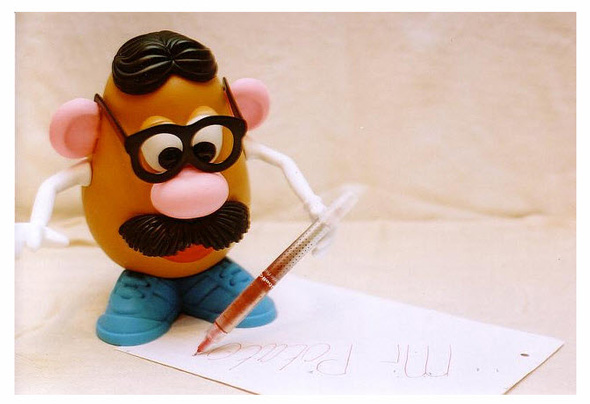
(Photo: Me circa 1987, just thinking about my future PA School Essay)
- Are you struggling to write your physician assistant personal statement?
- Are you out of ideas, or just need a second opinion?
- Do you want an essay that expresses who you truly are and grabs the reader's attention in the required 5,000-character limit?
We are here to help perfect your PA school essay
I have written countless times on this blog about the importance of your personal statement in the PA school application process. Beyond the well-established metrics (GPA, HCE/PCE hours, requisite coursework, etc.), the personal statement is the most crucial aspect of your application.
This is your time to express yourself, show your creativity, skills, and background, and make a memorable impression in seconds. This will be your only chance, so you must get it right the first time.
For some time, I had been dreaming about starting a physician assistant personal statement collaborative.
A place where PA school applicants like yourself can post their PA school essays and receive honest, constructive feedback followed by an acceptance letter to the PA school of your choice!
I have been reviewing a ton of essays recently, so many in fact that I can no longer do this on my own.
To solve this problem, I have assembled a team of professional writers, editors, and PA school admissions specialists who worked to revise and perfect my PA school application essay.
 Beth Eakman has taught college writing and worked as a professional writer and editor since the late 1990s. Her projects have involved a wide range of disciplines and media, from editing scientific research and technical reports to scriptwriting for television. Her writing has appeared in academic, professional, and popular publications. Beth lives with her family just outside Austin, Texas. She enjoys the unique opportunity that The PA Life offers to combine her training as a writer and editor with her experience teaching in order to support PAs and aspiring PAs in achieving their professional goals.
 Carly Hallman is a professional writer and editor with a B.A. in English Writing and Rhetoric (summa cum laude) from St. Edward's University in Austin, Texas. She has worked as a curriculum developer, English teacher, and study abroad coordinator in Beijing, China, where she moved in 2011. In college, she was a Gilman Scholar and worked as a staff editor for her university's academic journal. Her first novel, Year of the Goose, was published in 2015, and her first memoir is forthcoming from Little A Books. Her essays and creative writing have appeared in The L.A. Review of Books, The Guardian, LitHub, and Identity Theory, among other publications.
Read more client testimonials or purchase a revision
We Work as a Team
Our team of professional editors is wonderful at cutting out the "fluff" that makes an essay lose focus and sets people over the 5,000-character limit. Their advice is always spot-on.
Sue, Sarah, and Carly are amazingly creative writers who will take your "ordinary" and turn it into entirely extraordinary.
I mean it when I say this service is one-of-a-kind! We have spent countless hours interviewing PA School admissions directors and faculty from across the country to find out exactly what it is they are looking for in your personal statement.
We even wrote a book about it.
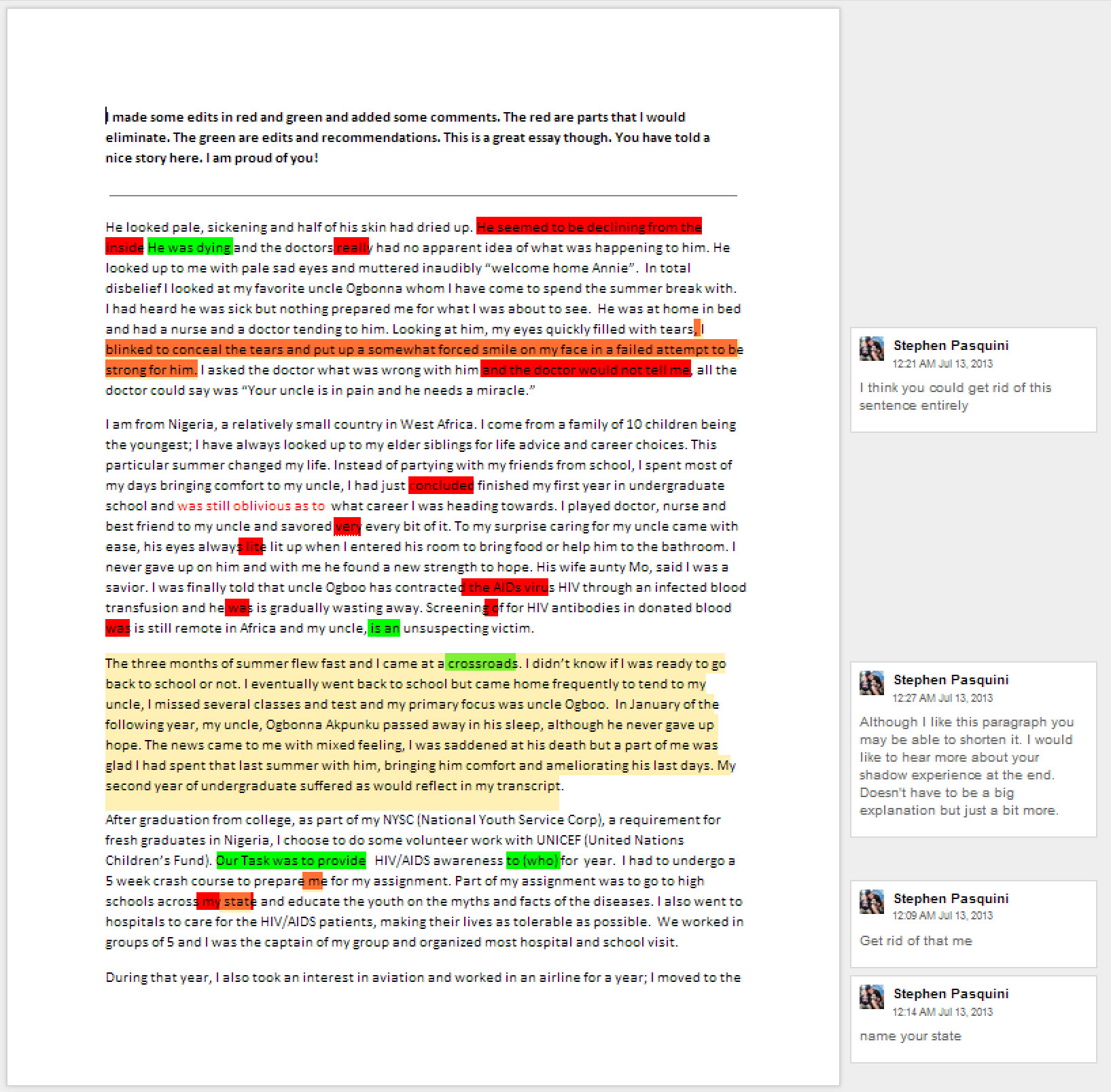 To collaborate, we use Google Drive. Google Drive is free, has an intuitive interface with integrated live comments in the sidebar, the ability to have a real-time chat, to collaborate effortlessly, and to compare, revise, or restore revisions on the fly. Google Drive also has an excellent mobile app that will allow you to make edits on the go!
Our team has worked with hundreds of PA school applicants within the Google Drive environment, and we have had enormous success.
The Physician Assistant Essay and Personal Statement Collaborative
I have set up two options that I hope will offer everyone a chance to participate:
- One-of-a-kind, confidential, paid personal statement review service
- A collaborative, free one (in the comments section)
Private, One-On-One Personal Statement Review Service
If you are interested in the paid service, you may choose your plan below.
The Personal Statement Review Service is:
- Behind closed doors within a private, secure network using Google Drive.
- It is completely interactive, meaning we will be able to provide real-time comments and corrections using the Google Drive interface.
- Telephone consultations are included with all edits above the single edit level. It’s often hard to communicate exactly what you want hundreds of miles away; for this reason, we offer the option to edit right along with us over the telephone while sharing in real-time over Google Drive. This is an option available to all our paid clients who purchase above the single edit level.
- We provide both revision and editing of all essays. What’s the difference? See below
- We will provide feedback, advice, and help with brainstorming and topic creation if you would like.
- We will help with a “final touch-up” before the big day, just in case your essay needs a few minor changes.

Why Choose Our Service?
- It’s not our opinion that matters. We have gone the extra step and personally interviewed PA school administrators from across the US to find out exactly what they think makes a personal statement exceptional.
- We are a team of PAs and professional writers, having worked over ten years with PA school applicants like yourself, providing countless hours of one-on-one editing and revision.
- Our clients receive interviews, and many go on to receive acceptance into their PA School of choice.
Because we always give 100%, we will open the essay collaborative for a limited number of applicants each month and then close this depending on the amount of editing that needs to be done and the time that is available.
Our goal is not quantity but quality. We want only serious applicants who are serious about getting into PA school.
Writing is not a tool like a piece of software but more like how a photograph can capture your mood. It’s more like art. The process of developing a unique, memorable personal statement is time-intensive, and it takes hours to compose, edit, finalize, and personalize an essay.
As Antoinette Bosco once said:
And this is why I am charging for this service. We love helping people find stories that define their lives, and we love helping individuals who have the passion to achieve their dreams. It’s hard to describe the feeling I get when an applicant writes back to tell me they were accepted into PA school.
There is no price tag I can place on this; it’s the feeling we get when we help another human being. It’s just like providing health care. But this takes time.
Interested? Choose your plan below.
Read more client testimonials.
Free Personal Statement Review
Post your essay in the comments section for a free critique
We want to make this opportunity available to everyone who would like help with their essay, and that is why we are offering free, limited feedback on the blog.
You post your essay in the comments section, and you will get our critique. It is that easy. We will try to give feedback to every single person who posts their COMPLETE essay here in the comments section of this blog post.
Also, by posting your comment, we reserve the right to use your essay.
We will provide feedback on essays that are complete and fit the CASPA requirements (View CASPA requirements here). We will not provide feedback on partial essays or review opening or closing statements. Your essay will be on a public platform, which has both its benefits and some obvious drawbacks. The feedback is limited, but we will try to help in any way we can.
Note: Comment Rules: Remember what Fonzie was like? Cool. That’s how we’re gonna be — cool. Critical is fine, but if you’re rude, I will delete your stuff. Otherwise, have fun, and thanks for adding to the conversation! And this should go without saying: if you feel the need to plagiarize someone else’s content, you do not deserve to go to PA school.
* Also, depending on the time of year, it may take me several weeks to reply!
We love working with PA school applicants, but don't just take our word for it!
How to submit your essay for the paid service
If you are serious and would like to have real, focused, and personalized help writing your personal statement, please choose your level of service and submit your payment below.
After you have submitted your payment, you will be redirected to the submissions page, where you can send us your essay as well as any special instructions. We will contact you immediately upon receipt of your payment and essay so we may begin work right away.
Pricing is as follows:
Choose your plan, then click "Buy Now" to submit your essay, and we will get started right away!
Every purchase includes a FREE digital copy of our new 100-page eBook, How to Write Your Physician Assistant Personal Statement, Our 101 PA School Admission Essays e-book, the expert panel audiobook, and companion workbook. This is a $65 value included for free with your purchase.
All credit card payments are processed via PayPal over a secure HTTPS server. Once your payment is processed, you will be immediately redirected back to the essay submission page. There, you will submit your essay along with some biographical info and all suggestions or comments you choose to provide. You will receive immediate confirmation that your essay has been securely transmitted as well as your personal copy of "How to Write Your Physician Assistant Personal Statement." Contact [email protected] if you have any questions, comments, or problems - I am available 24/7.
The hourly service includes your original edit and one-on-one time over Google Drive. It is simple to add more time if necessary, but you may be surprised at what a difference just a single edit can make. We find our four-hour service to be the most effective in terms of time for follow-up and full collaboration. We are open to reduced-rate add-ons to suit your individual needs.
Writing and Revision
All writing benefits from rewriting when done well.
When you are in the process of writing a draft of an essay, you should be thinking first about revision, not editing.
What’s the difference?
Revision refers to the substantial changing of text. For example, it may include re-organizing ideas and paragraphs, providing additional examples or information, and rewriting a conclusion for clarity.
Editing, on the other hand, refers to correcting mistakes in spelling, grammar, and punctuation.
We perform both revision and editing on all submissions.
How to submit your PA school essay for the FREE editing service
Follow the rules above and get to work below in the comments section. I look forward to reading all your essay submissions.
– Stephen Pasquini PA-C
View all posts in this series
- How to Write the Perfect Physician Assistant School Application Essay
- The Physician Assistant Essay and Personal Statement Collaborative
- Do You Recognize These 7 Common Mistakes in Your Personal Statement?
- 7 Essays in 7 Days: PA Personal Statement Workshop: Essay 1, “A PA Changed My Life”
- PA Personal Statement Workshop: Essay 2, “I Want to Move Towards the Forefront of Patient Care”
- PA Personal Statement Workshop: Essay 3, “She Smiled, Said “Gracias!” and Gave me a Big Hug”
- PA Personal Statement Workshop: Essay 4, “I Have Gained so Much Experience by Working With Patients”
- PA Personal Statement Workshop: Essay 5, “Then Reach, my Son, and Lift Your People up With You”
- PA Personal Statement Workshop: Essay 6, “That First Day in Surgery was the First Day of the Rest of my Life”
- PA Personal Statement Workshop: Essay 7, “I Want to Take People From Dying to Living, I Want to Get Them Down From the Cliff.”
- Physician Assistant Personal Statement Workshop: “To say I was an accident-prone child is an understatement”
- 9 Simple Steps to Avoid Silly Spelling and Grammar Goofs in Your PA School Personel Statement
- 5 Tips to Get you Started on Your Personal Essay (and why you should do it now)
- How to Write Your Physician Assistant Personal Statement The Book!
- How to Write “Physician Assistant” The Definitive PA Grammar Guide
- 101 PA School Admissions Essays: The Book!
- 5 Things I’ve Learned Going Into My Fourth Physician Assistant Application Cycle
- 7 Tips for Addressing Shortcomings in Your PA School Personal Statement
- The #1 Mistake PRE-PAs Make on Their Personal Statement
- The Ultimate PA School Personal Statement Starter Kit
- The Ultimate Guide to CASPA Character and Space Limits
- 10 Questions Every PA School Personal Statement Must Answer
- 5 PA School Essays That Got These Pre-PAs Accepted Into PA School
- 7 Questions to Ask Yourself While Writing Your PA School Personal Statement
- 101 PA School Applicants Answer: What’s Your Greatest Strength?
- 12 Secrets to Writing an Irresistible PA School Personal Statement
- 7 Rules You Must Follow While Writing Your PA School Essay
- You Have 625 Words and 2.5 Minutes to Get Into PA School: Use Them Wisely
- What’s Your #1 Personal Statement Struggle?
- 31 (NEW) CASPA PA School Personal Statement Examples
- How to Prepare for Your PA School Interview Day Essay
- Should You Write Physician Associate or Physician Assistant on Your PA School Essay?
- Meet the World’s Sexiest PA School Applicants
- PA School Reapplicants: How to Rewrite Your PA School Essay for Guaranteed Success
- How to Write a Personal Statement Intro that Readers Want to Read
- PA School Reapplicant Personal Statement Checklist
- How to Deal with Bad News in Your Personal Statement
- Inside Out: How to use Pixar’s Rules of Storytelling to Improve your PA Personal Statement
- Ratatouille: A Pixar Recipe for PA School Personal Statement Success
- Personal Statement Panel Review (Replay)
- Mind Mapping: A Tool for Personal Statements, Supplemental Essays, and Interviews
- Start at the End: Advice for your PA School Personal Statement
- Elevate Your Personal Statement: Using Bloom’s Taxonomy for Impactful Writing
- How to Write a Captivating Hook for Your PA School Personal Statement
- 3 Surprising Truths About the New CASPA Life Experiences Essay (And Why You Can’t Ignore It)
- 3 PA School Personal Statement Mistakes Our Editor Sees Again and Again
You may also like
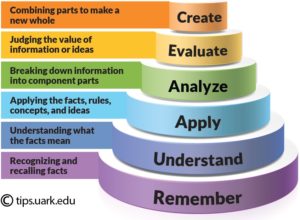
 Elevate Your Personal Statement: Using Bloom’s Taxonomy for Impactful WritingThe most common advice writers often give pre-PAs is to "show, don't tell" in your essays. (Though we like to encourage showing …
 Who Gets Into PA School in 2026? Here’s What You Need to KnowLeslie Mean is a 23-year-old single white female who presents to the PA school admissions committee on her second attempt to get …
 Start at the End: Advice for your PA School Personal StatementNot sure what to include in your personal statement? Start at the End! The conclusion should summarize your entire essay. Consider the …


CASPA Personal Statement Help
 We offer comprehensive, start-to-finish personal statement assistance or help to perfect a draft you already have. We have services to fit every budget.
 Schedule a Live Recorded PA School Video Interview

We offer 60-minute mock PA school interviews with post-interview feedback and advice. Includes a recorded video of your interview that you can watch, download, or share with family and friends. There is no better way to prepare!
Schedule an InterviewPre-PA Consulting and Advising
 Our pre-PA coaching service consists of a 1-hour phone consultation focused on addressing your specific questions or concerns about becoming a PA and applying to PA school.


Pain comes in all forms. The small ache, a bit of soreness, the random pain, and the normal pain we live with everyday. Then there’s the kind of pain you can’t ignore. A level of pain so great that it blocks everything out; makes the rest of your world fade away until all we can think about is how much we hurt.
This is the kind of pain that I saw in a young girl named Kristina. She trusted me enough to share her thoughts and her story with me. The thoughts in Kristina’s head were “all I want to do is die, there’s nothing to live for anymore”, her bipolar disorder had consumed her thought process with words that no human being deserves. But she came to me. I had been working as a Psychiatric assistant for 6 months at a residential treatment center, and I had no idea the experience would change my life. I looked forward to every shift so I could talk to her and make her laugh, and maybe just for a minute give her mind a break from the daunting negative thoughts that controlled her. Not every day was good though. I remember on one particular day we were outside walking around the playground when Kristina spotted a piece of sharp metal laying on the ground. Kristina picked up the metal without hesitation, “I miss the feeling of having a razor in my hand, it’s the only thing that really puts me at ease” she said. I allowed her to hold the metal in her hand while I talked to her about all the hard work she’s done and the positive things in her life. Emotions were running high, she broke down crying, handed me back the sharp metal piece, and said “I really want to change; I think I’m ready to finally accept treatment”.
She became especially fond of me after that day, because she said I reminded her of her big sister and that she could trust me with anything. Kristina continued to struggle with treatment and her controlling thoughts everyday and unfortunately after several baker acts she had to be sent to a different facility that could hopefully change her life for good.
The thing that really changed my life was the letter I received from her a couple of months later. Kristina thanked me for all that I had done for her and for supporting her throughout treatment no matter how difficult she had been. She wrote that she was in a much better place emotionally, and that filled me with overwhelming joy. I thought this is what I want to do for the rest of my life. In honor of Kristina and the countless number of patients that I’ve been able to help after her, I have been able to find a joy in my life like never before. I have been directly involved in healthcare for four years, and every experience has brought me great satisfaction. To be a part of a person’s day is a wonderful blessing. Certainly, there are many pleasures in life. But, for me none is greater than that which we find in the healing touch of another.
-Thank you so much!
Hi Davis,
Your essay shows you have great heart. But unfortunately, it doesn’t show much else. The essay sounds like you’re wonderful at your job and love it. In fact, you actually write, “I thought this is what I want to do for the rest of my life.” (By the way, cut that line). So why apply to PA school?
You haven’t said one word about that, and this is the essay that will teach Admissions Directors and faculty about you. They’ll be happy you’re a kind person who loves helping patients. That’s not enough to make them want to interview you. They’ll want to know why you’ve chosen the PA profession. What traits you have that will make you a good PA and what about the profession appeals to you.
If you haven’t shadowed or worked with PAs, do so. If you have, write about those experiences and why the profession is one that suits you and vice-versa. You could easily shorten your writing about Kristina to one paragraph and move on to more relevant topics.
I’d do some line editing if I knew what you were adding, but since I don’t know anything more about you, I don’t think that will be helpful.
Best of luck.
Sue Edmondson
http://www.thepalife
She lay there still, lifeless as the priest delivered her Last Rights. Cancer had invaded her body, and her prognosis was grim. Her loved ones had gathered and anticipated goodbye. But then, miraculously, her health started improving. Each day brought her closer to a normal life, void of tumors. Her health care team defeated the odds and successfully cured her of cancer by utilizing aggressive treatments. I spent countless days next to her in her hospital bed, attempting to comfort her through the pain. We were not only cousins, but also dear friends.
Although I was young and unable to fully understand the circumstances at the time, nearly losing Allie had a profound effect on my life. I have her health care providers to thank for many of my favorite memories. Because of them, I have been able to watch Allie grow into the incredible young woman she is today. Because of them, I have had her companionship for the past 21 years. Because of them, I want to help families like mine.
Allie’s cancer inspired me to dedicate my life to helping those in need. Along with participating in Relay for Life annually, I joined Dance Marathon, a fundraising organization for Children’s Miracle Network. Through this organization, I witnessed miracles. I watched a child with severe hydrocephalus run and dance despite doctors predicting she would never walk. I played hide and seek and laser tag with a girl who has endured numerous heart surgeries in her short five years of life. Seeing these children so full of life despite their prognoses encouraged me to pursue a health care career.
In addition to participating in Dance Marathon, I started volunteering at the University of Minnesota Children’s Hospital, where I became witness to more miracles. A premature infant, weighing just three pounds at birth, required constant attention. Her days were filled with uncertainties, and while her parents were at work, she would scream continuously. I spent hours holding her and relaxing her until she was discharged from the hospital after a grueling six-month stay. Comforting children like her through social interaction and watching their health improve until they are able to go home has fueled my fervor for health care. Every time I walk into the hospital to volunteer, I feel a rushing sense of belonging. I want to give new life to patients and their loved ones; I want to care for people during their darkest days and lead them to a future free from ailment. Each patient I have encountered has further solidified this decision.
I chose to follow this yearning to care for patients by working as a Certified Nursing Assistant. This is where I met Esther, an elderly woman on hospice care. Esther remains positive regardless of her diagnosis. She is selfless and caring, always asking about my day before I have the opportunity to ask about hers. Each time I enter Esther’s room, she reaches out her hand, longing for companionship. I spend twenty minutes each night tucking her into her bed, applying lotion to her hands, and asking about her life. I have discovered that she is a devoted mother of six children and a former Navy nurse. Caring for Esther in her last months of life has been an incredibly rewarding experience. I have learned the importance of being an emotionally-supportive caregiver. Additionally, I have been further inspired to become a health care professional.
While confident in my decision to pursue a health care career, I was formerly unsure which profession was right for me. Thus, I started researching careers and seeking advice from health care providers I was acquainted with. I shadowed a Dosimetrist, a Clinical Lab Scientist, and a Registered Nurse. Though all intriguing, none of these occupations seemed to provide what I was looking for.
Accustomed to being a student leader, I was in pursuit of a career that promoted leadership. I wanted to share my compassion with patients of all ages and prescribe treatments to improve their overall well-being. After shadowing a Physician Assistant (PA), I knew I had found the right occupation for me. Kristine Gehrmann interacted with each of her patients with empathy and understanding. She genuinely cared about their emotional, spiritual, and physical well-being, and she displayed compassion unmatched by other clinician types; I have found this to be true, too, of other PAs I have met. Physician Assistants are outstanding leaders and considerate, devoted caregivers. With physicians as their mentors, they work as part of a team to reach goals and save lives. I found the career I had been searching for.
Leaving the clinic after shadowing Kristine, I encountered the same feeling of belonging I experience when I volunteer. I am confident in my decision to become a PA, and I am excited for a future dedicated to improving the lives of ailing individuals. I look forward to giving families more time with their loved ones, just as Allie’s health care team did for my family.
Hi Emily,
I can tell you’ve spent a lot of time on your essay. I really like the opening and how you tied the conclusion to the it. Good job. It’s fairly polished with one big exception. Never capitalize physician assistant unless it’s in a name.
You could definitely cut much of the Dance Marathon and volunteer work at the Children’s Hospital info. The message is much the same and you don’t need to go into so much detail. Just because you have 5,000 characters and spaces doesn’t mean you need to use them all.
If you do want to add more, use the space to add details about your shadowing experience with the PA. Perhaps pick a specific patient to use as an example of things that you appreciate about the profession and why you’re well suited to it.
Best of luck.
Sue Edmondson
http://www.thepalife.com
Any advice, as specific as possible, would be of so much help!! Feel free to be extremely critical.
It has always been a joke in my family that I am a bit of a hypochondriac. With the onset of any abnormal symptom, I begin researching, intrigued by every new medical fact I come across, until I feel confident that I have solved my medical mystery. I ask myself, “what could this symptom mean?” and “what can I do to feel myself again?” The process is always the same. First I turn to Google for the more general responses. After narrowing down the potentials, I try to find the one that explains the majority of my symptoms and delve deeper into more realiable diagnostic research. Once I’m satisfied that I’ve found my answer, I explain to whomever is interested that I am either dying of some rare disease, or more likely I am suffering from some commonplace illness. Usually I get mocked, but even more often my diagnoses are actually correct. Friends and family members have started turning to me as their personal sleuth for medical advice, while simultaneously teasing me for the occasional obscure diagnosis. Whether they do this to get a kick out of my dedicated detective work, or to prepare me for my future as a physician assistant (PA) I do not know, but their encouragement instills me with confidence.
I have always had a passion for medicine, but more specifically for improving the quality of people’s lives in a one-on-one way. All the work that I have done thus far in my life has always been about serving people. Though waitressing has been my longest job to date and isn’t medically related I’ve never found the work meaningless. It reinforced what I already knew about myself—that I love interacting with a diverse variety of people from all walks of life. Having already had a background in customer service, I found it pleasantly surprising that being a patient care coordinator in a dermatology office was not so different than being a server in a restaurant. Each day I greet patients with a smile, ask them about their wellbeing, and then provide them with focused attention and quality care. Every patient I take into the examination room becomes my responsibility and my duty to tend to whether I am bandaging a post-surgical wound, clotting blood after a biopsy, or taking out sutures. The only difference is that I know when patients leave the office I didn’t simply serve them a meal, I had a role in improving whatever ailment drove them to seek medical care. There is nothing more rewarding than the feeling of helping another person.
I didn’t always know I wanted to be a PA, but some time during my junior year of college I went to an informational session about the career that made it sound like such a perfect fit for me that I had to learn more about it. The ability to transition from one specialty to another without years of additional training appealed to me most. Though I am currently interested in general surgery, I’m also passionate about pediatrics and value the ability to seamlessly transition from one to the other. Since I personally see a PA, and am familiar with the role of a family practice PA, I decided to shadow a pediatric PA. She taught me some of the most ingenious tricks to get her restless, non-verbal patients cooperating. My favorite was when she would have the toddlers run up and down the hall so that she could appropriately evaluate their heart and lung function. I was in awe of her creativity and her ability to diagnose even the most non-compliant of children.
In addition to what I learned from shadowing, my admiration for PAs also stems from a personal experience. It was a PA who ultimately saved my father’s life. He went to her with a bad cough, but with his history of smoking for over 20 years she decided to err on the side of caution and sent him for a chest x-ray. That’s when they found the lesion in his lung. Because of her, he had a lobectomy that removed the stage 1A cancer that was growing inside him. She was able to catch what his physician did not based off such an insignificant symptom because she had the time to truly get to know him and remembered his history. I aspire to be a PA whose patients can say the same thing about me.
As a physician assistant, my focus would always be on the patient. I hope to catch the little details that could end up being life saving. My goal as a provider would not be to see the most patients, or produce the most profit for the company, but to dedicate myself to providing patients with the best possible care, and when appropriate, knowing when to transfer that care to someone with more expertise than myself.
Hi,
Your essay really picks up after the first paragraph. Frankly, it won’t impress anyone in the medical profession that you use the Internet to diagnose illnesses or that you’re a bit of a hypochondriac. Some things are better left unsaid and those are two of them.
You could easily start your essay with the second paragraph. You could add more details about why the PA profession appeals to you. The ability to transition to other areas of specialty is not a particularly compelling reason to be a PA. There are so many more substantive aspects of the job that you could write about.
I hope this helps.
There was a compute glitch and I didn’t get to finish my post. I’m concerned about your conclusion. It just drops off. Actually, I’d delete most of it: As a physician assistant, my focus would always be on the patient, catching the little details that could end up being life saving. My goal as a provider would be to dedicate myself to providing patients with the best possible care.
If you want to add more, tie it back into your experiences.
Best of luck.
Sue Edmondson
http://www.thepalife.com
Like everyone else: Thank you!!! I’m feeling stuck and just feel like I need some direction for this essay. I look forward to everyone’s comments.
Life is made of checklists. Even before birth we are closely monitored to ensure that our bodies are developing according to the established milestones for health and development. Once we start school, more checklists of homework, projects, health, physical and character milestones must be reached before we can enter into society. Go to college, have a career, get married, have kids, be nice to others. Checklists are rewarding. There is nothing more satisfying than crossing something off a to-do list and having tangible evidence of being a productive member of society that day. Unfortunately this mentality can cause us to miss the most important moments in life. I thought healthcare was about a means to an end but have discovered that it is really about changing people’s lives.
I had only been on the job for about three weeks and it was one of my first solo days on the floor. I sat in my office and uncontrollably sobbed to my boss on the other end of the line. “I’m just so tired and we’re leaving for our trip in two hours, I don’t know if I can screen another baby” All I could think about was my checklist for the day and how uncomfortable and inexperienced I was. Seven babies, their parents exhausted from a night of no sleep and adrenaline pumping through their blood from the day before. Having already been in the parent’s room once that morning with an unsuccessful outcome, fear flooded my system not wanting to inconvenience them. “Take deep breaths” Christina soothed, “leave the last one for tomorrow, they won’t go home anyway. But you will need to screen one more before you go, you can do it, call me with any more questions.” Putting the phone away, wiping the tears from my eyes and collecting all the courage and composure I could muster, I went back on the floor to get the job done.
Fast-forward a year to April 2015 to a Neonatal Intensive Care Unit suite. Mom and Dad had finished feeding Baby and were watching the mandatory video all parents must see before the screen begins. If all went well, Baby would finally go home, a brand new start for this family. The sensors started reading, the computer analyzed and I looked at the tiny human being cradled by Dad. Glancing up at the monitor it was clear that the baby would do well and my heart jumped at the thought of sending this family home with good news. I wondered if there were siblings at home to welcome Baby and what the future holds. Glancing at my own growing belly and wondering what our birth story would be like, I wheeled the equipment out of the room with a final “Congratulations!”
What I didn’t know at the beginning of this long process of science classes, volunteering, new jobs and challenges was that book knowledge or shadowing experience are only a piece of the health care puzzle. Health care is not something you can check off your daily to-do list. In order for medicine to really be a part of health care, we must use our knowledge to touch the lives of human beings; to make a family whole after seeing their world fall apart. Although science and technology continue to advance, it is the human touch combined with masterful application of the science and technology that facilitate healing. Often, the hand of compassion is what encourages and gives confidence to the ill to own their healing process. That is why I will be a dedicated Physician’s Assistant.
Hi Maren,
i was very engaged by the opening of your essay. Great theme and one I haven’t seen before. But the second paragraph didn’t really hit the mark. For one, I don’t know how long ago this took place. More importantly, it didn’t really show me much positive about you. I don’t think you want to give the impression that when you’re first starting a challenging new position that you dissolve in tears. I know that wasn’t your intent, but that’s what’s on the page. The fast forward paragraph didn’t solve the problem. The conclusion though, is good.
What’s completely missing from your essay is why you want to be a PA. It sounds from reading it that you love your job and are good at it. The Admissions folks that are reading the essay will want to know what made you decide to become a PA.
Have you shadowed any? Worked with them? Write about those experiences. Write about the things that are different from the profession you’re currently in that you feel would be more suited to your interests, personality and skills.
I hope this helps.
Best of luck.
Sue Edmondson
http://www.thepalife
First try here….Let’s see how this goes…
Less than 3 minutes left on the score board. Ball is just inside the 30 yard line. Quarterback takes the snap and throws a pass and gets blindsided by the linebacker. As I watch intently from the sideline, the quarterback lays lifeless on the turf and the referee blows the whistle. I run quickly out to the player on the field. He is alert but is obviously disoriented and is complaining of tinnitus and headache. The referee informs me the quarterback did lose consciousness briefly after the hit. After ruling out any other injuries I escort the player to the sideline treatment table. I took his helmet away and placed it with my medical kit behind the bench. I continue my sideline concussion evaluation. The player is in stable condition but he obviously cannot return to the field after suffering this injury. I turn slightly to motion to his dad in the bleachers to come down to the field and before I knew it my head coach had grabbed the quarterback and given him his helmet and pushed him back on the field and said “Go get’em.” I tried to stop the game but the referees could not stop the game. I tried yelling at my head coach saying “He has a concussion and cannot play.” The head coach just smiled, shrugged his shoulders and ran away. That was the point that I knew that PA school was definitely in my future. This was the moment solidified that my “desire for more” was definitely worth listening to.
I had always had a desire to go to PA school but I had a stable job as a Head Athletic Trainer and Adjunct Professor in the collegiate setting. In total, I spent seven years in college athletics and I enjoyed working with athletes thoroughly. I have had so many great experiences ranging from managing open fractures on the field to observing ACL reconstructions in the operating room to rehabbing athletes back to full participation from a devastating injury. These experiences made me a great Athletic Trainer and I looked forward to each and every day because I never knew what type of injury, illness or problem I would face. However, the “business of athletic s” often took healthcare decisions out of my hands many times which put my athletes at risk not to mention my professional liability.
That school year, 2011-2012, was my last year in the collegiate setting. Since that time, I have been working as an athletic trainer in what is called a physician extender role with a Primary Care Sports Medicine Physician. I have thoroughly enjoyed this experience. It has deepened my desire for “more.” I spend a great deal of time evaluating injuries, documenting in EMR, administering balance and concussion testing, educating patients, casting and splinting factures, assisting in procedures in the office, communicating with school athletic trainers and a myriad of other tasks. Many people may say that I have found my dream job at my current setting, but I say I have found a catapult into my next level.
I plan to become a physician assistant, specializing in the area that I see fit as I go through my clinical rotations. Although I have a strong sports medicine and orthopedic background, I have found other specialties to be of interest as I have worked in primary care. I want to become a Physician Assistant so that I can continue to do what I love which is interacting with people, guiding and helping them. Just as I am a great Athletic Trainer I will be a phenomenal Physician Assistant because I have a great ability to connect with people and understand them in a way a healthcare provider needs to. I truly believe this is the right time in my life to pursue PA school. I may be older than the average PA student but I the experiences I have had are priceless and will only be of advantage to me as pursue my dream career.
Hi Bobbie,
You have some really great experience, which gives you a big head start on your application. It gives you a great opening for your essay, too, until I got to the “lifeless” quarterback and found out he was alive. So just say “appeared lifeless” or “seemed lifeless.”
That’s a minor point, though. The biggest problem is that you spend half your essay talking about a career or working in a ;ace where your opinion wasn’t valued enough to follow your advice. At least that’s the way it’s written. It leaves a negative impression.
The point you want to make about being Head Athletic Trainer is the great experience you got. So skip all the details, meaning cut most of that first and second paragraph. You can conclude that section with the sentence starting, However, the business of athletics . . . The whole section on that part of your career should be about three to four sentences max. Don’t conclude it with wanting to be a PA. You need to lay the groundwork first.
You say you always wanted to be a PA, but never say why. You say you wanted to do “more” (by the way, don’t put that or “the business of athletics” in quotes), but that’s essentially meaningless the way the essay is written.
After the second paragraph where you talk about your work as a physician extender, then you can say you want to be a PA. But you need to be specific. How did you come to this decision? What is it about the profession that appeals to you? Have you shadowed a PA or worked with one? If so, you can talk about those experiences and relate them to why you decided to apply to PA school.
Hope this helps.
Best of luck.
Sue Edmondson
http://www.thepalife.com
Hello, My name is Sumaiya and I am a recent college grad applying to PA schools this summer. Can you give me some feedback on this draft? Any help will be greatly appreciated. Thank you!
Anxiously I approached a young pregnant woman dressed in traditional African attire, humming a soft lullaby to her sleeping son. Despite her tired eyes, her inviting smile somewhat eased my tension, as it was my first day as a patient advocate for Harlem Hospital OB/GYN clinic. I introduced myself and told her about our program. She concentrated on the flier for a few minutes before finally asking “what food?” I quickly realized she was unclear of what I just said, so I slowly and thoroughly explained how I can connect her to government subsidized benefits, food assistance, affordable healthcare options, or childcare resources for her son. After a few seconds, she finally leaned in closer told me that sometimes she worries she may not have enough money to provide a proper meal for her children.
I was in awe of the struggles she was already facing, considering she was only a few years older than me and already expecting a second child. We completed an assessment and I immediately got to work. My first priority was to connect her to the Supplemental Nutrition Assistance Program and the Women Infants and Children program, which provide financial assistance to low income families.Through weekly follow up calls and occasional visits, we made progress in navigating the application process. In the mean time, I gave her a listing of all the food pantries near her home, and informed her of the Early Head Start and Head Start child care programs for her son. Since she was unemployed, I also informed her about employment agencies that catered to non citizens and people who had little to no education. I worked diligently to help her every way possible. The day she successfully enrolled in the SNAP program, she was very grateful and she called me.“Thank you so much Sumaiya, I will call you if I need anything”, she said. That was the last time I spoke to her, but the first time I knew that I wanted to continue to make such a difference for the rest of my life.
Through additional volunteer experiences in medical offices and hospitals, I gained insight into how health care professionals diagnose, treat, and prevent ailments of patients to ultimately promote a healthy life.The process of analyzing symptoms and administering treatment fascinated me, because it encompassed attention to a wide range of factors affecting the health of a patient. I observed Nurse Practitioners, Physicians, and Physician Assistants as they delivered patient care, and the role of a Physician Assistant appealed to me the most. There were two main reasons why I chose the PA route. First, I knew I wanted a career which followed the medical model; I wanted to be involved in determining the specific malfunction of the body and treating it. Second, I wanted the flexibility of exploring different specialties. If I work in Pediatrics for a few years and became interested in gynecology, I know I would have the ability to pursue that specialty seamlessly.
I further gravitated towards this career path, since the role of a PA resonated with my role as a patient advocate. As a patient advocate, I was able to discern other confounding factors that also played a role in the overall well being of a patient. For instance, the financial stresses of a patient causing repeated visits to the doctor for complications due to high blood pressure, or the lack of proper knowledge and access to healthy eating habits adding on to complications with diabetes. As I occasionally shadowed a PA in the OB/GYN clinic, he educated me on the prevalence of alcohol abuse amongst pregnant mothers, which made their unborn children susceptible to a plethora of physical and mental disorders. I screened patients and connected them with the resources they needed, whether it was affordable health care, self help programs, or food assistance programs to promote healthy eating. I also worked with my associate advocates and program managers every week to discuss issues with health disparities and ways we can further help our clients using the resources available to us in our city.
Up until that point in my life, I felt like I was living with my eyes closed. As I worked with the women of the OB/GYN clinic, I became more aware of the living conditions of the people of my city, and how multifaceted health care is. I opened my eyes to see that I was living in a city where people worried that they would lose their home because they could not afford rent, and teenage mothers struggled to provide their children with a proper upbringing. Working on these cases further instilled in me the importance of becoming a health care provider sensitive to the hurdles many patients experience living in underserved communities. To know I made even just a small difference to improve patient’s lives as a Patient Advocate impacted me greatly. But more importantly I know I do not want to stop there. As a PA, I wish to provide my patients with optimal medical care and the knowledge they need to lead a healthy life.
Hi Sumaiya,
You’ve done a lot for being a recent college grad. Congrats on that. You’ve gained great experience working with people living in poverty, and have great empathy for those who struggle. That will serve you well as a PA.
Before I forget, none of the following words are capitalized — Nurse Practitioners, Physicians, and Physician Assistants. You especially don’t want to capitalize physician assistant. It’s an instant red flag.
I’d omit the part about how being a PA gives you flexibility. Certainly there’s another aspect of being a PA that equally appeals, something that’s more substantial.
You could expand more on your experiences shadowing the PA and less about being a Patient Advocate. I’m not even sure from reading your essay why a career is medicine is for you. That’s an important point. I was thinking the essay could be written for admission to a master’s program in public health. Even though you’re fresh out of college, you have to make a case for yourself why you’d a good candidate for PA school. Healthcare, not social work is the foundation for the profession.
If you spend more time establishing the things I’ve talked about, you’ll have an excellent essay.
Best of luck.
Sue Edmondson
http://www.thepalife.com
Thanks for the awesome resource! This is my essay from last year’s cycle in which I was not accepted. I am looking to where I can better my essay.
“Jim, you need to settle down!” exclaimed the psychiatrist to the patient. Jim was suffering from Lewy Body Dementia. The first time I met Jim, he was delusional and unable to carry on a conversation. He was constantly trying to take his clothes off and throwing his food. The next week, when I returned to the Behavioral Health Unit (BHU), I was greeted by Jim with a huge smile on his face, sitting quietly in a recliner. Jim seemed like a different person. I met with the psychiatrists who worked with Jim numerous times throughout that summer. They taught me how they assess, diagnose, and treat patients like Jim to help them achieve lifelong wellbeing, a sense of normalcy, and freedom from their disease. The influence the psychiatrists from the BHU had on their patients was remarkable. Their patients were all in the end stage of their long lives, but the compassionate psychiatrists were able to help comfort their patients and the patients’ families. It was this experience that inspired my desire to pursue a career as a Physician’s Assistant. I want to provide support for those struggling with their health in unfortunate and unexpected situations.
Growing up in a small rural Minnesota community, life was simple, but I always wanted more in life. I left for college to broaden my perspectives. My first year at St. Thomas, I struggled being away from family and friends. I called my parents each night begging them to let me come home. My fear got the best of me, and my grades and potential friendships suffered. The next summer, I took an internship at Lakewood Health System. While working there, I was able to gain confidence and determination. I recognized my need to conquer fear. My time was spent in the nursing home and BHU visiting with residents, and shadowing providers. While observing the provider’s interactions with patients, it was clear that health care requires a deep level of commitment and compassion for others. It was that same level of commitment and compassion I experienced growing up in a small rural community where relationships and individuals were valued. The relationships the providers built with their patients reaffirmed my desire to pursue a career in health care.
The next three years of college, I was determined to not let fear and my freshman year struggles impact my career aspirations so I created new challenges for myself. I established friendships and my grades soared. My junior year, I traveled half way around the world to study abroad in New Zealand. My time abroad gave me the passion to have, not only a well-rounded education, but a well-rounded perspective on life. I took non-traditional courses such as New Zealand Christianity and Forensic psychology. I was overwhelmed with the desire to learn new things, realizing that a well-rounded spectrum of knowledge was a necessity for success in life. I feel very fortunate to have the opportunities to pursue my life’s passions. I want to help people who are suffering from illnesses that inhibit their ability to pursue their desires in life.
After shadowing numerous providers as a scribe and other internships, I knew medicine would be a rewarding profession where I could embark on a lifetime of learning; while providing a service to those in need. Though my first year in college was difficult, it was a necessary complication I needed in order to overcome fear. Through my determination, compassion, and desire for learning, I know I will be able to defeat any complication that arises when I am practicing medicine as a Physician’s Assistant.
Hi John,
Good for you overcoming a huge barrier to your future success. It wasn’t easy and you pushed yourself well beyond your comfort level. That will serve you well.
I see some issues with your essay. For one, and it’s a big one, the profession is physician assistant, not Physician’s Assistant. That is enough to make readers wonder if you just looked up careers on a website, and not a good website at that!
Your essay can use quite a bit of editing, more than I would do here. Overall, you can cut quite a bit from it to cover what is missing — why you chose the PA profession. You say you shadowed providers, but never mention any contact with PAs. Did you have any? If so, what about the work they did appeals to you? Apart from being a compassionate person, what personal strengths do you have that would make you a good PA? Admissions Directors and faculty need to know those things.
Less is going to be more in this essay when it comes to explaining your difficulties in your freshman year. Here’s how I’d edit it.
Growing up in a small rural Minnesota community, life was simple, but I always wanted more from life. I left for college to broaden my perspectives. My first year at St. Thomas, I struggled being away from family and friends and my grades and potential friendships suffered.
You want to approach your challenges from the most positive perspective you can so that people will see that you have the strength to overcome them. It’s good to address poor grades, and you’ve done that. You just don’t want to overdo it.
I rarely suggest professional editing for obvious reasons, even though most of the essays I review for free could greatly benefit from it. But since this is your second go-around, I would consider it to ensure you have the best essay possible.
I hope this helps.
Best of luck.
Sue Edmondson
http://www.thepalife.com
(First of all, thank you for such a wonderful resource! Your articles on essays have been extremely helpful during this stressful time.)
I was in the passenger seat giving directions to my house in the rural part of town. Just a half-mile away from home, I realized we were going too fast, and soon our car was going straight toward an eight-foot ditch. I braced myself as a sharp pain shot through my lower back, and I lost control of my left arm. An ambulance ride later, I was at the hospital diagnosed with a fractured humerus, ribs, and a lacerated liver. I was in absolute shock; these were my first broken bones as well as my first car accident.
While recovering from surgery and the emotional trauma, the treatment of the staff flowing in and out of my room remains a distinct memory. Among the staff was Christina, a physician assistant (PA). Christina actually sat with me and truly listened to my concerns and advised ways in which I was able to improve my experience on the otherwise mundane hospital bed. Also remarkable was that she spoke with me longer than most doctors did and explained more to me than nurses could. Christina was the most comforting and informative source during one of the most traumatic experiences of my life. The extra time taken by the PA incorporating teachable moments into her bedside manner made a lasting impression.
Five years later, I now work in the same hospital and operating room (OR) in which I received my surgery, and it is an everyday reminder that my recovery and productivity is a direct result of these medical professionals. Being integrated into this team has reinforced my decision to become a PA by teaching me how to be a better communicator, make quick decisions, and remain compassionate. As a current Arterial Monitor Technician, I have experienced numerous surgeries in most specialties, including level I trauma surgeries, and have learned how to carry out my duties while continuously collaborating with the rest of the team.
While the majority of my time with patients consists of them under general anesthesia, I cherish an instance in which an elderly patient had to be awake during her neurological surgery. As she was wheeled into the OR, she gripped a photo collage of her family. Being almost entirely an intraoperative employee, it is rare that I have the privilege of seeing into the true lives of our patients, and I wanted to know more. As her local anesthetic was being prepared, she was naming the smiling faces in her photos, and we assured her that she would see them all again. Once the operation was underway, there were times where she needed consolation. Because it was my responsibility to ensure that her arterial line in her radial artery was secure, I had easy access to her hand, and whenever she seemed to be in distress, I held her hand and her comforted expression touched me in a way that I had not experienced before.
I desire to play a bigger role in patients’ treatment and not be confined exclusively to intraoperative care. Kara, a PA I shadow in vascular surgery, has the opportunity to not only assist surgeons in the OR, but also to consult patients before surgery and then follow up with post-operative care. Having the ability to be more responsible for a patient’s overall care and health is my big motivation.
I would be very grateful for the opportunity to prove my enthusiasm through the PA program. The experiences I have had in the operating room and shadowing have elucidated some of the obstacles I expect to face, such has difficult decision-making and continuous education, but I welcome them. I know I can overcome challenges with my drive and determination as I have proven in the past to both others and myself. I excelled during my undergraduate career and then again with efficiently learning new jobs and skills in positions that were once unfamiliar. As a PA, I would strive to educate patients about their health and work towards making a positive impact, no matter how small, to the field of medicine.
Hi GT,
Great essay. I can tell you’ve done a lot of work to get to this point. You’ve covered the main points necessary and done it well.
The conclusion is a bit weak, especially first sentence. Read it again and see if it really delivers the message you hope readers will take from the essay. I think you’ll conclude that proving your enthusiasm is not a very good reason to become a PA. I recommend that you delete that sentence.
The last sentence is weak as well. It should be the one that ties up the entire essay. Delete the first sentence and rework the last sentence and you’ll have a strong essay.
Best of luck.
Sue Edmondson
http://www.thepalife.com
My life journey of soccer began at age four. I played on my very first recreational team and continued to fall in love with the game that helped build my life to everything it is now. I could not wait to go to practice twice a week and show up for my games every weekend. As I grew older, I began to play soccer competitively, traveling across the United States almost every weekend. Soccer began to consume my entire life outside of school.
I was fortunate enough to not have any major injuries until my junior year of high school when I began to have problems with my knees and ankles. My injuries led to many appointments with the Sports Medicine doctor. My visits to the doctor sparked an interest with sports medicine and the medical field in general as I found it interesting to learn details about my injuries. My doctor was able to explain my injuries in full detail, which helped me understand and become more interested in what was occurring in my body. My senior year of high school I began to have issues with my feet which led to bunion surgery. As with my sports medicine doctor, my podiatrist explained, in full detail, exactly what my surgery was going to consist of and how my body would react, the recovery and subsequent rehabilitation to return to my sport. These experiences with my own injuries helped make my decision to pursue the medical field further.
Based on my interest to pursue the medical field for my career and specifically sports medicine, I begin to search for schools with outstanding Kinesiology programs. With the help of my athletic scholarship for soccer, and my high school GPA, I enrolled in the Fresno State Kinesiology Program: Exercise Science. As I played Division 1 soccer at Fresno State, my interest for the medical field continued to grow. As an athlete, I had a close relationship with the athletic trainers and the team doctors. Learning from them about the different injuries of athletes continued to stimulate my interests in sports medicine. While learning about the body and the science behind every system in our body, I became interested in Physician Assistant. The fascination of science aspects of our body made me realize that Physician Assistant for a career would be my ultimate goal. Physician Assistant will keep me engaged in the science and learning of the bodies anatomy and physiology along with gaining experience and knowledge of working with patients and other medical professions.
The time constraints of being a student-athlete hindered my ability to get work experience in the medical field but I feel I was able to gain other exceptional skills as a collegiate athlete. After my last season ended, I was able to acquire an internship at the Saint Agnes Cardiac Rehabilitation Center. Although brief, my internship gave me experience in working with patients and gaining knowledge about the medical field. Being a student-athlete taught me time management, multitasking, dedication, along with determination, hard work and being a team player. Learning how to manage my schoolwork while I was playing collegiate soccer became difficult at times. Learning to manage my time was a key component that helped me keep up my athletic performance while keeping my grades up. Knowing it was not an option to let my performance or grades slip, helped me push myself to the limit to make sure I stayed at the top in all aspects of my life. Dedication to my schooling and to my sport helped me continue my dream of becoming a Physician Assistant.
Dedication will become exponential in my journey to become a Physician Assistant because of the work that needs to be put into the program. Staying dedicated throughout the program will help fulfill the expectations of the program and the high demand placed on myself. My strong work ethic will assure that my work gets done in a timely manner and with the upmost quality of work.. Being a team player is key for Physician Assistant programs and in the work field. Working with others will ensure people are held accountable for their own success and the success of the entire class.
Helping others with their health, building relationships and continuing to gain knowledge about others will help fulfill my life with my dreams through becoming a Physician Assistant. I would be honored to enter a program and the work field of Physician Assistant to encourage quality work, compassion, hard work and adaptability to this amazing career.
Hi Emily,
You’ve done a great job of highlighting the strengths you’ve gained as a soccer player. Your dedication, perseverance, teamwork, time management are all excellent skills that will carry you far in your career.
You could cut quite a bit of your soccer experiences though, and should. For example, I’d edit the first paragraph like this: My life journey of soccer began at age four when I played on my very first recreational team. As I grew older, I played soccer competitively, traveling across the United States almost every weekend. I continued to fall in love with the game that helped build my life to everything it is now.
The way you refer to PAs sounds like you’ve just plugged it into a form essay. This sentence for example: Physician Assistant will keep me engaged in the science and learning of the bodies anatomy and physiology. Normally people would say becoming a Physician Assistant or the Physician Assistant profession. The way it’s written you could substitute the word nurse or doctor or any other number of healthcare professions. That applies to the way you refer to PAs that way throughout. (By the way it’s body’s anatomy, not bodies anatomy. You want to make sure you do a careful grammar and spell check before submitting. Not every error gets caught, so have someone else proof your essay).
Which brings up the main problem — your essay suggests that you really don’t know what a PA does. This sentence I quoted above is an example. There’s no real tie to the job of PA other than a general interest in science aspects of our body. That’s insufficient.
If you haven’t shadowed a PA, you really need to spend some time doing it for two reasons. One, so you really know what the profession entails, and two, so you can communicate that in your essay. If you interacted with PAs in your internship, then write about it in detail. Even if your internship was brief, if you had contact with PAs make the most of it in your essay. That should make up the bulk of the essay, not your soccer experiences.
I hope this helps.
Best of luck.
Sue Edmondson
http://www.thepalife.com
I forgot to say that physician assistant isn’t capitalized. I copied what you’d written and didn’t change it in my comments!
Sorry, I should have caught that before pushing the post reply button.
Sue
Thanks in advance for any and all comments/criticism. You both are awesome.
Every morning I am awakened by a vibrating noise accompanied by its disturbing ring that we all have suffered and dislike, but this particular morning was different. It was around 3 AM when I was awakened by this common vibrating and ring. My room was pitch black, except for the light shining from my cell phone as I was receiving a call from my mother. I knew for a fact, just like anyone else would, that something was wrong. My heart was racing, hands trembling, and my mind was thinking of the most horrible reasons for the phone call as I answered, “Hey mom what’s wrong? Is everything ok?” She replied, “Your dad is in the hospital because he was experiencing chest pain and numbness.” This immediately took me back to 9 years prior where my father suffered a severe car accident and was in the hospital for months with multiple injuries. I asked my mother, “Is he ok? What tests are they doing?” She replied, “Yes he’s fine, don’t worry. The doctors think he may have had a small heart attack, so they’re doing blood work.”
After spending the day in the emergency room, my father was released from the hospital with the diagnosis of acid reflux and indigestion. The doctor recommended that my father visit a cardiologist to be certain it wasn’t his heart. My father followed the doctor’s recommendation and the cardiologist had my father perform a treadmill stress test; in which the results came back normal. A month passed by and my father seemed to be doing better, until I received another early morning call from my mother about 5 AM and heard that my father was in the hospital again with the same symptoms. This time the doctors kept him overnight for observation, acquired more blood work, and ordered an echocardiogram. The results of the echocardiogram came back normal and his cardiac troponin levels were also normal; indicating that his heart had not been damaged. Once more, the doctors diagnosed him with acid reflux and indigestion and prescribed him medication to relieve his symptoms.
After this second incident, I was a bit skeptical about the doctor’s diagnosis. I told my mother to watch him carefully when they sent him home because I had an uneasy feeling that something may happen again. Sure enough, I received a phone call that morning around 2 AM from my mother stating that my father was in severe pain. I spoke with him and he said to me, “Son you know that I can handle a lot of pain, but my whole entire stomach area is in excruciating pain and I don’t know what to do. I have been to the hospital here twice and they haven’t figured out what is wrong with me. I can’t handle this pain, I feel like I’m dying.” He was contemplating driving 70 miles to another hospital, but his pain was so bad that my mother took him to the emergency room at the same hospital. This time, he was greeted by a knowledgeable and compassionate PA who ordered morphine for my father’s pain and listened to my father’s symptoms. She ordered a stat ultrasound on his gallbladder and observed the ultrasound. She told my father that his gallbladder was full of gallstones and sludge, severely gangrenous, and it needed to be taken out immediately. Approximately 10 hours later, my father was out of surgery and in recovery. Today, he is doing awesome and we have been grateful towards the PA that saved his life.
So why do I want to be a PA? Well, this experience further enhanced my desire to become a PA because it helped me realize that not all doctors can determine the correct diagnosis and a PA is just as skilled as a doctor. The PA that helped my father found his problem in a matter of minutes whereas multiple doctors couldn’t find the problem. She was very observant when he came into the emergency room and truly cared for his well-being. I could tell that she took care of every patient with the upmost respect and empathy in their difficult time of distress. This motivated me to further enhance my patient care skills and I am confident that by becoming a PA I will be able to improve these skills. PAs take pride in providing high-quality patient care to all persons no matter race, ethnicity, gender, social status, economic status, age, etc. and I am dedicated to learn new methods to improve this patient care and the lives of every patient that walks through my door. I strive to hear the words “Thank you for your help” knowing that I made a difference in a person’s life and created a bond for the rest of my life.
Hi Dominic,
Thank you for the kind words. They’re always appreciated. And thank goodness your dad was lucky enough to find a good PA. I’m glad he’s well.
The problem with the essay is that is basically all you talk about. You haven’t mentioned anything about yourself and your experiences. Yes, your patient skills would improve if you became a PA. They would improve by doing a lot of different things.
Have a shadowed a PA? Spent anytime working with them? If so, write about those experiences and why they helped form your decision to apply to PA school. Then talk about your own experiences, and what traits or skills you have that would be good for the profession.
I’m afraid that if you rely on the one experience as the reason you want to be a PA, it won’t be enough. If that’s all you have right now, do some shadowing or volunteer work to expand your knowledge of the profession and develop insights into yourself.
Consolidate the whole first part of your essay into a short paragraph. Then work on writing the things that will show admission’s faculty you’re a good candidate for the profession.
Let me give you an example of cutting. Here’s what I would do with your first three sentences: At 3 AM my room was pitch black, except for the light shining from my cell phone as I was receiving a call from my mother.
It may seem discouraging to have to change so much. But if you want readers to consider you, that’s what you’ll need to do.
Best of luck.
Sue Edmondson
http://www.thepalife.com
As I took my first footsteps on Costa Rica, well known for its tropical beaches and thrilling adventures, I approached it differently than many other travelers did. I spent my vacation week at the National Children’s Hospital in San José to discover more about the healthcare systems outside of the United States and to help those who are in need. Although Costa Rica is known for having one of the best healthcare systems in Latin America, I was still able to see the less developed parts. I met a 20 month-old baby boy admitted due to malnutrition. He had bright, intelligent eyes but was receiving treatments because he was not the normal size for his age group. That moment, when I saw people in pain so up close, was the moment when I determined once again to pursue a career in the field of healthcare.
I was always interested in pursuing a career in the healthcare field because I naturally find the human body system fascinating. I have considered other healthcare careers throughout my lifetime. However, I firmly believe that Physician Assistant (PA) meets all my criteria of having much patient interaction, ability to diagnose and prescribe.
After I had firmly decided to become a PA, I shadowed PA at the Endocrinology Consultants in Englewood, NJ. Having observed the physician assistants from the start of their day to the end of the day, I now understand the profession and the curriculum of a PA. I worked at a pediatrician’s office for over a year as a medical assistant observing and learning closely from a doctor. In addition, I have volunteered at numerous hospitals both nationally and internationally. From those experiences, I learned that I love patient care and this is what I want to do for life.
I am a person of love and compassion. Because love is how I define myself, I have shown love to people who were unloved and because of my character, people naturally surrounds me. Ever since young I have been someone whom friends come for advice or for help when they are sick or are in need. I enjoy communicating and interacting with people, especially those who are in need of my help medically.
College was a turning point in my life where I discovered myself enjoying and working at my best when I work as a team. Since the beginning of time, humans could not live alone; we need each other and need to work together to bring the best outcome. In a novel The Great Wing, the author Louis A. Tartaglia tells a story of Canadian geese migrating for the season and how it reflects to human beings. The young geese hear about the “Flock Mind” ever since young and how to be receptive to the power of the Universe. Finally, the time for migration comes and Gomer, the protagonist, and his flock flies out strongly. They interchange the roles of leading the group and even the geese that seems to fail amongst the group does not founder from the “Great Wing” due to the help of other geese and eventually land at a new home for the season. As I read this book, I realized how similar it is to our human society. Unique individuals meet together to form a group and groups meet together to form a society. As a part of the society, we need to work together rather than fight for our own interest. Acknowledging the fact that we cannot live alone in this world leads us to live a life that is emphasized in the novel by Tartaglia. Thus, helping people in the world, medically, is also what I desire to do to contribute to the society that I live in.
Hi Sol,
Your compassion comes through loud and clear. Your patients will be lucky. Your opening is very good and only needs a bit of editing.
I would recommend cutting the description of The Great Wing and that fact that “you’re a person of love” and focus more on the things that draw you to the PA profession apart from the need of people to work together and your love of patient care. There are a lot of other healthcare professions that have those qualities. What admission’s folks are interested in is what you bring to the profession and why it’s right for you.
You say that college was when you learned you liked working as a team, but never flesh it out. You could tie those experiences to your health care experiences to show how it plays out for you. I’d rather see you write about that then spending almost an entire paragraph giving a synopsis of a book. Then add the rest of the information I’ve mentioned.
I hope this helps.
Best of luck.
Sue Edmondson
http://www.thepalife.com
“We have an MI being brought in by EMS, be prepared to document everything that goes on in that room, from the medications given to the time the patient is under critical care.” The doctor told me as we rushed to get ourselves situated to care for the incoming patient. As the patient was wheeled into the room the physician and the physician assistant immediately took over to try to bring the patient back to stable condition. “Give one shot of epinephrine!” The doctor yelled trying to get a heartbeat. Twenty minutes had passed and the patient was still unresponsive. I stood in the corner anxiously staring at the cardiac monitor, wishing I could do more to help. The physician was unable to intubate the patient, it had been too late. As the doctor called time of death, my heart plummeted into my stomach; I was not prepared for this.
I did not always know I wanted a career in medicine, however my desire to “do more” pushed me towards healthcare. I began college believing that becoming a doctor was my only option. To further acquaint myself with the medical profession, I started shadowing Dr. Passi, a physician specializing in cardiology. Shadowing Dr. Passi deepened my interest in medicine; I realized my desire to want to interact with patients on a daily basis. I initially became familiar with the physician assistant profession my sophomore year of college, however, I learned the true role of a PA when I began to shadow Lara West, a PA specializing in Emergency Medicine. Lara became my role model and my shadowing experience influenced my decision to become a PA. Shadowing Lara sparked my critical thinking and taught me how to evaluate a patient holistically. I learned the various responsibilities of a PA such as diagnosing, treating, educating and prescribing medications under the supervision of a physician. I also learned about the flexibility PAs have when switching between different specialties. Being able to compare the roles of a physician and a PA in a medical setting broadened my interest in the PA career. I learned the vital role PAs play in the healthcare team to provide quality patient care by working together with their supervising physician. It was during my shadowing experience I saw myself as a future physician assistant.
I have prepared myself for the challenges of PA school and the PA career through my academic and professional experiences. Although I struggled balancing my classes and extracurricular activities during my freshmen and sophomore year, my academic improvement from junior to senior year highlights my ability to reevaluate my work habits. I learned to use my time efficiently by prioritizing activities and studying actively which will help me succeed through a PA program.
Receiving rejections from PA schools was initially very disappointing, but upon reevaluating my application, I realized I had much to learn. I continued working as a medical assistant where I gained more experience interacting with patients. I also began working as an Emergency Department scribe which exposed me to the daily responsibilities of a physician and PA. As a scribe, I became the PA’s helping hand by efficiently completing patient charts as they examined patients. Listening to numerous patient interviews has trained me to focus on pertinent information of the patient’s complaint and has also made me proficient at comprehending medical terminology. By working with doctors and PAs on a daily basis, I have witnessed the transition of healthcare to a more team based approach. Working as a scribe has instilled in me a sense of responsibility, as my charts are the sole evidence of a patient’s visit. Among the fast pace environment of the ED, I not only learned to work efficiently, but I gained the skills necessary to interact with patients and medical staff in various circumstances which is something I will be doing as a PA. To broaden my knowledge of the PA career, I began shadowing PAs in urgent care and internal medicine. I witnessed the difference in practice of PAs in various medical settings. Throughout these experiences, I have become familiar with taking medical histories, performing patient physical examinations, performing medical procedures, medical decision making and patient disposition. My clinical experiences have given me the interpersonal skills necessary to become a successful PA student and PA.
From shadowing to listening to a patient’s chief complaint, I have gained a true understanding of the role and responsibilities of a PA. My various clinical and volunteer experiences have deepened my interest in medicine and desire to become a PA. As a reapplicant, I have seen growth in myself. My experiences have shaped me into a responsible and mature person, and have prepared me for the training required to become a PA. With confidence, I can now say that I am ready for the challenges that will come my way as a PA student and a future PA, and I am very excited to begin this new chapter of my life.
I have exactly 5000 characters on this essay, I am just not sure where to cut down on. Thank you for your feedback!!
Hi Keyur,
First, you did an excellent job of covering your progress since being rejected the first go-around. That will impress your readers.
Your opening paragraph is attention grabbing and that’s good. (This is how to do the quote, care,” the doctor told me . . .). But it doesn’t lead anywhere. You weren’t ready for the experience and . . . You need to draw a conclusion somewhere in the essay from it or it’s pointless.
You need to break up your second paragraph. Readers need a white space to give their eyes a rest.
If you’re looking to cut, you have lots of opportunities. Here’s how I would edit the first two sentences of the second paragraph:
I began college believing that becoming a doctor was my only option. I started shadowing a physician specializing in cardiology. Shadowing Dr. Passi deepened my interest in medicine; I realized my desire to interact with patients on a daily basis.
That cuts a lot of words and delivers the same message. I suggest you go through and take out what’s not critical. That way you’ll keep your readers attention.
Overall, very good work. With some careful editing, you’ll have a winner.
Best of luck.
Sue Edmondson
http://www.thepalife.com
Throughout life we will be impacted by people. Friends, family, and strangers will subtly influence the direction of our lives.The first time I noticed the impact people can make, was in an unfamiliar part of town, in a foreign country. I stepped off the subway in Shanghai, China and with every step towards my destination, anticipation rose. I finally reached the building I was looking for, a small homeless shelter. A Chinese man opened the door. As expected, but with little disappointment, he told me he did not speak English. As he led me into a room, hazy with cigarette smoke, he introduced himself as Tian. I scanned the room, sat down with him at a table filled with men and started to learn about their lives. After graduating college, I spent two years living in China working with a Christian mission’s organization. My job was to talk with college students about what was important to them; what their beliefs were and what shaped their worldviews. During that time, I learned a lot about people and what drove them. I cherish most the opportunity to learn how to interact with a variety of people. Especially, people whose culture and background is incredibly different from my own. The people I have met and their stories drive me towards a career as a physician assistant (PA).
While I was in China I had a friend who volunteered at a homeless shelter. She invited me to help lead an art therapy class for the shelter’s residents. The long term goal was to help teach people to express themselves and gain marketable skills through art. Due to my inability to speak Chinese fluently, my lack of technical art skills, and my inexperience working with the homeless, it proved to be my mountain to climb. I continued going to the shelter and helping to the best of my abilities. The more time I spent with them, the more I realized that even the smallest efforts can help people in great ways. This is something that I believe holds true in the PA to patient relationship.
Many of the men at the shelter were there because they were sick. They had no one to help or care for them. We all understand that poor health affects our quality of life. Working as a nursing assistant, I see just how true this statement can be. On my first day of clinical training, a woman named Gina asked me to get her ready to go home. After checking with the staff and realizing she was on hospice care, I had to break the news to her that she would not be able to go home that day. She started to cry, but there was nothing I could do. I held her hand and let her know that I cared. As a PA I would continue to bring dignity and kindness to my patients.
Having shadowed a PA in I saw the effect one person, who cares, can have on an individual. Relationships are built between the PA and their patient, over the smallest period of time. The PA, I had the privilege to watch, spent his time educating and explaining, to patients, their different diagnoses and helping then come to terms. If the PA was unsure he went to his team and asked for a consultation. He believed that, “The health of one is the health of us all”. Watching him work with this attitude and seeing the great patients responses, affirmed my passion to become a PA who takes charge and provides the best care.
The choice to pursue a career in medicine is clear, for me. I want to live not for myself, but doing something for the greater good. My story will be about the part I play in the lives of others, and what I can accomplish to help them thrive. My desire is to work both in primary care and to take part in medical missions where people might not otherwise receive care. No matter what, my life’s story will not be just my own. The lives we lead will have an impact on those we meet. My legacy will be providing care, both emotional and health to my patients as a PA.
Hi Josh,
There are some excellent parts of your essay. The ending is quite good, and sums everything you’ve written well.
You spend too much time on your China experience, though. You could easily consolidate it into one paragraph to summarize the points you make — that you’ve learned to interact with people of different cultures, that you perform well and to adapt to difficult conditions, that giving and that kindness are critical to good health care. For example, look at first and second sentences of your opening paragraph. The second in particular, “The first time I noticed the impact people can make, was in an unfamiliar part of town, in a foreign country,” makes a promise to the reader. Yet, you never specifically talk about anyone who impacted you or how you impacted others in that whole first paragraph. The admissions faculty won’t particularly care what your job was there, or that you learned a lot about people. Most of it is very general and could go. The same is true of the second paragraph.
The area where you need to write more is your work experience as a nursing assistant and shadowing PAs. Use those experiences as your examples to show that not only do you understand the role of the PA, but that it is the right profession for you and you are right for the profession. Be specific, using examples.
I hope this helps.
Best of luck.
Sue Edmondson
http://www.thepalife.com
“CORPSMAN UP”. My first medical experience in a combat zone, I treated a Third Country National who had received shrapnel wound to his calf from a 50 caliber Machine Gun. His calf was almost completely blown out. Adrenaline started pumping and I started freaking out on the inside, my brain racing a “proverbial 100 miles an hour”. All I could do was stop and force myself to take a deep breath. At that point in my career I had not had any experience with severe injuries, let alone combat injuries. However, what little training I had received kicked in and I was able to do what I needed to do to treat the casualty. After I turned him over to the combat hospital I walked outside and just started shaking. The adrenaline was finally leaving me. Looking back on that moment I was scared and excited all at once. The one thing I remember about afterwards, I went and asked the medical officers what I did wrong, what could I have done better. The tourniquet wasn’t on tight enough, I didn’t give him a proper turnover, but he did tell me what I did right, “you stayed calm”.
Fast forward to 2013, laying in my rack in the Republic of Georgia, when entered a Georgian Soldier telling me to hurry there is a person that has been injured. I race to the site of the injury, all the while my mind a blur, ticking off my mental checklist. Upon arriving on scene, the area was in complete chaos. The Georgian medics were racing around trying to treat the patient. Calmly I intervened and quickly evaluated the patient, he was having a heart attack. Without any hesitation I proceeded to deliver CPR and calling for an immediate medevac. Once the AED was delivered, I began delivering “shocks”. Helicopter lands and we are loaded, all the while I am still doing CPR and still utilizing the AED. His airway was starting to close and the air wasn’t being delivered properly. So I did something for the first time in my career, I inserted an Endotracheal tube. Having only inserted them into live animals, I didn’t let my lack of experience stop me. First attempt was as you would expect, a jumbled mess. The second attempt I took a calm relaxing breath and I successfully got it in. For 45 minutes I performed CPR and defibrillated him, all the while staying calm. When we landed, I did once last vital sign check, no pulse, no breath signs. I assumed he had passed on. Once I turned over the patient, something didn’t happen…I didn’t shake , there was no adrenaline rush, just a calmness. Fortunately for the patient, he did survive, thanks in part to my actions. Two weeks later when I talked to an American military medical officer, I briefed them on what had occurred. I asked for suggestions on ways I could improve, I asked about things I did wrong, asking for training materials that I could learn from for the future.
The take away from these two experiences…I improved. From day one, I have been training and still train to this day. If I mess up, I figure out a way to not do it again. If it was done sloppy, I learn ways to improve my abilities. Becoming a Physician Assistant is an example of this. It is just another step in learning the art of medicine and improving my abilities. I am not the best, nor will I ever be the best, but the training and experience I learn from being a PA will go a long ways towards making me be better at my job…being there for my patients when they need me the most. For me, my military experiences and training as a Hospital Corpsman have been the most of what I hope for in my medical career. As I continue in the Navy, I will decrease my patient interactions until finally I will not have anymore. PA is the next logical step, allowing me to continue doing what I love, patient care. From comforting a patient during a time of mourning, to getting the “Thank you very much” line from a patient you helped, to the bright smiles and hugs from patients. To those somber moments when you have to tell a patient that a “loved one” has passed on. These are moments that will live with me for the rest of my days. Being there for the patient is one of the greatest experiences and with your acceptance, I will be able to continue these experiences.
Hi Shawn,
You’ve been able to do what few writers ever accomplish — telling a hot story cold. By that I’m mean, it’s a straight forward telling of something horrific without the melodrama that usually accompanies it. Excellent work.
I recommend shortening what you’ve written about the experiences so you have room to write about why you want to become a PA. As I’ve said to others, Admissions Directors and faculty need to know that you understand what the profession involves and why it’s right for you. I’m not sure you even need the second example. It makes the same point — you stayed calm and learned from your experiences.
You clearly have the capability of writing excellent descriptions. If you haven’t shadowed a PA or worked with someone in the profession, then analogize from your experiences to show you understand what it takes to do the job.
Please don’t be self-effacing. You want to come from a position of strength, not weakness.
For example, I would delete almost this entire part of the paragraph: “If I mess up, I figure out a way to not do it again. If it was done sloppy, I learn ways to improve my abilities. Becoming a Physician Assistant is an example of this. It is just another step in learning the art of medicine and improving my abilities. I am not the best, nor will I ever be the best, but the training and experience I learn from being a PA will go a long ways towards making me be better at my job…being there for my patients when they need me the most.”
I might modify the first two sentences to read like this: “If I make mistakes, I learn ways to improve my abilities.” The rest of the part I’ve copied doesn’t really help your essay. Why specifically will being a PA go a long way toward making you better at a job or improve your skills? From this, I can’t tell. You could be a nurse and improve your skills or be better at your job. You could be a doctor and do the same. Everything has to be PA specific.
Here’s how I would edit your first paragraph (Notice that the period goes before the quote and it’s afterward, not afterwards. I don’t believe machine gun would be capitalized unless it’s a brand. Is Third Country National a title? If not, don’t capitalize the words. If he was a soldier, just say soldier, or a civilian, just say that):
“CORPSMAN UP.” My first medical experience in a combat zone, I treated a Third Country National who had received shrapnel wound to his calf from a 50 caliber machine gun. His calf was almost completely blown out. Adrenaline started pumping and my brain was racing a 100 miles an hour. At that point in my career I had not had any experience with severe injuries, let alone combat injuries. However, what little training I had received kicked in and I was able to do what I needed to do. After I turned him over to the combat hospital I just started shaking. Looking back on that moment I was scared and excited all at once. Afterward, I went and asked the medical officer what could I have done better. The tourniquet wasn’t tight enough, I learned. But he also told me what I had done right — I had stayed calm.
If the next time, if you tied the tourniquet tight, that could be the last line of your paragraph. Then you can eliminate the second example altogether, which will give you space to write about the things I’ve mentioned.
I hope this helps.
Best of luck.
Sue Edmondson
http://www.thepalife.com
Is example one a better example than the second example? If I delete the self-effacing paragraph that might allow me to keep both examples.
Selfless giving and the feeling that comes with it is the best feeling in the world. It takes a certain kind of person to possess these qualities and to never expect anything in return, beyond knowing they have given of themselves unconditionally. There are many levels of this character trait and those fortunate enough to have it know how rewarding it is. It knows no difference between age, skin color, religion, or the likelihood of reciprocation. It is with great certainty that I feel Physician Assistants embody this quality.
“Ugh, yes, that was the nastiest junk I’ve ever had to drink!” exclaimed my study participant. “I hear it’s not the most pleasant stuff,” I said, mimicking the face he had made. I had just recruited Mr. Walker for a research study and he and his wife were looking a bit nervous. I had been working in a GI clinic as a clinical research assistant for over a year and had met people from all walks of life who were coming in for their first colonoscopy. Most of my study participants were over 50 years old and having their procedure as a preventive screening. Mr. Walker was quite different. Mr. Walker was a 36 year old man whose younger brother had passed away a few months earlier from colon cancer. His wife was on the verge of tears as I explained the study to them. She was so afraid for her husband and he was trying his best to be strong for the both of them. I assured them that he would be getting excellent care and that they were doing the right thing having this procedure, no matter the outcome. I explained how the procedure would go and how the doctor would remove anything worrisome. As the nurse took him back and his wife returned to the waiting room, I did not know if my explanation eased their minds, but at least they had a better idea of what was going to happen. I had only talked with them for a few minutes, but my heart hurt for them and the unknown outcome they were facing. I wanted so badly for Mr. Walker to be okay; I held my breath as I watched his procedure. Fortunately, he did not have a single polyp, much less any evidence of cancer. When I saw the Walkers as they were leaving the clinic, the look of relief was written all over their faces. A weight had been lifted from them. Although I had only met them that day, I felt like a weight had been lifted from me as well. Even though I was able to give them information and console them, I longed to do more. This is just one instance of the many interactions I have been fortunate to have with patients and that feeling cannot be replaced.
I did not always want to be a Physician Assistant; in fact, I had not even heard of the profession until several years ago. I have always wanted to be helpful and appreciated, but my initial focus was on helping animals. Eventually the desire to work in the healthcare field found me and it has motivated and inspired me more than any other career I have considered. The feeling I get when I help someone in any way is like no other, and it makes me crave it more and more. I am fascinated by science, biology and the human body. Of my experiences working with various healthcare professionals, including doctors, nurses, nurse practitioners, and physician assistants, I find that physician assistants have a more personal relationship with their patients. This seems to hold true whether the interaction is brief, like in the emergency department, or lasting, such as in a primary care setting. I am meant to help others – it has been programmed into me. I was raised to put others before myself and I take great joy in knowing I have helped someone in some way, no matter how big or small.
Hi Leana,
I love the opening to the second paragraph. In fact, the whole second paragraph is really good except where you say you mimicked Mr. Walker. It sounds as if you’re making fun of him or being snotty, and I know neither is true.
The second paragraph should be your first paragraph, and the opening paragraph you have now should be deleted. It’s filled with generalizations and platitudes, what I call that “throat clearing.” You’re just getting ready to write what you need to write. I doesn’t say a word about you, which is the whole point of a personal essay.
Normally I’m telling people their essays are too long. Yours is too short. It doesn’t have any specifics about your work with PAs (I assume you’ve shadowed or interacted with them in your work because you mention them) and why you specifically want to become a PA. Having a personal relationship with a patient is not specific to PAs. Doctors, nurses, CNAs all do, too. It’s not enough to say that’s why you want to become one.
Are there specific cases you can describe that exemplifies what you appreciate about the PA profession? If so, write about those. I know you have the skills to do it by the wonderful story you told about the Walkers.
Here’s what you want your readers to know — that you understand what the PA profession entails and that you have personal traits that are compatible with the profession. You haven’t said a lot about either.
In your third paragraph, you should leave out that you wanted to work with animals. That isn’t key to your essay. These sentences also are general: “Eventually the desire to work in the healthcare field found me and it has motivated and inspired me more than any other career I have considered. The feeling I get when I help someone in any way is like no other, and it makes me crave it more and more.” Instead of writing these generalities, write what actually motivated you. There was a turning point where it clicked. Was there a patient in particular? Or was it the culmination of a number of experiences? If so, mention those.
By the way, it’s very passive to say “the desire to work in the healthcare field found you.” It sounds like you ended up interested in healthcare by chance. I don’t think you need a sentence like that, anyway, but if you do, make it active — My desire to work in healthcare motivated me . . . etc.
I hope this helps.
Best of luck.
Sue Edmondson
http://www.thepalife.com
The most exciting experiences of growing up as biology teacher’s daughter were getting to play with the skeletons in lab, taking home the lab rats for the summer, playing with cells and micro organelles made of clay, throwing project planets at my brother, among many more things. Inquisitive, curious, and satiated for answers, it was becoming of me as a scientist. In fifth grade, there was a discolored mass on my left breast that needed to be removed. The surgeon used local anesthetics for numbing while my eyes were glued to my mom for comfort. However, once numb, my curious nature to watch her do the invasive removal took over. It was the so interesting to see the mass in the doctors forceps and to know that a biopsy was going to be conducted to answer my question: what was that lump in me?! To our relief it was a benign tumor, to me it just looked like chicken fat. Nonetheless, my career coupled with my fascination in a medical profession was being impressed upon. There are many other experiences that have directed, shaped, and concluded my heart upon being a PA.
Ambitiousness, determination, self-discipliness accomplished the title of salutatorian of my graduating high school class. Attending MSU for college was the biggest growth spurt this 4’11 girl had. Being predisposed to alcoholism changed my priorities my first few semesters of college. My MSU transcript reflects this especially in comparison to my ECTC and UK transcripts. However, the most worthwhile things are acquired through struggle and perseverance. Becoming a member of Alcoholics Anonymous gave me a strength unbeknown to me at twenty years old. Compassion was taught to me and I never thought I could possess the amount that I now have. Jewel sings a song that says “dark is dark so the stars have a place to shine” which is an understatement to the feeling I have for life, for light, for inspiration. I sat across a table from a recovered alcoholic who shared her experience, strength, and hope with me with intentions I would do the same for another sufferer. And so it begun, working with sick people, becoming selfless, is where I found myself.
I know I could never requite the life AA has granted me but there are certain things within my power I can do to give back to my community. KCYPAA (Kentucky Conference of Young People in AA) was held in Lexington 2012 and the position I held was Arts and Graphics Chair. Our mission was to “raise the bottoms” of young people and to show others how to have fun sober; it was an amazing experience to watch people come together for a common purpose. I have also served as a GSR (Group Service Representative) which means I represent my homegrown for the business of AA. I have given my testimony countless times, served as a grapevine representative, given ladies rides to meetings, chaired meetings, and simply door greeted. However, sitting with another woman, giving her time and service to help her is something that has left a lasting impression, and again emphatically reassures me on becoming a PA.
Other than working with alcoholic women I have been privileged to care for people with Alzheimers. It has had its humorous moments, tragic moments, and challenging moments. However, my care transcends to their family and loved ones because they suffer equally. Therefore, my drive to provide outstanding care was enhanced beyond what they eye could see. My mind goes to the love and care I would want for my parents. I have also had the amazing opportunity to go on a medical missionary trip to Mexico with PA students and PAs. We set up a clinic in a drug rehabilitation center where I was able to connect with some newly sober people while taking their blood pressure. Although I wasn’t a medical provider, I provided what I could which was hope and dignity.
Shadowing a variety of PAs has allowed me to reaffirm my commitment of becoming a PA. Getting a medical history, performing a physical, diagnosing, and treating the patient is a method that complements my mind as a scientist. I enjoyed watching the collaborative work between the PAs and physicians to provide the patient the ultimate care. Becoming a PA allows flexibility in choosing a career path. For example, I am highly interested in neurosurgery but my experience in geriatrics has captured my heart. The freedom of being able to be in different fields throughout my life excites me. The idea of having to specialize in one field and do 3-7 years of residency, plus the excess debt, is something that I am not interested in. Being in the prePA club and a member of KAPA has taught me that laws are changing to better PAs and I want to be apart of that growth. My hope is become the best possible me, to be believed in, so that, in turn, I can believe in others.
Hi Erica,
Congratulations on your sobriety, and for your commitment to giving to the community. You clearly have great empathy, a quality that helps make a great PA.
Your essay makes some good points, but gets off topic, starting from the beginning. Admissions Directors and faculty have said they don’t want to know about early childhood experiences. Your opening, which is where you really want to grab your readers attention starts with information they’re not interested in. I recommend taking out almost the whole first paragraph. It’s too remote to be of real use. It would be different if you continued to have health issues, but it doesn’t sound like it.
You could start your essay by saying something about having a curious nature, which played out when you had a tumor removed in the fifth grade, and to everyone’s surprise, you were more interested in watching the surgery than afraid of the pain. Then you could write how your scientific curiosity has remained, but it was your life experiences that brought you to the place in life where you’re applying to PA school.
Some of your writing is awkward. For example, these two sentences:
“Ambitiousness, determination, self-discipliness accomplished the title of salutatorian of my graduating high school class,” and “Therefore, my drive to provide outstanding care was enhanced beyond what they eye could see.” (I’m ignoring the typo “they” instead of “the” but you can’t ignore them when you submit your final essay). I’m not sure what you mean by this either: “I know I could never requite the life AA has granted me.” I think you’re trying way too hard to make the essay sound formal. The writing is much more clear when you’re just being yourself and writing like you normally talk.
You focus far too much on your AA experiences. The details are not as important to the essay as you might think. You can combine the second two paragraphs into one. The points to make are that your drinking impacted your grades, that not only are you in recovery, but you’ve done significant work to help others. That explains any academic issues you had and shows your compassion.
The main focus of your essay should your work with Alzheimer’s patients and your shadowing experiences. Can you give examples by describing actual work with patients to show how you’ve helped patients and their families rather than just making general statements like these: “However, my care transcends to their family and loved ones because they suffer equally. Therefore, my drive to provide outstanding care was enhanced beyond what they eye could see. My mind goes to the love and care I would want for my parents.”
I’m certain in caring for Alzheimer’s patients, you’ve had emergency situations, stressful incidents, had to work with other care professionals. Describe a situation with a patient shows what you mean by “It has had its humorous moments, tragic moments, and challenging moments.” How did you respond? Did you learn you have the ability to deal with emergencies? Or work with other medical professionals? Did you learn that it often takes time to figure out what a patient needs? These are things you should be talking about.
Do the same with what you’ve witnessed when you were shadowing a PA.
You have many strengths, that much is clear. In this essay, you want to emphasize them in the context of why you want to be a PA, the personal (not necessarily clinical) skills you have that will make you a good PA.
I would always emphasize the positive. So leave out that you don’t want to spend seven years studying to be a doctor.
Don’t use exclamation points, and never use “?!.”
I know this may sound like a lot to tackle, but you’ve already overcome a challenge that many people never come close to doing. I am confident you can tackle this one, too.
Best of luck.
Sue Edmondson
http://www.thepalife.com
During my 2008 graduation commencement ceremony a classmate said, “You go to school here? I thought you only worked for Chartwells [our food service provider]. You were always there!” I was hurt that he did not recognize me as an academic peer. Even though I did not have the social life of my classmates, the time I spent working outside of school was not in vain. As an undergraduate I had to care for myself as well as my youngest brother, Tyler.
My mother was not prepared for the birth of her fourth child, and because of that Tyler was born chronically ill. Compelled to ensure the baby’s health, I decided to help raise him. This was not an easy endeavor as I had to interact with multiple doctors during countless visits, discuss and understand his diagnoses, and ask critical questions. Because he suffered from constant lung infections I spent a great deal of time researching medications and their side effects in an effort to assist his breathing. Then I would examine his symptoms with my mother and figure out if Tyler was making progress or having a setback. Throughout this entire process I also learned the importance of not letting my emotions and frustrations compromise my ability to improve his health. Medicine is not what I had originally thought it to be and through my experiences I came to understand that it is an intricate process that is not as black and white as it may seem. The dynamics and process in caring for Tyler inspired me to practice medicine.
My undergraduate years were not spent at parties or on wild spring break trips, they were spent travelling to NYC to see pulmonologists and visiting my sick brother. In my sophomore year my brother’s health was at his worse; the amount of infections he caught was increasing and trips to the Emergency Room were becoming more frequent. My focus shifted completely from trying to earn my degree to caring for my brother. However, this would mean working multiple jobs to support him. I became a NYS EMT and volunteered at the on-campus daycare site for 3 years. These experiences, which ranged from responding to car accidents to interacting with parents, were invaluable especially if medicine was something I would pursue in my future. My undergraduate grades are a reflection of my choice, not of my academic ability. I graduated from college and began my Master’s degree in 2008. My brother’s health deteriorated to the point where he could no longer live with my mother and I decided that he needed to live with me. I became a full time parent while simultaneously succeeding in graduate school and earning a higher GPA.
Since 2008, I have worked for the University at Albany as a professional staff member for the Department of Residential Life providing services for the students who live on campus. When a promotional opportunity was presented to me I started evaluating if I wanted to continue working in Higher Education. While I have enjoyed many aspects of my work, such as interacting with students during some of the most personal and difficult moments in their college careers, my passion was not fulfilled. Medicine was the piece that was missing. It was also around this time that Tyler had improved to the healthiest he had ever been in his whole life. I decided to focus on a career in medicine. I was excited about my decision, but felt a little uncertain. To quell my doubts I left my job in Higher education and began working in a local hospital, and immersed myself in the job.
As roles in medicine became clear through my 2013 medical mission work in Haiti and work at the hospital as a Patient Care Associate in a Surgical Neurosciences Intensive Care Unit. It was clear in my interactions with patients, their families, physicians, and the nurses, I found a sense of satisfaction. This is where I can fully use my experiences with Tyler to make an impact by not only providing medical care for patients with acute and chronic diseases but also through educational evaders such as training new staff. After these realizations I knew Physician Assistant was the professional road I wanted to take to practice medicine. Physician Assistant allows for my diverse background to be fully utilized to benefit a medical team in all aspects of patient care.
Looking back on my life, I do not regret the decisions I have made in caring for my brother. While difficult at times, this road has led to more life experiences than I ever thought possible. I truly believe that had I not raised a sick child I would not be an attentive practitioner. My experiences have given me the determination and maturity to purse medicine at a professional level. I can now say that I am able to take the Physician Assistant Professional Oath because I understand what it means to be passionate, to work hard, and be wholly dedicated to helping another person have the best outcome possible but also knowing that it takes many to achieve that goal.
Hi TP,
Sorry about the delay in reviewing your essay. Life interferes sometimes, as you know only too well. You have a compelling story. Now it’s a matter of finding the perfect way to tell it.
The opening is not as strong as it should be. No one cares if your feelings are hurt (sorry to say). Here’s a more positive way of approaching your essay:
“My undergraduate years were not spent at parties or on wild spring break trips, they were spent travelling to NYC visiting my sick brother, Tyler and seeing his pulmonologists. Even though I did not have the social life of my classmates, the time I spent working outside of school was not in vain.”
You do a good job of explaining why your grades suffered. But you never address specifically why you wish to become a PA as opposed to any other medical professional. That’s a must according to every Admissions Director and admissions faculty member I’ve spoken with. You make a few general statements that could actually apply to many other professions. Have you shadowed PAs? Worked with them? Give some specific detail about what appeals and why.
There are places to cut so you can add this information. You’ve seen how that can work in the revised first paragraph. It uses all your words in a concise way.
Here’s another example. Your original paragraph, “I was excited about my decision, but felt a little uncertain. To quell my doubts I left my job in Higher education and began working in a local hospital, and immersed myself in the job,” would read “I left my job in higher education and immersed myself in a job at a local hospital.” All the other details are unnecessary, and can bog down the message you’re trying to deliver.
By the way, higher education is not capitalized.
I hope all this helps.
Best of luck.
Sue Edmondson
http://www.thepalife.com
Thank you for any and all feedback.
Throughout my life, I have used my challenges and shortcomings to motivate me. I was diagnosed with kidney disease when I was 15. By the time I was 22 years old, I went to dialysis daily, had many symptoms from kidney failure, was working part-time, and was going to school full time. I had a lot on my plate but I saw the ultimate goal. I wanted a career in healthcare but even in my junior year of college, I was not sure which direction I wanted to take. It was finally a life changing experience that made me seriously think of pursuing a career as a physician assistant.
In March 2015, I received a call that a kidney was available for me. So many emotions rushed through me but I knew this was my ticket to a new healthy life. Throughout the process, physician assistants were there for me to talk to daily. They were caring and paid attention to my every need. PAs made up most of my postoperative transplant team and it really surprised me how much command they had in the decision-making process. I inquired about a career as a physician assistant before but I was also interested in other professions, which made me unsure of my decision.
My experience as a kidney transplant recipient has truly helped me in my decision to pursue this profession. As a patient, I appreciated that I had someone with medical training that I can talk to multiple times a day. I was able to communicate to my surgeon and nephrologist through my physician assistant when I had more specific concerns. When I had to return to the hospital for complications with the surgery, a physician assistant met me in one of the busiest emergency rooms in NYC just to assure me that a room in the transplant unit would soon be available. The feeling of reassurance that they provided for me during one of the most difficult periods of my life was appreciated and I want to be able to reciprocate that feeling to patients as a physician assistant.
One of the few calls I will always remember as an EMT is my first infant death. Everything around me was in slow motion as I was assessing the situation but when his small body was laid into my hands; my adrenaline went into over drive. As *Amari lay like a doll, I started to resuscitate him while my partner was in hysterics and the “newbie” was in shock. It was almost like tunnel vision; I couldn’t concentrate on anything else but his breath. As I continued to resuscitate Amari, bruises slowly started to show on his soft skin. How can anyone do this to a child? Transporting *Amari to the hospital seemed like an eternity, while the paramedics pumped medications into his tiny veins. My tunnel vision stopped as soon as I heard the blood-curdling cry of his mother as the ambulance arrived at the hospital.
Weeks later at his funeral, I was surprised to discover Amari’s organs were donated and helped many people. To reassure his mother, I shared my story of needing a kidney. I explained to her that those that were blessed with his organs have waited so long for a new lease on life and that Amari definitely served his purpose here on Earth. “Those were the words I needed to hear”, she said. I was happy to provide her comfort by sharing my experiences.
This area of healthcare has taught me how to work under conditions of high stress, allowing me to think independently in a versatile environment. It has also educated me on the importance of life and the benefits preventative care provides. Most of the emergency situations I come across are avoidable and have shown me the significance of promoting beneficial routines while discouraging the harmful. I was also able to relate to some of my patients health issues and sometimes was able to share personal experiences. Thus being a PA will not only give me the ability to positively influence peoples’ lives, but also allow me to use my personal experiences to become more relatable to the patient.
I have been exposed to many areas of healthcare and medicine. I have experienced the patient side by having kidney disease and receiving a kidney transplant. As an EMT, I have experienced patient care and have had calls that have affected me for the rest of my life and have shaped me to be a better healthcare provider. I have participated in medical education programs such as SMDEP (Summer Medical and Dental Education Program) that have exposed me to various areas in medicine and demonstrated how healthcare providers can work as a team and individually. Volunteering in the emergency room at a trauma center showed me the fast paced environment that I am used to but mainly as an observer. Seeing how the step-by-step process of saving someone’s’ life is remarkable. And my most recent occupation as a 911 dispatcher has taught me a different side to providing patient care. Even though I cannot physically see my patient, I must be able to pick up cues and efficiently provide the best care through my words and resources.
As I embark on this new journey in becoming a physician assistant, I have realized with my experiences that I want to be remembered not by my title, but what I did with my title to help people in a positive manner. This message has persevered in many areas of my life and I foresee that continuing in a career as a physician assistant.
Hi Destiny,
I can tell you’ve spent a lot of time on this. Overall it’s well done. You’ve done a good job of showing your experience and qualifications in an interesting way.
Watch for long (bordering on run-on) sentences, which are prevalent throughout. Vary the sentence length — take out the “and” to make two or even three separate sentences. Be careful about your word choices. They can make or break an essay.
This is one example of a long sentence with word choices that could be better: As an EMT, I have experienced patient care and have had calls that have affected me for the rest of my life and have shaped me to be a better healthcare provider.
First, I don’t think you meant to say “calls that have affected me for the rest of my life.” I think you meant “calls that will affect me for the rest of my life.” See how it looks when edited: “As an EMT, I have delivered patient care. I have had calls that will affect me for the rest of my life and have made me a better healthcare provider.” The word “shaped” doesn’t work the way you used it.
On the grammar side, punctuation comes before quotation marks. In your essay, this sentence should read, “Those were the words I needed to hear,” she said.
One part I found awkward was the part about Amari being transported. It all has a negative feeling — the use of tunnel vision adds to it. I’d edit it as follows: As *Amari lay like a doll, I started to resuscitate him. All my concentration focused on his breath. As I continued to resuscitate Amari, bruises slowly started to show on his soft skin. How can anyone do this to a child? Transporting him to the hospital seemed like an eternity, while the paramedics pumped medications into his tiny veins. My concentration broke when I heard the blood-curdling cry of his mother as the ambulance arrived at the hospital.
Hope this helps.
Best of luck.
Sue Edmondson
http://www.thepalife.com
The night of January 12, 2010 was the start of a defining chapter in my life. After delivering our patient to the emergency room I was completing my chart while my partner drove our ambulance back to base. I don’t remember the song on the radio, but I remember the hysteria that broke through, reporting the 7.0 earthquake that just shattered Léogâne Haiti.
I had been to Haiti on medical missions twice in the preceding year with a physician team headed by a local pediatrician. He and his wife started a non-profit organization that was in the middle of building a medical clinic in the remote location of Cayes, Haiti- only miles from the epicenter of the earthquake. During the construction we held mobile clinics, which provided the only health care in that region of Haiti. These were often inside of schools, churches, or local orphanages.
My limited knowledge of building construction led me to believe that the destruction would be massive and the assistance needed would be immense. My first thoughts were of the many friends I had made during my short time in Haiti and I wondered if they were even still alive.
I knew that I would be receiving a phone call asking if I was able to deploy with the group yet again. I also knew that my answer would be a very complicated yes. My wife had just given birth to our first child just four months earlier. I grappled with the knowledge of enormous pain and suffering and I knew beyond a doubt that I was meant to help elevate and my responsibilities as a new father. Was I a horrible father because I could already leave my son to go help others? I don’t know what frightened me more; the feelings of helplessness while people were suffering in Haiti or the feeling of letting my family down by leaving them.
In the end, my desire to teach my children to live their lives in the service of others won out and within six days I was in Haiti. I was beside myself. As a Marine infantryman who had served in Iraq, I knew what a war zone was. Seeing the devastation in Haiti was different. It looked like a war zone, but without the smell of ordinance or the sounds of weaponry. The destruction was no less real. We immediately started treating who we could with what we could. I delivered my first stillbirth under the light of a headlamp. I held a teenager’s leg as an orthopedic surgeon amputated what remained after rubble crushed it.
A nurse and I had separated from the team to necessitate mobility in an effort to reach those who were completely unable to travel. We found a tent that was once staffed by Doctors Without Borders, whose waiting area was filled with patients to be seen. The first thing my eyes found was a four-year-old boy who had second and third degree burns to about sixty percent of his body. He just sat there whimpering. My feelings were a mixture of outrage and pity. Why was this child sitting there and suffering and no one was helping him? I then realized that there was in fact, no one else. There was only us. At this moment I was struck with the realization that I needed to further my education. If I wanted to do more, I would have to become more.
All of my life I’ve been infatuated with medicine. I knew early on that I lacked the patience and discipline necessary to be successful in college immediately after high school. I still needed a challenge, so I chose to enlist in Marine Corps Infantry. I knew that with the structure and disciple provided, I would learn the tools necessary to excel in whatever future endeavors I took on. After honorably serving in the Marine Corps I trained to become a paramedic and later, a firefighter. I enjoyed this line of work immensely, but felt something was missing. I was still on the front lines providing emergency medicine to those in need, but had a yearning to do more.
While working on the ground as a paramedic I had ample opportunities to interact with flight clinicians. These were the professionals that I looked up to and could utilize when patients were in need of immediate critical intervention and rapid transport to definitive care. It was their scope of practice and autonomy that first drew me to this field. After numerous discussions with these clinicians and hours of research I decided pursue this next step in my career path. This decision did not come without sacrifice. A move to Arizona as well as a new employer necessitated a significant reduction in benefits and pay. I didn’t care about the money or the benefits. I wanted the ability to practice medicine. That’s where my heart is. The autonomy was a bit overwhelming at first, but I instantly knew this was the right decision. I exceled quickly and within two years became a clinical educator.
I love being a flight paramedic and feel it is an honor to be among such an elite group of professionals. Certified flight paramedics make up approximately one percent of the paramedic population. This is not, however the extent of my career growth. My thirst for knowledge and responsibility has only grown stronger with my increased scope of practice and autonomy. The last two years have been a testament to my tenacity and commitment to becoming a physician assistant. While undergoing a divorce, I have nearly completed my bachelor’s degree while maintaining a full-time position as a flight paramedic and a Clinical Educator. During this time I created a ride a-long program for Arizona and New Mexico. This program works to create a stronger bond between the medical flight crew and hospital staff by allowing any medical clinician the chance to fly with the flight crew for a day. During this time they learn the capabilities of what flight medicine provides along with the challenges of delivering critical care medicine in the dynamic environment in which we work.
The achievements of the last few years however, have not been limited to only my career. As a single father my children have become a central part of my life. I have enjoyed volunteering at their school as well as actively participating in their numerous activities. Recently I have introduced them to my passion and respect for the outdoors. I have taken them rock climbing, exposed them to camping, taught them the basics of sailing, and have taken them on many excursions throughout the southwest.
While reinforcing my role as a father, I’ve also made time to return to Haiti multiple times on medical missions, volunteer for the Maricopa County Child Fatality Review Team which reviews pediatric fatalities on a monthly basis, competing in my first triathlon, breaking personal barriers as a rock climber, and organizing events for a local rock climbing group.
What draws me to a career as a physician assistant is multifaceted, but truly quite simple. I feel that physician assistants are afforded more time to interact with the patients and are not bridled with the politics and insurance requirements to the degree to which physicians are. Team collaboration is also appealing. My entire career has depended on collaborative efforts in some shape or fashion. I currently work with a flight nurse and the care we deliver to our patients is the result of a partnership, which is greater than the care either of us could provide single handedly. As a Clinical Educator I also collaborate with the physicians who make up our team of medical directors. Working side by side in cadaver labs, we teach flight clinicians the intricacies of invasive procedures including chest thoracotomies, surgical cricothyrotomies, oral intubations, escharotomies, intraosseous access, central line access, etc. Teaching the human patient simulator lab also gives me the opportunity to refine these procedures and skills. Another draw to the field is the diversity in which physician assistants are able to practice medicine. I have a great passion for cardiology, emergency and critical care medicine and know that I would be an asset to all of these specialties.
It is not my experiences that make me a great candidate for physician assistant school, but the experiences that have shaped who I am today. I am an individual capable of handling highly stressful situations, collaborating with multidisciplinary fields, and advocating for me patients all with goal of safely providing the best patient care possible.
Hi Kevin,
You’ve been through some incredible experiences. But you can’t write about all of them here. Your essay is 8,272 characters (spaces count, too), and the limit is 5,000.
Due to the length of the essay, it’s difficult to give you any advice that would be helpful. If you’d like to resubmit it after you’ve cut about 3,000 characters, I’ll be happy to take a look at it then.
Take out anything that isn’t absolutely essential, things like, “During this time they learn the capabilities of what flight medicine provides along with the challenges of delivering critical care medicine in the dynamic environment in which we work”, and “Working side by side in cadaver labs, we teach flight clinicians the intricacies of invasive procedures including chest thoracotomies, surgical cricothyrotomies, oral intubations, escharotomies, intraosseous access, central line access, etc.”
Sue Edmondson
http://www.thepalife.com